Featured Image Post
Blog

AI Search Optimization for Med Spas: Getting Quoted by ChatGPT & Perplexity

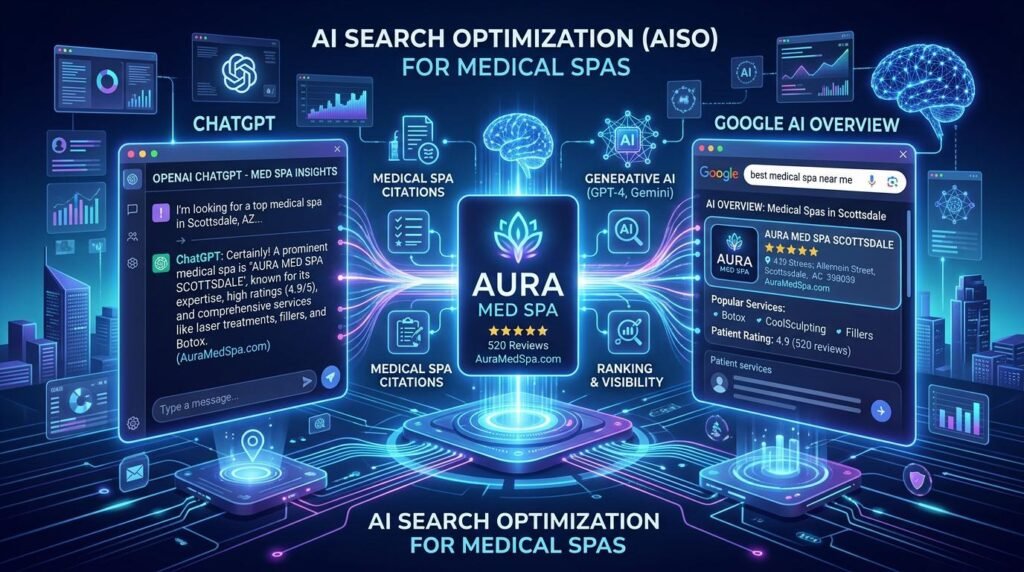
AI Search Optimization for Med Spas: Getting Quoted by ChatGPT & Perplexity Introduction Half of all Americans now use AI large language models like ChatGPT, Gemini, and Perplexity for search — making LLMs one of the fastest-adopted technologies in history [1]. For medical spa owners, this shift represents both a threat and an unprecedented opportunity. When a prospective patient asks ChatGPT, “What is the best med spa for Botox near me?” or “How does microneedling work?” — will your practice be the answer AI provides? Generative Engine Optimization (GEO) is the emerging discipline that ensures your med spa gets cited, quoted, and recommended by AI answer engines. Unlike traditional SEO, which fights for position on a search results page, GEO optimizes your content so AI models select your practice as a trusted source in their synthesized responses. Research from Princeton University found that GEO techniques can boost source visibility by up to 40% in generative engine responses [2]. At MedSpa SEO Agency — the only 100% med spa focused SEO agency — we’ve integrated GEO optimization into our service tiers starting at $2,449 per month. Our clients already see the compounding effect: a 276% average traffic increase combined with AI-driven brand mentions that traditional SEO alone cannot achieve. This guide covers everything you need to know about AI search optimization for your medical spa practice. Learn more about voice search for med spas. What Is Generative Engine Optimization (GEO) for Med Spas? Atomic Answer: GEO is the practice of structuring your med spa’s digital content so AI platforms like ChatGPT, Perplexity, and Google AI Overviews cite and recommend your practice when patients ask aesthetic treatment questions. Think of it this way: SEO gets you clicked; GEO gets you quoted. Traditional search engines return a ranked list of links and let users choose which to visit. Generative AI engines synthesize information from multiple sources into a single, conversational response — embedding citations inline [3]. Your content doesn’t just need to rank; it needs to be compelling enough for an AI to extract, cite, and present as authoritative information. For more insights, explore our guide on schema markup implementation. The term “Generative Engine Optimization” was formally introduced in a groundbreaking research paper published in November 2023 by researchers from Princeton University, Georgia Tech, The Allen Institute for AI, and IIT Delhi [2]. The study, titled “GEO: Generative Engine Optimization,” established the first academic framework for understanding how content creators can improve visibility in AI-generated responses. It was later presented at KDD 2024, cementing GEO’s place as a legitimate field of study [3]. For med spas, GEO is particularly critical because aesthetic medicine patients are research-intensive. Before booking a $600 Juvederm session or a $2,500 CoolSculpting package, patients ask AI detailed questions: “What should I expect from Botox treatment?” “How long does microneedling recovery take?” “Best med spa for PRP therapy near me?” GEO ensures your practice becomes the trusted source AI engines reference in their responses — driving pre-qualified patients directly to your booking calendar. The global medical spa market, projected to reach $26.2 billion by 2026 with a 12-15% CAGR, is increasingly being influenced by AI-driven patient research [4]. Practices that adopt GEO now gain a first-mover advantage while competitors remain focused solely on traditional blue-link SEO. How AI Models Select Medical Sources for Citations Atomic Answer: AI models use a process called Retrieval-Augmented Generation (RAG) — searching a corpus of trusted sources first, then synthesizing answers from the top-retrieved documents. For medical content, AI systems apply additional trust filters including domain authority, structured data presence, citation quality, and content freshness before selecting sources. Understanding how AI chooses which med spa to cite requires understanding RAG. When a user asks Perplexity or ChatGPT a question, the model doesn’t “know” the answer from training data alone. Instead, it performs a real-time search across indexed web content, retrieves the most relevant documents, and synthesizes a response from those sources [5]. This retrieval step is where your GEO strategy wins or loses. According to a landmark study by Ahrefs analyzing 15,000 prompts across ChatGPT, Gemini, Copilot, and Perplexity, only 12% of URLs cited by AI assistants appear in Google’s top 10 results for the same query [6]. This means AI engines are pulling from a different set of sources than traditional search — creating a new visibility battleground entirely. For medical and aesthetic content, AI models apply additional scrutiny. A September 2025 arXiv GEO study found that AI search exhibits a systematic bias toward earned media and authoritative third-party sources over brand-owned content when evaluating health-related queries [7]. However, the same research found that 86% of AI citations come from brand-managed sources — 44% from first-party websites and 42% from business listings — when those sources demonstrate authority through structured data, expert attribution, and citation-worthy content [8]. “The notion of visibility in generative engines is highly nuanced,” explains the Princeton GEO research team. “Generative engines provide rich and highly structured responses and embed websites as inline citations in the response, often embedding them with different lengths, at varying positions, and with diverse styles” [2]. For med spas, this means your content must be machine-readable, fact-dense, and structurally optimized for extraction — not just keyword-optimized for ranking. AI platforms also weight content freshness heavily. Seer Interactive’s 2025 analysis of 5,000+ URLs found that content updated within 30 days receives 3.2x more AI citations than stale content, and 85% of AI Overview citations come from the last two years [9]. Combining voice search optimization with GEO ensures your practice appears across every emerging search interface. For med spas, this means regularly updating treatment pages, pricing, and FAQ content is no longer optional — it’s essential for AI visibility. The Princeton GEO Study: What Works for Med Spas Atomic Answer: The Princeton GEO study tested nine optimization methods across 10,000 queries and found that adding citations boosted visibility by up to 115%, expert quotations increased visibility by 41-42.6%, and statistics improved visibility by 32-40% — making