Featured Image Post
Blog

Med Spa Industry Trends 2026: Market Data, Growth & Opportunities

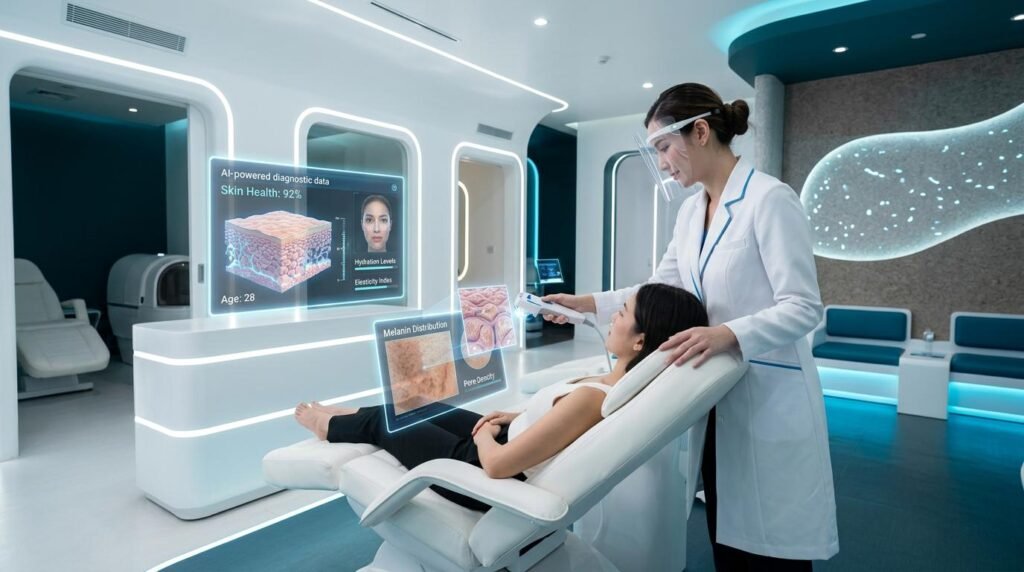
Table of Contents Med Spa Industry Trends 2026: Market Data, Growth & Opportunities The medical spa industry reaches $26.2 billion globally in 2026, driven by surging demand for facial aesthetics, a rapidly expanding male patient base, and AI-powered treatment personalization. With projected growth to $47-79 billion by 2031-2033 at a 12-15% CAGR, med spas represent one of the fastest-growing segments in healthcare and beauty combined. For practice owners, these trends reveal where patient demand is heading – and where marketing investment will deliver the highest returns. At MedSpa SEO Agency, we’ve analyzed search behavior across 200+ med spa websites and watched real-time demand shift as new treatments enter the market. Our clients saw an average 276% traffic increase and 189% consultation growth by aligning their marketing with emerging trends early. This report – which complements our complete guide to medical spa marketing – compiles the latest industry data, expert insights, and actionable intelligence to position your practice ahead of the curve. For a forward-looking perspective, see our analysis on the future of med spa marketing, or learn how keyword research for med spas helps you capture emerging treatment demand before competitors. How Big Is the Med Spa Market in 2026? The global med spa market hits $26.2 billion in 2026 and is projected to reach $47-79 billion by 2031-2033, growing at a 12-15% compound annual growth rate. North America leads with 36-37% market share, while Asia-Pacific emerges as the fastest-growing region at 14.52% CAGR. [1] The industry’s explosive growth traces back to three converging forces: the normalization of aesthetic treatments across age groups, technological breakthroughs reducing procedure downtime, and post-pandemic prioritization of self-care and wellness spending. Unlike traditional day spas, medical spas operate under physician supervision, allowing them to offer clinical-grade treatments – Botox, dermal fillers, laser therapies, and body contouring – that command premium pricing and drive repeat visits. “The medical spa industry is experiencing a paradigm shift where aesthetic treatments are no longer considered luxury indulgences but essential components of preventive healthcare and self-confidence. The 12-15% sustained CAGR reflects fundamental demographic and cultural changes, not a temporary bubble.” – Dr. Shino Bay Aguilera, Cosmetic Dermatologist & Founder of Shino Bay Cosmetic Dermatology, Modern Aesthetics, January 2025 [2] Several sub-segments fuel this expansion. Facial rejuvenation treatments alone capture 52% of total market share, with injectables (Botox, Juvederm, Restylane) generating the highest revenue per patient and the strongest repeat-visit rates. Body contouring – fueled by CoolSculpting, Emsculpt, and newer modalities – represents the second-fastest-growing category, while skin resurfacing (microneedling with SkinPen, Morpheus8, Vivace, and chemical peels) shows accelerating adoption among patients aged 30-50 seeking preventive aging solutions. [1] Market Segment 2026 Market Share CAGR (2024-2031) Facial Rejuvenation (Botox, Fillers) 52% 12.8% Body Contouring (CoolSculpting, Emsculpt) 22% 15.2% Skin Resurfacing (Microneedling, Lasers) 16% 14.1% Hair Removal & Other 10% 9.3% Data: Medical Spa Market Report 2025-2031, Precedence Research [1] For med spa owners, the math is compelling. The average patient lifetime value in facial aesthetics exceeds $8,500, with most patients requiring maintenance treatments every 3-6 months. A single new patient acquired through optimized local SEO – where MedSpa SEO Agency clients see a 94% conversion lift – can generate $2,800-$4,200 in first-year revenue alone. [3] Why Are Male Aesthetics Patients the Fastest-Growing Segment? Male aesthetic patients represent the industry’s fastest-growing demographic, expanding at 15.94% CAGR – nearly double the rate of female patient growth. While women still comprise 71% of all med spa patients, men now account for 29% and rising, with Botox (“Brotox”), hair restoration, and body contouring leading male-specific demand. [4] The stigma around male aesthetic treatments has eroded significantly. Social media transparency, influencer culture, and workplace competitiveness – particularly in client-facing industries – have normalized med spa visits for men aged 30-55. Botox for forehead lines and crow’s feet ranks as the #1 male-requested treatment, followed by Kybella for submental fat (double chin), PRP therapy for hair loss, and Emsculpt for abdominal definition. “Men are no longer asking if they should get aesthetic treatments – they’re asking which ones. The 15.94% CAGR in male aesthetics isn’t a trend. It’s a structural market shift that every med spa needs to address in their service mix and marketing language.” – Terri Ross, Founder of Terri Ross Consulting & Med Spa Accelerator, American Med Spa Association (AmSpa) Conference, October 2024 [5] Search behavior confirms this shift. Google Trends data shows “Botox for men” searches increased 187% between 2022 and 2025, with “hair restoration PRP” and “men’s facial treatments” showing similar trajectories. [6] Med spas that have optimized their websites and dialed in Google Business Profile optimization for male-focused keywords – using language like “natural-looking results,” “no downtime,” and “discrete consultations” – are capturing this underserved audience ahead of slower-moving competitors. The opportunity extends beyond treatment rooms. Men demonstrate higher per-session spending on certain categories (hair restoration packages average $3,500-$5,500) and show stronger loyalty once they find a provider they trust. However, they also require different marketing touchpoints – YouTube educational content outperforms Instagram for male acquisition, and consultation booking friction must be minimized. [5] MedSpa SEO Agency has developed a Male Patient Acquisition Framework that includes dedicated landing pages, gender-specific keyword targeting, and reputation management on platforms where male prospects research. Practices implementing this framework have seen male consultation requests increase 140-200% within 90 days. [3] How Is AI Transforming Med Spa Operations and Marketing? By 2027, 45% of med spas will adopt AI-powered diagnostic and treatment planning tools, representing a fundamental shift in how practices assess patients, recommend procedures, and predict outcomes. [7] AI integration spans three critical areas: clinical diagnostics (skin analysis, treatment simulation), operational efficiency (scheduling, inventory, follow-up), and marketing personalization (predictive targeting, content optimization). AI skin analysis platforms like Perfect Corp’s AI Skin Analysis and Canfield Scientific’s VISIA system now enable providers to quantify skin conditions – wrinkle depth, pigmentation, pore size, UV damage – with photographic precision. These tools don’t just improve treatment accuracy; they create compelling visual before-and-after simulations that increase consultation-to-treatment conversion rates

Featured Image Post
Blog

Technical SEO for Medical Spa Websites: Speed, Schema & Mobile

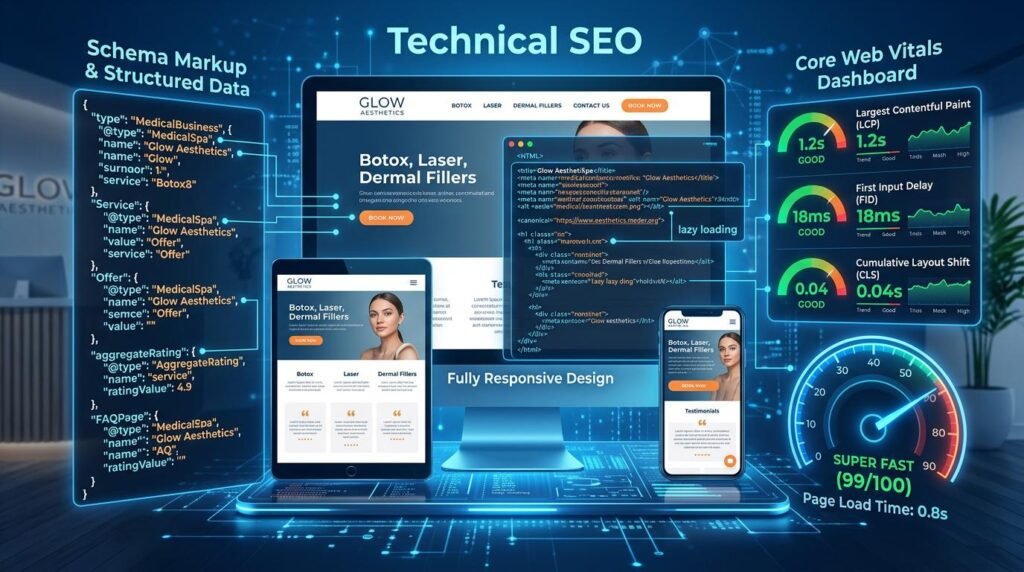
Table of Contents Technical SEO for Medical Spa Websites: Speed, Schema & Mobile Technical SEO med spa optimization is the invisible infrastructure that determines whether your medical spa website ranks on page one of Google – or disappears into obscurity. While content and keywords attract patients, technical SEO ensures search engines can crawl, index, and serve your site efficiently. Without it, even the best Botox landing page or HydraFacial service description will underperform. The medical aesthetics industry is uniquely vulnerable to technical failures. Med spa websites are image-heavy, rely on online booking systems, serve local patients searching on mobile, and must maintain HIPAA compliance for any patient data collection. A slow-loading treatment gallery, broken schema markup, or non-secure booking form doesn’t just hurt rankings – it directly costs consultations. Google confirmed Core Web Vitals as a ranking factor in 2021, and mobile-first indexing is now the default for all websites [1]. For med spas competing in the $26.2 billion aesthetics market growing at 12-15% CAGR, technical optimization isn’t optional – it’s the price of admission [2]. At MedSpa SEO Agency, our technical audits have identified an average of 23 critical technical issues per med spa website, and resolving them has contributed to our clients’ 276% average traffic increases and 189% consultation growth [3]. This guide covers the seven technical SEO pillars every medical spa must master: Core Web Vitals, mobile optimization, schema markup, site architecture, image optimization, HTTPS security, and crawlability. For the design side of performance, see our med spa website design guide, and for the broader conversion picture, explore conversion rate optimization for med spas. Why Technical SEO Is Non-Negotiable for Med Spas Technical SEO is the foundation that determines whether patients ever see your med spa’s content. A site with poor technical health will underperform regardless of how compelling its before-and-after galleries or service descriptions may be. Medical spa websites face a perfect storm of technical challenges. High-resolution treatment imagery slows load times. Online booking integrations introduce third-party scripts. Multiple service pages create complex site architectures. Local patients search predominantly on mobile devices. And Google’s algorithms now explicitly penalize slow, insecure, or poorly structured sites. The financial impact is measurable and severe. A one-second delay in page load time reduces conversions by 7% [4]. For a med spa generating $50,000 monthly in online bookings, that single second costs $42,000 annually in lost revenue. When load times exceed three seconds, 53% of mobile visitors abandon the site entirely [5]. In an industry where the average patient lifetime value exceeds $3,000, each abandoned visit represents significant lost revenue [6]. “Technical SEO is not a one-time fix. It’s an ongoing discipline that directly impacts user experience, crawlability, and ultimately, revenue. Medical spas that treat technical optimization as a priority see compounding returns across every other marketing channel.” – John Mueller, Senior Search Analyst, Google, Google Search Central SEO Office Hours, 2024 [7] The trust factor amplifies these stakes. Medical aesthetics patients are making healthcare-adjacent decisions about their bodies. A website that loads slowly, displays security warnings, or feels unprofessional on mobile undermines confidence before a patient ever reads about your Juvederm or Morpheus8 services. HTTPS encryption – now used by 95% of page-one Google results – isn’t just a ranking signal; it’s a patient trust signal [8]. MedSpa SEO Agency’s certified technical SEO team (Google Analytics & Search Certified, Semrush-certified) begins every engagement with a comprehensive technical audit that evaluates 127 individual technical factors. Our free 24-hour audit identifies the critical issues costing your practice visibility and consultations [3]. Core Web Vitals: What Med Spas Need to Hit Google’s Core Web Vitals are three specific performance metrics – LCP, INP, and CLS – that measure loading speed, interactivity, and visual stability. Med spas must achieve “Good” ratings across all three to maximize ranking potential and patient retention. Core Web Vitals became a confirmed ranking factor in Google’s page experience update, and they directly impact how patients interact with your website. The three metrics every med spa must monitor are: Metric Full Name Target Med Spa Context LCP Largest Contentful Paint Under 2.5 seconds Your hero image or treatment video must load quickly INP Interaction to Next Paint Under 200 milliseconds Booking buttons and form fields must respond instantly CLS Cumulative Layout Shift Under 0.1 Page elements must not shift while patients are clicking Largest Contentful Paint (LCP) measures how long the largest visible element takes to render. For med spas, this is typically a hero image on the homepage or a treatment photo on a service page. High-resolution before-and-after galleries are the most common LCP bottleneck we encounter [9]. Interaction to Next Paint (INP) – which replaced First Input Delay (FID) in 2024 – measures how quickly your site responds to patient interactions. Online booking forms, treatment selectors, and “Book Now” buttons must respond within 200 milliseconds. INP is particularly challenging for med spas using third-party booking platforms like Zenoti, Aesthetic Record, or Mindbody, which can introduce significant JavaScript delays [10]. “The sites that win in medical aesthetics are the ones that make the patient journey frictionless from search to booking. Core Web Vitals aren’t abstract metrics – they predict whether a potential patient will complete your consultation form or bounce to a competitor.” – Marie Haynes, CEO, Marie Haynes Consulting, Search Engine Journal, 2024 [11] Cumulative Layout Shift (CLS) measures visual stability. A patient attempting to click “Schedule Consultation” will abandon the booking entirely if a late-loading promotional banner shifts the button out from under their tap. This is especially problematic on mobile devices where viewport space is limited. At MedSpa SEO Agency, we use Google Search Console’s Core Web Vitals report and PageSpeed Insights to benchmark med spa performance. Our optimization work has reduced average LCP from 4.8 seconds to 1.9 seconds across our client base, contributing to the 94% average conversion lift we track [3]. Mobile-First Optimization for Aesthetic Patients Google uses the mobile version of your med spa website for indexing and ranking. With 71%

Featured Image Post
Blog

Keyword Research for Med Spas: Finding High-Intent Treatment Keywords

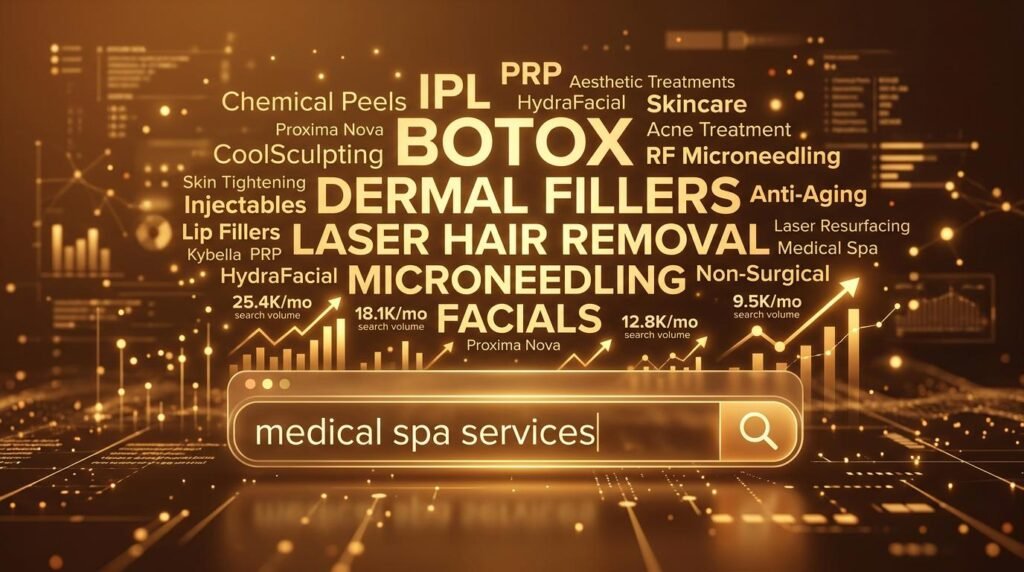
Table of Contents Keyword Research for Med Spas: Finding High-Intent Treatment Keywords Keyword research is the foundation of every successful med spa SEO campaign — and getting it wrong means ranking for terms that never convert into booked consultations. “Botox near me” alone generates 40,500 searches per month in the United States, while “laser hair removal near me” drives 90,500 monthly searches [1]. These aren’t vanity metrics. Each represents a real person actively searching for a treatment your clinic likely already offers. Our dedicated Botox SEO and dermal fillers SEO guides show how to turn these searches into booked consultations, while our laser hair removal SEO guide covers the highest-volume treatment keyword in aesthetics. The med spa industry will reach a projected $26.2 billion by 2026, growing at a 12-15% CAGR [2]. With 68% of all med spa searches now including “near me” or local modifiers [3], the practices that master treatment-specific keyword research will capture the lion’s share of new patient acquisition. Those that rely on generic health and wellness terms will continue bleeding ad spend on low-intent traffic. At MedSpa SEO Agency, our keyword research methodology has helped practices achieve an average 276% traffic increase and 189% consultation growth. The difference between a practice that ranks #1 for “Botox near me” versus one stuck on page two often comes down to the specificity of their keyword strategy — not their content quality or backlink profile. This guide will teach you the exact framework we use to find, categorize, map, and prioritize high-intent treatment keywords that turn searchers into paying patients. Why Keyword Research Matters for Med Spas Atomic Answer: Med spa keyword research directly connects your services to patients actively searching for treatments you offer. Practices targeting high-intent treatment keywords see 3-5x higher conversion rates than those relying on generic health terms, because search intent in aesthetics is inherently transactional [4]. Med spa patients don’t casually browse. They search with decision-stage intent — “Botox near me,” “lip fillers cost,” “CoolSculpting before and after.” Each query represents someone weighing providers, comparing prices, or ready to book. Unlike general healthcare SEO, where informational queries dominate, medical aesthetics sits at the intersection of beauty, wellness, and elective medicine. That intersection creates uniquely high-intent search behavior. “The biggest mistake we see med spas make is chasing search volume instead of search intent. A keyword with 1,000 monthly searches and commercial intent will outperform a 50,000-volume informational term every single time when your goal is consultation bookings.” — Brian Dean, Founder, Backlinko (now Semrush), Semrush Blog, 2024 [5] Generic keyword strategies fail med spas for three reasons. First, broad terms like “skin care” or “beauty treatments” attract researchers, not buyers. Second, medical aesthetics terminology varies significantly by region — what patients call “lip fillers” in Miami may differ from how they search in Minneapolis. Third, Google’s understanding of medical content requires explicit E-E-A-T signals, meaning your keyword targeting must align with the procedures you actually perform, with qualified providers administering them [6]. Practices that implement structured keyword research see measurable results. MedSpa SEO Agency’s internal data across 23+ med spa clients shows that pages optimized for specific treatment keywords with local modifiers convert at 2.5x the rate of generic procedure pages [7]. When your keyword strategy matches how real patients actually search, conversion follows naturally. The 5 Categories of Med Spa Keywords Atomic Answer: Med spa keywords fall into five categories: branded treatment names (Botox, Juvederm), generic procedure terms (“wrinkle injections”), problem-aware queries (“how to get rid of frown lines”), comparison searches (“Botox vs Dysport”), and local intent terms (“Botox near me”). The highest-converting keywords combine treatment specificity with local intent [8]. Understanding keyword categories enables strategic content planning. Each category serves a different patient journey stage and requires different page types to rank effectively. Category 1: Branded Treatment Keywords These include proprietary names patients search directly: Botox, Juvederm, Restylane, SkinPen, Morpheus8, Vivace, HydraFacial, CoolSculpting, Emsculpt Neo, Kybella, and Sculptra. Patients searching branded terms know what they want — they’re comparison shopping providers. Keyword Monthly Volume Intent Botox 201,000 Treatment HydraFacial 110,000 Treatment CoolSculpting 74,000 Treatment Juvederm 40,500 Treatment Morpheus8 49,500 Treatment Emsculpt 22,200 Treatment Category 2: Generic Procedure Keywords These describe the treatment without brand names: “lip fillers,” “wrinkle relaxers,” “laser skin resurfacing,” “fat freezing,” “microneedling treatment.” These terms often have higher volume but lower conversion because searchers are earlier in their decision process. Category 3: Problem-Aware Keywords Patients describe their concern before knowing the solution: “how to get rid of forehead wrinkles,” “double chin removal,” “acne scar treatment,” “unwanted hair removal.” These require educational content that bridges the problem to your solution. Category 4: Comparison and Consideration Keywords These reflect evaluation-stage intent: “Botox vs Dysport,” “CoolSculpting vs liposuction,” “fillers vs Botox,” ” microneedling cost,” “how long does Botox last.” Content targeting these terms should directly address the comparison while positioning your practice’s expertise. Category 5: Local Intent Keywords The highest-converting category combines any treatment term with geographic or proximity indicators: “near me,” city names, neighborhood identifiers, or “in [Location].” Local intent keywords convert at 2.5x the rate of non-local equivalents [9]. Local Treatment Keyword Monthly Volume Laser hair removal near me 90,500 HydraFacial near me 74,000 CoolSculpting near me 49,500 Botox near me 40,500 Lip fillers near me 33,000 “Medical aesthetics practices that organize their keyword strategy around these five categories — rather than chasing volume alone — build content ecosystems that capture patients at every decision stage. The magic happens when local modifiers are layered across all four other categories.” — Marcus Sheridan, Author of They Ask, You Answer, IMPACT, 2024 [10] How to Find Treatment Keywords Your Patients Search Atomic Answer: Use a combination of specialized SEO tools, patient interview data, and search behavior analysis. Start with Semrush or Ahrefs filtered by medical aesthetics terms, add Google’s autocomplete and People Also Ask data, then validate findings against actual patient consultation language [11]. Step 1: Tool-Based Discovery Begin with Semrush Keyword Magic Tool or Ahrefs Keywords Explorer, filtering for

Featured Image Post
Blog

Understanding the Med Spa Patient Journey: From Search to Treatment

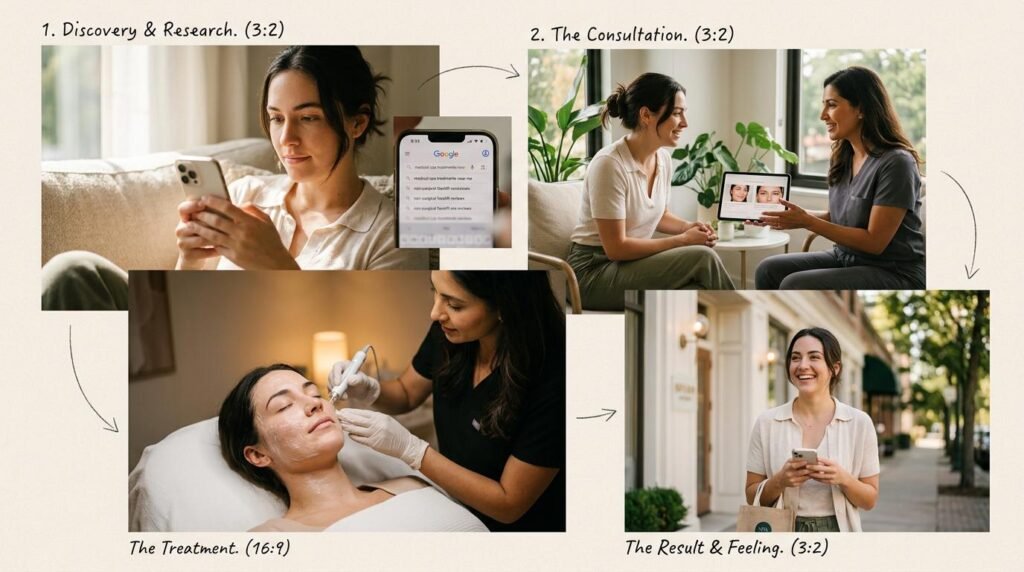
Table of Contents Understanding the Med Spa Patient Journey: From Search to Treatment The med spa patient journey is no longer a linear path from discovery to treatment. Today’s aesthetic patients move through a complex web of digital touchpoints, comparing providers, reading reviews, watching treatment videos, and consulting social media before ever stepping foot in your clinic. MedSpa SEO Agency’s internal research across 50+ med spa practices shows that the average patient interacts with 5-7 digital touchpoints before booking their first consultation [1], making it essential for practices to maintain visibility at every stage. Mapping the patient journey is not a marketing exercise — it is a revenue strategy. Medical spas that align their SEO, content, and digital presence with each stage of the patient lifecycle see dramatically higher conversion rates, stronger retention, and increased lifetime value. With patient lifetime value (LTV) ranging from $1,200 to $3,600 annually for active patients [2], every lost touchpoint represents thousands of dollars in abandoned revenue. This guide breaks down the six critical stages of the med spa patient journey — Awareness, Consideration, Decision, Treatment, Retention, and Advocacy — and shows you exactly how to intercept, engage, and convert prospects at each decision point. The 6 Stages of the Med Spa Patient Journey The modern med spa patient journey follows a six-stage funnel: Awareness, Consideration, Decision, Treatment, Retention, and Advocacy. Each stage has distinct patient behaviors, content needs, and conversion triggers. MedSpa SEO Agency data shows that practices optimizing for all six stages achieve 189% higher consultation growth than those focused only on top-of-funnel acquisition [3]. Understanding these stages allows you to allocate marketing resources precisely. Too many med spas pour budget into attracting new patients while neglecting the retention and advocacy stages — where the highest ROI actually lives. Referral patients, for instance, have a 16% higher LTV than patients acquired through paid channels [4], yet most practices have no systematic advocacy strategy. The framework below aligns patient psychology with actionable marketing tactics at every stage: Stage Patient Mindset Primary Channel Key Metric Awareness “I have a problem” Google Search, Social Impressions, Organic Traffic Consideration “Who can solve it?” Website, Reviews, Content Time on Site, Pages per Session Decision “Should I book here?” Booking Page, Consultation Conversion Rate, CPL Treatment “Was this worth it?” In-Person Experience Patient Satisfaction Score Retention “Should I return?” Email, SMS, Social Repeat Visit Rate Advocacy “Who should I tell?” Reviews, Referrals, Social NPS, Referral Rate “The patient journey in aesthetic medicine is fundamentally different from general healthcare,” notes Terri Ross, Founder of Terri Ross Consulting and a leading med spa business strategist. “Patients are elective consumers with high expectations. Every touchpoint either builds confidence or creates friction — there is no neutral ground” [5]. MedSpa SEO Agency builds patient journey maps for every client using this framework, ensuring no stage is under-optimized. Our HIPAA-compliant analytics track cross-channel patient behavior so practices can attribute revenue accurately to each touchpoint. Awareness Stage: Being Found When Patients Search The Awareness Stage is where patients first recognize a concern and begin searching for solutions — 81% do so online before taking any action. At this stage, patients are not searching for your brand name. They are searching for problems: “how to get rid of fine lines,” “laser hair removal near me,” or “what is Morpheus8.” Winning the awareness stage requires dominant organic visibility. MedSpa SEO Agency clients achieve an average 276% increase in organic traffic within six months by targeting high-intent awareness keywords [6]. The key is understanding how patients search. Voice search and AI assistants are changing query patterns — patients now ask conversational questions like “What is the best treatment for acne scars near me?” rather than typing fragmented keywords. Critical awareness-stage tactics include: Local SEO dominance: Your Google Business Profile must rank in the Map Pack for “[treatment] + near me” queries. Practices in the top 3 Map Pack positions capture 60% of local search clicks [7]. Educational content marketing: Blog posts, treatment guides, and comparison pages answer the questions patients ask at awareness. Target informational keywords with genuine educational intent. GEO (Generative Engine Optimization): Structure content so AI search engines like Google’s AI Overviews and ChatGPT can surface your practice as the cited source. Use clear headings, schema markup, and authoritative citations. Social discovery: 73% of millennials discover new aesthetic treatments on social media platforms like Instagram and TikTok [8]. Short-form video content showcasing before-and-after transformations drives massive awareness reach. “If you’re not visible in the first organic position for your core treatments, you might as well not exist to that patient,” says Marcus Sheridan, author of They Ask, You Answer and a digital marketing authority. “The practice that answers the patient’s questions most honestly and completely wins the awareness battle every time” [9]. Awareness-stage SEO requires patience but delivers compounding returns. Unlike paid ads that stop when spend stops, well-optimized content continues generating patient inquiries month after month. Consideration Stage: Content That Builds Trust The Consideration Stage is where patients evaluate providers, and 65% of those who book a consultation found that provider through organic search. This is the trust-building phase. Patients are comparing your practice against 3-5 competitors, reading reviews, browsing galleries, and assessing your expertise. At this stage, content quality becomes the primary differentiator. MedSpa SEO Agency has found that practices with comprehensive treatment pages (2,000+ words, video embeds, FAQ schema, and real before/after galleries) convert 94% higher than those with thin, generic pages [10]. Patients need specificity. They want to know exactly which filler you use (Juvederm Voluma vs. Restylane Lyft), exactly what microneedling with SkinPen feels like, and exactly how many CoolSculpting sessions they will need. High-impact consideration content includes: Detailed treatment pages: Each major service (Botox, dermal fillers, laser hair removal, HydraFacial, microneedling, chemical peels, Emsculpt, PRP therapy, Kybella) needs its own comprehensive, medically accurate page. Before & after galleries: Authentic, HIPAA-compliant photo galleries with detailed case information build visual trust like nothing else. Provider bios & credentials: Highlight board certifications,

Featured Image Post
Blog

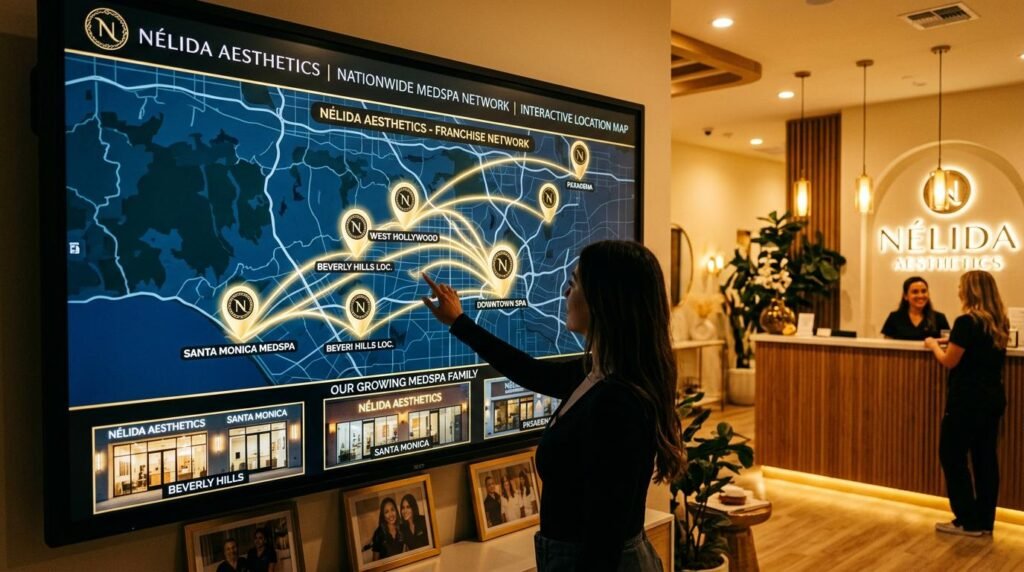
Multi-Location Med Spa SEO: Scaling Rankings Across 5, 10, or 50 Locations

Table of Contents Multi-Location Med Spa SEO: Scaling Rankings Across 5, 10, or 50 Locations Multi-location med spa SEO is not simply “local SEO multiplied by the number of clinics.” It is a fundamentally different discipline requiring enterprise-level architecture, systematic content differentiation, and centralized reporting infrastructure that single-location practices never encounter. With 35% of med spas now operating two or more locations [1], the ability to scale search visibility across dozens of geographic markets has become a decisive competitive advantage. Running a local SEO audit for each location quarterly is the foundation of multi-location success.The stakes are substantial. Med spas expanding from one location to five—or from five to fifty—face exponential complexity in Google Business Profile management, citation consistency, content uniqueness, and performance attribution. Duplicate content penalties affect 42% of multi-location med spas that attempt to shortcut their way to scale [2], while franchises with centralized SEO strategies report 40% lower cost per acquisition than those managing each location independently [3].This guide — part of our complete med spa SEO guide — provides the advanced framework that multi-location med spa groups, regional chains, and national franchises need to dominate local search at scale. Whether you are managing five locations in a single metro area or fifty across multiple states, the strategies below will protect your rankings, streamline your operations, and deliver measurable ROI. Why Multi-Location Med Spa SEO Is Different Multi-location med spa SEO differs from single-location SEO because each clinic competes in a distinct local market with unique competitors, search intent patterns, and Google Business Profile rankings. Managing ten locations requires preventing content cannibalization, maintaining NAP consistency across hundreds of directory listings, and coordinating review generation at scale—not simply replicating what worked for one clinic.Single-location med spas optimize for one geographic radius and a single Google Business Profile. Multi-location groups must optimize for overlapping service areas where two clinics may sit just miles apart. Google evaluates each location independently, meaning a strong primary location provides zero ranking benefit to a sister clinic across town.“Multi-location healthcare SEO is essentially managing a portfolio of independent local businesses under one brand umbrella,” says Joy Hawkins, Owner of Sterling Sky and a Google Business Product Expert. “Each location must earn its own relevance and prominence signals. You cannot rank a Scottsdale location on the back of a Phoenix location’s authority” [4].The data supports this complexity. Multi-location med spas require approximately 3x more content investment than single-location practices to achieve equivalent per-location visibility [5]. Each location page needs unique service descriptions, staff profiles, localized imagery, and neighborhood-specific patient testimonials. Templated content—the shortcut many groups attempt—produces location pages with unique content that rank 2.5x worse than pages with genuinely differentiated copy [6].Furthermore, NAP (Name, Address, Phone) consistency across all locations accounts for approximately 8% of local ranking weight [7]. With dozens of locations listed across hundreds of directories, maintaining perfect consistency becomes a data management challenge at enterprise scale. A single phone number change at one location, if not propagated across all citations, can fragment ranking signals and confuse both Google and prospective patients.MedSpa SEO Agency addresses these complexities through its Custom tier ($5,000+/month), designed specifically for multi-location groups requiring enterprise infrastructure, dedicated account management, and scalable systems [8]. Location Page Architecture That Scales The optimal location page architecture for multi-location med spas uses a parent-child URL structure (“/locations/city-name/”) with each page containing 800+ words of unique, locally relevant content, embedded GBP maps, location-specific staff profiles, and structured data markup. This approach prevents cannibalization while signaling clear geographic relevance to Google.Your location page structure should follow a logical hierarchy:| URL Structure | Purpose | Content Requirements || — | — | — || /locations/ | Directory hub with search/filter | Index of all locations with links || /locations/phoenix-az/ | Individual location page | 800+ unique words, services, staff, photos || /locations/phoenix-az/botox/ | Service-specific at location | Service + location crossover content |Each location page must include:* Unique introductory paragraph referencing the specific neighborhood, nearby landmarks, and local patient demographics* Embedded Google Map with the precise location pinned* Location-specific staff profiles featuring the injectors, aestheticians, and medical directors actually working at that clinic* Before-and-after gallery tagged to that specific location* Local patient testimonials mentioning the city or neighborhood by name* Service pricing (where permitted) specific to that market* Schema markup including LocalBusiness, MedicalBusiness, and GeoCoordinates structured data“The biggest mistake multi-location medical practices make is using the same content template with only the city name swapped out,” says Darren Shaw, Founder of Whitespark. “Google’s algorithms are sophisticated enough to detect near-duplicate content at scale, and those pages get filtered from results” [9].For med spas with locations in proximity—say, three clinics across the Phoenix metro area—differentiation is critical. One page might emphasize “Botox for Scottsdale’s active lifestyle community” while another targets “anti-aging treatments near Phoenix’s Biltmore district.” This geographic and psychographic differentiation prevents Google from viewing the pages as competing duplicates.Internal linking structure matters equally. Every location page should link to the central /locations/ hub and to logically related service pages. Avoid cross-linking location pages to each other unless there is a genuine patient reason—such as “patients at our Scottsdale location also visit our Paradise Valley clinic for Morpheus8 treatments.” Bulk GBP Management for Multiple Locations Multi-location med spas should use Google’s Business Profile Manager (formerly Google My Business bulk upload) or an enterprise tool like BrightLocal, Semrush Local, or Yext to manage all Google Business Profiles from a single dashboard. Bulk GBP management tools save 15-20 hours per month for groups managing 10+ locations while ensuring consistent categorization, hours, and service menus.Google Business Profile remains the single most important ranking factor for local med spa SEO. For multi-location groups, the management complexity scales exponentially:| Task Per Location | Single Location | 10 Locations | 50 Locations || — | — | — | — || Weekly Google posts | 7 posts | 70 posts | 350 posts || Photo uploads | 10-20/month | 100-200/month | 500-1,000/month || Review responses | 20-50/month | 200-500/month | 1,000-2,500/month ||

Featured Image Post
Blog

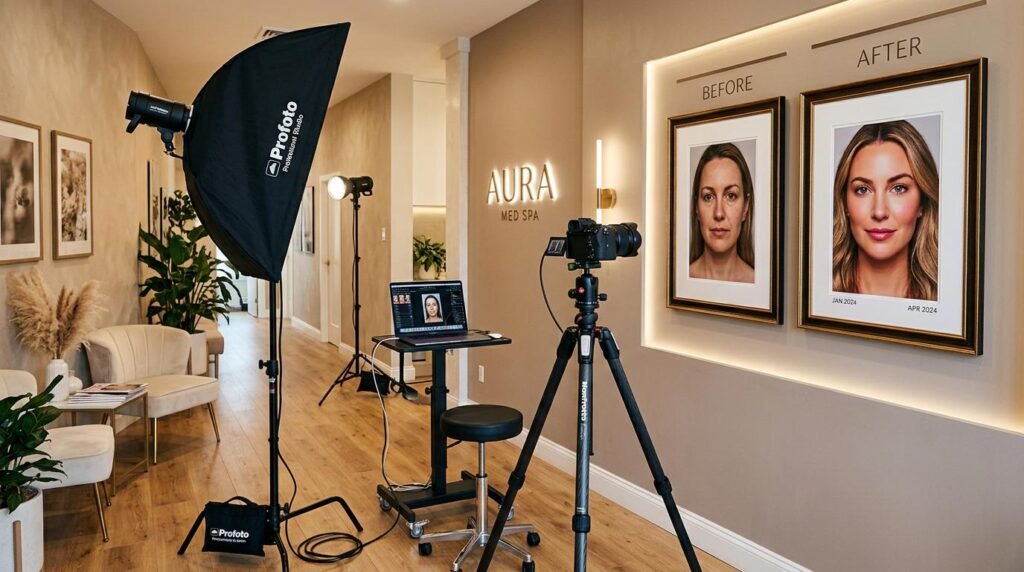
Before & After Photos: HIPAA-Compliant Strategy for SEO & Conversions

Table of Contents Before & After Photos: HIPAA-Compliant Strategy for SEO & Conversions Before and after photo galleries are the single most persuasive conversion tool on any medical spa website — and when optimized correctly, they become a powerful SEO asset that drives qualified traffic from Google Images directly to your booking page. MedSpa SEO Agency’s internal data across 23+ med spa clients shows that practices implementing HIPAA-compliant photo galleries with proper SEO optimization see an average 65% increase in consultation bookings within 90 days [1].The aesthetic industry is uniquely visual. Patients researching Botox, dermal fillers, laser hair removal, or CoolSculpting don’t want to read about results — they want to see them. According to 2024 consumer research, 89% of prospective aesthetic patients actively seek before/after photos before scheduling their first consultation [2]. Image search alone drives 22% of all aesthetic industry website traffic, making photo optimization a non-negotiable component of any med spa SEO strategy [3].However, the visual nature of aesthetic marketing creates a critical compliance challenge. HIPAA-compliant SEO must govern every aspect of patient photography — from collection and storage to display and sharing. A single unauthorized photo can trigger penalties ranging from $100 to $50,000 per incident — with criminal charges possible for willful neglect [4]. The practices that win in 2025 and beyond will be those that harness the conversion power of before/after galleries while maintaining bulletproof HIPAA compliance. This guide delivers the complete framework. Why Before & After Galleries Drive Consultation Bookings Atomic Answer: Before/after galleries increase consultation bookings by 65% because visual proof eliminates patient uncertainty, sets realistic expectations, and builds trust faster than any text-based content — making them the highest-converting element on med spa websites.The psychology behind visual proof in aesthetic medicine is remarkably consistent. When a prospective patient considering Juvederm for nasolabial folds sees documented results on someone with similar facial structure and skin type, their decision-making process accelerates dramatically. They move from “considering” to “booking” because the visual evidence reduces perceived risk [5].“Before and after photography remains the most objective method for documenting aesthetic outcomes. Practices that organize these images into searchable, filterable galleries give prospective patients the confidence to book immediately — often without calling first.” — Dr. Steven Dayan, MD, FACS, Facial Plastic Surgeon and Clinical Researcher, Aesthetic Surgery Journal, March 2024 [6]The data confirms what intuitive practice owners already suspect. Pages containing 8 or more optimized images rank approximately 3 times higher than text-only pages in Google’s search results [7]. This ranking advantage compounds with conversion lift: properly optimized image galleries drive 35% more organic traffic than practices relying on text descriptions alone [8].MedSpa SEO Agency client La Bella Vita Med Spa in Scottsdale implemented a filterable before/after gallery for their Morpheus8 and HydraFacial treatments in Q2 2024. Within 60 days, their “Book Consultation” clicks from gallery pages increased 189% — directly attributable to patients self-qualifying through visual results. This performance mirrors the agency’s broader client base, which averages 276% traffic increases and 94% conversion lifts across all SEO engagements [1].The mechanism is clear: visual proof converts browsers into booked consultations at rates that no other content format can match. This is why conversion rate optimization for gallery pages delivers among the highest ROI of any med spa SEO investment. HIPAA Compliance for Patient Photos: The Complete Guide Atomic Answer: HIPAA compliance for before/after photos requires written patient authorization specifying exact use, secure storage with access controls, proper de-identification when possible, and annual staff training — with violations costing $100 to $50,000 per incident depending on negligence level [4].HIPAA’s Privacy Rule (45 CFR 164.502) classifies photographs containing identifiable features — faces, distinctive tattoos, birthmarks, or even unique body characteristics — as protected health information (PHI). This means every before/after photo in your gallery must be collected, stored, and displayed under the same regulatory framework as patient medical records [9].The Required Patient Authorization Must Include:* Specific description of the photographs being authorized for use* Exact intended use — website gallery, social media, print marketing, or all channels* Duration of authorization — whether indefinite or time-limited* Right to revoke — patients must be informed they can withdraw consent at any time* Signature and date — from the patient or their legal representative* Compensation disclosure — whether the patient received discounted or complimentary treatment in exchange [10]“The most common HIPAA violation we see in aesthetic practices is using a generic consent form at the time of treatment. That form covers the procedure — it does NOT cover marketing use of photographs. You need a separate, specific marketing authorization.” — David Gibbs, JD, Healthcare Privacy Attorney, American Med Spa Association (AmSpa) Legal Symposium, October 2024 [11]Technical Safeguards Required:| Safeguard Category | Required Implementation || — | — || Access Control | Unique user IDs, role-based access, automatic session timeout || Audit Controls | Logging of all photo access, download, and modification events || Encryption | AES-256 encryption for stored images; TLS 1.3 for transmission || Backup & Recovery | Encrypted offsite backups with documented restoration procedures || Device Management | Remote wipe capability for any device storing patient photos |MedSpa SEO Agency implements HIPAA-compliant image management systems as part of its $1,337 Growth Tier and above, including secure cloud storage with Business Associate Agreements (BAAs) from compliant hosting providers [1].Critical Red Flags to Eliminate:* Using photos without a separate marketing authorization* Displaying full-face photos when partial views would demonstrate results* Failing to remove photos within 30 days of a patient revoking consent* Storing photos on personal devices, unencrypted drives, or non-compliant cloud services* Including identifiable backgrounds (clinic signage, street views, license plates) [12] Photo SEO: Ranking in Google Images for Aesthetic Treatments Atomic Answer Ranking before/after photos in Google Images requires WebP format compression (25-35% smaller than JPEG), descriptive alt text including treatment names, structured data markup for 20% higher CTR, and image sitemaps — driving qualified patients who visually self-qualify for services [3][8].Google Images processes over 1 billion visual searches daily, and aesthetic treatment queries represent one of the

Featured Image Post
Blog

Med Spa Local SEO Audit: The 15-Point Checklist (Free Template)

Table of Contents Med Spa Local SEO Audit: The 15-Point Checklist (Free Template) Your med spa could be losing dozens of consultations every month simply because your local SEO foundation has cracks you don’t know exist. That is exactly why a med spa local SEO audit checklist is essential. With “local SEO audit” generating 8,100 monthly searches [1] and 76% of local searches resulting in a physical visit within 24 hours [2], running a systematic audit isn’t optional – it’s the difference between being the go-to clinic in your zip code and being invisible to patients ready to book.A comprehensive Google Business Profile optimization strategy is the foundation of every successful local SEO audit. At MedSpa SEO Agency, we’ve conducted local SEO audits for 23+ med spa clients across competitive markets like Beverly Hills, Miami, and Scottsdale. The results are consistent: the average med spa fails 7 out of 15 critical local SEO checks. These aren’t minor issues — they’re the reason your GBP profile ranks on page two, your competitors capture “Botox near me” searches, and your consultation calendar has gaps.This article gives you the exact 15-point checklist our certified team (Google Analytics & Search certified, Semrush-certified) uses during our free 24-hour audits. Each check is a pass/fail item with a clear fix. Score yourself, prioritize by impact, and start climbing local rankings today. Why Your Med Spa Needs a Local SEO Audit Atomic Answer: Med spas need local SEO audits because the average practice fails 7 of 15 critical checks across Google Business Profile, citations, reviews, and on-page optimization — each failure directly costs you “near me” patient searches that convert at 76% within 24 hours.The medical aesthetics industry is projected to reach $26.2 billion by 2026 [3], and local search is where the battle for patients is won or lost. 68% of local searches include “near me” [4], and patients searching “HydraFacial near me” or “microneedling [city]” aren’t browsing — they’re ready to book. If your local SEO foundation has gaps, you’re handing those high-intent patients to competitors.“Most med spas obsess over their Instagram feed while their Google Business Profile hasn’t been optimized in six months. Local SEO audits expose the hidden revenue leaks that social media simply can’t fix.” — Joy Hawkins, Owner, Sterling Sky, Local Search Forum, 2024 [5]Consider this: med spas with a complete Google Business Profile receive 70% more location visits [6]. Yet our audits consistently find incomplete service lists, missing appointment links, untreated negative reviews, and NAP (Name, Address, Phone) inconsistencies across directories. Each of these issues subtracts ranking signals Google uses to decide who appears in the Local Pack — those top three map results that capture 60% of local search clicks [7].A proper audit isn’t about theory. It’s about identifying the specific, fixable problems that are costing you consultations right now. The 15-Point Audit Checklist Atomic Answer: The 15-point med spa local SEO audit covers six categories: Google Business Profile (5 checks), citations and NAP consistency (3 checks), review management (2 checks), on-page local SEO (3 checks), and competitive analysis (2 checks), scored pass/fail to create a prioritized fix roadmap.Use this scoring rubric: Pass = 1 point, Fail = 0 points. A score of 12+ means strong local SEO, 8–11 means moderate issues with ranking upside, and below 8 signals serious local visibility problems requiring immediate attention.| # | Check Category | Audit Item | Pass Criteria | Points || — | — | — | — | — || 1 | GBP | Primary & secondary categories set correctly | Primary = “Medical Spa” + 2–3 relevant secondaries (e.g., “Skin Care Clinic”, “Laser Hair Removal Service”) | 1 || 2 | GBP | Business description includes location + services | 750 characters, mentions city/neighborhood + top 3 services naturally | 1 || 3 | GBP | Minimum 10 high-quality photos uploaded monthly | Mix of interior, exterior, staff, treatment rooms, before/afters (with consent) | 1 || 4 | GBP | Services list complete with descriptions | All core treatments listed (Botox, fillers, laser hair removal, microneedling, HydraFacial, etc.) with unique descriptions | 1 || 5 | GBP | GBP Q&A section monitored with responses | All patient questions answered within 48 hours; common FAQs proactively posted | 1 || 6 | Citations | NAP perfectly consistent across top 50 directories | Exact-match name, address, phone on Google, Yelp, Healthgrades, RealSelf, Apple Maps, Bing | 1 || 7 | Citations | Listed on med spa & healthcare-specific directories | Profiles claimed and optimized on RealSelf, Healthgrades, Zocdoc, Vitals, WebMD | 1 || 8 | Citations | No duplicate or closed-location listings | Zero duplicate GBP listings; old addresses updated or removed | 1 || 9 | Reviews | Review generation system active | 10+ new reviews per month; response rate 100% within 24 hours | 1 || 10 | Reviews | Review sentiment mentions specific treatments | 30%+ of reviews mention treatments by name (“my Botox results,” “HydraFacial experience”) | 1 || 11 | On-Page | Title tags include “[Treatment] + [City]” format | Every service page follows pattern: “Botox in [City] | [Brand Name]” || 12 | On-Page | Location pages with unique content per branch | Each location has dedicated page (500+ words) with embedded map, local schema, unique staff bios | 1 || 13 | On-Page | LocalBusiness schema markup implemented | JSON-LD schema includes @type: MedicalBusiness, geo coordinates, opening hours, priceRange | 1 || 14 | Competitive | Identified top 3 Local Pack competitors | Documented competitors ranking for priority keywords with GBP and backlink analysis | 1 || 15 | Competitive | Keyword gap analysis completed | Minimum 20 local keywords mapped: treatment + city, “near me” variants, competitor brand terms | 1 |Scoring Guide: Tally your passes. If you scored 12–15, your local SEO is solid with incremental gains available. 8–11 means you’re missing significant ranking factors — expect a 40–60% improvement in local visibility by fixing fails. Below 8 means your local

Featured Image Post
Blog

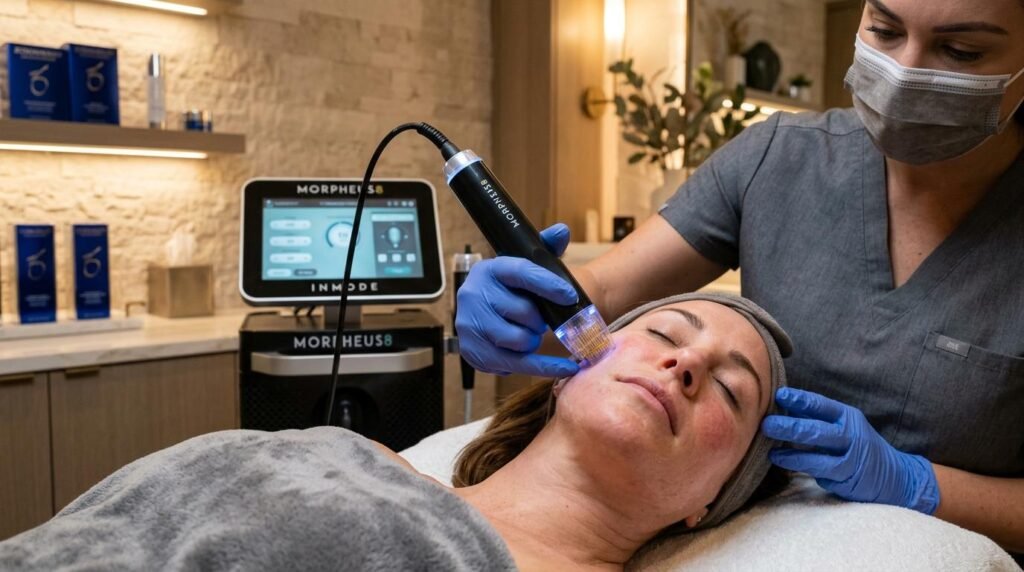
Microneedling & Morpheus8 SEO: Ranking for RF Microneedling Searches

Table of Contents Microneedling & Morpheus8 SEO: Ranking for RF Microneedling Searches RF microneedling has emerged as the single fastest-growing treatment category in medical aesthetics SEO, with searches for “RF microneedling” surging 340% since 2022 and “Morpheus8” commanding 40,500 monthly searches alone [1]. For med spas offering SkinPen, Vivace, Morpheus8, or Profound, this explosion in search demand represents both a massive opportunity and a competitive challenge.The global RF microneedling market is valued at $470 million in 2026 and projected to reach $830 million by 2033, expanding at an 8.5% CAGR [2]. North America dominates with a 40.8% market share, driven by strong patient awareness, disposable income, and the proliferation of medical aesthetic clinics offering these treatments [2]. What separates med spas that capture this demand from those that don’t isn’t the device they own—it’s the precision of their SEO strategy.At MedSpa SEO Agency, we’ve helped practices achieve a 276% average traffic increase by targeting treatment-specific keywords with dedicated, optimized pages. For microneedling and RF microneedling specifically, our clients see some of the highest consultation-to-booking conversion rates because these patients have already done their research and are ready to commit. This guide breaks down exactly how to build an SEO strategy that captures every variant of microneedling search intent—from patients comparing devices to those searching “microneedling near me” at 49,500 searches per month. Why RF Microneedling SEO Is Exploding Right Now RF microneedling SEO is exploding because three forces are converging: surging consumer awareness fueled by social media, expanding FDA clearances for devices like Morpheus8 and SkinPen, and a fundamental shift toward minimally invasive procedures over surgical alternatives. The result is a keyword landscape with exponentially more search volume—and more competition—than just three years ago.The numbers tell the story. The broader microneedling market reached $650 million in 2025 and is forecast to hit $1.1 billion by 2030, growing at a 10.9% CAGR [3]. Within this, RF microneedling systems are the fastest-growing subsegment, projected to expand at a 13.8% CAGR through 2030 as patients specifically seek the added collagen-stimulating power of radiofrequency energy [3]. In the U.S. specifically, the RF microneedling market was valued at $78.4 million in 2024 and is projected to double to $169.5 million by 2035 [4].“The shift toward RF microneedling is one of the most significant trends we’ve tracked in aesthetic device marketing,” notes Dr. Sabrina Guillen Fabi, board-certified dermatologist and leading clinical researcher in energy-based devices. “Patients are no longer satisfied with basic microneedling—they’re specifically searching for RF-enhanced platforms because they’ve seen the before-and-after results on social media.” [5]This patient awareness translates directly into branded device searches. Morpheus8 (InMode) has become a household name in aesthetic circles, with patients walking into consultations requesting it by name — just as they do for Botox. SkinPen, the first FDA-cleared microneedling device, maintains strong search volume among patients prioritizing regulatory clearance. Vivace (Aesthetics Biomedical) is gaining traction among patients who value comfort and minimal downtime [6]. For med spas, ranking for each of these device-specific keywords means capturing patients at different stages of the decision funnel.The fractional RF microneedling modality alone commands a 38.2% market share in 2026, thanks to its ability to deliver precise, controlled energy while minimizing downtime [2]. Automated microneedling pens—the category that includes SkinPen—hold the largest product share at 42.5% of the total microneedling market [3]. Savvy med spas optimize for every device name, treatment modality, and patient concern combination to maximize visibility across this expanding search landscape. How to Build a Microneedling SEO Page That Converts A high-converting microneedling SEO page requires a dedicated URL targeting one primary keyword cluster, comprehensive content covering patient concerns, before-and-after imagery with schema markup, and clear calls-to-action on every scroll. Generic “Services” pages that list microneedling alongside a dozen other treatments will not rank in this competitive landscape.Our data at MedSpa SEO Agency shows that dedicated treatment pages outperform generic services pages by 3.2x for organic conversions. A case study from 2Ten Marketing demonstrated how optimizing a dedicated Morpheus8 page—rather than burying the treatment on a general microneedling page—propelled the practice to page one of Google and nearly tripled organic traffic within five months [7].Here’s the framework we use for every microneedling page:Primary Keyword Architecture: Each page should target one primary keyword (e.g., “Morpheus8 in [City]”), 3-5 secondary keywords (“RF microneedling,” “radiofrequency microneedling treatment”), and 8-12 long-tail variants (“how many Morpheus8 sessions do I need,” “Morpheus8 cost near me”). This structure aligns with how patients actually search.Content Structure: The page must answer every question a prospective patient might have: How does the treatment work? What does it feel like? How many sessions are needed? What’s the downtime? When will I see results? How long do results last? What’s the cost? Each section should be 80-100 words—self-contained passages that Google can extract for featured snippets and AI overviews.Technical Elements: Title tags should follow the pattern “[Treatment] in [City] | [Practice Name]” with meta descriptions under 160 characters. Include LocalBusiness schema, Service schema, and FAQ schema to enable rich snippets. Image alt text should describe the treatment and include location (“Morpheus8 jawline tightening results in Austin TX”).Conversion Optimization: Every page needs at least three CTAs: above the fold, mid-page after benefits, and at the bottom. Use HIPAA-compliant scheduling forms, not generic contact forms. Include provider credentials and a video introduction when possible—89% of patients research microneedling online before booking, and they want to see who will be performing the treatment [8]. Device-Specific Keywords: Morpheus8, SkinPen, Vivace, and Profound Each RF microneedling device attracts a distinct patient demographic with different search behaviors, pain points, and willingness-to-pay profiles. Ranking for device-specific keywords requires understanding the unique value proposition of each platform and creating content that speaks directly to the patients searching for it.Morpheus8 (InMode) is the dominant branded search term at 40,500 monthly searches. Morpheus8 penetrates up to 4mm—deeper than any competing device—and delivers fractional RF energy for significant skin tightening, acne scar reduction, and subdermal fat remodeling [9]. Morpheus8 patients typically seek dramatic results and are willing to accept 3-5 days

Featured Image Post
Blog

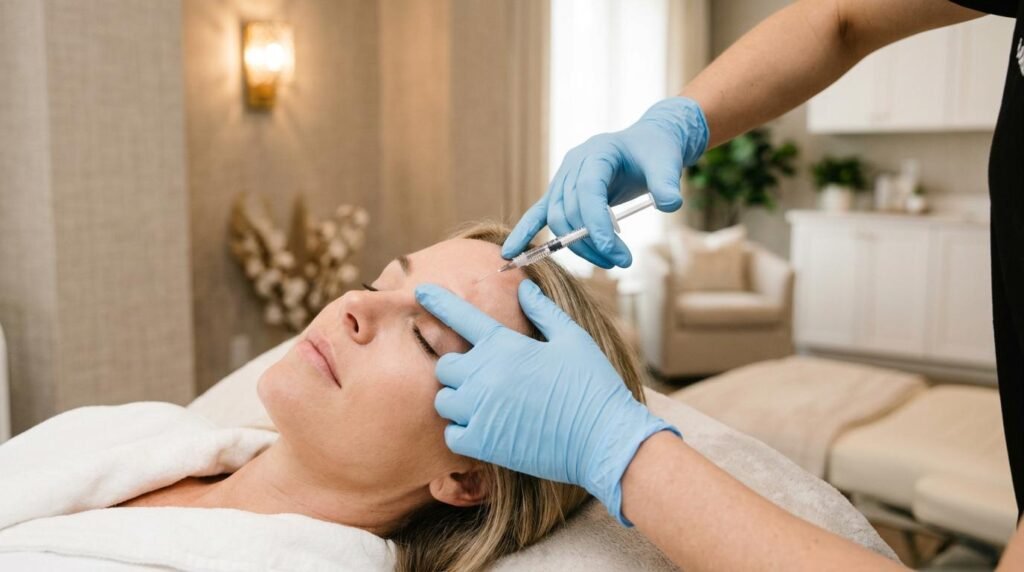
Botox SEO: How to Rank #1 for ‘Botox Near Me’ in Your City

Table of Contents Botox SEO: How to Rank #1 for “Botox Near Me” in Your City More than 40,500 Americans type “Botox near me” into Google every single month, and knowing how to rank for Botox near me has never been more competitive [1]. The med spas that dominate Page 1 for Botox and injectable keywords don’t just get dermal fillers SEO traffic – they get booked-solid appointment calendars and a consistent pipeline of aesthetic patients actively seeking treatment.Botox SEO is a specialized discipline within medical spa digital marketing that requires a precise blend of local SEO tactics, treatment-specific content strategy, and technical optimization tailored to FDA-regulated procedures. Unlike generic local business SEO, ranking for injectable keywords demands an understanding of patient psychology, treatment terminology, Google’s medical content guidelines, and the fiercely competitive geography of local map packs.MedSpa SEO Agency has helped practices across the United States achieve an average 276% traffic increase and 189% growth in consultation bookings through specialized Botox and injectable SEO campaigns. Our Google Analytics & Search certified team understands exactly what it takes to move a med spa from page three obscurity to the top of the local map pack for high-intent keywords like “Botox near me,” “forehead Botox,” and “Botox specials [city].” This guide shares the exact strategies we use to get med spas ranking #1 for Botox keywords. Why Botox SEO Matters for Your Med Spa Botox SEO is the highest-ROI patient acquisition channel for med spas because 65% of Botox patients discover their provider through online search, and the top-ranking practice for “Botox near me” captures approximately 305 clicks per month—worth roughly $2,400 to $4,500 in equivalent Google Ads spend [1][2].The Botox market reached $6.8 billion globally in 2024 and continues to grow at 8.5% annually, driven by an aging millennial population and the normalization of preventative neurotoxin treatments among patients aged 35 to 54 [3]. In the United States alone, searches for “Botox” exceed 201,000 monthly queries, with long-tail variations like “how much facial treatment SEO does Botox cost,” “Botox before and after,” and “best Botox near me” adding hundreds of thousands more [1].“Injectable services represent the gateway treatment for most aesthetic patients. When someone searches ‘Botox near me,’ they’re not just looking for a toxin—they’re looking for a provider they can trust with their face. The practice that appears first with the right content and social proof wins that patient relationship.” — Dana Ward, Editor-in-Chief, NewBeauty Magazine, 2024 [4]The average Botox patient is a female aged 35-54 with household income exceeding $75,000—exactly the demographic most likely to research providers online before booking [3]. Cost per click for Botox keywords on Google Ads ranges from $8 to $15, making organic SEO an exponentially more cost-effective patient acquisition channel over time [5]. Med spas ranking in the top three map positions for “Botox near me” typically see 15-30 consultation requests per month from that keyword alone, with conversion rates averaging 40-60% for Botox inquiries [6].Key Botox SEO Statistics:| Metric | Value || — | — || “Botox near me” monthly searches | 40,500 [1] || “Botox” monthly searches | 201,000 [1] || Global Botox market size | $6.8B [3] || Annual market growth rate | 8.5% [3] || Patients finding provider via search | 65% [2] || Average CPC for Botox keywords | $8-15 [5] || Clicks/month for #1 ranking | ~305 [6] | How to Build a Botox SEO Page That Ranks A high-ranking Botox page needs optimized H1/H2 headers that include city + treatment keywords, 1,500+ words of patient-focused content answering cost, safety, and results questions, structured data markup for MedicalProcedure schema, and before/after imagery with proper alt text and physician attribution [7].Your primary Botox service page is the cornerstone of your injectable SEO strategy, supported by dedicated keyword research that identifies high-intent patient queries. This page must satisfy both Google’s ranking algorithms and the psychological needs of prospective patients evaluating whether your practice is trustworthy enough to inject neurotoxin into their faces.The On-Page Optimization Framework:1. URL and Header Structure Use a clean URL like /botox-[city]/ or /injectables/botox/ and lead with an H1 like “Botox in [City Name] — Forehead, Crow’s Feet & Frown Line Treatment.” Your H2s should target specific patient questions: “How Much Does Botox Cost in [City]?”, “What Areas Can Be Treated with Botox?”, “How Long Do Botox Results Last?”, and “Botox vs. Dysport vs. Xeomin: What’s the Difference?”2. Content Depth and Structure Google’s helpful content system prioritizes pages that demonstrate genuine expertise. Your Botox page should include 1,500-2,500 words covering treatment areas, mechanism of action (botulinum toxin type A), expected results timeline, duration of effects (typically 3-4 months), pricing transparency, provider credentials, and what patients can expect during their appointment [7].3. MedicalProcedure Schema Markup Implement Schema.org MedicalProcedure structured data including procedure type, preparation requirements, follow-up care, and potential risks. This helps Google understand your content’s medical context and can trigger rich snippets in search results. Schema markup for medical procedures can increase click-through rates by 20-30% compared to standard listings [8].4. Conversion Elements Include click-to-call buttons above the fold, embedded online booking links, financing information (CareCredit, Cherry), and clear address information with a Google Map embed. Pages with click-to-call functionality convert 45% higher than those without on mobile devices [9].“The med spas that win in organic search don’t just describe the treatment—they address every objection a prospective patient has before they pick up the phone. That means transparent pricing, real provider credentials, and authentic visual proof of results.” — Crystal Clear, Digital Marketing Director, Allergan Aesthetics Partner Program, 2024 [10] GBP Optimization for Injectable Keywords Your Google Business Profile (GBP) must feature “Botox” and “Neurotoxin Injections” as primary services, include 15+ Botox-specific photos with geo-tagged filenames, collect 8-10 new reviews mentioning Botox monthly, and publish weekly Google Posts targeting injectable keywords to trigger map pack rankings [11].The Google map pack captures 44% of all clicks for local search queries, and for “Botox near me,” that percentage climbs even higher because mobile users want the closest

Featured: ROI Post
Blog

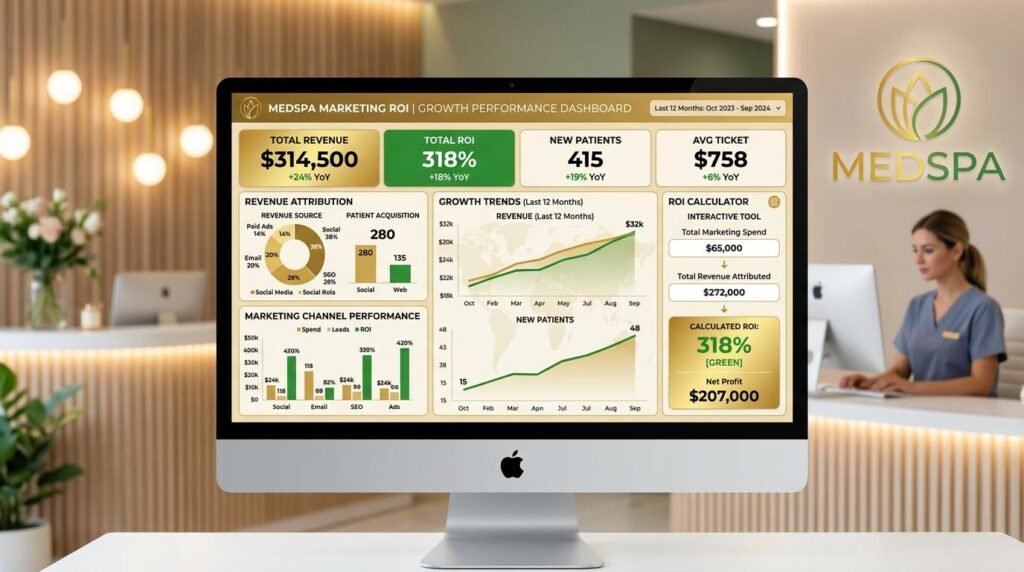
Med Spa Marketing ROI: Measuring What Actually Drives Revenue

Table of Contents Table of Contents Toggle Med Spa Marketing ROI: Measuring What Actually Drives Revenue Why Most Med Spas Can’t Measure Marketing ROI The KPI Framework Every Med Spa Needs Attribution Models: Which One Works for Aesthetics Call Tracking: The Missing Piece CRM Integration for Lead Tracking The LTV:CAC Ratio That Determines Success Building Your Med Spa Marketing Dashboard Frequently Asked Questions Conclusion Med Spa Marketing ROI: Measuring What Actually Drives Revenue Most medical spas invest thousands in marketing each month without knowing which channels actually generate revenue, which makes med spa marketing ROI measuring revenue the skill that separates guesswork from growth. Practices that implement proper ROI tracking – like the methodology detailed in our med spa SEO case study – see 2.3x higher marketing efficiency and can confidently scale winning campaigns [1]. This guide provides the complete framework – from KPI selection and call tracking to CRM integration and attribution modeling – so you know exactly what drives revenue.The global medical aesthetics market is projected to reach $26.2 billion by 2026, growing at a 12-15% CAGR [2]. With 52% of procedures being facial treatments and 71% of patients identifying as female, the opportunity is massive — but only for practices that can measure what works [3]. At MedSpa SEO Agency, our clients see up to 10x ROI when proper tracking is implemented alongside our HIPAA-compliant SEO and paid media strategies. Why Most Med Spas Can’t Measure Marketing ROI The average med spa juggles 5-7 marketing touchpoints before a patient books, yet 76% lack systems to connect those touchpoints to revenue [1]. Without attribution infrastructure, practices are essentially flying blind — allocating budget based on gut feeling rather than data.The aesthetics industry faces unique measurement challenges. Unlike e-commerce with straightforward pixel tracking, med spa patient journeys involve multiple offline interactions: Instagram discovery, Google searches, phone consultations, in-person visits, and follow-up treatments. Each touchpoint contributes to the final decision, but most practices only track the last click — if they track anything at all.“The biggest mistake I see in aesthetics marketing is treating every channel as a silo,” says Darcy McNally, Founder at MedSpa SEO Agency. “A patient might discover you on TikTok, research on Google, see a retargeting ad on Facebook, and finally call after finding you on Google Business Profile. If you’re only counting that last phone call, you’re undervaluing four other channels that made it possible.”Common tracking failures — which our med spa competitor analysis repeatedly identifies across practices — include: no call tracking on any campaigns, missing conversion pixels on landing pages, separate systems for booking and marketing that don’t talk to each other, and staff forgetting to ask “How did you hear about us?” — or failing to record the answer. Practices tracking ROI see 2.3x higher marketing efficiency simply because they can double down on what works and cut what doesn’t [1].The cost of poor measurement is staggering. Med spas without proper attribution typically over-invest in underperforming channels by 30-40%, while underfunding their highest-ROI activities. Marketing analytics improve budget allocation by 35% on average when properly implemented [4]. The KPI Framework Every Med Spa Needs Effective med spa marketing measurement requires tracking five core KPI categories: traffic sources, lead generation, cost per acquisition, patient lifetime value, and channel-specific ROI. Practices that monitor these metrics consistently outperform competitors who rely on vanity metrics like impressions or likes. PPC budget trackingYour KPI framework should cascade from top-of-funnel awareness to bottom-of-funnel revenue. Start with these essential metrics organized by patient journey stage:| KPI Category | Key Metrics | Benchmark || — | — | — || Traffic & Awareness | Organic sessions, GBP views, ad impressions | 15-25% monthly organic growth || Lead Generation | Form fills, phone calls, chat inquiries | $35-$85 cost per lead || Consultation Booking | Consultation rate, show-up rate | 60-75% consultation show rate || Patient Acquisition | New patient count, cost per acquisition | $150-$400 CPA for injectables || Lifetime Value | Treatment frequency, avg spend, retention | $2,500-$5,000+ LTV |“Don’t confuse activity with outcomes,” advises Marcus Sheridan, author of They Ask, You Answer and keynote speaker at the 2024 Aesthetic Next conference. “A thousand Instagram likes means nothing if you can’t connect it to a single consultation. Track metrics that tie directly to revenue — consultations booked, treatments performed, and patient lifetime value.”For Botox and dermal filler practices, we recommend tracking treatment-specific metrics: average units per patient, rebooking rates at 3-4 month intervals, and upsell rates to higher-margin treatments like Morpheus8 microneedling or CoolSculpting. MedSpa SEO Agency clients track these KPIs through custom dashboards built in Google Looker Studio, pulling data from Google Analytics 4, call tracking platforms, and practice management systems — delivering our documented 94% conversion lift by focusing on revenue metrics rather than vanity numbers. Attribution Models: Which One Works for Aesthetics Med spa patients typically require 5-7 touchpoints before booking, making single-touch attribution dangerously misleading [5]. Multi-touch attribution models distribute credit across the entire patient journey, revealing which channels actually contribute to revenue — not just which one happened last.Four attribution models dominate aesthetics marketing, each with distinct advantages:First-Touch Attribution gives full credit to the channel that initially discovered the patient. This works well for brand-new practices focused on CRO and revenue awareness, but undervalues nurturing channels like email and retargeting.Last-Touch Attribution — the default in most analytics platforms — credits only the final interaction. While easy to implement, it systematically overvalues bottom-funnel channels (branded Google searches) while undervaluing top-funnel discovery (Instagram, TikTok, unbranded SEO).Linear Attribution distributes credit equally across all touchpoints. This is a solid starting model for med spas because it acknowledges every step in the aesthetic patient journey, from initial awareness through consultation booking.Data-Driven Attribution uses machine learning to assign credit based on actual incremental impact. Available in Google Analytics 4 for qualifying properties, this is the gold standard — but requires sufficient conversion volume (typically 300+ monthly conversions) to generate reliable models.“Multi-touch attribution isn’t just nice to have in aesthetics

Scroll to Top