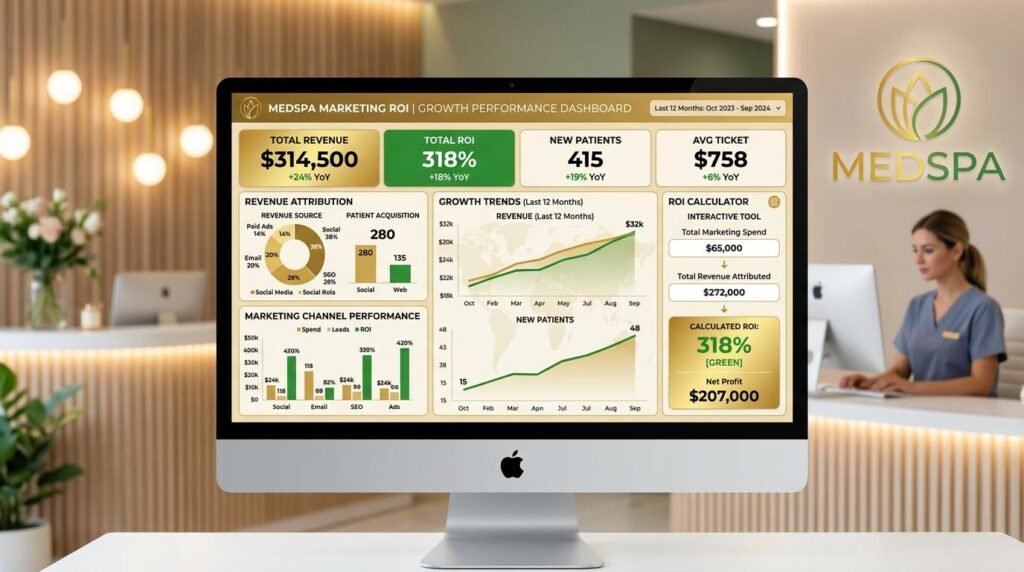
Med Spa Marketing ROI: Measuring What Actually Drives Revenue
Table of Contents Table of Contents Toggle Med Spa Marketing ROI: Measuring What Actually Drives Revenue Why Most Med Spas Can’t Measure Marketing ROI The KPI Framework Every Med Spa Needs Attribution Models: Which One Works for Aesthetics Call Tracking: The Missing Piece CRM Integration for Lead Tracking The LTV:CAC Ratio That Determines Success Building Your Med Spa Marketing Dashboard Frequently Asked Questions Conclusion Med Spa Marketing ROI: Measuring What Actually Drives Revenue Most medical spas invest thousands in marketing each month without knowing which channels actually generate revenue. Practices that implement proper ROI tracking — like the methodology detailed in our med spa SEO case study — see 2.3x higher marketing efficiency and can confidently scale winning campaigns [1]. This guide provides the complete framework for measuring med spa marketing ROI — from KPI selection and call tracking to CRM integration and attribution modeling — so you know exactly what drives revenue. The global medical aesthetics market is projected to reach $26.2 billion by 2026, growing at a 12-15% CAGR [2]. With 52% of procedures being facial treatments and 71% of patients identifying as female, the opportunity is massive — but only for practices that can measure what works [3]. At MedSpa SEO Agency, our clients see up to 10x ROI when proper tracking is implemented alongside our HIPAA-compliant SEO and paid media strategies. Why Most Med Spas Can’t Measure Marketing ROI The average med spa juggles 5-7 marketing touchpoints before a patient books, yet 76% lack systems to connect those touchpoints to revenue [1]. Without attribution infrastructure, practices are essentially flying blind — allocating budget based on gut feeling rather than data. The aesthetics industry faces unique measurement challenges. Unlike e-commerce with straightforward pixel tracking, med spa patient journeys involve multiple offline interactions: Instagram discovery, Google searches, phone consultations, in-person visits, and follow-up treatments. Each touchpoint contributes to the final decision, but most practices only track the last click — if they track anything at all. “The biggest mistake I see in aesthetics marketing is treating every channel as a silo,” says Darcy McNally, Founder at MedSpa SEO Agency. “A patient might discover you on TikTok, research on Google, see a retargeting ad on Facebook, and finally call after finding you on Google Business Profile. If you’re only counting that last phone call, you’re undervaluing four other channels that made it possible.” Common tracking failures — which our med spa competitor analysis repeatedly identifies across practices — include: no call tracking on any campaigns, missing conversion pixels on landing pages, separate systems for booking and marketing that don’t talk to each other, and staff forgetting to ask “How did you hear about us?” — or failing to record the answer. Practices tracking ROI see 2.3x higher marketing efficiency simply because they can double down on what works and cut what doesn’t [1]. The cost of poor measurement is staggering. Med spas without proper attribution typically over-invest in underperforming channels by 30-40%, while underfunding their highest-ROI activities. Marketing analytics improve budget allocation by 35% on average when properly implemented [4]. The KPI Framework Every Med Spa Needs Effective med spa marketing measurement requires tracking five core KPI categories: traffic sources, lead generation, cost per acquisition, patient lifetime value, and channel-specific ROI. Practices that monitor these metrics consistently outperform competitors who rely on vanity metrics like impressions or likes. PPC budget tracking Your KPI framework should cascade from top-of-funnel awareness to bottom-of-funnel revenue. Start with these essential metrics organized by patient journey stage: | KPI Category | Key Metrics | Benchmark | | — | — | — | | Traffic & Awareness | Organic sessions, GBP views, ad impressions | 15-25% monthly organic growth | | Lead Generation | Form fills, phone calls, chat inquiries | $35-$85 cost per lead | | Consultation Booking | Consultation rate, show-up rate | 60-75% consultation show rate | | Patient Acquisition | New patient count, cost per acquisition | $150-$400 CPA for injectables | | Lifetime Value | Treatment frequency, avg spend, retention | $2,500-$5,000+ LTV | “Don’t confuse activity with outcomes,” advises Marcus Sheridan, author of They Ask, You Answer and keynote speaker at the 2024 Aesthetic Next conference. “A thousand Instagram likes means nothing if you can’t connect it to a single consultation. Track metrics that tie directly to revenue — consultations booked, treatments performed, and patient lifetime value.” For Botox and dermal filler practices, we recommend tracking treatment-specific metrics: average units per patient, rebooking rates at 3-4 month intervals, and upsell rates to higher-margin treatments like Morpheus8 microneedling or CoolSculpting. MedSpa SEO Agency clients track these KPIs through custom dashboards built in Google Looker Studio, pulling data from Google Analytics 4, call tracking platforms, and practice management systems — delivering our documented 94% conversion lift by focusing on revenue metrics rather than vanity numbers. Attribution Models: Which One Works for Aesthetics Med spa patients typically require 5-7 touchpoints before booking, making single-touch attribution dangerously misleading [5]. Multi-touch attribution models distribute credit across the entire patient journey, revealing which channels actually contribute to revenue — not just which one happened last. Four attribution models dominate aesthetics marketing, each with distinct advantages: First-Touch Attribution gives full credit to the channel that initially discovered the patient. This works well for brand-new practices focused on CRO and revenue awareness, but undervalues nurturing channels like email and retargeting. Last-Touch Attribution — the default in most analytics platforms — credits only the final interaction. While easy to implement, it systematically overvalues bottom-funnel channels (branded Google searches) while undervaluing top-funnel discovery (Instagram, TikTok, unbranded SEO). Linear Attribution distributes credit equally across all touchpoints. This is a solid starting model for med spas because it acknowledges every step in the aesthetic patient journey, from initial awareness through consultation booking. Data-Driven Attribution uses machine learning to assign credit based on actual incremental impact. Available in Google Analytics 4 for qualifying properties, this is the gold standard — but requires sufficient conversion volume (typically 300+ monthly conversions) to