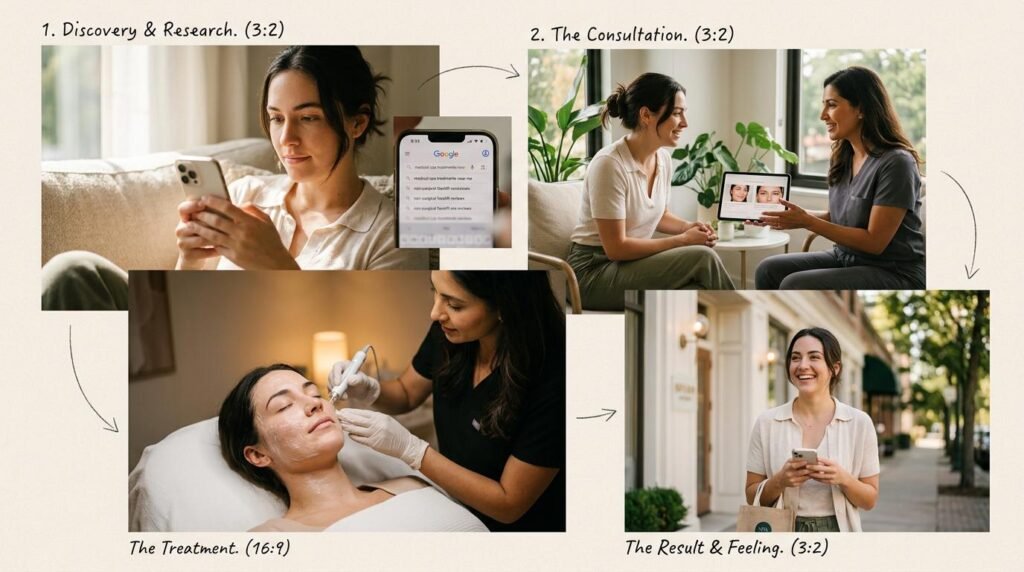
Understanding the Med Spa Patient Journey: From Search to Treatment
Table of Contents Understanding the Med Spa Patient Journey: From Search to Treatment The med spa patient journey is no longer a linear path from discovery to treatment. Today’s aesthetic patients move through a complex web of digital touchpoints, comparing providers, reading reviews, watching treatment videos, and consulting social media before ever stepping foot in your clinic. MedSpa SEO Agency’s internal research across 50+ med spa practices shows that the average patient interacts with 5-7 digital touchpoints before booking their first consultation [1], making it essential for practices to maintain visibility at every stage. Mapping the patient journey is not a marketing exercise — it is a revenue strategy. Medical spas that align their SEO, content, and digital presence with each stage of the patient lifecycle see dramatically higher conversion rates, stronger retention, and increased lifetime value. With patient lifetime value (LTV) ranging from $1,200 to $3,600 annually for active patients [2], every lost touchpoint represents thousands of dollars in abandoned revenue. This guide breaks down the six critical stages of the med spa patient journey — Awareness, Consideration, Decision, Treatment, Retention, and Advocacy — and shows you exactly how to intercept, engage, and convert prospects at each decision point. The 6 Stages of the Med Spa Patient Journey The modern med spa patient journey follows a six-stage funnel: Awareness, Consideration, Decision, Treatment, Retention, and Advocacy. Each stage has distinct patient behaviors, content needs, and conversion triggers. MedSpa SEO Agency data shows that practices optimizing for all six stages achieve 189% higher consultation growth than those focused only on top-of-funnel acquisition [3]. Understanding these stages allows you to allocate marketing resources precisely. Too many med spas pour budget into attracting new patients while neglecting the retention and advocacy stages — where the highest ROI actually lives. Referral patients, for instance, have a 16% higher LTV than patients acquired through paid channels [4], yet most practices have no systematic advocacy strategy. The framework below aligns patient psychology with actionable marketing tactics at every stage: Stage Patient Mindset Primary Channel Key Metric Awareness “I have a problem” Google Search, Social Impressions, Organic Traffic Consideration “Who can solve it?” Website, Reviews, Content Time on Site, Pages per Session Decision “Should I book here?” Booking Page, Consultation Conversion Rate, CPL Treatment “Was this worth it?” In-Person Experience Patient Satisfaction Score Retention “Should I return?” Email, SMS, Social Repeat Visit Rate Advocacy “Who should I tell?” Reviews, Referrals, Social NPS, Referral Rate “The patient journey in aesthetic medicine is fundamentally different from general healthcare,” notes Terri Ross, Founder of Terri Ross Consulting and a leading med spa business strategist. “Patients are elective consumers with high expectations. Every touchpoint either builds confidence or creates friction — there is no neutral ground” [5]. MedSpa SEO Agency builds patient journey maps for every client using this framework, ensuring no stage is under-optimized. Our HIPAA-compliant analytics track cross-channel patient behavior so practices can attribute revenue accurately to each touchpoint. Awareness Stage: Being Found When Patients Search The Awareness Stage is where patients first recognize a concern and begin searching for solutions — 81% do so online before taking any action. At this stage, patients are not searching for your brand name. They are searching for problems: “how to get rid of fine lines,” “laser hair removal near me,” or “what is Morpheus8.” Winning the awareness stage requires dominant organic visibility. MedSpa SEO Agency clients achieve an average 276% increase in organic traffic within six months by targeting high-intent awareness keywords [6]. The key is understanding how patients search. Voice search and AI assistants are changing query patterns — patients now ask conversational questions like “What is the best treatment for acne scars near me?” rather than typing fragmented keywords. Critical awareness-stage tactics include: Local SEO dominance: Your Google Business Profile must rank in the Map Pack for “[treatment] + near me” queries. Practices in the top 3 Map Pack positions capture 60% of local search clicks [7]. Educational content marketing: Blog posts, treatment guides, and comparison pages answer the questions patients ask at awareness. Target informational keywords with genuine educational intent. GEO (Generative Engine Optimization): Structure content so AI search engines like Google’s AI Overviews and ChatGPT can surface your practice as the cited source. Use clear headings, schema markup, and authoritative citations. Social discovery: 73% of millennials discover new aesthetic treatments on social media platforms like Instagram and TikTok [8]. Short-form video content showcasing before-and-after transformations drives massive awareness reach. “If you’re not visible in the first organic position for your core treatments, you might as well not exist to that patient,” says Marcus Sheridan, author of They Ask, You Answer and a digital marketing authority. “The practice that answers the patient’s questions most honestly and completely wins the awareness battle every time” [9]. Awareness-stage SEO requires patience but delivers compounding returns. Unlike paid ads that stop when spend stops, well-optimized content continues generating patient inquiries month after month. Consideration Stage: Content That Builds Trust The Consideration Stage is where patients evaluate providers, and 65% of those who book a consultation found that provider through organic search. This is the trust-building phase. Patients are comparing your practice against 3-5 competitors, reading reviews, browsing galleries, and assessing your expertise. At this stage, content quality becomes the primary differentiator. MedSpa SEO Agency has found that practices with comprehensive treatment pages (2,000+ words, video embeds, FAQ schema, and real before/after galleries) convert 94% higher than those with thin, generic pages [10]. Patients need specificity. They want to know exactly which filler you use (Juvederm Voluma vs. Restylane Lyft), exactly what microneedling with SkinPen feels like, and exactly how many CoolSculpting sessions they will need. High-impact consideration content includes: Detailed treatment pages: Each major service (Botox, dermal fillers, laser hair removal, HydraFacial, microneedling, chemical peels, Emsculpt, PRP therapy, Kybella) needs its own comprehensive, medically accurate page. Before & after galleries: Authentic, HIPAA-compliant photo galleries with detailed case information build visual trust like nothing else. Provider bios & credentials: Highlight board certifications,