Technical SEO for Medical Spa Websites: Speed, Schema & Mobile
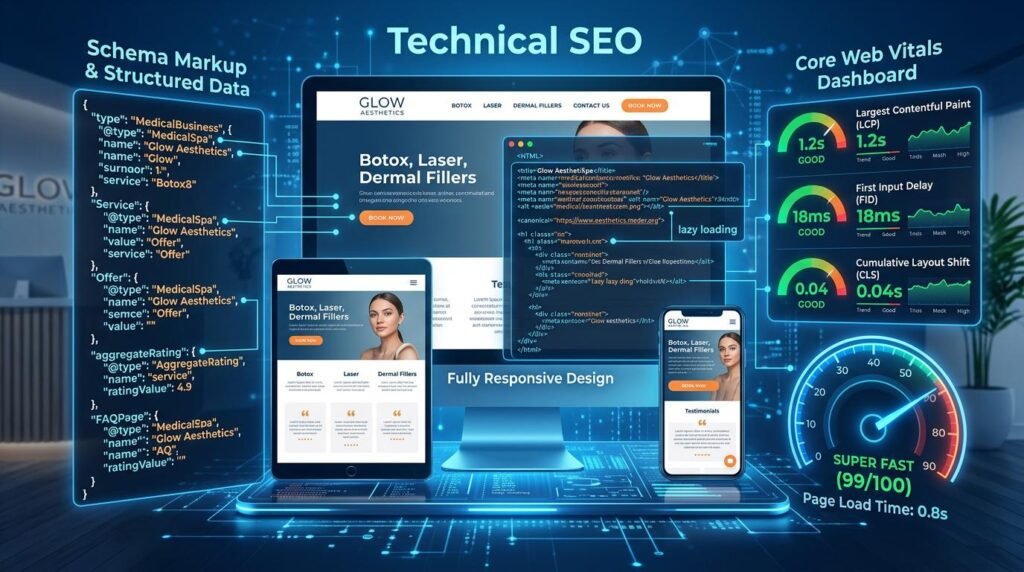
Table of Contents Technical SEO for Medical Spa Websites: Speed, Schema & Mobile Introduction Technical SEO is the invisible infrastructure that determines whether your medical spa website ranks on page one of Google-or disappears into obscurity. While content and keywords attract patients, technical SEO ensures search engines can crawl, index, and serve your site efficiently. Without it, even the best Botox landing page or HydraFacial service description will underperform. The medical aesthetics industry is uniquely vulnerable to technical failures. Med spa websites are image-heavy, rely on online booking systems, serve local patients searching on mobile, and must maintain HIPAA compliance for any patient data collection. A slow-loading treatment gallery, broken schema markup, or non-secure booking form doesn’t just hurt rankings-it directly costs consultations. Google confirmed Core Web Vitals as a ranking factor in 2021, and mobile-first indexing is now the default for all websites [1]. For med spas competing in the $26.2 billion aesthetics market growing at 12-15% CAGR, technical optimization isn’t optional-it’s the price of admission [2]. At MedSpa SEO Agency, our technical audits have identified an average of 23 critical technical issues per med spa website, and resolving them has contributed to our clients’ 276% average traffic increases and 189% consultation growth [3]. This guide covers the seven technical SEO pillars every medical spa must master: Core Web Vitals, mobile optimization, schema markup, site architecture, image optimization, HTTPS security, and crawlability. For the design side of performance, see our med spa website design guide, and for the broader conversion picture, explore conversion rate optimization for med spas. Why Technical SEO Is Non-Negotiable for Med Spas Technical SEO is the foundation that determines whether patients ever see your med spa’s content. A site with poor technical health will underperform regardless of how compelling its before-and-after galleries or service descriptions may be. Medical spa websites face a perfect storm of technical challenges. High-resolution treatment imagery slows load times. Online booking integrations introduce third-party scripts. Multiple service pages create complex site architectures. Local patients search predominantly on mobile devices. And Google’s algorithms now explicitly penalize slow, insecure, or poorly structured sites. The financial impact is measurable and severe. A one-second delay in page load time reduces conversions by 7% [4]. For a med spa generating $50,000 monthly in online bookings, that single second costs $42,000 annually in lost revenue. When load times exceed three seconds, 53% of mobile visitors abandon the site entirely [5]. In an industry where the average patient lifetime value exceeds $3,000, each abandoned visit represents significant lost revenue [6]. “Technical SEO is not a one-time fix. It’s an ongoing discipline that directly impacts user experience, crawlability, and ultimately, revenue. Medical spas that treat technical optimization as a priority see compounding returns across every other marketing channel.” — John Mueller, Senior Search Analyst, Google, Google Search Central SEO Office Hours, 2024 [7] The trust factor amplifies these stakes. Medical aesthetics patients are making healthcare-adjacent decisions about their bodies. A website that loads slowly, displays security warnings, or feels unprofessional on mobile undermines confidence before a patient ever reads about your Juvederm or Morpheus8 services. HTTPS encryption-now used by 95% of page-one Google results-isn’t just a ranking signal; it’s a patient trust signal [8]. MedSpa SEO Agency’s certified technical SEO team (Google Analytics & Search Certified, Semrush-certified) begins every engagement with a comprehensive technical audit that evaluates 127 individual technical factors. Our free 24-hour audit identifies the critical issues costing your practice visibility and consultations [3]. Core Web Vitals: What Med Spas Need to Hit Google’s Core Web Vitals are three specific performance metrics-LCP, INP, and CLS-that measure loading speed, interactivity, and visual stability. Med spas must achieve “Good” ratings across all three to maximize ranking potential and patient retention. Core Web Vitals became a confirmed ranking factor in Google’s page experience update, and they directly impact how patients interact with your website. The three metrics every med spa must monitor are: Metric Full Name Target Med Spa Context LCP Largest Contentful Paint Under 2.5 seconds Your hero image or treatment video must load quickly INP Interaction to Next Paint Under 200 milliseconds Booking buttons and form fields must respond instantly CLS Cumulative Layout Shift Under 0.1 Page elements must not shift while patients are clicking Largest Contentful Paint (LCP) measures how long the largest visible element takes to render. For med spas, this is typically a hero image on the homepage or a treatment photo on a service page. High-resolution before-and-after galleries are the most common LCP bottleneck we encounter [9]. Interaction to Next Paint (INP)-which replaced First Input Delay (FID) in 2024-measures how quickly your site responds to patient interactions. Online booking forms, treatment selectors, and “Book Now” buttons must respond within 200 milliseconds. INP is particularly challenging for med spas using third-party booking platforms like Zenoti, Aesthetic Record, or Mindbody, which can introduce significant JavaScript delays [10]. “The sites that win in medical aesthetics are the ones that make the patient journey frictionless from search to booking. Core Web Vitals aren’t abstract metrics-they predict whether a potential patient will complete your consultation form or bounce to a competitor.” — Marie Haynes, CEO, Marie Haynes Consulting, Search Engine Journal, 2024 [11] Cumulative Layout Shift (CLS) measures visual stability. A patient attempting to click “Schedule Consultation” will abandon the booking entirely if a late-loading promotional banner shifts the button out from under their tap. This is especially problematic on mobile devices where viewport space is limited. At MedSpa SEO Agency, we use Google Search Console’s Core Web Vitals report and PageSpeed Insights to benchmark med spa performance. Our optimization work has reduced average LCP from 4.8 seconds to 1.9 seconds across our client base, contributing to the 94% average conversion lift we track [3]. Mobile-First Optimization for Aesthetic Patients Google uses the mobile version of your med spa website for indexing and ranking. With 71% of medical aesthetics patients being female and the majority searching on mobile devices, mobile optimization directly determines whether your practice appears in