Blog

Medspa Marketing Agency: How to Choose the Right Partner for Your Practice

Medspa Marketing Agency: How to Choose the Right Partner for Your Practice Running a med spa is hard. You’re managing treatments, staff, compliance, and patient relationships. The last thing you need is wasting money on a marketing agency that doesn’t understand your business. That’s why this guide exists. We’ll walk you through what a real medspa marketing agency does, what to look for when hiring one, and the red flags that separate actual specialists from generic agencies slapping “med spa” on their services. By the end, you’ll know exactly how to evaluate agencies, what questions to ask, and whether you’re getting a partner who can actually move the needle on your bookings and revenue. Table of Contents What Is a Medspa Marketing Agency? Why Generic Marketing Agencies Fail Med Spas Core Services You Should Expect How to Evaluate a Medspa Marketing Agency 5 Questions to Ask Before Hiring Red Flags to Watch For How to Measure Marketing ROI Choosing Between Agency, Freelancer, or In-House Key Takeaways What Is a Medspa Marketing Agency? A medspa marketing agency is a specialized firm that focuses exclusively (or primarily) on growing medical aesthetics practices. Unlike generalist agencies, they understand your specific challenges: Compliance matters. Healthcare marketing has rules. HIPAA, state regulations, before-and-after photo guidelines—it’s not the same as promoting a pizza restaurant. High-intent patient searches. People searching “Botox near me” or “microneedling in [city]” are ready to book. You need someone who knows how to rank for those exact keywords. Treatment variety. Your practice offers 10-20+ different treatments. A quality agency knows how to market each one separately, not just bundle them together. Patient psychology. Med spa patients care about results, safety, practitioner credentials, and before-and-after proof. Generic copywriting misses all of that. Revenue per patient is high. A single patient conversion can be worth $500-$5,000+. That means your ROI math is different—you can invest more to acquire the right patient. A real medspa marketing agency knows all of this cold. They’ve run campaigns for dozens (or hundreds) of practices. They know what works, what wastes money, and what positions you to actually compete in your market. Why Generic Marketing Agencies Fail Med Spas Here’s the honest truth: most marketing agencies will take your money and deliver mediocre results. They’ll tell you they “have experience with med spas,” but what they really mean is they once did a website for a dermatologist five years ago. The problems: 1. They Don’t Understand Patient Intent A generalist agency might create content about “aesthetic treatments” without realizing that patients don’t search that way. They search “best Botox in Denver” or “Morpheus8 before and after.” If your agency isn’t running keyword research specific to med spa treatments, they’re shooting in the dark. 2. They Miss Compliance Issues You can’t just post before-and-after photos without proper disclaimers. You can’t make unsubstantiated medical claims. A generic agency might create ads that sound amazing but get flagged by Facebook or risk regulatory issues. A medspa specialist knows the guardrails. 3. They Don’t Know Your Cost Per Acquisition (CPA) In med spas, patient acquisition cost and lifetime value math are completely different from other industries. If your average client spends $2,500 over their lifetime with you, you can afford to spend $300-$500 to acquire them. A generic agency might only spend $50 and leave money on the table—or overspend and kill your ROI. 4. They Treat All Treatments the Same Botox attracts different patients than chemical peels. Microneedling patients have different concerns than those interested in laser hair removal. A specialized agency creates separate strategies for each treatment. A generalist bundles everything and wonders why CTR is terrible. 5. They Don’t Know Local Med Spa Dynamics Local SEO for med spas is incredibly competitive. Your competitors are likely spending $5,000-$15,000 per month on marketing in your area. A generic agency doesn’t know the competitive landscape, so they can’t position you to win. Core Services You Should Expect From a Medspa Marketing Agency Here’s what a quality medspa marketing agency should offer (or at least have expertise in): 1. Local SEO This is the bread-and-butter service. Local SEO means ranking your Google Business Profile, building citations, earning reviews, and creating location-specific content so you show up when people search “med spa near me” in your city. What to look for: Case studies showing ranking improvements for specific keywords, review management strategies, and Google Business Profile optimization. 2. SEO & Content Strategy Beyond local, you need a content strategy that ranks for high-intent keywords. This includes blog posts, treatment pages, and educational content that answers patient questions before they call. What to look for: A documented content marketing strategy, keyword research, and an editorial calendar. Not just random blog posts. 3. Paid Advertising (PPC) While SEO builds organic traffic, PPC and paid ads get immediate results. Your agency should know how to run Google Ads, Facebook ads, and Instagram ads specifically for med spa treatments. What to look for: Proven ad account management, A/B testing, and measurable ROAS (return on ad spend) results. 4. Website Design & Conversion Optimization Your website is your 24/7 sales rep. A medspa marketing agency should either provide web design services or partner with someone who does. Your site needs to convert visitors into appointment requests. What to look for: Conversion-focused design, mobile optimization, clear CTAs, and treatment page layouts that drive bookings. 5. Review & Reputation Management Patients trust reviews more than any ad copy. A quality agency should help you systematically collect reviews, respond to them, and improve your overall reputation. What to look for: A process for collecting reviews, reputation monitoring, and documented review growth. 6. Analytics & Reporting You need to know what’s working and what’s wasting money. This means monthly reporting that ties marketing activity to actual bookings and revenue. What to look for: Clear dashboards, monthly reports showing traffic/leads/revenue impact, and willingness to discuss ROI openly. How to Evaluate a Medspa Marketing Agency 1. Do They Have Med Spa Case Studies? Ask
Blog

Med Spa Franchise Marketing Agency: Complete Strategy Guide for 2026

You’ve built something special with your med spa franchise. Now you need to scale it without losing the brand magic that makes patients choose you. The challenge? Traditional med spa marketing breaks down when you go from one location to ten—or fifty. Each location needs different tactics. Your HQ can’t be everywhere at once. And what works in Phoenix doesn’t automatically work in Portland. This is where franchise marketing strategy becomes your competitive edge. It’s not just bigger versions of single-location tactics. It’s a system designed to build consistent brand presence across multiple markets while letting each location compete locally. Here’s what franchise operators and their marketing partners need to know right now. Table of Contents Why Franchise Marketing Requires Its Own Strategy Multi-Location SEO for Med Spa Franchises Building Brand Consistency Across Locations Local Dominance: Getting Each Location to Rank Paid Ads Across Multiple Markets Content Strategy That Works at Scale Managing Reviews & Reputation Across Franchises Measuring ROI Across Locations Key Takeaways Why Franchise Marketing Requires Its Own Strategy Single-location med spa marketing is straightforward. You’re competing in one city. Your Google Business Profile has one address. Your social media focuses on one community. Franchise marketing? It’s a different animal. You’re now managing: Multiple Google Business Profiles (one per location) Local SEO in 5, 10, or 50+ different markets Paid advertising budgets spread across competing markets Review management at scale Brand consistency while respecting local differences Inventory challenges (some locations have Botox, others don’t) Here’s the reality: Most med spa franchises fail at marketing because they treat each location like a mini-me of headquarters. That doesn’t work. Denver has different competitors than Dallas. A saturated Phoenix market needs different strategies than an emerging Austin market. A smart med spa marketing agency understands this. They build franchise marketing systems that: Protect brand consistency (your colors, voice, core messaging stay the same) Allow local flexibility (each market can adjust for local competition and preferences) Scale efficiently (you’re not rebuilding the wheel for location #47) Measure ROI by location (you know which franchisees are marketing effectively) This is why working with experienced partners in the med spa space matters. They’ve seen what works and what doesn’t. Multi-Location SEO for Med Spa Franchises Multi-location SEO is your foundation. Done right, it gives every franchise location a fighting chance to rank locally without cannibalizing each other. The Core Challenge: Avoiding Cannibalization Cannibalization happens when your own pages compete against each other in search results. You have a services page, a location page, and a treatment guide—all targeting “Botox near me” in Denver. Google shows one. The others don’t rank. You’ve wasted authority. You’re not maximizing your footprint. Multi-location SEO strategy fixes this by: Creating location-specific pages for each franchise (not just copying one template) Using unique location schema so Google understands where each service is available Building authority at headquarters while pushing ranking power to location pages Managing internal linking strategically to avoid confusion For franchises, this means: Headquarters site = brand authority, thought leadership, corporate info Location pages or subdomains = local ranking for “Botox near [city],” “Morpheus8 in [city],” etc. Each location gets its own optimized Google Business Profile Technical Setup That Scales You have two main options: Subdomain model: denver.medspafame.com, phoenix.medspafame.com, etc. Clean. Each location gets its own site authority. Good for SEO. Subfolder model: medspafame.com/denver, medspafame.com/phoenix. Shares root domain authority. Easier to manage. Good if locations aren’t too different. For most growing franchises, subdomains win because they let you: Rank multiple locations for the same keyword without competing Give franchisees some autonomy in their local site structure Sell local packages or specific services by location Building Brand Consistency Across Locations Your franchise brand is worth money. Inconsistent marketing loses it. But here’s the trap: Too much control kills franchisee buy-in. They feel like branches, not real business owners. That resentment shows in their marketing effort. The solution is controlled flexibility. What Stays the Same (The Non-Negotiables) Logo and color palette Core brand messaging (what makes you different—unique staff, treatment quality, luxury experience, etc.) Service names (call it “Botox” not “toxin injections”—consistency matters) Pricing frameworks (if you’re premium, all locations reflect that) Visual templates for social media, emails, ads Patient experience standards (booking flow, intake process, follow-up) What Can Flex (The Local Variables) Local testimonials and before/afters (use real patients from that city) Community partnerships and local sponsorships Local pricing (NYC and rural Montana have different economics) Local treatment focus (one location might specialize in injectables, another in lasers) Local language and cultural messaging Franchisee backgrounds and stories (build the local team, not just the brand) A strong med spa brand position makes this easier. If you’re known for “science-driven results” or “luxury without the price,” that message scales. Local tactics just reflect it differently. Local Dominance: Getting Each Location to Rank You can have 50 locations. But if each one ranks #15 for local searches, you lose millions in bookings. Local dominance means each location consistently ranks in the top 3 for its market. Google Business Profile Mastery (Non-Negotiable) Your Google Business Profile is your #1 local ranking factor. Frankly, if your GBP is weak, nothing else matters. For franchises: Each location gets a verified, distinct GBP. No shortcuts. Each GBP needs unique photos, descriptions, and posts. Using HQ photos on all 50 location pages looks like a national chain. You lose local credibility. Post regularly. Every location should post 2-3 times per month (specials, new staff, patient stories, educational content). Manage questions and answers. Patients ask questions through GBP. Franchisees must respond within 24 hours. Collect reviews relentlessly. More on this below. This sounds tedious for 50 locations. And it is. Which is why you need systems—templates, workflows, accountability checks. Local Content That Converts Ranking #1 means nothing if searchers don’t click. You need content that makes sense to local audiences. Example: “Botox in Denver” ≠ “Botox in Denver Near Cherry Creek” “Best Morpheus8 Results” ≠ “Why Denver Patients Love Morpheus8 for Aging Skin” Local content should:

Featured Image Post
Blog

Medical Spa Google Business Profile Optimization: Complete 2026 Guide – Copy

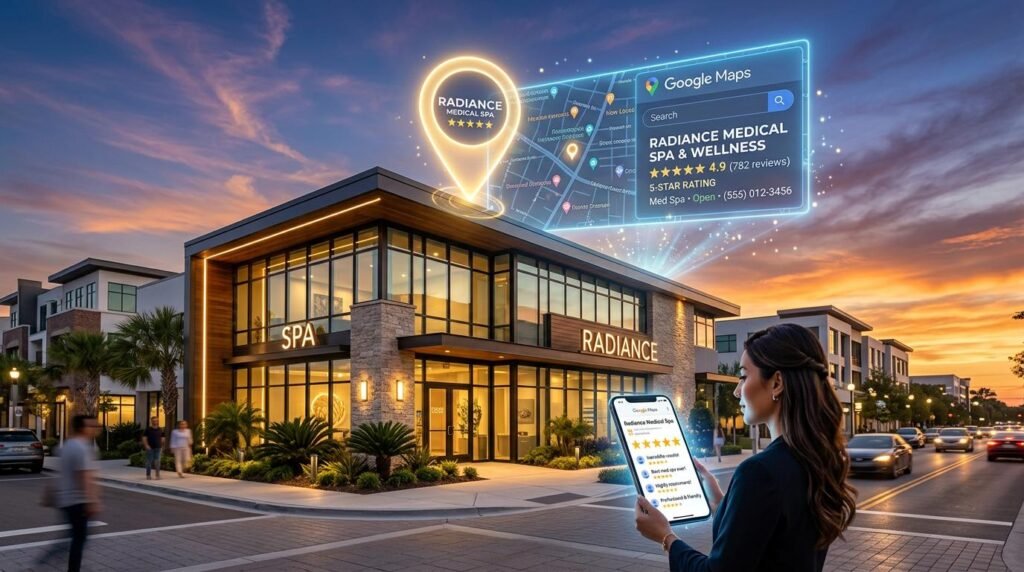
Table of Contents Medical Spa Google Business Profile Optimization: Complete 2026 Guide Your Google Business Profile (GBP) is the single most powerful free tool for attracting local patients searching for treatments like Botox, laser hair removal, and HydraFacial. With GBP carrying 36% of the ranking weight for local map pack results [1], optimizing it correctly can mean the difference between a booked consultation calendar and an empty waiting room. MedSpa SEO Agency has used the exact tactics in this guide to increase client consultation calls by up to 189% — with one practice achieving an 800% growth result. This comprehensive 2026 guide covers category selection, photo strategy, review management, posts, Q&A optimization, and HIPAA-compliant practices specific to medical aesthetics. Why Google Business Profile Is the #1 Growth Channel for Medical Spas Atomic Answer: Google Business Profile accounts for 36% of local ranking factors and drives 76% of local visitors to take action within 24 hours. For medical spas, an optimized GBP generates more qualified consultation calls than any other single marketing channel — including paid advertising [1][2]. The medical aesthetics industry is projected to reach $26.2 billion by 2026, growing at a 12-15% compound annual growth rate [3]. In this hyper-competitive landscape, your GBP is often the first — and sometimes only — touchpoint potential patients have with your practice before deciding to book. According to Google Consumer Insights, 76% of people who search for something nearby visit a business within 24 hours, and 28% of those searches result in a purchase or booking [2]. For medical spas specifically, the patient journey almost always begins with a local search. Someone typing “Botox near me” or “best med spa in [city]” is typically in the consideration or decision phase — meaning they have intent to book within days, not weeks. Your GBP is what appears at the exact moment of highest intent, above organic results and often above paid ads in the local map pack. “The Google Business Profile has evolved from a simple directory listing into a dynamic patient acquisition platform,” says Joy Hawkins, Owner of Sterling Sky and a Google Product Expert. “Medical practices that treat their GBP as a living, updated asset — rather than a set-it-and-forget-it listing — consistently outperform competitors who neglect it” [4]. The data supports this emphatically. Med spas with 100 or more GBP photos receive 520% more calls than those with sparse visual content [5], making before/after photography one of the highest-ROI investments in your profile. Practices maintaining a 4.5+ star rating get 25% more clicks than those rated below 4.0 [6]. And clinics that publish regular GBP posts see a 15-20% increase in patient engagement [7]. These aren’t marginal gains — they’re transformative differences that compound over time. At MedSpa SEO Agency, we’ve documented that 63% of patients check a medical spa’s GBP before booking their first consultation [8]. In an industry where trust and credibility are paramount — patients are, after all, entrusting their faces and bodies to your practice — your GBP functions as a real-time reputation billboard that either builds confidence or drives prospects to competitors. How to Set Up Your GBP for Medical Aesthetics Success Atomic Answer: Setting up a medical spa GBP requires selecting “Medical Spa” as your primary category, adding all relevant treatment services, uploading professional photos, and ensuring your NAP (Name, Address, Phone) matches exactly across all directories. HIPAA-compliant practices must also avoid sharing protected health information in any public-facing content [9]. Step-by-Step GBP Setup Framework 1. Claim and Verify Your Listing Begin by claiming your GBP at google.com/business. Verification typically occurs via postcard mailed to your physical address — a critical step that confirms your legitimate business presence. Some medical spas may qualify for phone, email, or instant verification. Do not attempt to verify using a P.O. box or virtual office; Google’s algorithms are increasingly sophisticated at detecting and suppressing listings without genuine physical presence. 2. NAP Consistency Is Non-Negotiable Your Name, Address, and Phone number must be identical across every online directory — Yelp, Healthgrades, RealSelf, RealSelf Pro, Vitals, and industry-specific directories. Even minor variations (“St.” versus “Street” or suite number formatting differences) dilute ranking signals. Use a tool like Semrush’s Listing Management or Moz Local to audit and synchronize your citations across 70+ directories simultaneously. 3. Business Description Optimization Write a 750-character description that naturally incorporates your primary treatments and location. Lead with what differentiates your practice — board-certified medical director, specific technologies (SkinPen, Morpheus8, CoolSculpting Elite), years in practice, or specialization areas. Include your city and primary service area naturally within the text. Example opening: “[Practice Name] is a physician-led medical spa in [City] specializing in non-surgical facial rejuvenation, including Botox, dermal fillers, microneedling with Morpheus8, and laser skin resurfacing. Our board-certified team delivers natural-looking results in a luxury medical environment.” 4. Service Area Configuration If you offer mobile services or serve patients from surrounding communities, define your service radius carefully. For fixed-location medical spas, set your primary location and optionally add nearby cities where patients commonly travel from. This expands your visibility for searches like “Juvederm in [neighboring town].” “The most common setup error we see is medical spas rushing through the initial configuration and skipping service details,” notes Greg Gifford, VP of Search at SearchLab Digital. “Spend 90 minutes getting the foundation right, and you’ll save months of underperformance later” [10]. Choosing the Right Categories and Services for Maximum Visibility Atomic Answer: Select “Medical Spa” as your primary category and add secondary categories like “Skin Care Clinic,” “Laser Hair Removal Service,” and “Dermatologist” where applicable. List every specific treatment you offer — Botox, dermal fillers, microneedling, laser hair removal, chemical peels — as individual services with descriptions and pricing [11]. Primary and Secondary Category Strategy Google allows one primary category and up to nine secondary categories. Your primary category should be “Medical Spa” — this is the category that carries the most ranking weight and determines which search queries trigger your listing most prominently. However, strategic secondary categories

Scroll to Top