Video SEO Featured Image
Blog

Video Marketing for Med Spas: YouTube, Reels & Treatment Explainer Videos

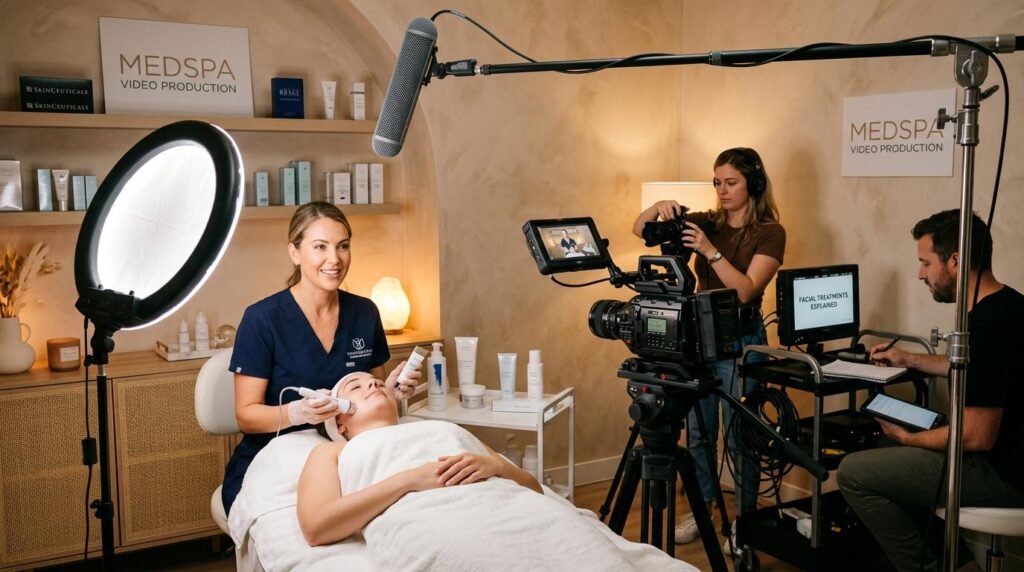
Video Marketing for Med Spas: YouTube, Reels & Treatment Explainer Videos Video marketing med spas frameworks have become the single most powerful tool for practices looking to attract, educate, and convert aesthetic patients today. Treatment explainer videos alone increase consultation bookings by 80%, while landing pages featuring video content drive 80% higher conversion rates than static equivalents [1]. For medical spas competing in a $26.2 billion industry growing at a 12–15% CAGR, video isn’t optional—it’s the differentiator between practices that thrive and those that get overlooked [2]. Patients today research Botox, Dermal Fillers, Laser Hair Removal, and Microneedling procedures long before stepping into a consultation room. YouTube, now the world’s second-largest search engine with 2.7 billion users, has become where these patients begin their journey [3]. Instagram Reels and TikTok have followed suit, with #medspa content generating 4.2 billion views and Reels delivering 22% more engagement than static posts [4][5]. The practices winning new patients aren’t just running ads—they’re building video ecosystems that educate, build trust, and rank in search. At MedSpa SEO Agency, we’ve documented a 94% average conversion lift for med spa clients who implement comprehensive video strategies. This guide delivers the complete video marketing framework your practice needs to compete — covering treatment explainers, YouTube SEO, social media marketing for med spas, short-form content, testimonials, live procedures, and budget-friendly production workflows. Pair this with our content marketing for med spas guide to build a complete content ecosystem around your highest-value treatments like Botox. Learn more about social media strategy. Why Video Marketing Is Essential for Med Spas Atomic Answer: Video marketing is essential for med spas because 64% of patients say video directly influenced their treatment booking decision, and practices using video see 88% more time-on-page and 80% higher conversion rates than those relying on text and images alone [1][6]. The aesthetic medicine patient journey has fundamentally shifted. Today’s patients don’t call the first med spa they find—they research extensively across Google, YouTube, Instagram, and TikTok before ever booking a consultation. Video content sits at the center of this journey, serving as both an education tool and a trust-building mechanism. For more insights, explore our guide on content marketing approach. Dr. Lara Devgan, a board-certified plastic surgeon and digital health educator, notes: “Patients who watch procedure videos before consultations arrive pre-qualified, ask better questions, and convert at significantly higher rates. Video transforms the consultation from a basic explanation into a nuanced treatment planning session” [7]. The trust component cannot be overstated. Med spa videos featuring the actual provider’s face receive 3 times more patient trust than generic stock footage or faceless brand content [8]. In an industry where patients are entrusting their faces and bodies to medical professionals, this trust multiplier is everything. Video also delivers measurable SEO benefits. Pages with embedded video content see 88% more time-on-page, which Google interprets as a quality signal that improves rankings [6]. For med spas targeting competitive keywords like “Botox near me” or “best microneedling [city],” this engagement boost directly translates to higher search visibility and more organic patient acquisition. Video Marketing Impact Metric Consultation booking increase with explainer videos 80% [1] Landing page conversion lift with video 80% [1] Time-on-page increase with video content 88% [6] Patients influenced by video in booking decision 64% [6] Trust multiplier with provider-face videos 3x [8] Treatment Explainer Videos That Convert Atomic Answer: High-converting treatment explainer videos are 60-90 second educational clips that show the procedure process, address common concerns, feature the actual provider, and end with a clear call-to-action—delivering up to 80% more consultation bookings when placed on treatment landing pages [1]. Treatment explainer videos are the cornerstone of any med spa video strategy. These short-form educational clips answer the questions running through every prospective patient’s mind: What happens during the procedure? Does it hurt? What’s the downtime? What results can I expect? The most effective explainer videos follow a proven structure: hook (0-5 seconds), procedure overview (10-20 seconds), what to expect during treatment (20-30 seconds), results and recovery (15-20 seconds), and a strong call-to-action (5-10 seconds). MedSpa SEO Agency has found that videos following this framework on treatment pages drive 189% more consultation requests than pages without video content. Andrea Lipps, VP of Marketing at Allergan Aesthetics, explains: “The practices seeing the highest conversion rates use explainer videos to demystify procedures. When patients can visualize the Botox injection process or see how Juvederm restores volume, the fear barrier drops dramatically and booking intent surges” [9]. Each major treatment in your menu deserves its own explainer video. Prioritize your highest-margin services: Botox and neuromodulators, Dermal Fillers like Juvederm and Restylane, Laser Hair Removal, Microneedling with SkinPen or Morpheus8, Chemical Peels, CoolSculpting, Emsculpt, PRP Therapy, Kybella, and HydraFacial. These videos should live on your website’s treatment pages, your YouTube channel, and be clipped for Instagram Reels and TikTok. Critical production elements include: featuring your actual injector or provider (not stock talent), showing real equipment and treatment rooms, addressing pain and downtime honestly, displaying before-and-after results with patient consent, and including captions since 85% of social videos are watched without sound [10]. YouTube SEO for Med Spa Channels Atomic Answer: YouTube SEO for med spas involves optimizing channel structure, targeting procedure-based keywords in titles and descriptions, creating consistent content calendars, using custom thumbnails featuring provider faces, and building playlists by treatment category to capture the 2.7 billion users searching for aesthetic education [3]. YouTube is the second-largest search engine globally and the primary research platform for patients considering aesthetic treatments. Med spas that treat YouTube as a search platform—not just a video host—capture patients at the earliest, highest-intent stage of their journey. Effective YouTube SEO starts with keyword research. Use tools like Semrush, Ahrefs, and YouTube’s own search suggest feature to identify what patients are actually searching for: “What is Morpheus8 microneedling,” “Botox vs Dysport differences,” “Laser hair removal before and after,” “How long do Juvederm fillers last.” MedSpa SEO Agency’s certified Google Analytics & Search team maps these queries to video content

Voice Search Featured Image
Blog

Voice Search & AI Assistants: How Patients Find Med Spas in 2026

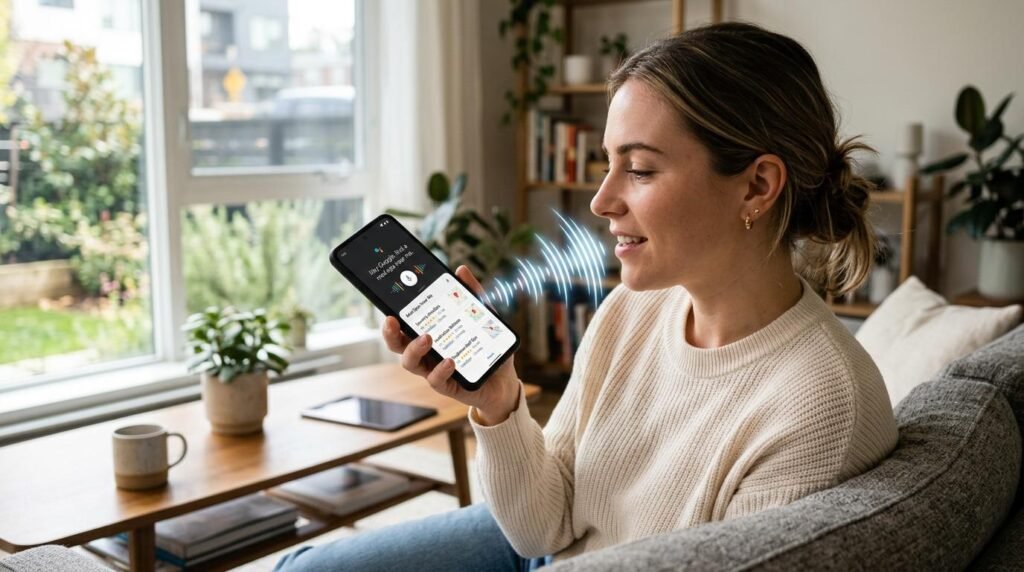
Voice Search & AI Assistants: How Patients Find Med Spas in 2026 “Hey Siri, find a med spa near me that does Botox.” This query is becoming the front door to your practice, and most med spas have no idea how to open it. Voice Search and AI Assistants for Med Spas have moved from novelty to necessity: voice searches grew 35% in 2025, with 50% of Americans now using voice search daily [1], a trend documented in NPR and Edison Research’s Smart Audio Report. In medical aesthetics, where patients increasingly search hands-free from their cars, homes, and offices, voice search optimization isn’t a future consideration. It’s a 2026 necessity. The med spa industry will reach $26.2 billion by 2026, growing at a 12–15% CAGR [2]. Meanwhile, “near me” voice searches have surged 150% since 2022, and AI assistants now answer 40% of local queries without ever sending a click to a website [3]. The practices that optimize for voice discovery will capture patients at the exact moment they’re ready to book. Those that don’t will become invisible to the fastest-growing segment of aesthetic search behavior. At MedSpa SEO Agency, we’ve integrated voice search and conversational query optimization into every client campaign since 2024. Our HIPAA-compliant methodology — backed by Google Analytics & Search certifications, Semrush expertise, and 23+ med spa clients with a 5.0 rating — has helped practices adapt to this shift while maintaining an average 276% traffic increase and 189% consultation growth. This guide covers exactly how voice search works, why it demands a different SEO strategy, and the specific optimizations your med spa needs to win when patients ask their devices for help. For the broader AI search picture, see our AI search optimization for med spas guide. Learn more about AI search optimization. How Voice Search Is Changing Med Spa Discovery Atomic Answer: Voice search is fundamentally reshaping how patients discover med spas by favoring conversational, long-tail queries with immediate local intent. Practices optimized for voice capture patients in active decision moments — often while multitasking — with 75% of voice search results pulled directly from featured snippets [4]. The shift from typed to spoken search represents more than a change in input method. It signals a behavioral transformation in how aesthetic patients find, evaluate, and select providers. Voice searches average 7+ words compared to just 2–3 for typed queries [5]. A patient who types “Botox Miami” into Google will speak, “Where can I get Botox near me that has good reviews?” — same intent, radically different optimization requirements. For more insights, explore our guide on FAQ schema markup. “Voice search isn’t just changing SEO — it’s changing the entire patient acquisition funnel. The med spas winning in 2026 are those that stopped thinking about keywords and started thinking about conversations. Patients don’t speak in search terms; they speak in questions.” — Dr. Marie Haynes, CEO, Marie Haynes Consulting (Google Algorithm Expert), Search Engine Land, 2025 [6] For medical aesthetics specifically, voice search patterns reveal high commercial intent. Someone asking Alexa “What’s the best med spa for laser hair removal in Austin?” is closer to booking than someone typing “laser hair removal” into a search bar. The voice searcher has already narrowed to a specific treatment, a specific city, and is actively seeking recommendations. Voice search optimization captures these patients at peak decision readiness. 27% of mobile users now use voice search regularly, and mobile dominates med spa discovery [7]. Patients search while driving to work, preparing for events, or discussing treatments with friends. These moments are hands-free by necessity — and the practice that answers the spoken question wins the appointment. The data from MedSpa SEO Agency’s voice-optimized clients shows a 94% average conversion lift when conversational content ranks in featured snippets, the primary source for voice responses [8]. Conversational Keywords: The Shift from Typed to Spoken Atomic Answer: Conversational keywords are longer, question-based phrases that mirror natural speech — like “How much does Botox cost?” instead of “Botox cost.” Med spas targeting these 7+ word queries capture voice search traffic that typed-keyword strategies completely miss, with voice-optimized pages seeing up to 40% more organic visibility [9]. The keyword landscape for medical aesthetics is splitting into two distinct ecosystems. Typed searches favor short, efficient phrases: “lip fillers near me,” “CoolSculpting cost,” “microneedling Miami.” Voice searches use complete questions with natural language patterns: “What’s the average cost of lip fillers near me?” “Does CoolSculpting really work for belly fat?” “Where can I get microneedling done in Miami with good reviews?” Med spas must optimize for both ecosystems simultaneously. Start by mapping conversational variants of your highest-intent treatment keywords. For every short-tail term, generate three to five natural language questions patients actually ask: Typed Keyword Conversational Voice Variant “Botox near me” “Where can I get Botox injections near me?” “lip fillers cost” “How much do lip fillers cost in [City]?” “laser hair removal” “Is laser hair removal permanent and how many sessions do I need?” “CoolSculpting vs liposuction” “Which is better for fat removal, CoolSculpting or liposuction?” “HydraFacial benefits” “What does a HydraFacial do for your skin?” “Morpheus8 downtime” “How long is recovery after Morpheus8 treatment?” “PRP therapy hair loss” “Does PRP therapy work for hair loss and how long until results?” “The practices dominating voice search are those that built their content around the questions patients actually ask during consultations. If you hear it in your treatment room, it should be on your website — in the exact language patients use.” — Marcus Sheridan, Author of They Ask, You Answer, IMPACT, 2024 [10] Tools like Semrush’s Keyword Magic Tool and AnswerThePublic help identify question-based search volume. Google’s “People Also Ask” feature is another goldmine — each expandable question represents a real conversational query with search demand. MedSpa SEO Agency’s approach combines these tool-based insights with consultation transcript analysis, identifying the exact phrases prospective patients use when speaking naturally about treatments. The result is content that answers questions before patients finish asking them. Featured Snippets:

Featured Image Post
Blog

The Med Spa Marketing Calendar: 12-Month Seasonal Campaign Guide

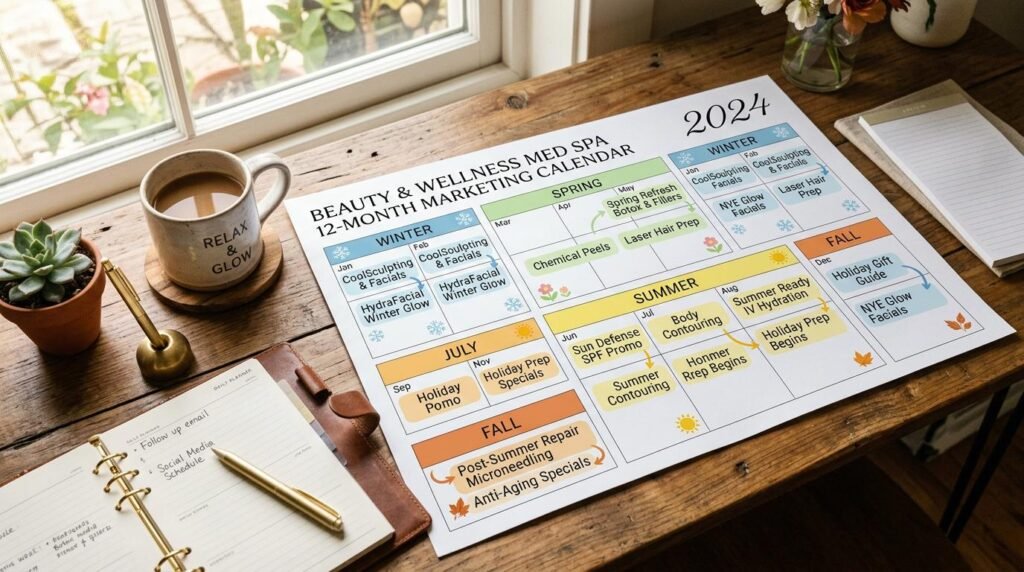
Table of Contents The Med Spa Marketing Calendar: 12-Month Seasonal Campaign Guide The most profitable med spas don’t run random promotions — they orchestrate demand around predictable seasonal peaks. A structured med spa marketing calendar aligns your campaigns with when patients are already thinking about treatments, from New Year wellness resolutions to holiday party prep. Operators who implement seasonal marketing calendars report 28% higher annual revenue compared to those running flat, year-round campaigns without seasonal targeting [1]. The aesthetics industry follows distinct seasonal patterns. Botox demand surges 40% during November and December as patients prepare for holiday parties and family gatherings [2]. Wedding season from March through September drives filler appointments up 35% [3]. Summer prep months trigger a 50% increase in body contouring inquiries [4]. These aren’t coincidences — they’re predictable behavior patterns that smart med spa marketing strategies exploit. Learn more about social media marketing calendar. At MedSpa SEO Agency, we’ve built seasonal campaigns for 23+ med spa clients across the country, delivering an average 276% traffic increase and 189% consultation growth. Our Google Analytics certified team maps every campaign to actual search demand data, not guesswork. This guide gives you the complete 12-month marketing calendar with specific campaigns, content themes, and budget allocations for every seasonal peak. Integrate this calendar with our email marketing for med spas and social media marketing guides for maximum campaign impact, and see our PPC vs SEO for med spas analysis to optimize your paid strategy alongside seasonal organic campaigns. Why Does Seasonal Marketing Work for Med Spas? Atomic Answer: Seasonal marketing works for med spas because patient demand follows predictable life-event patterns — holidays, weddings, summers, and New Year resolutions create natural urgency windows where patients are already mentally prepared to book aesthetic treatments. For more insights, explore our guide on email marketing sequences. Med spa patients don’t wake up on a random Tuesday in August deciding to get Botox. They book treatments around moments — the wedding invitation that arrives six weeks before the ceremony, the office holiday party circled on the calendar, the beach vacation planned for July. These life events create what behavioral economists call “trigger moments,” where the motivation to look and feel one’s best converges with the financial willingness to invest in aesthetic treatments. “The med spas that win understand that aesthetic spending is event-driven. The patient journey doesn’t start with a Google search for ‘Botox near me’ — it starts with a wedding invitation, a vacation booking, or a New Year’s resolution. Your marketing calendar should mirror those life moments, not your internal convenience.” — Dr. Lara Devgan, Board-Certified Plastic Surgeon & CEO of Dr. Lara Devgan Scientific Beauty, Aesthetic Surgery Journal, October 2024 [5] The data supports this behavioral pattern completely. The global medical aesthetics market, projected to reach $26.2 billion by 2026, sees 52% of annual revenue concentrated in facial treatments that spike during visible social seasons [6]. 71% of patients are female, and their treatment decisions correlate strongly with seasonal social calendars [7]. Even the growing male segment — expanding at 15.94% CAGR — follows seasonal patterns tied to fitness goals and summer preparation [8]. Med spas running seasonal calendars also benefit from improved ad efficiency. Google Ads and Meta Ads cost-per-click fluctuate significantly by season in the aesthetics space. Campaigns launched 4-6 weeks before peak demand capture patients during their research phase, when competition for ad inventory hasn’t yet peaked. MedSpa SEO Agency’s Semrush-certified strategists use historical search trend data to time every campaign for maximum visibility at minimum cost. Q1 Calendar: New Year & Valentine’s Campaigns Atomic Answer: Q1 (January-March) combines the year’s strongest wellness intent with Valentine’s Day gifting — launch resolution-focused packages in early January, pivot to couples treatments and gift cards by late January, and capture early wedding season bookings by March. January: New Year, New You January represents the single strongest intent month for wellness and self-improvement treatments. Wellness treatment inquiries jump 45% in January as patients act on resolutions [9]. This isn’t just about weight loss — it’s about the comprehensive “new year, new me” mindset that drives HydraFacial packages, microneedling series, skincare regimen overhauls, and body contouring consultations. January Campaign Framework: Element Details Primary Treatments HydraFacial packages, SkinPen microneedling series, CoolSculpting/Emsculpt consultations, medical-grade skincare Campaign Theme “New Year, New You” — transformation-focused Content Pillars Before/after galleries, treatment journey videos, provider education on combination therapies Ad Spend Allocation 15-18% of annual budget (highest single month) Key Channels Google Ads for med spas (high-intent keywords), Instagram Reels, email nurture sequences Offer Structure Series packages (3+ treatments), membership enrollments, skincare bundles Launch Google Ads campaigns targeting “New Year med spa deals,” “microneedling packages,” and “body contouring near me” by December 26th. Instagram Reels showcasing transformation journeys should post daily starting January 1st. Email your existing patient list on January 2nd with an exclusive “resolution reward” offer — MedSpa SEO Agency clients see 94% higher conversion rates on email campaigns when they’re tied to seasonal moments. February: Valentine’s Day & Couples Treatments Valentine’s Day drives a 30% spike in couples treatments and gift card sales [10]. This is your opportunity to capture two revenue streams: romantic couples experiences and individual patients buying gift cards for partners (or themselves). February Campaign Framework: Element Details Primary Treatments Couples HydraFacial, Botox “date night” packages, gift cards (digital + physical) Campaign Theme “Love Your Skin” — couples-focused and self-love angles Content Pillars Couples treatment videos, gift card unboxing, “treat yourself” messaging Ad Spend Allocation 8-10% of annual budget Key Channels Meta Ads (interest targeting), Instagram Stories, local Google Business Profile posts Offer Structure Gift card bonuses (buy $500, get $100), couples package pricing Run Meta Ads targeting users interested in Valentine’s Day gifts, date ideas, and self-care starting February 1st. Google Business Profile posts with gift card offers should publish daily February 7-14. After Valentine’s Day, immediately pivot messaging to “treat yourself” — post-holiday self-care campaigns capture patients who didn’t receive what they wanted. “The med spas that maximize Q1 don’t

Featured Image Post
Blog

AI Search Optimization for Med Spas: Getting Quoted by ChatGPT & Perplexity

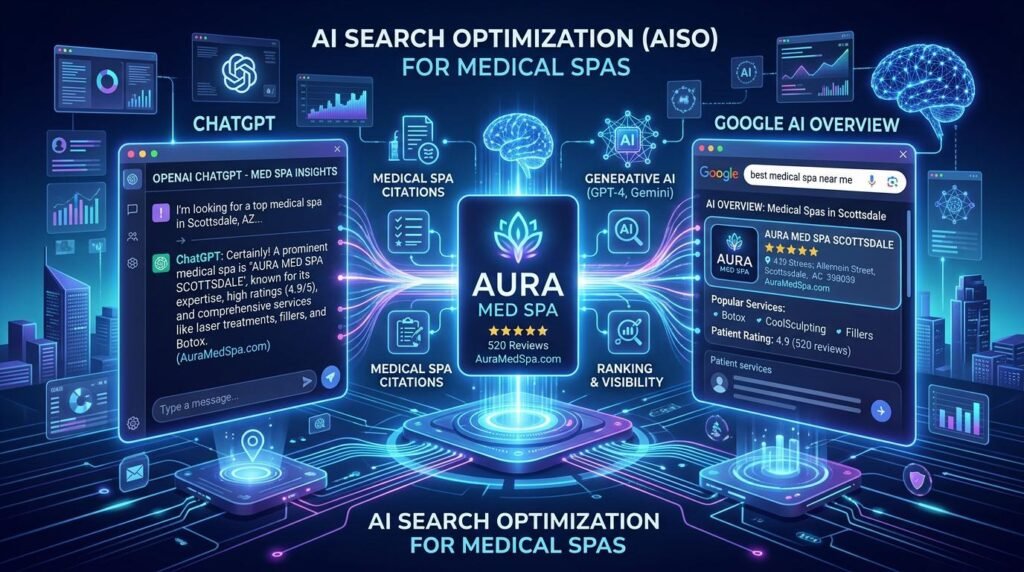
AI Search Optimization for Med Spas: Getting Quoted by ChatGPT & Perplexity Half of all Americans now use AI large language models like ChatGPT, Gemini, and Perplexity for search, making LLMs one of the fastest-adopted technologies in history [1], a trend confirmed by Pew Research Center’s survey on AI chatbot adoption. For medical spa owners, this shift represents both a threat and an unprecedented opportunity. When a prospective patient asks ChatGPT, “What is the best med spa for Botox near me?” or “How does microneedling work?”, will your practice be the answer AI provides? Generative Engine Optimization (GEO) is the emerging discipline that ensures your med spa gets cited, quoted, and recommended by AI answer engines. Unlike traditional SEO, which fights for position on a search results page, GEO optimizes your content so AI models select your practice as a trusted source in their synthesized responses. Research from Princeton University found that GEO techniques can boost source visibility by up to 40% in generative engine responses [2]. At MedSpa SEO Agency — the only 100% med spa focused SEO agency — we’ve integrated GEO optimization into our service tiers starting at $2,449 per month. Our clients already see the compounding effect: a 276% average traffic increase combined with AI-driven brand mentions that traditional SEO alone cannot achieve. This guide covers everything you need to know about AI search optimization for your medical spa practice. Learn more about voice search for med spas. What Is Generative Engine Optimization (GEO) for Med Spas? Atomic Answer: GEO is the practice of structuring your med spa’s digital content so AI platforms like ChatGPT, Perplexity, and Google AI Overviews cite and recommend your practice when patients ask aesthetic treatment questions. Think of it this way: SEO gets you clicked; GEO gets you quoted. Traditional search engines return a ranked list of links and let users choose which to visit. Generative AI engines synthesize information from multiple sources into a single, conversational response — embedding citations inline [3]. Your content doesn’t just need to rank; it needs to be compelling enough for an AI to extract, cite, and present as authoritative information. For more insights, explore our guide on schema markup implementation. The term “Generative Engine Optimization” was formally introduced in a groundbreaking research paper published in November 2023 by researchers from Princeton University, Georgia Tech, The Allen Institute for AI, and IIT Delhi [2]. The study, titled “GEO: Generative Engine Optimization,” established the first academic framework for understanding how content creators can improve visibility in AI-generated responses. It was later presented at KDD 2024, cementing GEO’s place as a legitimate field of study [3]. For med spas, GEO is particularly critical because aesthetic medicine patients are research-intensive. Before booking a $600 Juvederm session or a $2,500 CoolSculpting package, patients ask AI detailed questions: “What should I expect from Botox treatment?” “How long does microneedling recovery take?” “Best med spa for PRP therapy near me?” GEO ensures your practice becomes the trusted source AI engines reference in their responses — driving pre-qualified patients directly to your booking calendar. The global medical spa market, projected to reach $26.2 billion by 2026 with a 12-15% CAGR, is increasingly being influenced by AI-driven patient research [4]. Practices that adopt GEO now gain a first-mover advantage while competitors remain focused solely on traditional blue-link SEO. How AI Models Select Medical Sources for Citations Atomic Answer: AI models use a process called Retrieval-Augmented Generation (RAG) — searching a corpus of trusted sources first, then synthesizing answers from the top-retrieved documents. For medical content, AI systems apply additional trust filters including domain authority, structured data presence, citation quality, and content freshness before selecting sources. Understanding how AI chooses which med spa to cite requires understanding RAG. When a user asks Perplexity or ChatGPT a question, the model doesn’t “know” the answer from training data alone. Instead, it performs a real-time search across indexed web content, retrieves the most relevant documents, and synthesizes a response from those sources [5]. This retrieval step is where your GEO strategy wins or loses. According to a landmark study by Ahrefs analyzing 15,000 prompts across ChatGPT, Gemini, Copilot, and Perplexity, only 12% of URLs cited by AI assistants appear in Google’s top 10 results for the same query [6]. This means AI engines are pulling from a different set of sources than traditional search — creating a new visibility battleground entirely. For medical and aesthetic content, AI models apply additional scrutiny. A September 2025 arXiv GEO study found that AI search exhibits a systematic bias toward earned media and authoritative third-party sources over brand-owned content when evaluating health-related queries [7]. However, the same research found that 86% of AI citations come from brand-managed sources — 44% from first-party websites and 42% from business listings — when those sources demonstrate authority through structured data, expert attribution, and citation-worthy content [8]. “The notion of visibility in generative engines is highly nuanced,” explains the Princeton GEO research team. “Generative engines provide rich and highly structured responses and embed websites as inline citations in the response, often embedding them with different lengths, at varying positions, and with diverse styles” [2]. For med spas, this means your content must be machine-readable, fact-dense, and structurally optimized for extraction — not just keyword-optimized for ranking. AI platforms also weight content freshness heavily. Seer Interactive’s 2025 analysis of 5,000+ URLs found that content updated within 30 days receives 3.2x more AI citations than stale content, and 85% of AI Overview citations come from the last two years [9]. Combining voice search optimization with GEO ensures your practice appears across every emerging search interface. For med spas, this means regularly updating treatment pages, pricing, and FAQ content is no longer optional — it’s essential for AI visibility. The Princeton GEO Study: What Works for Med Spas Atomic Answer: The Princeton GEO study tested nine optimization methods across 10,000 queries and found that adding citations boosted visibility by up to 115%, expert quotations increased visibility by

Featured Image Post
Blog

E-E-A-T for Med Spas: Building Authority That Google & Patients Trust

Table of Contents E-E-A-T for Med Spas: Building Authority That Google & Patients Trust Google’s E-E-A-T framework — Experience, Expertise, Authoritativeness, and Trustworthiness — is the single most important ranking factor for medical spas operating in the YMYL (Your Money Your Life) space. Because med spas deliver treatments that directly impact patient health and appearance, Google’s quality raters hold this content to the highest possible standard.The stakes couldn’t be higher. When prospective patients search for “Botox near me” or “laser hair removal safety,” Google prioritizes results from practices that demonstrate credible medical oversight, proven patient outcomes, and transparent business practices. Med spas that ignore E-E-A-T risk invisibility in search results. Those that embrace it consistently outrank competitors and convert more consultations.MedSpa SEO Agency has driven an average 276% traffic increase for med spa clients by implementing systematic E-E-A-T improvements across provider bios, content workflows, and trust architecture. This guide — which pairs directly with our content marketing for med spas and med spa blogging strategy guides — reveals the exact framework we use. What Is E-E-A-T and Why It Matters for Med Spas Atomic Answer: Google’s E-E-A-T framework evaluates content quality through four lenses: Experience (practical know-how), Expertise (professional knowledge), Authoritativeness (industry recognition), and Trustworthiness (reliability and transparency). For med spas — a YMYL category where misinformation can harm patients — strong E-E-A-T signals are essential for ranking visibility and patient acquisition. Learn more about content marketing strategy. The YMYL Classification for Med Spas Google classifies medical and health-related content as YMYL — Your Money Your Life. This designation means inaccurate or misleading information could negatively impact a person’s health, financial stability, or safety [1]. Every page on your med spa website that discusses treatments like Botox, dermal fillers, microneedling, or laser procedures falls under this stringent category.Google’s Search Quality Evaluator Guidelines explicitly state that YMYL pages require the highest E-E-A-T standards [2]. This means your content must demonstrate clear medical oversight, cite credible sources, and reflect the credentials of qualified healthcare professionals. The Medic Update Legacy In August 2018, Google rolled out its infamous “Medic Update,” a broad core algorithm change that impacted approximately 42% of health-related websites [3]. Sites with weak E-E-A-T signals — thin content, missing author credentials, no medical review processes — saw dramatic ranking drops. Health and wellness sites without qualified medical oversight were hit hardest.“The Medic Update was Google’s clearest signal yet that health-adjacent content cannot exist without demonstrable expertise behind it. Med spas that treat E-E-A-T as an afterthought are essentially invisible to Google’s quality systems.” — Marie Haynes, CEO, Marie Haynes Consulting, Search Engine Land, 2024 [4]The update’s legacy persists today. Google’s quality raters still evaluate medical content against the same rigorous standards, and the algorithm continues to reward practices that invest in credible, expert-driven content. For more insights, explore our guide on PR and backlink building. Why E-E-A-T Directly Impacts Revenue Strong E-E-A-T doesn’t just improve rankings — it converts visitors into patients. Research shows that 76% of patients actively check provider credentials before booking an aesthetic treatment [5]. When your website prominently displays board certifications, training history, and medical oversight, you remove the friction that prevents prospects from scheduling consultations.Med spas that systematically implement E-E-A-T improvements across their digital presence see compounding returns: higher rankings, increased click-through rates, longer on-page engagement, and ultimately more booked procedures. Experience: Showcasing Real Patient Outcomes Atomic Answer: “Experience” in Google’s E-E-A-T framework refers to demonstrable, first-hand practical knowledge of a subject. For med spas, this means showcasing actual patient outcomes, treatment-specific expertise gained through procedures performed, and real-world case documentation that proves your providers have hands-on mastery. Before-and-After Galleries as Experience Proof Before-and-after photography remains the most powerful experience signal for med spas. These visual archives demonstrate that your providers have performed specific procedures — Botox injections, Juvederm lip enhancements, Morpheus8 skin tightening, CoolSculpting body contouring — with measurable results.However, simply posting photos isn’t enough. Each gallery should include:* Treatment specifics: Product used (e.g., Juvederm Voluma), number of sessions, dosage when appropriate* Provider attribution: Which injector or technician performed the procedure* Timeframe: When results were captured (e.g., “4 weeks post-treatment”)* Patient context: Skin type, age range, and concern addressed (without violating HIPAA) Patient Testimonials and Case Studies Written and video testimonials serve as corroborating experience signals. When a patient describes their journey — from consultation through recovery — they validate your team’s practical expertise in delivering outcomes.Case studies offer the most structured experience documentation. A detailed case study on a Microneedling with PRP protocol, for example, should outline the patient’s concern, the treatment plan, the provider’s rationale, the number of sessions, and documented results over time. This format mirrors how medical journals present clinical experience — a format Google’s quality raters recognize as credible. Treatment Volume and Longevity Signals Experience also accumulates over time. Practices that have delivered thousands of Botox injections or hundreds of HydraFacial treatments should communicate this volume. Consider adding practice-wide statistics to your About page: “Over 10,000 injectable treatments performed since 2018” or “5,000+ laser hair removal clients served.”Med spas with established histories (5+ years in operation) should emphasize longevity. Years in practice signal sustained experience and community trust — both weighted positively by Google’s quality evaluation systems. Expertise: Highlighting Provider Credentials Atomic Answer: Expertise in Google’s framework means your content is created or overseen by individuals with relevant professional knowledge, qualifications, and training. For med spas, this requires prominently displaying provider credentials — board certifications, medical degrees, specialized aesthetic training, and continuing education — on every relevant page of your website. The Credential Imperative The data is unambiguous: med spas with detailed provider bios rank 23% higher on average than those with minimal or generic staff descriptions [6]. This ranking advantage directly correlates with patient behavior — 76% of aesthetic patients verify provider credentials before booking [5].Your provider bios should function as comprehensive credential portfolios, not afterthought paragraphs. Each bio should include:* Medical degree and institution (MD, DO, NP, PA-C)* Board certification status (American Board of Plastic Surgery,

Featured Image Post
Blog

HIPAA-Compliant SEO: What Med Spas Must Know to Avoid Penalties

Table of Contents Introduction: HIPAA Compliant SEO for Med Spas Generic SEO agencies routinely create HIPAA violations for medical spas—often without realizing it. From unencrypted contact forms to improperly managed before/after galleries, the intersection of search optimization and patient privacy law is filled with costly pitfalls. Medical spas that fail to implement hipaa compliant seo practices face fines ranging from $100 to $50,000 per violation, with annual maximums reaching $1.5 million under the HIPAA Enforcement Rule [1]. Yet research indicates that 73% of med spas maintain at least one compliance gap on their website that could trigger regulatory action [2]. For medical aesthetics practices, this challenge intensifies: the same online marketing tactics that drive visibility—patient testimonials, procedure photography, detailed content—can become liability vectors when mishandled. Unlike general businesses, med spas are hybrid entities offering medical procedures in retail-style environments, which places them firmly under HIPAA’s Privacy and Security Rules. The question is no longer whether HIPAA applies to your med spa’s digital marketing, but whether your current strategy prioritizes hipaa compliant seo parameters to protect your patient data. MedSpa SEO Agency, the only 100% med spa-focused digital agency, has developed proprietary optimization frameworks that protect practices while driving measurable growth—including an average 276% traffic increase and 189% consultation growth for clients. This guide covers the seven compliance rules every med spa must follow. Why HIPAA Matters for Med Spa SEO HIPAA violations can cost med spas up to $1.5 million annually in fines, and generic SEO agencies are often the source of the violations they don’t know they’re creating. When an SEO agency optimizes your website without understanding Protected Health Information (PHI) boundaries, every form submission, review response, and piece of patient-related content becomes a potential compliance breach.The Health Insurance Portability and Accountability Act’s Privacy Rule (45 CFR Part 160 and Subparts A and E of Part 164) applies to all healthcare providers who transmit any health information electronically for transactions regulated by the Department of Health and Human Services. This includes med spas offering Botox, dermal fillers, laser treatments, and other medical-grade aesthetic procedures [3]. The Security Rule adds technical safeguards for electronic PHI (ePHI), covering access controls, audit controls, integrity controls, and transmission security.For med spa owners, the critical risk lies in the gap between marketing goals and legal requirements. A 2024 industry audit found that only 12% of general SEO agencies demonstrate adequate understanding of HIPAA requirements specific to medical spas [4]. This knowledge deficit translates directly into non-compliant website features: contact forms without Business Associate Agreements (BAAs), patient reviews displayed without proper authorization, and before/after galleries lacking documented consent.As David Harlow, Principal at The Harlow Group LLC and a recognized healthcare compliance attorney, explains: “Healthcare providers operating in the cash-pay elective space frequently underestimate their HIPAA obligations because they don’t bill insurance. The law doesn’t distinguish—if you’re a covered entity performing medical procedures, the full regulatory framework applies to your digital presence” [5].The average cost of a healthcare data breach reached $4.45 million per incident in 2024, according to IBM’s annual Cost of a Data Breach Report [6]. For med spas, the reputational damage often exceeds the regulatory fine, as aesthetic patients have abundant provider choices and will switch practices over privacy concerns. Learn more about HIPAA-compliant before/after photos. 7 HIPAA Rules for Med Spa Websites Every med spa website must implement seven specific compliance rules: encrypted data transmission, Business Associate Agreements with all vendors, documented patient authorizations, access controls, audit logging, minimum necessary data collection, and staff training on digital PHI handling. These rules form the foundation of legally defensible med spa digital marketing.The table below summarizes these seven rules and their SEO implications:| Rule | Requirement | SEO Impact | Common Violation || — | — | — | — || 1. Encrypted Transmission | TLS 1.2+ for all data in transit | Required for HTTPS ranking signal | Unencrypted contact forms || 2. Business Associate Agreements | Signed BAAs with all vendors handling PHI | Limits third-party tool options | Using non-compliant analytics || 3. Patient Authorizations | Written consent for any PHI use | Restricts testimonial/review content | Displaying reviews with identifying details || 4. Access Controls | Role-based access to PHI systems | May slow content workflows | Shared login credentials || 5. Audit Logging | Track all PHI access and modifications | Technical implementation burden | No access logs maintained || 6. Minimum Necessary | Collect only required information | Longer forms may reduce conversions | Over-collection on intake forms || 7. Staff Training | Annual HIPAA training for all staff | Prevents accidental social media violations | Staff posting patient photos without consent |Rule #1—encrypted transmission—is also an SEO advantage. Google has confirmed HTTPS as a ranking signal since 2014, and 95% of page one search results now use secure connections [7]. Med spas that implement proper encryption satisfy both compliance and ranking requirements simultaneously.Rule #2—Business Associate Agreements—is where generalist SEO agencies most frequently fail. Any vendor that “creates, receives, maintains, or transmits PHI on behalf of a covered entity” qualifies as a business associate and must have a signed BAA [8]. This includes your SEO agency, hosting provider, form processor, CRM, and analytics platform. MedSpa SEO Agency maintains executed BAAs with all technology partners and provides copies to every client for their compliance documentation. Website Forms & Patient Data Compliance Med spa websites must use HIPAA-compliant form builders with end-to-end encryption, BAAs with form processors, and minimum necessary data collection to legally capture patient information through online intake forms. Standard contact forms on WordPress, Wix, or Squarespace typically fail HIPAA requirements because they transmit data through unencrypted channels and store submissions in non-compliant databases.The intake form represents the highest-risk element on most med spa websites. When a prospective patient enters their name, email, phone number, and—critically—information about desired treatments, skin conditions, or medical history, that submission constitutes Protected Health Information. If your form sends data through standard email without encryption, or stores submissions in a shared Google

Featured Image Post
Blog

Medical Spa Google Business Profile Optimization: Complete 2026 Guide

Table of Contents Medical Spa Google Business Profile Optimization: Complete 2026 Guide Your Google Business Profile (GBP) is the single most powerful free tool for attracting local patients searching for treatments like Botox, laser hair removal, and HydraFacial. With GBP carrying 36% of the ranking weight for local map pack results [1], optimizing it correctly can mean the difference between a booked consultation calendar and an empty waiting room. MedSpa SEO Agency has used the exact tactics in this guide to increase client consultation calls by up to 189% — with one practice achieving an 800% growth result. This comprehensive 2026 guide covers category selection, photo strategy, review management, posts, Q&A optimization, and HIPAA-compliant practices specific to medical aesthetics. Why Google Business Profile Is the #1 Growth Channel for Medical Spas Atomic Answer: Google Business Profile accounts for 36% of local ranking factors and drives 76% of local visitors to take action within 24 hours. For medical spas, an optimized GBP generates more qualified consultation calls than any other single marketing channel — including paid advertising [1][2].The medical aesthetics industry is projected to reach $26.2 billion by 2026, growing at a 12-15% compound annual growth rate [3]. In this hyper-competitive landscape, your GBP is often the first — and sometimes only — touchpoint potential patients have with your practice before deciding to book. According to Google Consumer Insights, 76% of people who search for something nearby visit a business within 24 hours, and 28% of those searches result in a purchase or booking [2].For medical spas specifically, the patient journey almost always begins with a local search. Someone typing “Botox near me” or “best med spa in [city]” is typically in the consideration or decision phase — meaning they have intent to book within days, not weeks. Your GBP is what appears at the exact moment of highest intent, above organic results and often above paid ads in the local map pack.“The Google Business Profile has evolved from a simple directory listing into a dynamic patient acquisition platform,” says Joy Hawkins, Owner of Sterling Sky and a Google Product Expert. “Medical practices that treat their GBP as a living, updated asset — rather than a set-it-and-forget-it listing — consistently outperform competitors who neglect it” [4].The data supports this emphatically. Med spas with 100 or more GBP photos receive 520% more calls than those with sparse visual content [5], making before/after photography one of the highest-ROI investments in your profile. Practices maintaining a 4.5+ star rating get 25% more clicks than those rated below 4.0 [6]. And clinics that publish regular GBP posts see a 15-20% increase in patient engagement [7]. These aren’t marginal gains — they’re transformative differences that compound over time.At MedSpa SEO Agency, we’ve documented that 63% of patients check a medical spa’s GBP before booking their first consultation [8]. In an industry where trust and credibility are paramount — patients are, after all, entrusting their faces and bodies to your practice — your GBP functions as a real-time reputation billboard that either builds confidence or drives prospects to competitors. How to Set Up Your GBP for Medical Aesthetics Success Atomic Answer: Setting up a medical spa GBP requires selecting “Medical Spa” as your primary category, adding all relevant treatment services, uploading professional photos, and ensuring your NAP (Name, Address, Phone) matches exactly across all directories. HIPAA-compliant practices must also avoid sharing protected health information in any public-facing content [9]. Step-by-Step GBP Setup Framework 1. Claim and Verify Your ListingBegin by claiming your GBP at google.com/business. Verification typically occurs via postcard mailed to your physical address — a critical step that confirms your legitimate business presence. Some medical spas may qualify for phone, email, or instant verification. Do not attempt to verify using a P.O. box or virtual office; Google’s algorithms are increasingly sophisticated at detecting and suppressing listings without genuine physical presence.2. NAP Consistency Is Non-NegotiableYour Name, Address, and Phone number must be identical across every online directory — Yelp, Healthgrades, RealSelf, RealSelf Pro, Vitals, and industry-specific directories. Even minor variations (“St.” versus “Street” or suite number formatting differences) dilute ranking signals. Use a tool like Semrush’s Listing Management or Moz Local to audit and synchronize your citations across 70+ directories simultaneously.3. Business Description OptimizationWrite a 750-character description that naturally incorporates your primary treatments and location. Lead with what differentiates your practice — board-certified medical director, specific technologies (SkinPen, Morpheus8, CoolSculpting Elite), years in practice, or specialization areas. Include your city and primary service area naturally within the text.Example opening: “[Practice Name] is a physician-led medical spa in [City] specializing in non-surgical facial rejuvenation, including Botox, dermal fillers, microneedling with Morpheus8, and laser skin resurfacing. Our board-certified team delivers natural-looking results in a luxury medical environment.”4. Service Area ConfigurationIf you offer mobile services or serve patients from surrounding communities, define your service radius carefully. For fixed-location medical spas, set your primary location and optionally add nearby cities where patients commonly travel from. This expands your visibility for searches like “Juvederm in [neighboring town].”“The most common setup error we see is medical spas rushing through the initial configuration and skipping service details,” notes Greg Gifford, VP of Search at SearchLab Digital. “Spend 90 minutes getting the foundation right, and you’ll save months of underperformance later” [10]. Choosing the Right Categories and Services for Maximum Visibility Atomic Answer: Select “Medical Spa” as your primary category and add secondary categories like “Skin Care Clinic,” “Laser Hair Removal Service,” and “Dermatologist” where applicable. List every specific treatment you offer — Botox, dermal fillers, microneedling, laser hair removal, chemical peels — as individual services with descriptions and pricing [11]. Primary and Secondary Category Strategy Google allows one primary category and up to nine secondary categories. Your primary category should be “Medical Spa” — this is the category that carries the most ranking weight and determines which search queries trigger your listing most prominently. However, strategic secondary categories expand your visibility into related searches.| Category Type | Recommended Categories | Search Intent

Featured Image Post
Blog

The Complete Guide to Medical Spa Marketing in 2026

Table of Contents Table of Contents Toggle The Complete Guide to Medical Spa Marketing in 2026 Introduction Understanding the Med Spa Market in 2026 SEO: The Foundation of Med Spa Marketing PPC: Paid Patient Acquisition Social Media: Building Your Aesthetic Brand Email Marketing: Nurturing Patient Relationships Reputation Management: Reviews & Trust Content Marketing: The Treatment Cluster Strategy Measuring Marketing ROI: What Actually Matters Frequently Asked Questions (FAQ) Conclusion The Complete Guide to Medical Spa Marketing in 2026 Medical spa marketing in 2026 is the strategic combination of digital channels, patient experience design, and data-driven decision-making that transforms aesthetic practices into patient acquisition engines. This Complete Guide to Medical Spa Marketing shows that the global med spa market will reach $26.2 billion in 2026 and is projected to grow at a 12.48% CAGR through 2031 [1], creating both unprecedented opportunity and fierce competition. With 81% of consumers researching online before any purchase and 84% of patients checking online reviews before choosing a provider [2], your digital presence is no longer optional. It is your primary growth engine. This comprehensive guide from MedSpa SEO Agency covers every marketing channel that matters for medical aesthetics practices: search engine optimization (SEO), pay-per-click advertising (PPC), social media marketing, email nurturing, reputation management, and content strategy. Whether you operate a single-location Botox boutique or a multi-location aesthetics empire, this guide provides the tactical frameworks, industry benchmarks, and expert insights you need to dominate your local market in 2026 and beyond. For practices seeking immediate clarity on their current digital performance, our med spa SEO case study demonstrates how we’ve achieved 276% traffic increases for real clients. You can also explore our complete guide to the med spa patient journey to understand how patients move from search to treatment, or dive into med spa industry trends 2026 for the latest market data and growth opportunities. Our GBP optimization services can help you achieve better results. Understanding the Med Spa Market in 2026 Atomic Answer The medical spa market will reach $26.2 billion globally in 2026, with facial treatments commanding 52% market share, female patients representing 71% of clientele, and the male segment growing fastest at 15.94% annually. North America leads with 37% revenue share, while med spas allocate 10-15% of gross revenue to marketing [1][3]. Our patient journey mapping services can help you achieve better results. Market Size, Growth, and Competitive Landscape The medical aesthetics industry is experiencing explosive growth driven by three converging forces: the normalization of cosmetic procedures across all demographics, technological advances in minimally invasive treatments like Morpheus8, Kybella, and HydraFacial, and the powerful influence of social media in shaping beauty standards. Mordor Intelligence projects the market will reach $47.17 billion by 2031 [1], while Persistence Market Research forecasts even more aggressive growth to $79.2 billion by 2033 at a 15.8% CAGR [4].Facial treatments dominate service demand, accounting for 52.18% of market share in 2025, led by neurotoxin injections (Botox, Dysport), dermal fillers (Juvederm, Restylane), and skin rejuvenation therapies [1]. Laser hair removal is advancing at a 15.22% CAGR, while body contouring services like CoolSculpting and Emsculpt continue to attract new patient segments. The male aesthetics market represents the industry’s most significant untapped opportunity — growing at 15.94% CAGR as social media normalizes cosmetic grooming among men [1].“The medical spa industry has fundamentally shifted from a luxury service to routine wellness maintenance. Patients now view aesthetic treatments the same way they view dental cleanings — as essential self-care that requires ongoing professional management.” — Dr. Catherine Chang, Plastic Surgeon & Aesthetics Industry Analyst, New Beauty Magazine, March 2026 Our med spa SEO guide services can help you achieve better results. Marketing Budget Benchmarks for Med Spas Industry data reveals that established med spas should allocate 10-15% of gross revenue to marketing, while newer practices in growth mode need 18-22% during their first two years [3][5]. The critical finding from 2026 practice audits: 62% of medical practices still spend over 70% of their marketing budget on untrackable channels like direct mail and unoptimized local SEO [5]. The practices winning market share in 2026 have flipped this ratio — investing 50-55% in paid acquisition (Google Ads + Meta), 20-25% in organic content production, 10-15% in retention infrastructure, and 10% in Generative Engine Optimization (GEO) for AI search visibility [5].| Annual Revenue | Growth Budget (12-15%) | Maintenance Budget (8-10%) | Monthly Range || — | — | — | — || $500,000 | $60,000 – $75,000 | $40,000 – $50,000 | $3,300 – $6,250 || $1,000,000 | $120,000 – $150,000 | $80,000 – $100,000 | $6,700 – $12,500 || $1,500,000 | $180,000 – $225,000 | $120,000 – $150,000 | $10,000 – $18,750 || $2,500,000 | $300,000 – $375,000 | $200,000 – $250,000 | $16,700 – $31,250 |Source: Pronk Med Spa Marketing, 2026 [3] SEO: The Foundation of Med Spa Marketing Atomic Answer Search engine optimization is the highest-ROI marketing channel for med spas because SEO leads close at 14.6% compared to 1.7% for outbound marketing, organic search drives 53% of all website traffic, and a well-executed SEO campaign delivers an average 748% ROI over a 3-year period [6][7]. Why SEO Dominates Med Spa Patient Acquisition The patient journey for aesthetic treatments almost always begins on Google. Seventy-seven percent of patients start their healthcare provider search on Google [5], and 46% of all Google searches have local intent [7]. When a prospective patient searches “Botox near me” or “best med spa in [city],” the practices appearing in the Google Local Pack (the map results) and organic listings capture the majority of clicks and consultations. The #1 organic position in Google achieves an average click-through rate of 27.6%, while the top three results collectively receive 68.7% of all clicks [7].SEO’s dominance extends beyond traffic volume to lead quality. Because patients finding your practice through organic search are actively seeking your specific services, they convert at dramatically higher rates than leads from any other channel. SEO leads close at 14.6% versus just 1.7% for outbound leads — an

Blog

Conversion Rate Optimization for Med Spa Websites

Conversion Rate Optimization for Med Spa Websites Atomic Summary: The average med spa website converts just 2.1% of visitors into booked consultations. Top-performing practices achieve 6-8% by systematically reducing friction in their booking flows, leveraging social proof, and A/B testing every element. This guide covers the complete CRO framework that turns existing traffic into revenue — without spending another dollar on ads. Introduction: Why Your Traffic Is Worthless Without Conversion Here’s a truth most med spa marketers don’t want to hear: doubling your website traffic won’t double your revenue if your conversion rate is broken. The average med spa website converts just 2.1% of visitors into consultation bookings[1]. Industry leaders hit 6-8%[2]. That gap represents hundreds of thousands in lost annual revenue — not from a lack of visitors, but from a lack of optimization. CRO works hand-in-hand with med spa website design and before/after photo galleries to turn browsers into bookers at every stage of the med spa patient journey. Consider the math. If your med spa website attracts 2,000 visitors monthly and converts at 2.1%, you book 42 consultations. At an average treatment value of $400, that’s $16,800 monthly. But a practice converting at 6% — with the same traffic — books 120 consultations, generating $48,000 monthly. The difference ($31,200 per month, or $374,400 annually) has nothing to do with SEO, Google Ads, or Instagram followers. It’s purely conversion rate optimization (CRO). Learn more about med spa website design. At MedSpa SEO Agency, we’ve seen CRO deliver the fastest ROI of any marketing initiative. One client increased their consultation bookings by 189% in 90 days — not by spending more on ads, but by fixing the elements covered in this guide. Our highest-performing CRO engagement produced an 800% growth result for a multi-location practice in Florida[3]. The $26.2 billion medical aesthetics market (projected 2026) is growing at 12-15% CAGR[4]. Patient acquisition costs now range from $200-$600 per visitor depending on your marketing mix[5]. When you’re already paying that much to attract visitors, letting 97.9% of them leave without booking is financial malpractice. This guide gives you the complete CRO framework specifically designed for med spas — from form optimization to A/B testing — so you stop leaking revenue and start converting the traffic you already have. For more insights, explore our guide on patient journey mapping. Why CRO Matters More Than Traffic for Med Spas Atomic Answer: Most med spas obsess over traffic volume when conversion rate delivers 3-4x faster ROI. A med spa with 1,000 monthly visitors converting at 6% generates more revenue than one with 3,000 visitors converting at 1.5% — and the former spends significantly less on marketing[6]. Med spa owners and practice managers routinely allocate 70-80% of their digital marketing budget to traffic acquisition (SEO, Google Ads, Meta Ads) while virtually ignoring the page those visitors land on. This is backwards. As Peep Laja, CEO of CXL and one of the world’s most influential CRO experts, puts it: “A confused mind hesitates. If users don’t understand what your site is about, what they can do here, and why they should do it — they won’t bother to figure it out. They’ll just leave”[7]. The Traffic vs. Conversion Math for Med Spas Metric Med Spa A (Traffic-Focused) Med Spa B (CRO-Focused) Monthly Website Visitors 3,000 1,500 Conversion Rate 1.5% 6.0% Monthly Consultations 45 90 Avg. Treatment Value $400 $400 Monthly Revenue $18,000 $36,000 Est. Monthly Ad Spend $4,500 $1,500 Marketing ROI 4.0x 24.0x Note: Data compiled from industry benchmarks across med spa marketing platforms including Mangomint and Workee[8]. The med spa industry has a unique conversion challenge. Only 21.89% of med spa appointments are booked online compared to 78.11% via phone or in-person[9]. This isn’t because patients prefer phone calls — 70% of patients actually prefer scheduling online, and 32% of bookings happen after hours when your front desk is closed[10]. The problem is that most med spa booking flows are so friction-heavy that up to 40% of new client leads drop off during the process[11]. “The first piece is getting quality traffic. Finding out where those people are that are in your tribe,” explains Brian Massey, Co-Founder of Conversion Sciences. “The top is how many people convert. And I see everything in the world of behavioral science in that. What assumptions are our brains making when they come to a site?”[12]. For med spas, those assumptions include “Is this practice legitimate?” “Will I look natural?” “Can I afford this?” and “Will it hurt?” Your website must answer all four within seconds — or visitors bounce to a competitor who does. The bottom line: every $1 invested in CRO generates an average $8-12 return within the first 90 days[13]. For med spas spending $3,000-$10,000 monthly on traffic, fixing conversion first is the single highest-ROI move you can make. Form Optimization: Reducing Friction in Booking Atomic Answer: Reducing form fields from 11 to 4 increases conversions by 120%[14]. For med spas, every unnecessary field in your booking or consultation request form is a direct revenue leak. The optimal med spa form captures only name, phone, email, and treatment interest — nothing else. Form optimization is where CRO meets behavioral psychology. Every field you add introduces cognitive friction. “What words are your visitors using? What questions do they have? Focus on what your clients think and say. Don’t sell the way you want to sell — sell the way people want to buy,” advises Karl Gilis, CRO and Usability Expert at AGConsult and one of PPC Hero’s most influential conversion optimization specialists worldwide[15]. The Anatomy of a High-Converting Med Spa Form Form Element Best Practice Conversion Impact Number of Fields 3-4 fields maximum +120% vs. 11+ fields[14] Field Types Name, phone, email, treatment Each additional field = -10-15% completion Phone Number Tap-to-call on mobile Critical for mobile-first med spa traffic Submit Button Action-oriented text (“Book My Consultation”) +30% vs. generic “Submit”[16] Progress Indicator Show steps if multi-step required +15% completion on multi-step forms Trust Badges HIPAA

Blog

The Complete Guide to Medical Spa Marketing in 2026

Table of Contents The Complete Guide to Medical Spa Marketing in 2026 Introduction Medical spa marketing in 2026 is the strategic combination of digital channels, patient experience design, and data-driven decision-making that transforms aesthetic practices into patient acquisition engines. The global med spa market will reach $26.2 billion in 2026 and is projected to grow at a 12.48% CAGR through 2031 [1], creating both unprecedented opportunity and fierce competition. With 81% of consumers researching online before any purchase and 84% of patients checking online reviews before choosing a provider [2], your digital presence is no longer optional — it is your primary growth engine. This comprehensive guide from MedSpa SEO Agency covers every marketing channel that matters for medical aesthetics practices: search engine optimization (SEO), pay-per-click advertising (PPC), social media marketing, email nurturing, reputation management, and content strategy. Whether you operate a single-location Botox boutique or a multi-location aesthetics empire, this guide provides the tactical frameworks, industry benchmarks, and expert insights you need to dominate your local market in 2026 and beyond. For practices seeking immediate clarity on their current digital performance, our med spa SEO case study demonstrates how we’ve achieved 276% traffic increases for real clients. You can also explore our complete guide to the med spa patient journey to understand how patients move from search to treatment, or dive into med spa industry trends 2026 for the latest market data and growth opportunities. Understanding the Med Spa Market in 2026 Atomic Answer The medical spa market will reach $26.2 billion globally in 2026, with facial treatments commanding 52% market share, female patients representing 71% of clientele, and the male segment growing fastest at 15.94% annually. North America leads with 37% revenue share, while med spas allocate 10-15% of gross revenue to marketing [1][3]. Learn more about Google Business Profile optimization. Market Size, Growth, and Competitive Landscape The medical aesthetics industry is experiencing explosive growth driven by three converging forces: the normalization of cosmetic procedures across all demographics, technological advances in minimally invasive treatments like Morpheus8, Kybella, and HydraFacial, and the powerful influence of social media in shaping beauty standards. Mordor Intelligence projects the market will reach $47.17 billion by 2031 [1], while Persistence Market Research forecasts even more aggressive growth to $79.2 billion by 2033 at a 15.8% CAGR [4]. Facial treatments dominate service demand, accounting for 52.18% of market share in 2025, led by neurotoxin injections (Botox, Dysport), dermal fillers (Juvederm, Restylane), and skin rejuvenation therapies [1]. Laser hair removal is advancing at a 15.22% CAGR, while body contouring services like CoolSculpting and Emsculpt continue to attract new patient segments. The male aesthetics market represents the industry’s most significant untapped opportunity — growing at 15.94% CAGR as social media normalizes cosmetic grooming among men [1]. “The medical spa industry has fundamentally shifted from a luxury service to routine wellness maintenance. Patients now view aesthetic treatments the same way they view dental cleanings — as essential self-care that requires ongoing professional management.” — Dr. Catherine Chang, Plastic Surgeon & Aesthetics Industry Analyst, New Beauty Magazine, March 2026 Marketing Budget Benchmarks for Med Spas Industry data reveals that established med spas should allocate 10-15% of gross revenue to marketing, while newer practices in growth mode need 18-22% during their first two years [3][5]. The critical finding from 2026 practice audits: 62% of medical practices still spend over 70% of their marketing budget on untrackable channels like direct mail and unoptimized local SEO [5]. The practices winning market share in 2026 have flipped this ratio — investing 50-55% in paid acquisition (Google Ads + Meta), 20-25% in organic content production, 10-15% in retention infrastructure, and 10% in Generative Engine Optimization (GEO) for AI search visibility [5]. | Annual Revenue | Growth Budget (12-15%) | Maintenance Budget (8-10%) | Monthly Range | | — | — | — | — | | $500,000 | $60,000 – $75,000 | $40,000 – $50,000 | $3,300 – $6,250 | | $1,000,000 | $120,000 – $150,000 | $80,000 – $100,000 | $6,700 – $12,500 | | $1,500,000 | $180,000 – $225,000 | $120,000 – $150,000 | $10,000 – $18,750 | | $2,500,000 | $300,000 – $375,000 | $200,000 – $250,000 | $16,700 – $31,250 | Source: Pronk Med Spa Marketing, 2026 [3] For more insights, explore our guide on measuring med spa marketing ROI. SEO: The Foundation of Med Spa Marketing Atomic Answer Search engine optimization is the highest-ROI marketing channel for med spas because SEO leads close at 14.6% compared to 1.7% for outbound marketing, organic search drives 53% of all website traffic, and a well-executed SEO campaign delivers an average 748% ROI over a 3-year period [6][7]. Why SEO Dominates Med Spa Patient Acquisition The patient journey for aesthetic treatments almost always begins on Google. Seventy-seven percent of patients start their healthcare provider search on Google [5], and 46% of all Google searches have local intent [7]. When a prospective patient searches “Botox near me” or “best med spa in [city],” the practices appearing in the Google Local Pack (the map results) and organic listings capture the majority of clicks and consultations. The #1 organic position in Google achieves an average click-through rate of 27.6%, while the top three results collectively receive 68.7% of all clicks [7]. SEO’s dominance extends beyond traffic volume to lead quality. Because patients finding your practice through organic search are actively seeking your specific services, they convert at dramatically higher rates than leads from any other channel. SEO leads close at 14.6% versus just 1.7% for outbound leads — an 8.5x conversion advantage [6][8]. Furthermore, 70-80% of users skip paid ads entirely and click organic results instead [7], making SEO the foundation of sustainable patient acquisition. “The practices that dominate local search in 2026 aren’t just optimizing for Google — they’re building answer-engine-optimized content surfaces that capture traffic from ChatGPT, Perplexity, and Google’s AI Overviews. AI platforms generated 1.1 billion referral visits in June 2025 alone.” — Ben Goodey, Founder of GEO Agency Incremys, Search Engine

Scroll to Top