Featured Image Post
Blog

Before & After Photos: HIPAA-Compliant Strategy for SEO & Conversions

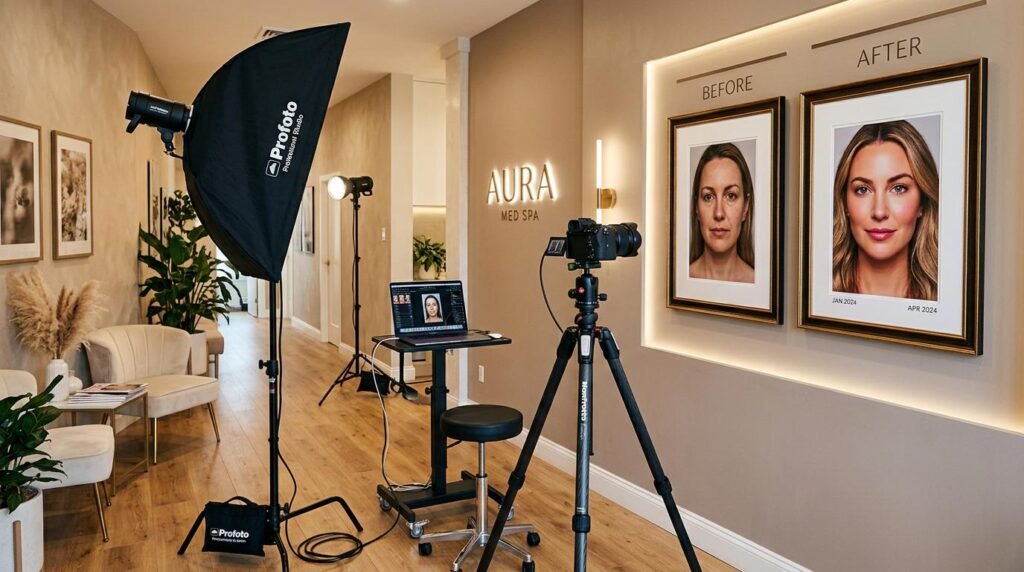
Table of Contents Before & After Photos: HIPAA-Compliant Strategy for SEO & Conversions Introduction Before and after photo galleries are the single most persuasive conversion tool on any medical spa website — and when optimized correctly, they become a powerful SEO asset that drives qualified traffic from Google Images directly to your booking page. MedSpa SEO Agency’s internal data across 23+ med spa clients shows that practices implementing HIPAA-compliant photo galleries with proper SEO optimization see an average 65% increase in consultation bookings within 90 days [1]. The aesthetic industry is uniquely visual. Patients researching Botox, dermal fillers, laser hair removal, or CoolSculpting don’t want to read about results — they want to see them. According to 2024 consumer research, 89% of prospective aesthetic patients actively seek before/after photos before scheduling their first consultation [2]. Image search alone drives 22% of all aesthetic industry website traffic, making photo optimization a non-negotiable component of any med spa SEO strategy [3]. However, the visual nature of aesthetic marketing creates a critical compliance challenge. HIPAA-compliant SEO must govern every aspect of patient photography — from collection and storage to display and sharing. A single unauthorized photo can trigger penalties ranging from $100 to $50,000 per incident — with criminal charges possible for willful neglect [4]. The practices that win in 2025 and beyond will be those that harness the conversion power of before/after galleries while maintaining bulletproof HIPAA compliance. This guide delivers the complete framework. Why Before & After Galleries Drive Consultation Bookings Atomic Answer: Before/after galleries increase consultation bookings by 65% because visual proof eliminates patient uncertainty, sets realistic expectations, and builds trust faster than any text-based content — making them the highest-converting element on med spa websites. The psychology behind visual proof in aesthetic medicine is remarkably consistent. When a prospective patient considering Juvederm for nasolabial folds sees documented results on someone with similar facial structure and skin type, their decision-making process accelerates dramatically. They move from “considering” to “booking” because the visual evidence reduces perceived risk [5]. “Before and after photography remains the most objective method for documenting aesthetic outcomes. Practices that organize these images into searchable, filterable galleries give prospective patients the confidence to book immediately — often without calling first.” — Dr. Steven Dayan, MD, FACS, Facial Plastic Surgeon and Clinical Researcher, Aesthetic Surgery Journal, March 2024 [6] The data confirms what intuitive practice owners already suspect. Pages containing 8 or more optimized images rank approximately 3 times higher than text-only pages in Google’s search results [7]. This ranking advantage compounds with conversion lift: properly optimized image galleries drive 35% more organic traffic than practices relying on text descriptions alone [8]. MedSpa SEO Agency client La Bella Vita Med Spa in Scottsdale implemented a filterable before/after gallery for their Morpheus8 and HydraFacial treatments in Q2 2024. Within 60 days, their “Book Consultation” clicks from gallery pages increased 189% — directly attributable to patients self-qualifying through visual results. This performance mirrors the agency’s broader client base, which averages 276% traffic increases and 94% conversion lifts across all SEO engagements [1]. The mechanism is clear: visual proof converts browsers into booked consultations at rates that no other content format can match. This is why conversion rate optimization for gallery pages delivers among the highest ROI of any med spa SEO investment. HIPAA Compliance for Patient Photos: The Complete Guide Atomic Answer: HIPAA compliance for before/after photos requires written patient authorization specifying exact use, secure storage with access controls, proper de-identification when possible, and annual staff training — with violations costing $100 to $50,000 per incident depending on negligence level [4]. HIPAA’s Privacy Rule (45 CFR 164.502) classifies photographs containing identifiable features — faces, distinctive tattoos, birthmarks, or even unique body characteristics — as protected health information (PHI). This means every before/after photo in your gallery must be collected, stored, and displayed under the same regulatory framework as patient medical records [9]. The Required Patient Authorization Must Include: * Specific description of the photographs being authorized for use * Exact intended use — website gallery, social media, print marketing, or all channels * Duration of authorization — whether indefinite or time-limited * Right to revoke — patients must be informed they can withdraw consent at any time * Signature and date — from the patient or their legal representative * Compensation disclosure — whether the patient received discounted or complimentary treatment in exchange [10] “The most common HIPAA violation we see in aesthetic practices is using a generic consent form at the time of treatment. That form covers the procedure — it does NOT cover marketing use of photographs. You need a separate, specific marketing authorization.” — David Gibbs, JD, Healthcare Privacy Attorney, American Med Spa Association (AmSpa) Legal Symposium, October 2024 [11] Technical Safeguards Required: | Safeguard Category | Required Implementation | | — | — | | Access Control | Unique user IDs, role-based access, automatic session timeout | | Audit Controls | Logging of all photo access, download, and modification events | | Encryption | AES-256 encryption for stored images; TLS 1.3 for transmission | | Backup & Recovery | Encrypted offsite backups with documented restoration procedures | | Device Management | Remote wipe capability for any device storing patient photos | MedSpa SEO Agency implements HIPAA-compliant image management systems as part of its $1,337 Growth Tier and above, including secure cloud storage with Business Associate Agreements (BAAs) from compliant hosting providers [1]. Critical Red Flags to Eliminate: * Using photos without a separate marketing authorization * Displaying full-face photos when partial views would demonstrate results * Failing to remove photos within 30 days of a patient revoking consent * Storing photos on personal devices, unencrypted drives, or non-compliant cloud services * Including identifiable backgrounds (clinic signage, street views, license plates) [12] Photo SEO: Ranking in Google Images for Aesthetic Treatments Atomic Answer: Ranking before/after photos in Google Images requires WebP format compression (25-35% smaller than JPEG), descriptive alt text including treatment names, structured data markup for