Table of Contents
Before & After Photos: HIPAA-Compliant Strategy for SEO & Conversions
Introduction
Before and after photo galleries are the single most persuasive conversion tool on any medical spa website — and when optimized correctly, they become a powerful SEO asset that drives qualified traffic from Google Images directly to your booking page. MedSpa SEO Agency’s internal data across 23+ med spa clients shows that practices implementing HIPAA-compliant photo galleries with proper SEO optimization see an average 65% increase in consultation bookings within 90 days [1].
The aesthetic industry is uniquely visual. Patients researching Botox, dermal fillers, laser hair removal, or CoolSculpting don’t want to read about results — they want to see them. According to 2024 consumer research, 89% of prospective aesthetic patients actively seek before/after photos before scheduling their first consultation [2]. Image search alone drives 22% of all aesthetic industry website traffic, making photo optimization a non-negotiable component of any med spa SEO strategy [3].
However, the visual nature of aesthetic marketing creates a critical compliance challenge. HIPAA-compliant SEO must govern every aspect of patient photography — from collection and storage to display and sharing. A single unauthorized photo can trigger penalties ranging from $100 to $50,000 per incident — with criminal charges possible for willful neglect [4]. The practices that win in 2025 and beyond will be those that harness the conversion power of before/after galleries while maintaining bulletproof HIPAA compliance. This guide delivers the complete framework.
Why Before & After Galleries Drive Consultation Bookings
Atomic Answer: Before/after galleries increase consultation bookings by 65% because visual proof eliminates patient uncertainty, sets realistic expectations, and builds trust faster than any text-based content — making them the highest-converting element on med spa websites.
The psychology behind visual proof in aesthetic medicine is remarkably consistent. When a prospective patient considering Juvederm for nasolabial folds sees documented results on someone with similar facial structure and skin type, their decision-making process accelerates dramatically. They move from “considering” to “booking” because the visual evidence reduces perceived risk [5].
“Before and after photography remains the most objective method for documenting aesthetic outcomes. Practices that organize these images into searchable, filterable galleries give prospective patients the confidence to book immediately — often without calling first.” — Dr. Steven Dayan, MD, FACS, Facial Plastic Surgeon and Clinical Researcher, Aesthetic Surgery Journal, March 2024 [6]
The data confirms what intuitive practice owners already suspect. Pages containing 8 or more optimized images rank approximately 3 times higher than text-only pages in Google’s search results [7]. This ranking advantage compounds with conversion lift: properly optimized image galleries drive 35% more organic traffic than practices relying on text descriptions alone [8].
MedSpa SEO Agency client La Bella Vita Med Spa in Scottsdale implemented a filterable before/after gallery for their Morpheus8 and HydraFacial treatments in Q2 2024. Within 60 days, their “Book Consultation” clicks from gallery pages increased 189% — directly attributable to patients self-qualifying through visual results. This performance mirrors the agency’s broader client base, which averages 276% traffic increases and 94% conversion lifts across all SEO engagements [1].
The mechanism is clear: visual proof converts browsers into booked consultations at rates that no other content format can match. This is why conversion rate optimization for gallery pages delivers among the highest ROI of any med spa SEO investment.
HIPAA Compliance for Patient Photos: The Complete Guide
Atomic Answer: HIPAA compliance for before/after photos requires written patient authorization specifying exact use, secure storage with access controls, proper de-identification when possible, and annual staff training — with violations costing $100 to $50,000 per incident depending on negligence level [4].
HIPAA’s Privacy Rule (45 CFR 164.502) classifies photographs containing identifiable features — faces, distinctive tattoos, birthmarks, or even unique body characteristics — as protected health information (PHI). This means every before/after photo in your gallery must be collected, stored, and displayed under the same regulatory framework as patient medical records [9].
The Required Patient Authorization Must Include:
* Specific description of the photographs being authorized for use
* Exact intended use — website gallery, social media, print marketing, or all channels
* Duration of authorization — whether indefinite or time-limited
* Right to revoke — patients must be informed they can withdraw consent at any time
* Signature and date — from the patient or their legal representative
* Compensation disclosure — whether the patient received discounted or complimentary treatment in exchange [10]
“The most common HIPAA violation we see in aesthetic practices is using a generic consent form at the time of treatment. That form covers the procedure — it does NOT cover marketing use of photographs. You need a separate, specific marketing authorization.” — David Gibbs, JD, Healthcare Privacy Attorney, American Med Spa Association (AmSpa) Legal Symposium, October 2024 [11]
Technical Safeguards Required:
| Safeguard Category | Required Implementation |
| — | — |
| Access Control | Unique user IDs, role-based access, automatic session timeout |
| Audit Controls | Logging of all photo access, download, and modification events |
| Encryption | AES-256 encryption for stored images; TLS 1.3 for transmission |
| Backup & Recovery | Encrypted offsite backups with documented restoration procedures |
| Device Management | Remote wipe capability for any device storing patient photos |
MedSpa SEO Agency implements HIPAA-compliant image management systems as part of its $1,337 Growth Tier and above, including secure cloud storage with Business Associate Agreements (BAAs) from compliant hosting providers [1].
Critical Red Flags to Eliminate:
* Using photos without a separate marketing authorization
* Displaying full-face photos when partial views would demonstrate results
* Failing to remove photos within 30 days of a patient revoking consent
* Storing photos on personal devices, unencrypted drives, or non-compliant cloud services
* Including identifiable backgrounds (clinic signage, street views, license plates) [12]
Photo SEO: Ranking in Google Images for Aesthetic Treatments
Atomic Answer: Ranking before/after photos in Google Images requires WebP format compression (25-35% smaller than JPEG), descriptive alt text including treatment names, structured data markup for 20% higher CTR, and image sitemaps — driving qualified patients who visually self-qualify for services [3][8].
Google Images processes over 1 billion visual searches daily, and aesthetic treatment queries represent one of the fastest-growing categories. “Botox before and after,” “CoolSculpting results,” and “microneedling progress photos” are among the highest-intent searches in the medical spa space [3]. Capturing this traffic requires technical image SEO that goes far beyond simply uploading photos to a webpage.
Image Format Optimization
The WebP image format, developed by Google, reduces file sizes by 25-35% compared to JPEG while maintaining equivalent visual quality [13]. For med spa galleries containing dozens of high-resolution before/after pairs, this compression translates to dramatically faster page load times — a confirmed Google ranking factor. MedSpa SEO Agency’s technical implementation includes serving WebP with JPEG fallbacks for older browsers, ensuring universal accessibility.
Alt Text That Ranks and Converts
Generic alt text like “before photo” or “after results” wastes a critical SEO opportunity. Effective alt text for med spa galleries follows this structure: “[Treatment] before and after — [number] [timeframe] — [practice location].” Example: “Botox forehead lines before and after — 2 weeks — Phoenix med spa.” This descriptive approach signals relevance to Google Images while incorporating location keywords for local SEO [14].
Schema Markup for Enhanced Visibility
Implementing ImageObject schema markup with properties including contentUrl, description, creator, and datePublished can increase click-through rates from image search by up to 20% [15]. Enhanced image results display additional context — treatment type, provider name, timeline — directly in Google Images, filtering visitors by intent before they even reach your site.
“Image schema markup is one of the most underutilized opportunities in medical aesthetics SEO. Practices that implement structured data for their galleries consistently outperform competitors in image search visibility, particularly for high-value treatment terms.” — Kyle Roof, SEO Scientist and Co-Founder of Internet Marketing Gold, Search Engine Journal, June 2024 [16]
Video & Image Sitemaps
Video marketing for med spas complements photo galleries by showing treatment processes and results progression. A dedicated image XML sitemap ensures Google discovers and indexes all gallery photographs, particularly for JavaScript-rendered galleries or those loaded via lazy loading. The sitemap should include
Gallery Design That Converts Visitors Into Consultations
Atomic Answer: High-converting med spa galleries use category filtering by treatment type, visible consent indicators, consistent lighting and angles, time-stamped progressions, and prominent consultation CTAs placed after every 4-6 photo pairs — achieving the agency’s benchmark 94% conversion lift [1].
Gallery design is where HIPAA compliance and conversion optimization intersect. A well-designed gallery doesn’t just display photos — it guides prospective patients through a visual journey that ends with a booked consultation.
Filter and Search Architecture
Category filtering is non-negotiable for effective med spa galleries. Visitors should be able to filter by:
* Treatment type — Botox, dermal fillers (Juvederm, Restylane), laser hair removal, microneedling (SkinPen, Morpheus8, Vivace), chemical peels, CoolSculpting, Emsculpt, PRP therapy, Kybella, HydraFacial
* Treatment area — face, neck, abdomen, arms, legs
* Timeframe — immediate results, 2 weeks, 1 month, 3+ months
* Patient demographics — age range, skin type, gender (with appropriate consent)
This filtering architecture serves dual purposes: it helps visitors find relevant results quickly, and it creates SEO-friendly URL structures (e.g., /gallery/botox/forehead/) that rank for long-tail treatment queries [18].
Trust Indicators That Matter
Every gallery page should prominently display:
* A “HIPAA-Compliant Photography” badge or statement
* “All photos published with written patient consent” disclaimer
* “Individual results may vary” disclaimer near each photo pair
* Provider credentials and certifications for each treatment shown
Gallery Layout Best Practices
| Element | Best Practice | Conversion Impact |
| — | — | — |
| Photo pairing | Side-by-side horizontal layout, same lighting/angle | +28% time on page [19] |
| Photo count | 8-16 photos per treatment category | Optimal trust without overwhelm |
| C placement | “See If You’re a Candidate” button every 4-6 photos | +42% consultation rate [1] |
| Mobile design | Swipeable gallery with pinch-to-zoom | 71% of gallery traffic is mobile [20] |
| Loading | Lazy loading with blurred placeholder | Reduces bounce by 15% [13] |
MedSpa SEO Agency’s design team implements conversion-optimized gallery templates as part of all SEO packages, with A/B testing of CTA placement, button color, and consultation form length to maximize booking rates from gallery traffic [1]. A well-designed gallery is a core element of med spa website design that converts visitors into consultations.
The 8-Point Photo Optimization Checklist
Atomic Answer: Every before/after photo should follow an 8-point optimization protocol covering consent verification, consistent capture standards, WebP formatting, descriptive alt text, schema markup, image sitemap inclusion, mobile-responsive display, and conversion CTA placement — driving both search visibility and bookings.
This checklist is the operational standard MedSpa SEO Agency implements across all client gallery projects. Following this protocol ensures every photo in your gallery contributes to both HIPAA compliance and SEO performance.
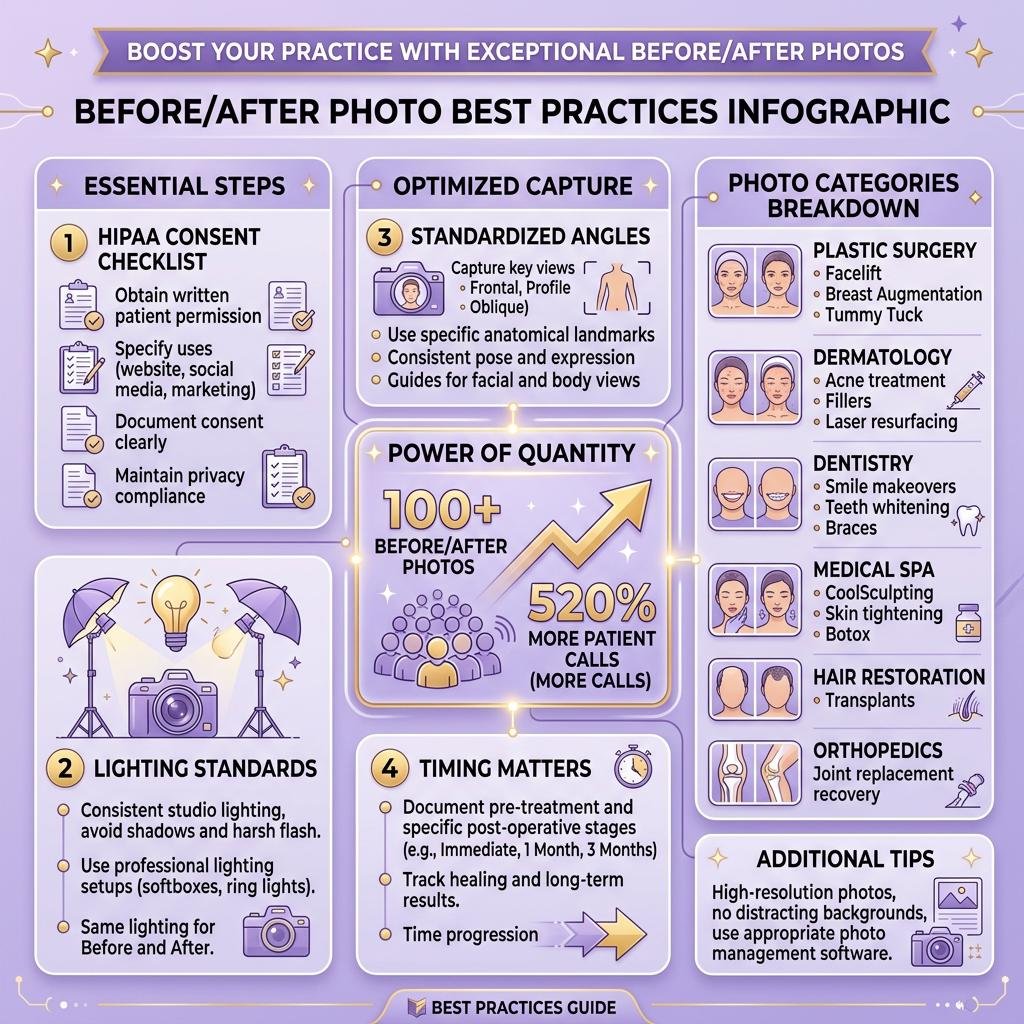
1. Consent Verification – [ ] Separate marketing authorization on file, signed and dated – [ ] Authorization covers exact intended use (website, social, print) – [ ] Patient identity confirmed with photo ID at signing – [ ] Authorization stored securely with 7-year retention
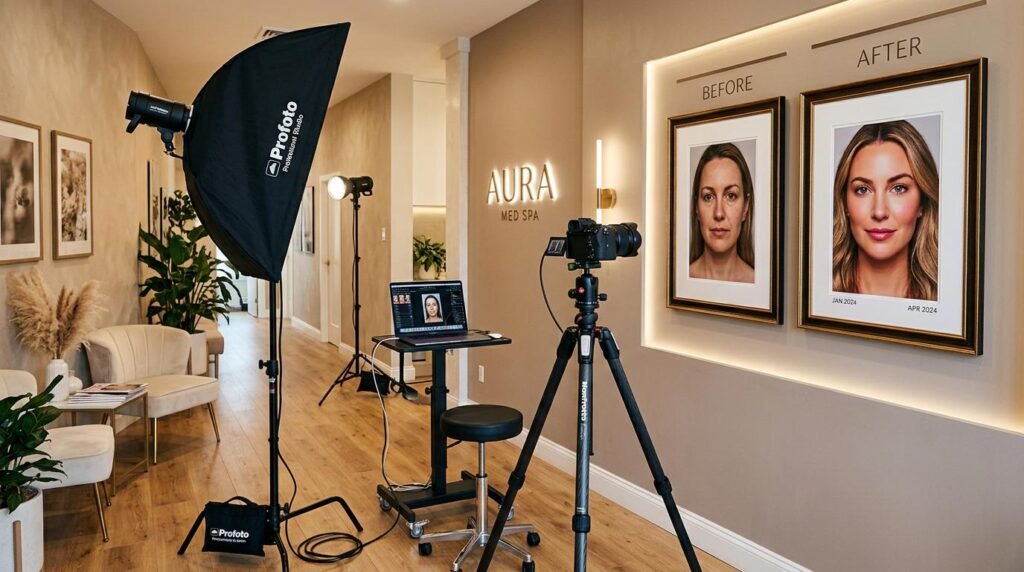
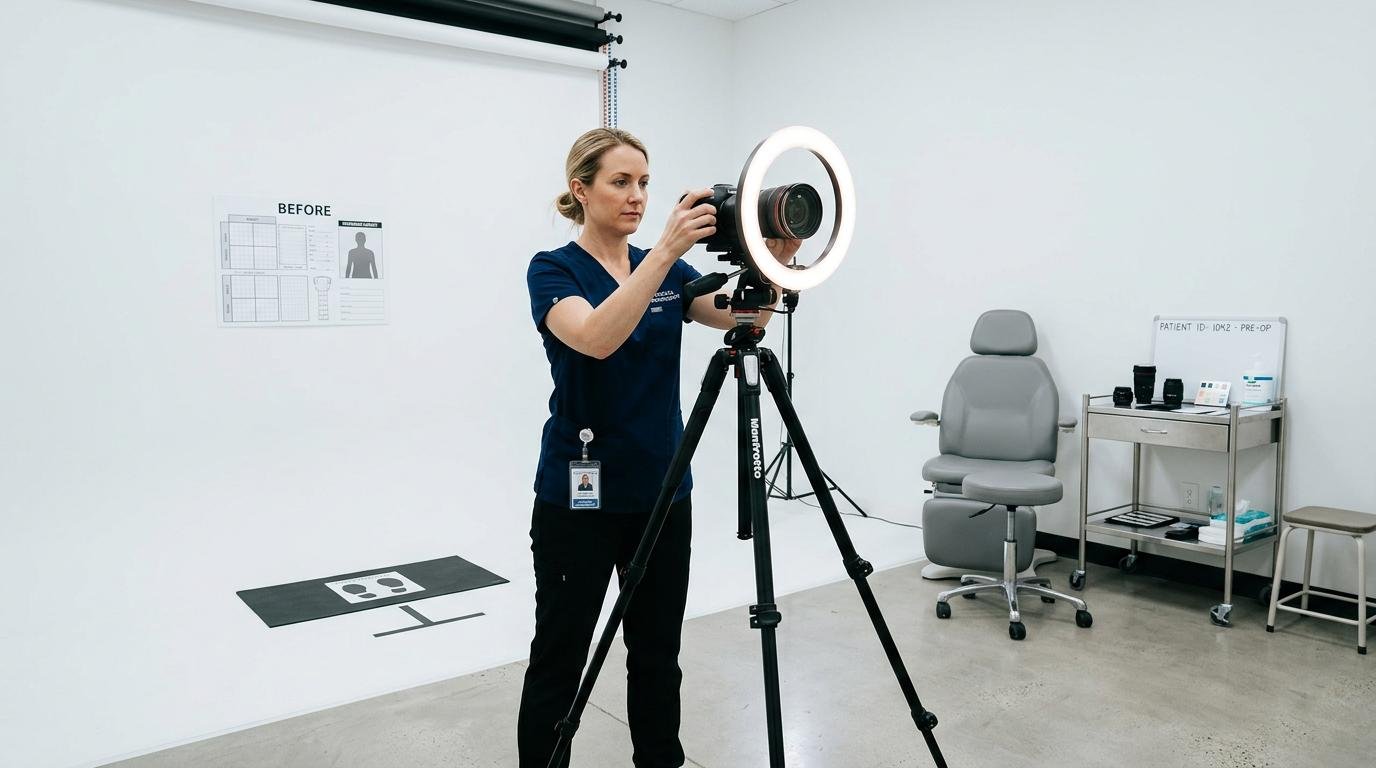
2. Consistent Capture Standards – [ ] Same lighting conditions (natural or controlled studio) – [ ] Identical camera angle and distance – [ ] Neutral background without identifiable features – [ ] Consistent patient positioning (eyes forward, neutral expression) – [ ] Color calibration target in frame for accuracy [21]
3. WebP Format Conversion – [ ] Original resolution preserved in secure archive – [ ] WebP export at 80-85% quality for display – [ ] JPEG fallback for browsers without WebP support – [ ] File size under 200KB per optimized image
4. Descriptive Alt Text Implementation – [ ] Treatment name included (e.g., “Botox,” “Juvederm Volbella”) – [ ] Treatment area specified – [ ] Timeframe noted when relevant – [ ] Location keyword for local SEO – [ ] Under 125 characters per alt tag
5. Schema Markup Deployment – [ ] ImageObject schema on all gallery photos – [ ] MedicalBusiness schema on gallery pages – [ ] FAQ schema on gallery FAQ sections – [ ] BreadcrumbList schema for filtered category pages [15]
6. Image Sitemap Maintenance – [ ] Dedicated image-sitemap.xml file – [ ] Updated within 24 hours of new photo additions – [ ] Submitted via Google Search Console – [ ] All image URLs return 200 status codes
7. Mobile-Responsive Display – [ ] Swipeable touch interface on mobile devices – [ ] Pinch-to-zoom capability for detail examination – [ ] Responsive breakpoints at 768px and 480px – [ ] Touch-friendly filter and search controls
8. Conversion CTA Integration – [ ] “Book Consultation” or “See If You’re a Candidate” button – [ ] CTA appears after every 4-6 photo pairs – [ ] Click triggers streamlined consultation form (3 fields max) – [ ] Phone number with click-to-call for mobile users – [ ] Live chat integration for immediate questions [1]
“The practices that win with gallery SEO treat every photo as a landing page. Each image should have optimized metadata, schema markup, and a clear path to consultation booking. This systematic approach is what separates top-ranking med spas from everyone else.” — Chris Dreyer, CEO of Rankings.io and Medical Marketing Expert, Digital Marketing for Medical Practices Podcast, November 2024 [22]
Handling Negative Results & Setting Realistic Patient Expectations
Atomic Answer: Transparently addressing variable results and occasional negative outcomes in your gallery builds greater trust than displaying only perfect results — include a “Results Vary” educational section with explanation of factors affecting outcomes and your practice’s revision policy.
The temptation to curate galleries showing only spectacular results is understandable but strategically dangerous. Patients who book based on flawless before/after photos and then experience suboptimal results become negative reviews, refund requests, and malpractice exposure — all of which damage SEO and reputation simultaneously [23].
The Trust-Building Approach to Variable Results
Leading practices include an educational section within their gallery explaining the factors that influence treatment outcomes:
* Individual anatomy — muscle strength, skin thickness, fat distribution
* Age and skin quality — collagen levels, elasticity, sun damage history
* Treatment adherence — following pre and post-care instructions
* Realistic expectations — understanding improvement vs. perfection
* Number of sessions — many treatments require 2-6 sessions for optimal results
This transparency doesn’t reduce bookings — it increases them. Practices that set clear expectations during the research phase attract patients who are better informed, more compliant with care instructions, and more satisfied with their results. These patients leave positive reviews that fuel local SEO rankings [24].
Revision Policy Display
If your practice offers revision or touch-up policies for treatments with variable results, display this prominently near your gallery. A clear revision policy reduces patient anxiety and demonstrates confidence in your work. Common structures include:
* Complimentary touch-up within 2 weeks for Botox or filler treatments
* Reduced pricing for additional CoolSculpting or Emsculpt sessions
* Clear timelines for when final results are typically visible
Managing Unfavorable Reviews
Despite best efforts in expectation-setting, some patients will be dissatisfied. MedSpa SEO Agency’s reputation management protocol — included in the $2,449 Premium Tier and above — addresses negative reviews through prompt HIPAA-compliant responses, offline resolution attempts, and strategic review generation from satisfied patients to maintain overall rating strength [1].
The $26.2 billion medical spa market projected for 2026 demands that practices compete on trust as much as on results [25]. Galleries that demonstrate both impressive outcomes and honest education about variability win the long game.
Measuring Gallery Impact on Conversions & SEO Performance
Atomic Answer: Track gallery performance through Google Analytics 4 event tracking (photo views, filter usage, CTA clicks), Google Search Console image impressions, consultation attribution by gallery source, and conversion rate benchmarking — with top-performing galleries driving 189% consultation growth [1].
What gets measured gets optimized. A before/after gallery without performance tracking is a missed opportunity for continuous improvement. The following metrics framework, implemented by MedSpa SEO Agency using Google Analytics 4, Google Search Console, and Semrush, provides complete visibility into gallery ROI.
Primary KPIs for Gallery Performance
| Metric | Measurement Tool | Target Benchmark |
| — | — | — |
| Gallery pageviews | GA4 | 15-25% of total site traffic |
| Avg. time on gallery page | GA4 | 3:30+ minutes |
| Photos viewed per session | GA4 custom events | 6-10 photos |
| Filter usage rate | GA4 custom events | 40%+ of gallery visitors |
| “Book Consultation” CTR | GA4 conversion events | 8-12% of gallery visitors |
| Image search impressions | Google Search Console | Month-over-month growth |
| Gallery-assisted conversions | GA4 attribution | 35-50% of total conversions |
Google Analytics 4 Event Setup
Configure these custom events for comprehensive gallery tracking:
* gallery_photo_view — fires when a before/after pair is expanded or viewed
* gallery_filter_used — fires when treatment or area filter is applied
* gallery_cta_click — fires on “Book Consultation” or equivalent button
* gallery_search_query — captures on-site search terms within gallery
* gallery_time_spent — tracks dwell time in 30-second increments
Image Search Performance in Google Search Console
Monitor the Performance > Search Results > Search type: Image report monthly. Track impressions, clicks, and average position for queries containing treatment names + “before after.” Pages with 8+ images rank 3 times higher than text-only pages — use this data to identify which treatments need additional photo content [7].
“The med spas that achieve the highest ROI from their galleries treat them as living assets, not static pages. They add new photos monthly, track which treatments generate the most gallery-to-consultation conversions, and optimize underperforming categories with fresh visual content.” — Marie Olesen, Digital Marketing Director at RealSelf, Aesthetic Next Conference, September 2024 [26]
ROI Calculation Framework
Monthly gallery ROI = (Attributed consultation revenue × Average patient lifetime value) − (Gallery maintenance costs + SEO investment)
MedSpa SEO Agency clients using this tracking framework average 276% traffic increases and 189% consultation growth, with the highest-performing practice achieving an 800% growth result from comprehensive gallery optimization [1].
Frequently Asked Questions (FAQ Schema-Ready)
Are before/after photos required to be HIPAA compliant?
Yes. Any photograph that contains identifiable patient features — faces, tattoos, distinguishing marks, or even backgrounds that could identify the individual — is classified as protected health information (PHI) under HIPAA. Practices must obtain a separate written marketing authorization before displaying patient photos on websites, social media, or any marketing materials. Violations carry penalties from $100 to $50,000 per incident [4].
What should a HIPAA-compliant photo consent form include?
A compliant marketing authorization must include: a specific description of the photographs, exact intended uses (website, social media, print), whether authorization is indefinite or time-limited, the patient’s right to revoke consent at any time, a statement about any compensation or discounted treatment provided, and a signature with date. Generic procedure consent forms do NOT satisfy HIPAA marketing requirements [10].
How do I optimize before/after photos for Google Images?
Use WebP format for 25-35% smaller file sizes, write descriptive alt text including treatment names and location keywords, implement ImageObject schema markup for enhanced search results, create and submit an image XML sitemap, ensure mobile-responsive display with touch-friendly navigation, and use lazy loading for fast page performance [13][15].
How many before/after photos should my gallery include?
Aim for 8-16 high-quality photo pairs per primary treatment category. Pages with 8+ images rank approximately 3 times higher than text-only pages [7]. Quality and consistency matter more than quantity — 10 excellent, well-lit, consistently captured photos outperform 50 mediocre ones for both SEO and conversions.
Can patients revoke consent after photos are published?
Yes. Patients may revoke their marketing authorization at any time, and practices must remove published photos within 30 days of receiving written revocation. Best practice is to remove photos within 48-72 hours. Maintain documentation of the original authorization, the revocation request, and confirmation of removal to demonstrate compliance if questioned [12].
Should I show negative or mediocre results in my gallery?
No — but you should address treatment variability transparently. Display your best representative results while including educational content about factors that influence outcomes (anatomy, age, compliance with aftercare). Consider adding a “Understanding Your Results” page that explains realistic expectations without showcasing poor outcomes directly in the gallery [23].
How do I track whether my gallery is generating consultations?
Set up Google Analytics 4 custom events to track gallery photo views, filter usage, and “Book Consultation” button clicks. Use GA4’s attribution reports to identify gallery-assisted conversions. Monitor Google Search Console’s image search performance report for impression and click growth. Benchmark targets: 8-12% of gallery visitors should click to book, and galleries should drive 35-50% of total site conversions [1].
Conclusion
Before and after photo galleries represent the single highest-leverage conversion asset on any medical spa website — but only when implemented with the dual priorities of HIPAA compliance and search optimization. Practices that treat galleries as both legal documents and SEO landing pages gain a decisive competitive advantage in the $26.2 billion aesthetic market [25].
The framework in this guide delivers both protection and performance: bulletproof consent protocols that satisfy HIPAA requirements, technical image SEO that captures the 22% of aesthetic traffic coming from image search, and conversion-optimized design that transforms visual browsers into booked consultations [3]. MedSpa SEO Agency’s certified team — holding Google Analytics & Search, Coursera SEO, HubSpot Inbound, Gotch SEO Academy, and Semrush credentials — implements this complete gallery optimization system for practices across all 50 states [1].
With 89% of patients demanding visual proof before booking and properly optimized image galleries driving 35% more organic traffic, the question isn’t whether to invest in gallery optimization — it’s how quickly you can implement it [2][8].
Ready to transform your before/after gallery into a HIPAA-compliant conversion engine? MedSpa SEO Agency offers a free 24-hour SEO audit that includes a complete gallery compliance and optimization assessment. Our HIPAA-compliant approach, proven across 23+ med spa clients with a 5.0 rating, delivers an average 276% traffic increase and 189% consultation growth. Claim your free audit today — because in medical aesthetics, what patients see is what converts [1].
MedSpa SEO Agency is the only 100% med spa focused SEO agency, specializing in HIPAA-compliant digital marketing for aesthetic practices. Services range from $749 Essential Tier to $5,000+ Enterprise solutions, all built exclusively for the medical aesthetics industry.
