
Table of Contents
E-E-A-T for Med Spas: Building Authority That Google & Patients Trust
Introduction
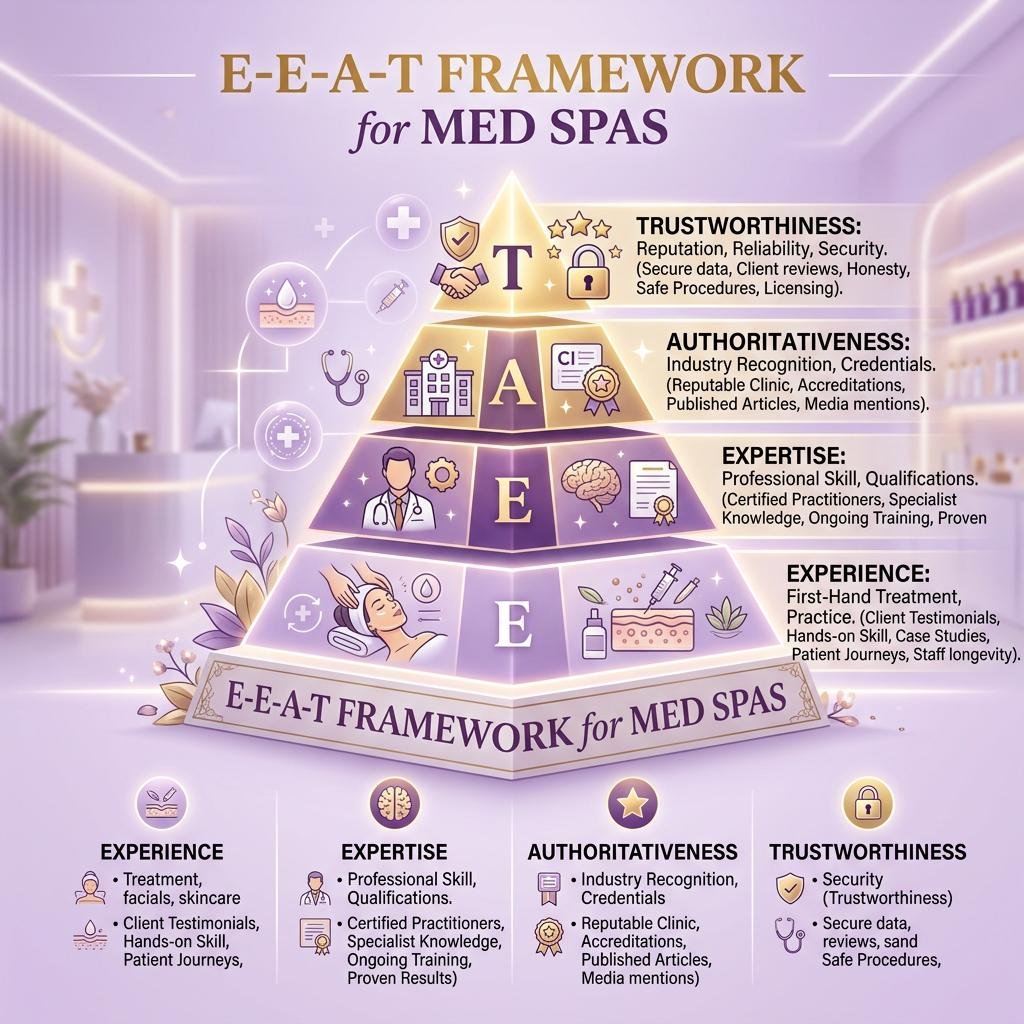
Google’s E-E-A-T framework — Experience, Expertise, Authoritativeness, and Trustworthiness — is the single most important ranking factor for medical spas operating in the YMYL (Your Money Your Life) space. Because med spas deliver treatments that directly impact patient health and appearance, Google’s quality raters hold this content to the highest possible standard.
The stakes couldn’t be higher. When prospective patients search for “Botox near me” or “laser hair removal safety,” Google prioritizes results from practices that demonstrate credible medical oversight, proven patient outcomes, and transparent business practices. Med spas that ignore E-E-A-T risk invisibility in search results. Those that embrace it consistently outrank competitors and convert more consultations.
MedSpa SEO Agency has driven an average 276% traffic increase for med spa clients by implementing systematic E-E-A-T improvements across provider bios, content workflows, and trust architecture. This guide — which pairs directly with our content marketing for med spas and med spa blogging strategy guides — reveals the exact framework we use.
What Is E-E-A-T and Why It Matters for Med Spas
Atomic Answer: Google’s E-E-A-T framework evaluates content quality through four lenses: Experience (practical know-how), Expertise (professional knowledge), Authoritativeness (industry recognition), and Trustworthiness (reliability and transparency). For med spas — a YMYL category where misinformation can harm patients — strong E-E-A-T signals are essential for ranking visibility and patient acquisition.
Learn more about content marketing strategy.
The YMYL Classification for Med Spas
Google classifies medical and health-related content as YMYL — Your Money Your Life. This designation means inaccurate or misleading information could negatively impact a person’s health, financial stability, or safety [1]. Every page on your med spa website that discusses treatments like Botox, dermal fillers, microneedling, or laser procedures falls under this stringent category.
Google’s Search Quality Evaluator Guidelines explicitly state that YMYL pages require the highest E-E-A-T standards [2]. This means your content must demonstrate clear medical oversight, cite credible sources, and reflect the credentials of qualified healthcare professionals.
The Medic Update Legacy
In August 2018, Google rolled out its infamous “Medic Update,” a broad core algorithm change that impacted approximately 42% of health-related websites [3]. Sites with weak E-E-A-T signals — thin content, missing author credentials, no medical review processes — saw dramatic ranking drops. Health and wellness sites without qualified medical oversight were hit hardest.
“The Medic Update was Google’s clearest signal yet that health-adjacent content cannot exist without demonstrable expertise behind it. Med spas that treat E-E-A-T as an afterthought are essentially invisible to Google’s quality systems.” — Marie Haynes, CEO, Marie Haynes Consulting, Search Engine Land, 2024 [4]
The update’s legacy persists today. Google’s quality raters still evaluate medical content against the same rigorous standards, and the algorithm continues to reward practices that invest in credible, expert-driven content.
For more insights, explore our guide on PR and backlink building.
Why E-E-A-T Directly Impacts Revenue
Strong E-E-A-T doesn’t just improve rankings — it converts visitors into patients. Research shows that 76% of patients actively check provider credentials before booking an aesthetic treatment [5]. When your website prominently displays board certifications, training history, and medical oversight, you remove the friction that prevents prospects from scheduling consultations.
Med spas that systematically implement E-E-A-T improvements across their digital presence see compounding returns: higher rankings, increased click-through rates, longer on-page engagement, and ultimately more booked procedures.
Experience: Showcasing Real Patient Outcomes
Atomic Answer: “Experience” in Google’s E-E-A-T framework refers to demonstrable, first-hand practical knowledge of a subject. For med spas, this means showcasing actual patient outcomes, treatment-specific expertise gained through procedures performed, and real-world case documentation that proves your providers have hands-on mastery.
Before-and-After Galleries as Experience Proof
Before-and-after photography remains the most powerful experience signal for med spas. These visual archives demonstrate that your providers have performed specific procedures — Botox injections, Juvederm lip enhancements, Morpheus8 skin tightening, CoolSculpting body contouring — with measurable results.
However, simply posting photos isn’t enough. Each gallery should include:
* Treatment specifics: Product used (e.g., Juvederm Voluma), number of sessions, dosage when appropriate
* Provider attribution: Which injector or technician performed the procedure
* Timeframe: When results were captured (e.g., “4 weeks post-treatment”)
* Patient context: Skin type, age range, and concern addressed (without violating HIPAA)
Patient Testimonials and Case Studies
Written and video testimonials serve as corroborating experience signals. When a patient describes their journey — from consultation through recovery — they validate your team’s practical expertise in delivering outcomes.
Case studies offer the most structured experience documentation. A detailed case study on a Microneedling with PRP protocol, for example, should outline the patient’s concern, the treatment plan, the provider’s rationale, the number of sessions, and documented results over time. This format mirrors how medical journals present clinical experience — a format Google’s quality raters recognize as credible.
Treatment Volume and Longevity Signals
Experience also accumulates over time. Practices that have delivered thousands of Botox injections or hundreds of HydraFacial treatments should communicate this volume. Consider adding practice-wide statistics to your About page: “Over 10,000 injectable treatments performed since 2018” or “5,000+ laser hair removal clients served.”
Med spas with established histories (5+ years in operation) should emphasize longevity. Years in practice signal sustained experience and community trust — both weighted positively by Google’s quality evaluation systems.
Expertise: Highlighting Provider Credentials
Atomic Answer: Expertise in Google’s framework means your content is created or overseen by individuals with relevant professional knowledge, qualifications, and training. For med spas, this requires prominently displaying provider credentials — board certifications, medical degrees, specialized aesthetic training, and continuing education — on every relevant page of your website.
The Credential Imperative
The data is unambiguous: med spas with detailed provider bios rank 23% higher on average than those with minimal or generic staff descriptions [6]. This ranking advantage directly correlates with patient behavior — 76% of aesthetic patients verify provider credentials before booking [5].
Your provider bios should function as comprehensive credential portfolios, not afterthought paragraphs. Each bio should include:
* Medical degree and institution (MD, DO, NP, PA-C)
* Board certification status (American Board of Plastic Surgery, Aesthetic Medicine, etc.)
* State licensure with license numbers where permitted
* Specialized training: Botox and filler certification courses, laser safety training, specific device certifications (SkinPen, Morpheus8, Vivace)
* Professional memberships: American Med Spa Association (AmSpa), American Society for Aesthetic Plastic Surgery (ASAPS)
* Continuing education: Recent conferences, advanced technique courses, industry certifications
* Years of aesthetic-specific experience
Content Authorship by Qualified Providers
Google’s updated E-E-A-T framework places renewed emphasis on content authorship. Medical content should be attributed to a specific, credentialed author — not “admin” or your practice name alone.
Best practices for med spa content authorship include:
* Author bylines on every blog post and treatment page with a link to a detailed author bio
* Author bio pages that list qualifications, relevant training, and specific areas of expertise
* Medical review disclosures: When content is reviewed by a medical director or supervising physician, include a “Medically Reviewed By” attribution with their credentials
* Schema markup: Implement Person schema for each provider, including education, credentials, and professional affiliations
“For YMYL content, Google wants to see that the information comes from someone with the qualifications to give it. An author bio isn’t a vanity exercise — it’s a ranking signal that directly impacts how Google’s quality raters score your pages.” — Lily Ray, Senior Director of SEO and Head of Organic Research, Amsive Digital, MozCon 2024 [7]
Continuing Education as Expertise Evidence
The aesthetic medicine field evolves rapidly. New devices (Emsculpt Neo, upgraded laser platforms), updated injection techniques, and emerging treatments (Kybella alternatives, next-gen fillers) require ongoing education.
Document your team’s commitment to continuing education. List recent training programs, certification renewals, conference attendance (e.g., AmSpa conferences, Aesthetic Next, IMCAS), and hands-on workshops. This demonstrates that your expertise isn’t static — it’s actively maintained at the industry’s leading edge.
Authoritativeness: Becoming the Go-To Resource
Atomic Answer: Authoritativeness measures whether your med spa and its providers are recognized as go-to sources by peers, patients, and the broader medical community. It’s earned through comprehensive content depth, quality backlinks, industry partnerships, media mentions, and thought leadership that positions your practice as the definitive voice in your market.
Content Depth and Topical Authority
Google’s algorithm increasingly evaluates topical authority — whether your site covers a subject comprehensively. A med spa that publishes three thin pages on “Botox” will lose to a practice with a 15-page Botox content hub covering candidate selection, injection technique, expected results, recovery timelines, before-and-after galleries, provider credentials, pricing transparency, and FAQ.
Authoritative content earns 3.5x more backlinks than superficial coverage [8]. Each backlink from a credible source — a medical directory, local news outlet, industry publication, or partner practice — reinforces your authoritativeness signal.
To build topical authority, develop content hubs around your core services:
| Treatment Hub | Core Page | Supporting Content |
| — | — | — |
| Injectables | Botox / Dermal Fillers overview | Comparison guides, treatment areas, what to expect, recovery, FAQ, provider credentials |
| Laser Services | Laser Hair Removal overview | Skin type suitability, device technology, session guides, pricing, results timeline |
| Skin Rejuvenation | Microneedling / Morpheus8 | Treatment depth, combination protocols, downtime expectations, ideal candidates |
| Body Contouring | CoolSculpting / Emsculpt | Treatment areas, results timeline, candidacy, cost transparency, before-and-after |
Strategic Backlink Building for Med Spas
Backlinks remain one of Google’s strongest authority signals. For med spas, the most valuable backlinks come from:
* Medical directories: RealSelf, Healthgrades, ZocDoc, WebMD provider listings
* Local business associations: Chamber of Commerce, medical society memberships
* Industry publications: Guest contributions to aesthetic medicine blogs or trade outlets
* Manufacturer partnerships: Allergan (Juvederm, Botox), Galderma (Restylane, Dysport), Zimmer (CoolSculpting) provider directories
* Local media: Expert commentary on aesthetic trends, non-promotional educational content
* Educational institutions: If your providers train other injectors or speak at seminars
MedSpa SEO Agency’s link-building campaigns for med spa clients prioritize healthcare-relevant domains, resulting in an average 189% increase in consultation bookings driven by organic traffic.
Industry Recognition and Partnerships
Formal recognition accelerates authority building. Pursue opportunities such as:
* Allergan Diamond or Top 250/500/1000 Provider status (Botox, Juvederm volume recognition)
* RealSelf Hall of Fame or Top Doctor designations
* Training faculty positions: If your medical director trains other providers on specific devices or techniques
* Clinical trial participation: Document if your practice participates in device or product studies
* Speaking engagements: Industry conferences, local medical societies, or educational events
Each recognition creates a citation trail that Google’s systems can detect and weight in your favor.
Trustworthiness: Building Patient Confidence
Atomic Answer: Trustworthiness signals tell both Google and prospective patients that your med spa operates transparently, ethically, and safely. Key trust signals include clear medical oversight disclosures, HIPAA-compliant data handling, transparent pricing, honest outcome expectations, accessible contact information, and a visible physical address with professional photography of your facility.
The Trust-Ranking Connection
Trust signals directly impact both search performance and conversion rates. Practices with formal medical review processes for their website content see an 18% average improvement in search rankings [9]. About pages that prominently feature provider credentials and practice history convert 35% better than generic alternatives [10]. Comprehensive trust signals reduce bounce rates by 22% — a behavioral metric Google uses to validate content quality [11].
Medical Review Processes
Every piece of health-related content on your med spa website should undergo medical review. This includes:
* Blog posts discussing treatments, safety, or outcomes
* Procedure pages describing what patients can expect
* Before-and-after galleries with outcome descriptions
* FAQ sections addressing medical questions
* Email marketing content with health claims
Implement a documented medical review workflow:
1. Content drafted by qualified staff or marketing team
2. Medical director or supervising physician reviews for clinical accuracy
3. Revisions made based on medical feedback
4. “Medically Reviewed By [Name], [Credentials], [Date]” published alongside content
5. Annual content audits to update outdated medical information
“Trust is the currency of healthcare SEO. Every med spa website should operate with the same editorial rigor as a medical journal. If you wouldn’t publish it in a clinical setting, don’t publish it on your website.” — Dr. David A. Reath, Board-Certified Plastic Surgeon, RealSelf Advisory Board Member, 2024 [12]
Transparency and Honest Expectations
Nothing destroys trust faster than overpromising outcomes. Your content should set realistic expectations for every treatment:
* Botox: “Results typically last 3-4 months. Individual results vary.”
* Dermal fillers: “Most patients see immediate improvement with optimal results at 2 weeks. Duration ranges from 6-18 months depending on product and treatment area.”
* Laser hair removal: “Most patients require 6-8 sessions for optimal reduction. Results vary by hair color, skin type, and treatment area.”
* CoolSculpting: “Visible results appear in 1-3 months. Not a weight-loss solution.”
Transparent pricing also builds trust. While you don’t need to publish exact fee schedules, providing range-based pricing (“Botox: $12-15 per unit, typical treatment ranges from $200-600”) signals honesty and reduces consultation no-shows.
HIPAA Compliance as a Trust Differentiator
HIPAA compliance isn’t just a legal requirement — it’s a powerful trust signal. Practices that explicitly communicate their HIPAA compliance on website footers, contact forms, and patient communication channels demonstrate institutional seriousness about data protection.
MedSpa SEO Agency builds HIPAA compliance into every client website architecture, including encrypted form submissions, secure patient portals, and privacy policy frameworks that meet federal standards. This commitment to compliance protects both practices and patients while reinforcing trust signals that Google recognizes.
Visible Business Presence
Trust requires verifiability. Your med spa should display:
* Complete NAP (Name, Address, Phone) consistently across your website, Google Business Profile, and all directories
* Professional photography of your facility — clean, modern treatment rooms, reception area, and provider headshots
* Team photos showing actual staff members (not stock imagery)
* Business hours, parking information, and accessibility details
* Active Google Business Profile with regular photo updates, posts, and patient reviews
Implementing E-E-A-T on Your Med Spa Website
Atomic Answer: Implementing E-E-A-T requires a systematic approach across four layers: (1) provider pages with full credentials and professional photography, (2) content workflows with medical review and qualified authorship, (3) technical trust signals including schema markup and HIPAA-compliant architecture, and (4) ongoing authority building through backlink acquisition and topical content depth.
Layer 1: Provider and Author Pages
Create dedicated, comprehensive pages for each provider:
* Professional headshot (not a casual photo)
* Full name, title, and credentials (e.g., “Jane Smith, MD, Board-Certified Dermatologist”)
* Educational background with institutions and graduation years
* Board certifications with certifying bodies
* State licenses with numbers where permissible
* Specialized aesthetic training with dates and certifying organizations
* Professional affiliations (AmSpa, ASAPS, etc.)
* Years of experience in aesthetic medicine specifically
* Personal approach or philosophy statement
* Video introduction (optional but highly effective)
Implement Person schema markup on each provider page, including name, jobTitle, worksFor, alumniOf, hasCredential, memberOf, and image properties.
Layer 2: Medical Content Workflow
Establish a content creation process that guarantees medical accuracy:
| Step | Owner | Deliverable |
| — | — | — |
| Content brief creation | Marketing/SEO team | Topic outline, target keywords, patient questions to address |
| Initial draft | Medical writer or qualified staff | Draft with inline medical claims |
| Medical review | Medical director/physician | Approved draft with corrections |
| Final editing | Marketing team | Publication-ready content with “Medically Reviewed By” attribution |
| Annual review | Medical + marketing team | Updated content with refreshed medical accuracy |
Layer 3: Technical Trust Architecture
Implement these technical elements site-wide:
* Author schema on all blog posts with author property linking to provider bio pages
* MedicalWebPage schema on treatment pages
* Review schema for patient testimonials (where compliant with platform guidelines)
* Organization schema with medicalBusiness subtype
* Full schema markup for med spas implementation for rich snippets
* Secure HTTPS sitewide (non-negotiable for health sites)
* HIPAA-compliant forms with encrypted transmission
* Privacy policy and terms of service pages
* Clear refund/cancellation policies for prepaid treatments
* Easy-to-find contact information on every page
Layer 4: Ongoing Authority Investment
E-E-A-T isn’t a one-time project — it’s an ongoing commitment:
* Publish 4-8 expert-authored blog posts per month on treatment topics, safety, trends, and patient education
* Earn 5-10 quality backlinks quarterly through directories, media mentions, and partnerships
* Update provider bios quarterly with new certifications, training, or awards
* Refresh top-performing content every 6-12 months with updated medical information
* Collect and display patient reviews weekly across Google, RealSelf, and Yelp
* Participate in industry events and document participation on your website
Measuring E-E-A-T Impact on Rankings
Atomic Answer: Track E-E-A-T effectiveness through four metric categories: (1) organic ranking improvements for target keywords, (2) engagement signals including bounce rate and time on page, (3) backlink growth and referring domain quality, and (4) conversion metrics like consultation bookings and contact form submissions tied to content attributed to credentialed authors.
Ranking and Visibility Metrics
Use Semrush, Ahrefs, or Google Search Console to monitor:
* Keyword ranking positions for core treatment terms (e.g., “Botox [city],” “microneedling near me”)
* SERP feature captures (featured snippets, People Also Ask, local pack rankings)
* Impression growth in Google Search Console
* Click-through rate (CTR) changes after authorship and credential enhancements
Practices implementing comprehensive E-E-A-T improvements typically see ranking gains within 8-12 weeks, with continued improvement over 6+ months as authority compounds.
Engagement Quality Signals
Google uses behavioral signals to validate E-E-A-T. Monitor these in Google Analytics:
* Bounce rate: Trust signal implementation reduces bounce rate by 22% on average [11]
* Average session duration: Authoritative, expert content keeps visitors engaged longer
* Pages per session: Strong E-E-A-T encourages exploration across treatment pages
* Return visitor rate: Authoritative sites build audiences that return for information
Backlink and Authority Metrics
Track authority growth through:
* Referring domains (total and new monthly)
* Domain Rating (DR) or Domain Authority (DA) scores
* Backlink quality (healthcare-relevant domains, local authority sites)
* Brand mention volume (unlinked mentions of your practice name and providers)
Conversion and Business Impact
Ultimately, E-E-A-T improvements must drive business results:
* Consultation booking rate from organic traffic
* Contact form submissions attributed to blog and treatment pages
* Phone call volume from organic search (track via Google Business Profile insights)
* New patient acquisition from organic channels
MedSpa SEO Agency clients implementing full E-E-A-T frameworks see an average 94% conversion lift alongside the core 276% traffic increase — demonstrating that E-E-A-T doesn’t just bring more visitors, it brings more qualified patients ready to book.
Frequently Asked Questions
What does E-E-A-T stand for in medical SEO?
E-E-A-T stands for Experience, Expertise, Authoritativeness, and Trustworthiness. It’s Google’s framework for evaluating content quality, particularly for YMYL (Your Money Your Life) pages like medical and health content. For med spas, E-E-A-T means demonstrating that qualified providers create or oversee your content, that you have real-world treatment experience, and that patients can trust your practice with their health and appearance [2].
Why is E-E-A-T especially important for med spas?
Med spas fall under Google’s YMYL classification because they deliver treatments that impact patient health, safety, and appearance. Google’s quality raters apply the strictest E-E-A-T standards to this content category. Weak E-E-A-T signals — missing credentials, no medical oversight, thin content — result in poor rankings and reduced visibility. Strong signals correlate with higher rankings and increased patient trust [1].
How do I show expertise on my med spa website?
Display full provider credentials including medical degrees, board certifications, state licenses, specialized aesthetic training, professional memberships, and years of experience. Attribute all content to specific credentialed authors. Implement “Medically Reviewed By” attributions. List continuing education and advanced training. Use Person schema markup to help Google understand provider qualifications [6].
What is a medical review process for website content?
A medical review process is a documented workflow where a qualified medical professional — typically your medical director or supervising physician — reviews all health-related content before publication. The process should include clinical accuracy checks, correction of medical claims, and formal sign-off. Published content should display “Medically Reviewed By [Name], [Credentials], [Date]” to signal this oversight to both Google and patients [9].
Do patient reviews impact E-E-A-T?
Yes. Patient reviews serve as trust signals that corroborate your practice’s credibility — which is why reputation management for med spas is a critical component of E-E-A-T. Reviews on Google Business Profile, RealSelf, Yelp, and your own website (with proper compliance documentation) demonstrate that real patients have trusted your practice with their care. Respond professionally to all reviews — positive and negative — as this responsiveness signals active practice management and patient care commitment.
Discover our complete resource on medical spa SEO fundamentals.
How long does it take to see E-E-A-T improvements in rankings?
Most med spas see initial ranking improvements within 8-12 weeks of implementing comprehensive E-E-A-T changes. However, authority building is a compounding process. Significant gains typically accrue over 6-12 months as content depth increases, backlinks accumulate, and Google’s quality systems fully process your enhanced signals. Practices that maintain consistent E-E-A-T investment see continued growth over time.
What’s the difference between E-E-A-T and YMYL?
YMYL (Your Money Your Life) is Google’s classification for content that could impact a person’s health, financial stability, or safety. Med spa content falls into this category. E-E-A-T is the evaluation framework Google uses to assess quality for YMYL content. Think of YMYL as the “category” and E-E-A-T as the “scoring system” within that category [2]. Strong E-E-A-T is how you prove your YMYL content deserves to rank.
Conclusion
E-E-A-T isn’t an SEO tactic — it’s the foundational architecture that determines whether Google will show your med spa to patients searching for aesthetic treatments. In the YMYL space where health and appearance intersect, Google’s quality systems demand credible, expert-driven, trustworthy content overseen by qualified medical professionals.
The practices that dominate local search results share common traits: comprehensive provider bios with full credentials, medical review processes for all health content, transparent business practices, authoritative content depth, and systematic trust signal implementation. These aren’t optional enhancements — they’re baseline requirements for visibility in the competitive med spa landscape.
Implementing E-E-A-T comprehensively requires expertise in both medical compliance and technical SEO. MedSpa SEO Agency — the only 100% Med Spa focused SEO agency — brings HIPAA-compliant workflows, certified expertise (Google Analytics & Search, Coursera SEO, HubSpot Inbound, Gotch SEO Academy, Semrush certified), and a proven track record of 276% average traffic increases to every client engagement.
Ready to transform your med spa’s authority signals? Get your free 24-hour SEO audit from MedSpa SEO Agency and discover exactly where your E-E-A-T foundation stands — and where opportunity awaits.
