Med Spa Social Media Marketing: Instagram & TikTok Growth Guide
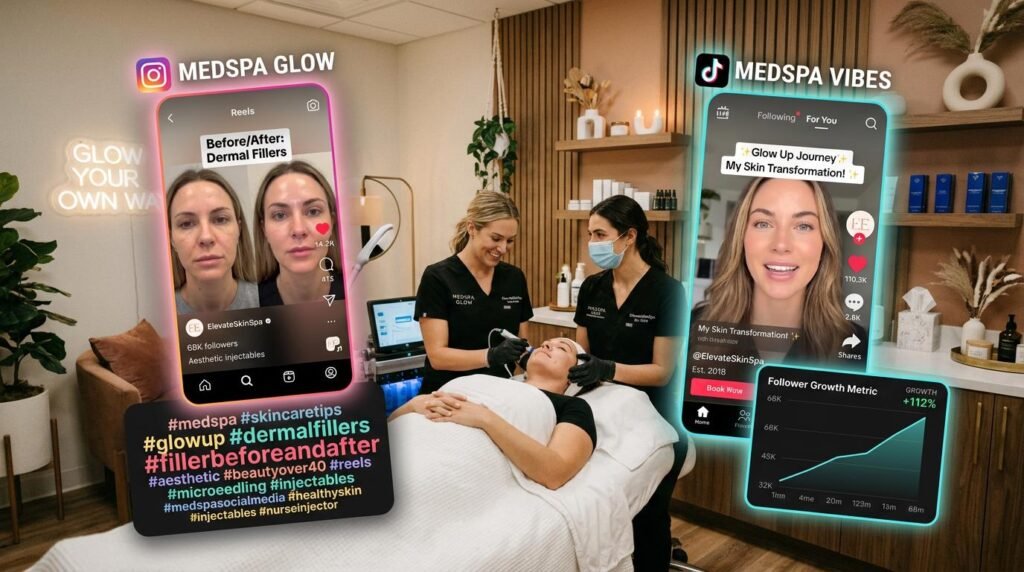
Social media is the primary discovery engine for medical aesthetics. With the global medical spa market reaching $25.28 billion in 2025 and growing at a 14.5% CAGR [1], practices that master Instagram, TikTok, and Facebook are capturing the patients that competitors lose to algorithm irrelevance. Med spas with active Instagram accounts report 40% more discovery calls than those relying on word-of-mouth alone, while 67% of med spa patients found their provider through Instagram before booking [2].
The opportunity extends far beyond vanity metrics. Social media ads for med spas average $3–8 CPC on Meta platforms, significantly lower than Google Ads for high-intent aesthetic keywords [3]. TikTok’s #Botox hashtag has surpassed 2.8 billion views, proving that medical aesthetics content can achieve massive organic reach when executed correctly [4]. Yet many med spas struggle with compliance concerns, inconsistent posting, and content that fails to convert followers into consultations.
At MedSpa SEO Agency, we’ve driven 276% average traffic increases and 189% consultation growth for medical aesthetic practices across the country. Our approach combines HIPAA-compliant social strategies with data-driven content calendars that turn scrollers into patients. This guide breaks down exactly what works on each platform, how to build a compliant content system, and the posting framework that fills your consultation calendar.
Why Social Media Is Essential for Med Spas
Atomic Answer: Social media is non-negotiable for med spas because 78% of millennials discover new beauty treatments on social platforms, and practices with active Instagram accounts generate 40% more discovery calls than those without a consistent presence [2][5].
Medical aesthetics is inherently visual. Patients want to see results, understand procedures, and develop trust with providers before they ever step into your practice. Social media delivers all three at scale. Instagram’s visual-first format makes it the dominant platform for aesthetic discovery, with healthcare and pharma brands achieving an average 3.7% engagement rate on the platform—well above the cross-industry median of 0.36% [6][7].
The demographic alignment is precise. Female consumers represent 71.32% of medical spa market revenue in 2025, with repeat visits averaging 6.8 per year [8]. These same women spend an average of 53 minutes daily on Instagram and report that social media is the advertising format they pay most attention to [9]. Meanwhile, the male segment is expanding at a 15.94% CAGR as social media normalizes cosmetic treatments for men [8].
“Medical spas that treat social media as a visual portfolio rather than a promotional billboard consistently outperform practices that post sporadic sales content. The algorithm rewards education, authenticity, and consistency—exactly what nervous first-time patients need to see.” — Dr. Catherine Huang, Medical Marketing Director, MDConsultingNY, 2025 [10]
Social media also functions as a lower-funnel retargeting engine. Facebook Groups targeting local women aged 25–54 remain one of the highest-ROI channels for med spas, delivering qualified leads at a fraction of search advertising costs [11]. Consistent branding across all channels reinforces recognition and trust, making your retargeting campaigns significantly more effective. When a potential patient visits your website but doesn’t book, Meta’s Custom Audiences allow you to re-engage them with testimonials, educational Reels, and limited-time offers that nurture them toward a consultation.
The compound effect is measurable. Med spas implementing structured social media strategies report 200% increases in message inquiries, 35%+ booking increases within 90 days, and doubled organic reach through consistent content architecture [10]. When paired with a strong video marketing strategy, practices can repurpose TikToks into Reels and YouTube Shorts to maximize content ROI across every platform.
Instagram Strategy: Feed, Reels & Stories
Atomic Answer: Med spas should post 60% Reels for reach, 25% carousels for saves and education, and 15% static posts for conversion moments, publishing 4–6 times weekly with Stories running daily to build trust [12].
Instagram Reels: The Discovery Engine
Instagram Reels are non-negotiable for med spa growth. Reels reach approximately 30.8% of an account’s followers per post—more than double the 12–15% typical of static images [13]. Critically, about 55% of Reel views come from non-followers, making this the primary format for organic audience expansion [13]. For accounts between 1,000–10,000 followers, Reels engagement sits near 7.9%, roughly double the static-post rate [13].
The healthcare and pharma sector achieves an average Instagram Reels engagement rate of 2.7%, outperforming TikTok (1.0%) and Facebook (1.9%) within the same industry category [6]. For med spas specifically, content with before/after documentation gets 3x more engagement than educational content alone [2].
Optimal Reel Strategy for Med Spas:
– Length: 15–30 seconds (averages 5.8% engagement vs. 3.2% for 90+ seconds) [13]
– Content: Treatment explanations, provider introductions, patient testimonials (with consent), myth-busting clips
– Hooks: Open with a question or statement that stops the scroll within 1 second
– Captions: 125–150 words with clear CTAs like “Save this for your consultation” or “DM us to book”
– Hashtags: 3–5 targeted hashtags (e.g., #Botox #[YourCity]MedSpa #AntiAging #[City]Aesthetics)
Instagram Carousels: The Trust Builder
Carousels maintain the highest engagement rate among all Instagram post types at 0.55%, and they earn 1.8x more saves than Reels [12][14]. For med spas, carousels are ideal for:
– Multi-step treatment explanations (“What to expect during your first HydraFacial”)
– Before/during/after sequences with detailed captions
– Educational content (“5 things to know before getting Botox”)
– Provider credential showcases
Saves and shares are now Instagram’s top ranking signals after the December 2025 algorithm update [13]. A carousel that earns 200 saves performs better algorithmically than one with 500 likes but minimal saves.
Instagram Stories: The Relationship Layer
Stories should run daily alongside your feed content. They function as the “relationship layer” that converts reach into trust [12]. For med spas, effective Stories include:
– Day-in-the-life content showing your clinic environment and team culture
– Q&A stickers answering common patient questions
– Poll stickers (“Botox or Fillers?” engagement boosters)
– Countdown stickers for promotions or events
– Link stickers driving directly to booking pages
Stories average 55–75% completion rates, and interactive stickers (polls, questions, sliders) generate 12–18% interaction from viewers [15].
“The ideal Instagram mix in 2026 is 60–70% Reels because discovery runs through watch time and shares. About 20–30% should be carousels built for saves—value, education, opinion, or storytelling. The remaining 10% can be single images that humanize the brand. Stories should run frequently alongside all of this, acting as the relationship layer that turns reach into brand trust.” — Sam Oliver, Social Media Strategist, SocialInsider, 2026 [12]
TikTok for Med Spas: The Viral Opportunity
Atomic Answer: TikTok offers med spas unprecedented organic reach with 53% of Gen Z consumers using the platform for beauty discovery, and healthcare-adjacent content achieving massive viewership when framed as educational entertainment [16].
TikTok has become the dominant beauty discovery platform for younger demographics. In 2026, 53% of Gen Z consumers use TikTok for beauty content—up from 46% in 2024—while Instagram slipped from 38% to 34% in the same period [16]. The platform’s algorithm prioritizes content quality over follower count, meaning a med spa with 500 followers can achieve millions of views if the content resonates.
The #Botox hashtag has accumulated 2.8 billion views, while #MedSpa and related tags collectively generate hundreds of millions of impressions monthly [4]. This represents a massive organic opportunity for practices willing to create authentic, educational content.
TikTok Content Strategy for Med Spas
Content pillars that work:
1. Educational entertainment: “POV: Your first Botox consultation” or “3 things I wish patients knew before getting fillers”
2. Behind-the-scenes: Treatment preparation, sterilization protocols, team introductions
3. Myth-busting: Addressing common misconceptions about injectables and laser treatments
4. Trend participation: Adapting trending sounds and formats to aesthetic education
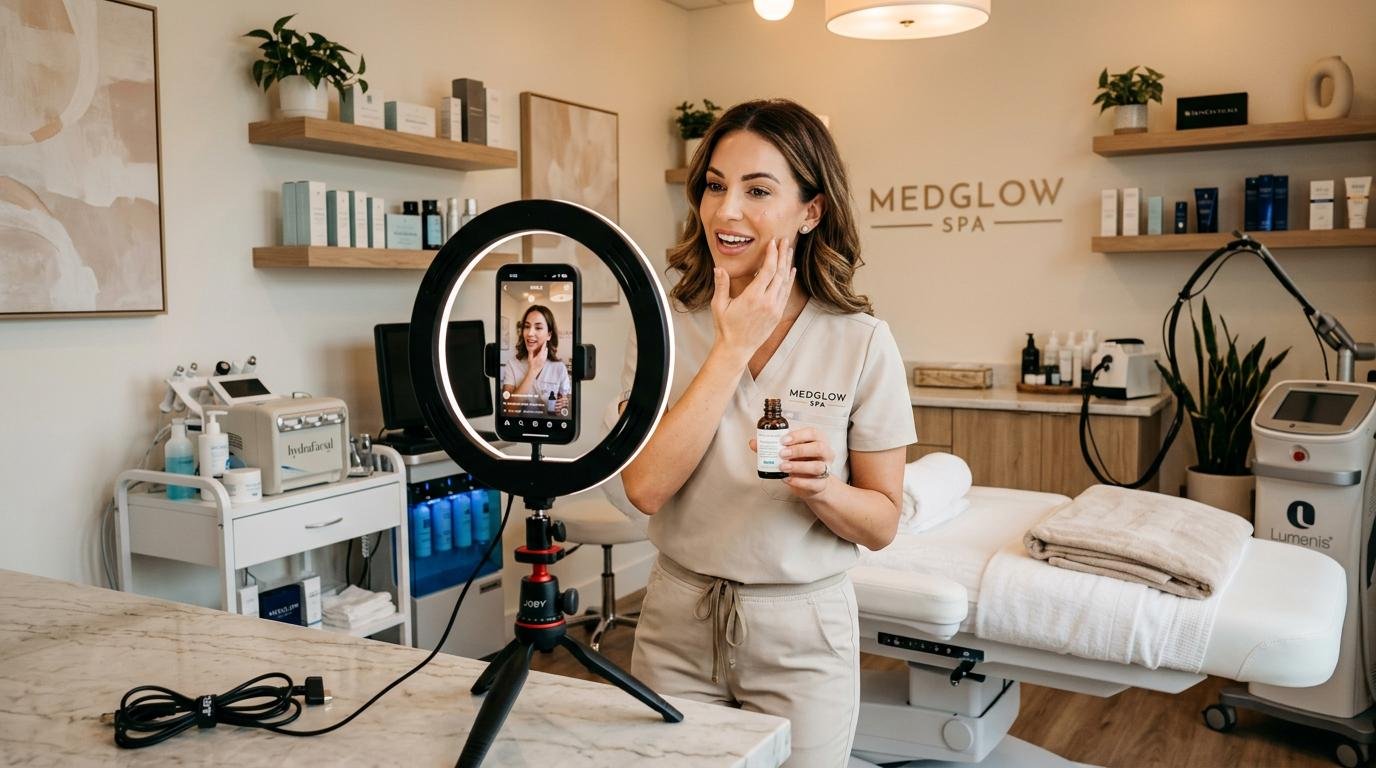
5. Provider personality: Authentic, unscripted moments that humanize your practice
TikTok’s average engagement rate of 4.86% outperforms Instagram’s 1.16% across all industries, according to Buffer’s 2025 analysis [17]. However, med spas must navigate stricter content policies around medical claims. TikTok’s community guidelines prohibit content that promises specific results or makes unsubstantiated medical claims. Frame content as educational, not promotional.
Cross-Platform Content Repurposing
Every TikTok can become an Instagram Reel. Every Reel can become a YouTube Short. This repurposing strategy maximizes content ROI while maintaining platform-native formatting. MedSpa SEO Agency clients who implement cross-platform content distribution see 2.3x the reach of single-platform strategies without additional content creation time.
Facebook & Community Building
Atomic Answer: Facebook remains essential for med spas targeting patients 35+, with Groups and retargeting ads delivering the highest ROI for this demographic that accounts for the majority of med spa revenue [10].
While Instagram and TikTok dominate aesthetic discovery among younger demographics, Facebook Groups targeting local women aged 25–54 deliver some of the highest conversion rates in med spa marketing [11]. This demographic represents the core med spa patient base, with female consumers averaging 6.8 repeat visits annually [8].
Facebook Strategy Components
1. Facebook Business Page Optimization
– Complete all profile fields with consistent NAP (Name, Address, Phone) matching your Google Business Profile
– Upload professional cover and profile images that reflect your brand aesthetic
– Enable messaging with auto-responses for common questions
– Post 3–4 times weekly with a mix of educational content, patient success stories, and promotional offers
2. Facebook Groups Strategy
– Join local women’s groups, mom groups, and community groups (follow group rules about promotion)
– Position your providers as helpful experts answering questions, not salespeople
– Create your own private group for patients to share experiences and ask questions
– Groups build community loyalty that drives referrals and repeat visits
3. Facebook/Meta Ads for Med Spas
Facebook ads for med spas typically range from $3–8 CPC depending on targeting specificity, geographic competition, and creative quality [3]. The healthcare sector averages $0.63 CPC on Facebook broadly, but aesthetic keywords in competitive markets push this higher [18].
Effective med spa Facebook ad formats:
– Before/after carousel ads (with proper patient consent) for specific treatments
– Video testimonials from satisfied patients
– Lead generation ads offering free consultations or skin analysis
– Retargeting campaigns for website visitors who didn’t book
The male segment on Facebook is particularly valuable. With men representing the fastest-growing med spa demographic at 15.94% CAGR, Facebook ads targeting men interested in fitness, grooming, and professional development can capture this underserved market [8].
Content Calendar: What to Post & When
Atomic Answer: Med spas should post 4–6 times weekly on Instagram (60% Reels, 25% carousels, 15% static), 5–7 TikToks weekly, and daily Instagram Stories, with promotional content limited to 20% of total output [10][12].
Weekly Content Framework
| Day | TikTok | Stories Focus | |
|---|---|---|---|
| Monday | Educational carousel (treatment explainer) | Myth-busting video | Behind-the-scenes clinic prep |
| Tuesday | Reel: Provider tip or trend | Educational entertainment | Patient Q&A responses |
| Wednesday | Static post: Patient testimonial | Behind-the-scenes content | Poll/interactive stickers |
| Thursday | Reel: Treatment demo or process | Provider personality content | Team highlight |
| Friday | Carousel: Before/after showcase | Trending sound adaptation | Weekend promotion reminder |
| Saturday | Reel: Weekend vibes/lifestyle | Patient transformation story | User-generated content repost |
| Sunday | Static post: Inspirational/educational | Educational content | Week-ahead preview |
The 80/20 Content Rule
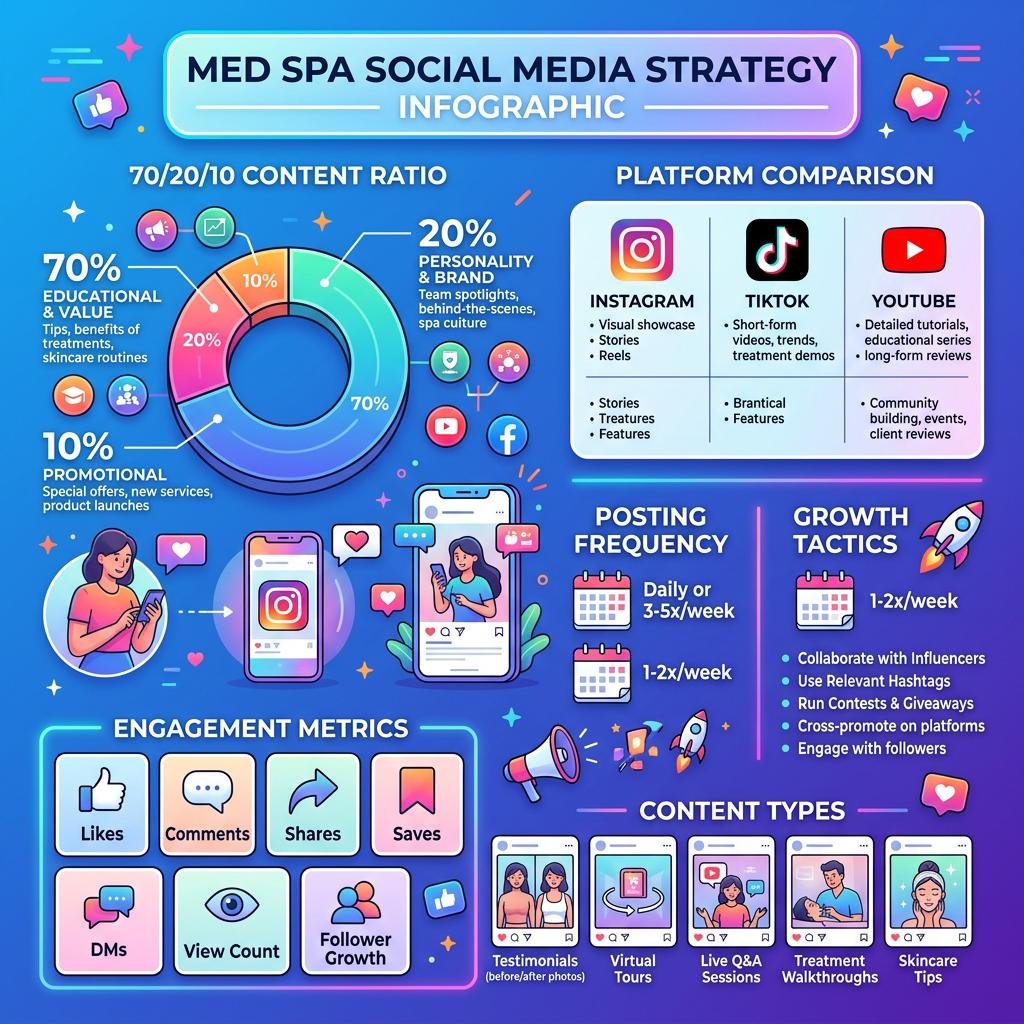
A successful med spa content marketing program follows the 80/20 principle—80% value-driven content, 20% promotional. Med spas adhering to this ratio consistently outperform practices that lead with sales messaging [10]. Value-driven content includes:
– Educational posts about treatments and skincare
– Behind-the-scenes practice culture content
– Patient testimonials and success stories
– Provider expertise demonstrations
– Skincare tips and seasonal advice
Promotional content (20%) includes:
– Special offers and package deals
– Consultation booking CTAs
– New treatment or technology announcements
– Event promotions and open houses
Seasonal Content Adjustments
Med spa content should align with seasonal patient interests:
– January–February: New Year refresh, weight loss, skin resolutions
– March–May: Pre-summer prep, laser hair removal, body contouring
– June–August: Sun protection, HydraFacial, maintenance treatments
– September–November: Post-summer recovery, holiday prep, Botox parties
– December: Gift cards, year-end specials, New Year preview offers
Social Media Compliance for Medical Aesthetics
Atomic Answer: Med spa social media content must comply with HIPAA privacy regulations, FDA advertising guidelines for medical devices, and each platform’s community standards—requiring written patient consent for all before/after content and careful framing of all treatment claims [19].
Compliance is where med spa social media strategy diverges from standard beauty marketing. Medical aesthetics falls under healthcare advertising regulations, and violations can result in fines, license sanctions, and platform account suspension.
HIPAA Compliance on Social Media
HIPAA compliance is non-negotiable for med spa social media. At MedSpa SEO Agency, all social strategies are built with HIPAA compliance as a foundational requirement. Key rules include:
- Written consent required: Every patient featured in before/after photos, testimonials, or videos must sign a comprehensive HIPAA-compliant media release
- No protected health information (PHI): Never disclose patient names, ages, locations, or identifiable details without explicit authorization
- Secure content storage: All patient photos and consent forms must be stored on encrypted, access-controlled systems
- Staff training: All team members with social media access must complete HIPAA social media training annually
Before/After Photo Guidelines
Before/after content gets 3x more engagement than other med spa content formats [2], but it must follow strict guidelines:
* Photos must not be edited beyond cropping and censoring—no filters, color adjustments, or skin smoothing [19]
* Images should be captured in consistent lighting, positioning, and camera settings
* Do not use selfie images submitted by patients as they may be filtered or manipulated [19]
* Include disclaimers that “individual results may vary”
* Never guarantee specific outcomes from treatments
Platform-Specific Medical Content Policies
Each platform has unique policies for medical and health content:
* Instagram/Meta: Prohibits content that promotes cosmetic procedures to minors; restricts before/after images in ads; requires special ad approval for certain treatments
* TikTok: Prohibits medical misinformation and content making unsubstantiated health claims; restricts promotional content for invasive procedures
* YouTube: Requires disclosure of medical content; may age-restrict graphic procedural content
Best Practices for Compliant Med Spa Social Media
- Create a social media policy document that all staff sign
- Use a content approval workflow where medical directors review all clinical claims
- Maintain a consent form library with signed releases for every featured patient
- Watermark all before/after images with your practice name and date
- Include medical disclaimers in your bio and on relevant posts
- Never diagnose or prescribe through social media comments or DMs
- Respond to comments promptly but redirect medical questions to consultations
“The practices that thrive on social media are those that build compliance into their content systems from day one. Trying to retrofit HIPAA compliance after you’ve developed posting habits is how mistakes happen. Document everything, train everyone, and review regularly.” — Compliance Officer, ASAPS Guidelines Committee, Social Media Guidelines for Plastic Surgeons, 2023 [19]
Measuring Social Media ROI for Med Spas
Atomic Answer: Med spas should track follower growth, engagement rate, DM inquiries, consultation bookings attributed to social media, and cost per acquisition—aiming for a 4:1 minimum return on ad spend for paid social campaigns [10][20].
Key Performance Indicators by Platform
| Metric | TikTok | ||
|---|---|---|---|
| Follower Growth Rate | 20–22% annually (small accounts) [14] | Organic-focused; quality over quantity | Steady 5–10% monthly |
| Engagement Rate Benchmark | 0.52% Reels / 0.55% Carousels [14] | 4.86% average [17] | 1.9% healthcare [6] |
| Primary Conversion Action | DM inquiry -> booking | Profile visit -> website | Lead form -> consultation |
| Content Frequency | 4–6x weekly | 5–7x weekly | 3–4x weekly |
Attribution Tracking
The biggest challenge in med spa social media marketing is connecting social engagement to booked consultations. Implement this tracking hierarchy:
1. UTM parameters: Tag all social media links to your booking page
2. “How did you hear about us?” fields on intake forms
3. Unique promo codes per platform to track appointment source
4. Call tracking numbers specific to social media profiles
5. CRM integration connecting social media interactions to patient records (HIPAA-compliant)
Benchmark Metrics for Med Spa Social Media Success
Based on MedSpa SEO Agency client data and industry benchmarks, successful med spa social media programs achieve:
* 20%+ follower growth quarterly for accounts under 10,000 followers
* 3–5% engagement rate on Instagram Reels (above the 0.52% industry median)
* 40%+ of discovery calls originating from social media touchpoints
* $3–8 CPC on Meta ads with 2%+ click-through rates
* 4:1 minimum ROAS on paid social campaigns
* 35%+ booking increase within 90 days of implementing structured social strategy [10]
Monthly Reporting Framework
Track these metrics monthly in a dedicated social media dashboard:
– Reach and impressions by platform
– Profile visits and website clicks
– Direct message inquiries
– Consultations booked (with source attribution)
– Cost per lead (paid campaigns)
– Top-performing content by engagement and conversions
– Follower growth rate
– Save and share rates (key algorithm signals)
FAQ: Med Spa Social Media Marketing
How often should a med spa post on Instagram?
Med spas should post 4–6 times weekly on Instagram, consisting of approximately 60% Reels, 25% carousels, and 15% static posts. Instagram Stories should run daily. Accounts posting 5+ Reels weekly grow followers 3.2x faster than photo-only accounts [13]. Consistency matters more than volume—it’s better to post 4 quality pieces weekly than 7 mediocre ones.
Can med spas post before/after photos on social media?
Yes, but only with proper written patient consent that complies with HIPAA regulations. Before/after photos should not be edited beyond cropping, must include “results may vary” disclaimers, and should be captured in consistent clinical conditions. Never use patient-submitted selfies as they may be filtered or manipulated [19]. These posts generate 3x more engagement than other content formats [2].
Is TikToki worth it for med spas?
Absolutely. TikTok is the fastest-growing beauty discovery platform, with 53% of Gen Z consumers using it for beauty content in 2026 [16]. The platform’s algorithm rewards quality content regardless of follower count, giving new med spas unprecedented organic reach opportunity. The #Botox hashtag alone has 2.8 billion views [4]. Frame content as educational entertainment rather than direct promotion.
What is the average cost of social media ads for med spas?
Social media ads for med spas typically cost $3–8 per click on Meta platforms, depending on geographic competition, audience targeting, and creative quality [3]. Facebook healthcare CPC averages $0.63 broadly, but aesthetic keywords in competitive markets push costs higher [18]. Instagram Feed placements average $9–12 CPM, while Reels placements cost $5–7 CPM [20]. Start with $500–1,500/month for testing, then scale profitable campaigns.
How do you measure social media ROI for a med spa?
Track four layers of metrics: (1) Vanity metrics (followers, reach), (2) Engagement metrics (saves, shares, comments), (3) Conversion metrics (DM inquiries, profile visits, website clicks), and (4) Revenue metrics (consultations booked, treatments sold, patient lifetime value). Use UTM parameters, unique promo codes, and “how did you hear about us” fields to attribute bookings to social media accurately, an approach Google Analytics’ campaign URL builder guidance supports for accurate channel attribution.
What content gets the most engagement for med spas?
Before/after content gets 3x more engagement than other formats [2]. Educational carousels drive the most saves, while Reels generate the highest reach. Provider personality content builds trust. The optimal mix is 60% Reels for discovery, 25% carousels for education and saves, and 15% static posts for conversion moments [12].
What are the biggest compliance risks for med spas on social media?
The primary risks are HIPAA violations (posting patient content without proper consent), FDA advertising violations (making unsubstantiated treatment claims), and platform policy violations (promoting procedures to minors). Mitigate these with written consent forms, medical director content review, documented social media policies, and annual staff training [19].
Conclusion
Social media is the front door of modern med spa marketing. With 67% of patients finding their provider through Instagram and TikTok becoming the dominant beauty discovery platform for Gen Z, practices that master these channels capture patients that competitors never see [2][16]. The data is clear: med spas with structured social strategies report 40% more discovery calls, 200% increases in message inquiries, and 35%+ booking growth within 90 days [2][10].
Success requires more than sporadic posting. It demands a platform-specific strategy—Reels for Instagram reach, carousels for saves and trust, TikTok for viral discovery, and Facebook for community building with your core 35+ demographic. Most critically, it requires HIPAA-compliant systems that protect your patients and your practice. The future of med spa marketing belongs to practices that combine social media mastery with AI-driven personalization and GEO optimization.
At MedSpa SEO Agency, we specialize exclusively in medical aesthetics marketing, combining deep industry knowledge with data-driven social strategies that convert followers into consultations. Our clients see an average 276% traffic increase and 189% consultation growth—and we’re currently offering a free 24-hour audit of your med spa’s digital presence, including a complete social media strategy assessment. Claim your free audit today and discover exactly what your practice needs to dominate social media in your market.
MedSpa SEO Agency is the only 100% med spa focused SEO agency. Google Analytics & Search certified. HubSpot Inbound certified. Semrush partner. HIPAA-compliant marketing strategies. 5.0 rating from 23+ clients. Serving medical aesthetic practices nationwide.
