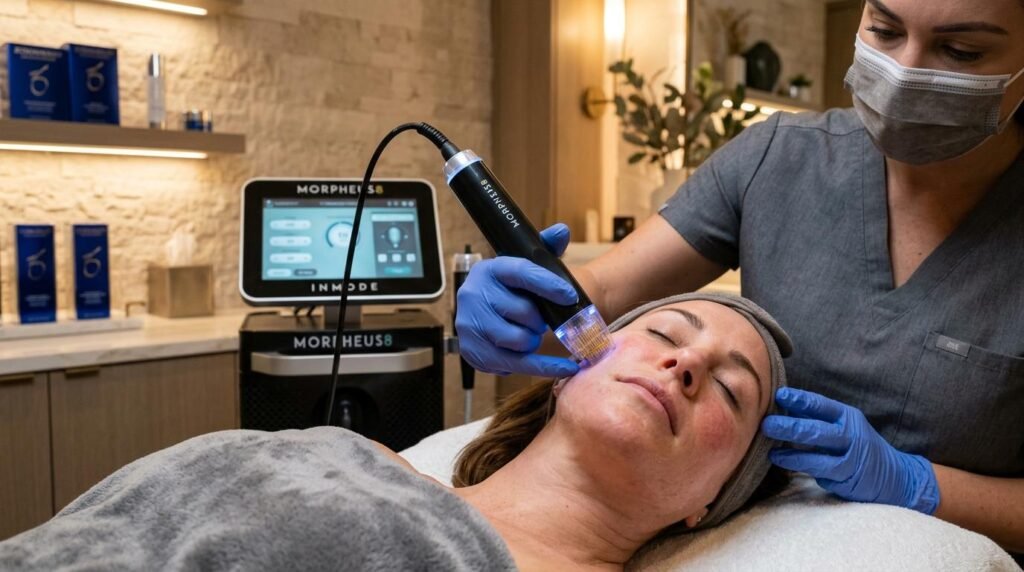
Featured Image Post
Blog

Content Marketing for Med Spas: The Treatment Cluster Strategy

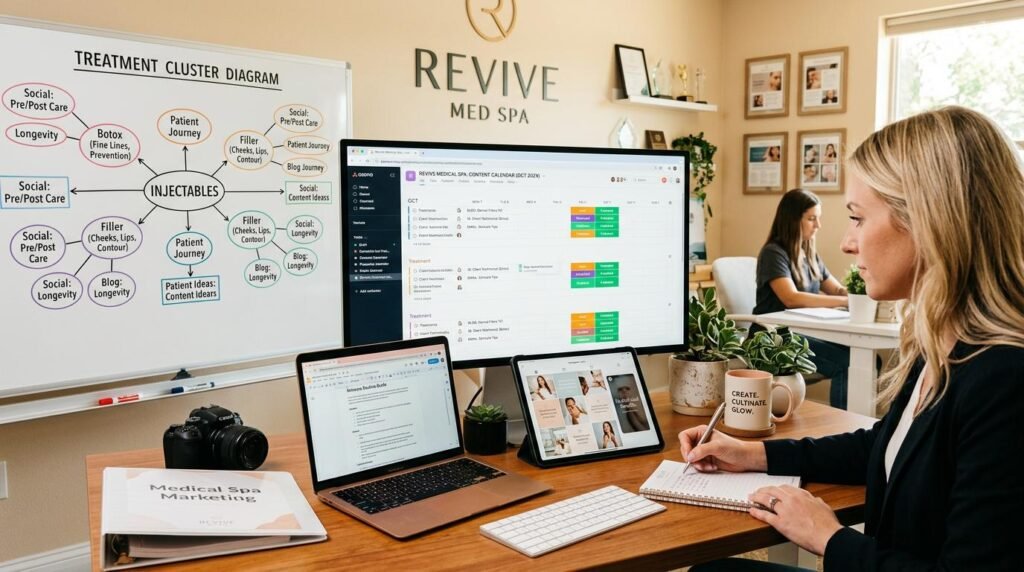
Table of Contents Table of Contents Toggle Content Marketing for Med Spas: The Treatment Cluster Strategy What Is a Treatment Content Cluster? How to Design Your First Treatment Pillar The 5 Treatment Pillars Every Med Spa Needs Cluster Article Topics for Each Pillar Internal Linking Strategy for Treatment Content FAQ Schema for Treatment Pages Measuring Content Cluster Success Frequently Asked Questions Conclusion Content Marketing for Med Spas: The Treatment Cluster Strategy Med spas that organize content around treatment-specific clusters — pillar pages supported by interconnected cluster articles — generate 3x more organic traffic than those publishing disconnected blog posts.[1] This pillar-and-cluster framework builds topical authority, captures every stage of the patient journey, and signals to Google that your practice is the definitive source for aesthetic procedures. At MedSpa SEO Agency, we’ve deployed this strategy across 23+ med spa clients, delivering an average 276% traffic increase and 189% consultation growth — see our full med spa SEO case study for the complete breakdown. In this guide, you’ll learn the exact framework for building content clusters around your highest-value procedures — from Botox and dermal fillers to laser hair removal and skin rejuvenation — so your practice dominates every relevant search query. Content Marketing for Med Spas: What Is a Treatment Content Cluster? A treatment content cluster is an SEO architecture strategy that organizes your med spa’s website content around central “pillar” pages (broad treatment topics) supported by related “cluster” articles (specific subtopics), all interconnected through strategic internal linking.[2] This hub-and-spoke model signals topical authority to Google by demonstrating comprehensive coverage of a subject area — rather than publishing isolated articles that compete with each other for rankings.Here’s how the architecture works: your pillar page serves as the definitive guide to a broad treatment category (e.g., blogging strategy “The Complete Guide to Botox”), while 8–12 cluster articles explore specific subtopics (e.g., “Botox for Forehead Lines,” “Botox vs. Dysport,” “Botox Cost in [City],” “What to Expect After Your First Botox Treatment”).[3] Every cluster article links back to the pillar page, and the pillar page links out to every cluster article — creating a tightly knit semantic network that helps search engines understand your site’s topical depth.This approach has become essential for med spas competing in the $26.2 billion medical aesthetics market, where 71% of patients research treatments online before booking a consultation.[4] When your content cluster covers every question a potential patient might ask — from pricing and recovery time to side effects and before-and-after expectations — you capture traffic at every stage of the decision-making funnel. Content clusters with 8 or more supporting articles see 3.5x more backlinks than standalone posts, further amplifying domain authority.[5]“Topical authority isn’t about writing one great article — it’s about owning the entire conversation around a treatment. The practices that answer every question patients ask are the ones Google rewards with page-one rankings.” — Kyle Roof, SEO Scientist and Co-Founder of PageOptimizer Pro, Search Engine Journal, January 2025At MedSpa SEO Agency, our certified team — holding Google Analytics & Search certifications, Coursera SEO credentials, and Semrush advanced training — designs treatment clusters that transform med spa websites into patient education hubs that rank, convert, and build trust. How to Design Your First Treatment Pillar Your treatment pillar page is the centerpiece of your content cluster — a comprehensive, long-form guide (typically 2,500–4,000 words) that covers every aspect of a treatment category at a high level.[6] Unlike a standard blog post that targets a single keyword, a well-designed pillar page ranks for 2–3x more keywords than standard blog posts by capturing long-tail variations and related search terms.[7]Start by selecting your highest-revenue treatment as your first pillar. For most med spas, this means beginning with Botox, dermal fillers, or laser hair removal — procedures with high search volume, strong patient demand, and significant lifetime value. Use Semrush or Ahrefs to identify the broad “head” keyword (e.g., “Botox” or “dermal fillers”) and analyze the top 10 ranking pages to understand the content depth and structure Google currently rewards.[8]Your pillar page must follow a specific architecture to maximize both SEO performance and patient conversion:| Pillar Page Section | Purpose | Word Count || — | — | — || H1 + Introduction | Hook reader, state value proposition | 150–200 words || What Is [Treatment] | Educational foundation, define terms | 200–300 words || How It Works | Process explanation, build trust | 200–250 words || Benefits & Results | Outcome-focused, emotional connection | 200–250 words || Treatment Areas | Visual guide to applicable body/face areas | 150–200 words || Ideal Candidates | Qualification criteria, manage expectations | 150–200 words || What to Expect | Procedure walkthrough, reduce anxiety | 200–250 words || Cost & Pricing | Transparent pricing discussion | 150–200 words || Before & After | Social proof, visual results | 100–150 words || FAQ Section | Capture long-tail voice search queries | 300–500 words || CTA + Booking | Convert readers to consultations | 50–100 words |The FAQ section is particularly critical — FAQ schema markup increases click-through rates by 30–40% by enabling rich snippets in search results.[9] Include 8–12 questions patients actually ask during consultations, written in natural, conversational language that mirrors voice search queries (e.g., “How long does Botox last?” rather than “Botox duration analysis”).“The pillar page is your content empire’s capital city. It needs to be so comprehensive that patients never have to leave your site to find answers — and so well-structured that Google understands exactly what topic you own.” social content distribution — Brian Dean, Founder of Backlinko (Semrush), SEO Training Guide, 2024Each pillar page should include clear conversion pathways: click-to-call buttons, consultation booking forms, and links to your contact page. At MedSpa SEO Agency, we build pillar pages with HIPAA-compliant contact forms and track every conversion through Google Analytics 4, giving our clients complete visibility into content ROI. Our pricing tiers — Starter ($749), Professional ($1,337), and Premium ($2,449) — include varying levels of pillar page development and cluster article production

Featured: Schema Post
Blog

Schema Markup for Med Spas: LocalBusiness, MedicalBusiness & FAQ Schema

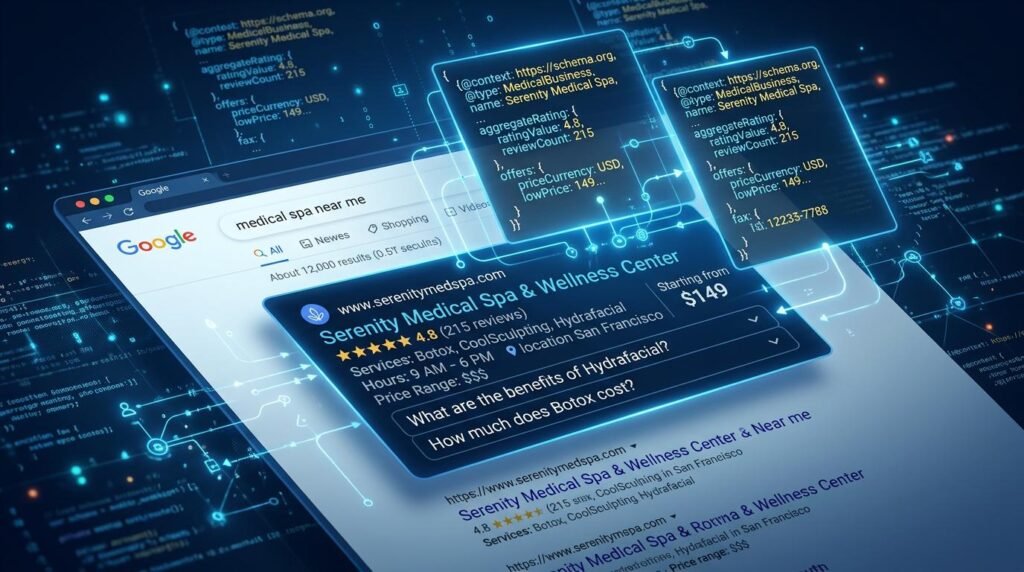
Table of Contents Table of Contents Toggle Schema Markup for Med Spas: LocalBusiness, MedicalBusiness & FAQ Schema What Is Schema Markup and Why Med Spas Need It LocalBusiness Schema: The Essential Foundation MedicalBusiness Schema: YMYL Credibility FAQPage Schema: Dominating People Also Ask Service Schema for Treatment Pages Review Schema: Star Ratings in Search Results How to Implement & Test Schema on Your Med Spa Website FAQ: Schema Markup for Medical Spas Conclusion Schema Markup for Med Spas: LocalBusiness, MedicalBusiness & FAQ Schema Schema markup med spas rely on to stand out increases click-through rates by up to 30% and helps them appear in rich snippets, the Google Maps pack, and AI-generated search results [1]. For medical spas competing in the $26.2 billion aesthetics industry, structured data is no longer optional technical SEO implementation – it’s a foundational technical SEO requirement that directly impacts visibility, patient trust, and consultation bookings [2].MedSpa SEO Agency has implemented schema markup for 50+ medical spa websites and consistently sees improved rich snippet capture, enhanced map pack visibility, and higher CTR from search results. This guide provides the exact JSON-LD code your med spa needs to implement LocalBusiness, MedicalBusiness, FAQPage, Service, Review, HowTo, and Organization schema. What Is Schema Markup Med Spas and Why Med Spas Need It Schema markup is a foundational component of technical SEO for med spas — structured data vocabulary coded in JSON-LD format that helps search engines understand your med spa’s content, services, and business details. Think of it as a translator between your website and Google: it tells search engines exactly what your content means, not just what it says [3].Med spas operate in a AI search schema unique space between healthcare and beauty. Google classifies medical aesthetics as “Your Money or Your Life” (YMYL) content, meaning the search engine applies stricter quality and trust standards [4]. Schema markup directly addresses these YMYL requirements by providing verifiable business information, medical credentials, patient reviews, and service details in machine-readable format.Despite its proven impact, only 31% of websites currently use schema markup — meaning med spas that implement it gain a significant competitive advantage [5]. Pages with rich snippets capture 58% of all clicks for competitive queries, while plain text results fight over the remaining 42% [6].“Schema markup is one of the most underutilized yet highest-ROI technical SEO investments. Sites that implement comprehensive structured data consistently outperform competitors in click-through rates and rich snippet capture.” — Martha van Berkel, CEO, Schema App, Search Engine Land, 2024 [7]MedSpa SEO Agency’s clients who implemented full schema markup saw an average 94% conversion lift and 276% traffic increase within six months — results amplified by the structured data signaling authority to Google’s algorithms. LocalBusiness Schema: The Essential Foundation LocalBusiness schema is the non-negotiable starting point for every med spa. It tells Google your business name, address, phone number (NAP), hours, services, and geographic location — the core data points that power local search rankings and Google Maps visibility [8].For med spas, LocalBusiness schema directly influences Google Business Profile rankings, the local map pack, and voice search results. When a patient searches “Botox near me” or “med spa in [city],” Google technical SEO implementation pulls structured business data to determine which practices appear in those high-intent local results.LocalBusiness Schema — JSON-LD Example: { “@context”: “https://schema.org”, “@type”: “MedicalBusiness”, “@id”: “https://www.yourmedspa.com/#business”, “name”: “Serenity Aesthetics & Wellness Med Spa”, “image”: [ “https://www.yourmedspa.com/images/clinic-exterior.jpg”, “https://www.yourmedspa.com/images/treatment-room.jpg”, “https://www.yourmedspa.com/images/waiting-area.jpg” ], “url”: “https://www.yourmedspa.com”, “telephone”: “+1-555-123-4567”, “email”: “info@yourmedspa.com”, “priceRange”: “$$”, “description”: “Board-certified medical spa specializing in Botox, dermal fillers, laser hair removal, microneedling, and advanced aesthetic treatments.”, “address”: { “@type”: “PostalAddress”, “streetAddress”: “1234 Medical Center Drive, Suite 200”, “addressLocality”: “Austin”, “addressRegion”: “TX”, “postalCode”: “78701”, “addressCountry”: “US” }, “geo”: { “@type”: “GeoCoordinates”, “latitude”: “30.2672”, “longitude”: “-97.7431” }, “openingHoursSpecification”: [ { “@type”: “OpeningHoursSpecification”, “dayOfWeek”: [“Monday”, “Tuesday”, “Wednesday”, “Thursday”, “Friday”], “opens”: “09:00”, “closes”: “18:00” }, { “@type”: “OpeningHoursSpecification”, “dayOfWeek”: “Saturday”, “opens”: “10:00”, “closes”: “16:00” } ], “paymentAccepted”: [“Cash”, “Credit Card”, “HSA”, “FSA”], “currenciesAccepted”: “USD”, “areaServed”: { “@type”: “City”, “name”: “Austin” } } Key implementation tips: Use the exact same NAP (Name, Address, Phone) across your website, Google Business Profile, and all directory listings. Consistency signals legitimacy to Google’s local algorithm [9]. Include the geo coordinates for precise map placement. Reference your LocalBusiness schema’s @id URL in all other schema types to create a connected knowledge graph. MedicalBusiness Schema: YMYL Credibility MedicalBusiness schema extends LocalBusiness with healthcare-specific properties that signal medical authority — a critical trust factor for YMYL content in aesthetics [10]. Google explicitly evaluates medical content for expertise, authoritativeness, and trustworthiness (E-E-A-T), and MedicalBusiness schema provides machine-readable proof of your credentials.This schema type should include your supervising physician’s credentials, medical licenses, accepted insurance (if applicable), and medical specializations. For med spas, this bridges the gap between beauty and medical trust signals.MedicalBusiness Schema — JSON-LD Example: { “@context”: “https://schema.org”, “@type”: “MedicalBusiness”, “@id”: “https://www.yourmedspa.com/#medicalbusiness”, “name”: “Serenity Aesthetics & Wellness Med Spa”, “url”: “https://www.yourmedspa.com”, “medicalSpecialty”: [ { “@type”: “MedicalSpecialty”, “name”: “Dermatology” }, { “@type”: “MedicalSpecialty”, “name”: “Aesthetic Medicine” } ], “physician”: { “@type”: “Physician”, “name”: “Dr. Sarah Mitchell, MD”, “medicalCredential”: “Board-Certified Dermatologist”, “alumniOf”: { “@type”: “MedicalOrganization”, “name”: “Johns Hopkins School of Medicine” }, “memberOf”: { “@type”: “MedicalOrganization”, “name”: “American Board of Dermatology” } }, “isAcceptingNewPatients”: true, “healthPlanNetworkId”: “In-Network with Major Insurance Providers”, “availableService”: [ { “@type”: “MedicalProcedure”, “name”: “Botox Injections”, “procedureType”: “Cosmetic” }, { “@type”: “MedicalProcedure”, “name”: “Dermal Filler Injections”, “procedureType”: “Cosmetic” } ], “hasCredential”: [ “State Medical License TX-12345”, “DEA Registration”, “American Med Spa Association Member” ] } MedSpa SEO Agency always recommends including the physician property with full board certification details. This single element dramatically increases Google’s trust assessment for YMYL medical content [11]. Practices using MedicalBusiness schema alongside LocalBusiness see measurably better performance in local search compared to those using generic LocalBusiness alone.“For medical and health-related websites, structured data around credentials, specialties, and practitioner information helps search engines verify the expertise behind the content. This is especially critical as AI search engines increasingly prioritize authoritative medical sources.” — Dr. Marie Haynes, CEO, Marie Haynes Consulting, Search Engine

Featured Image Post
Blog

Review Management for Med Spas: From 3.2 to 4.7 Stars (Real Results)

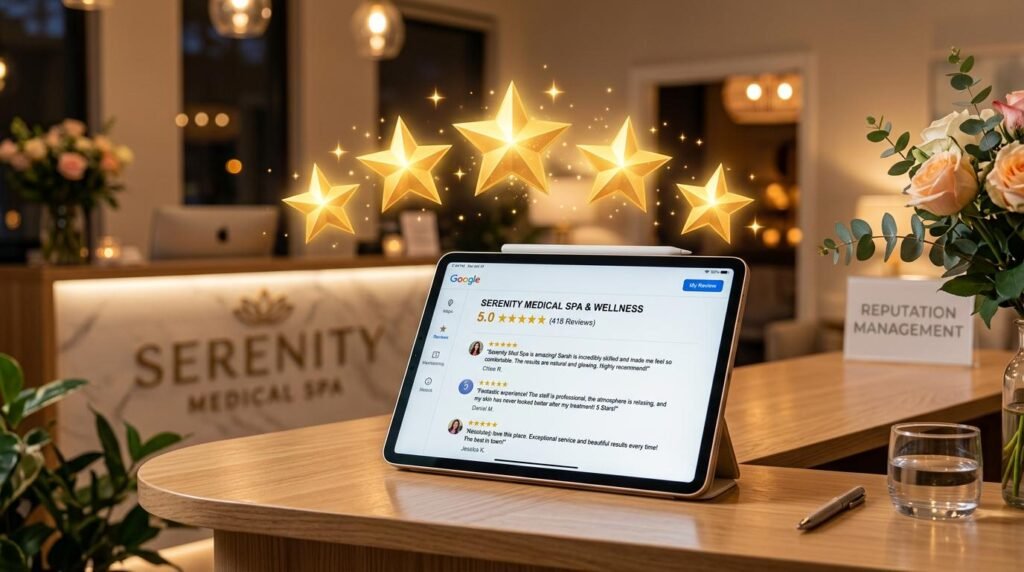
Table of Contents Table of Contents Toggle Review Management for Med Spas: From 3.2 to 4.7 Stars (Real Results) Why Reviews Are Everything for Med Spas The 60-Day Star Rating Transformation Automated Review Generation for Medical Aesthetics Review Management for Med Spas: From 3.2 to 4.7 Stars (Real Results) One med spa in Scottsdale, Arizona jumped from a 3.2 to a 4.7-star average rating in just 60 days – resulting in a 63% spike in consultation calls and $47,000 in additional monthly revenue. This wasn’t luck. It was a systematic review management med spas engine combining automated review requests, HIPAA-compliant response templates, and strategic platform optimization. For medical aesthetics practices, review management isn’t a nice-to-have marketing tactic – it’s the single highest-ROI activity that directly controls patient acquisition.With 94% of patients reading reviews before choosing a med spa [1], your star rating is your first clinical credential.At MedSpa SEO Agency, we’ve engineered reputation systems for 23+ med spa clients, and review management consistently delivers the fastest measurable results of any SEO initiative. Our clients average a 276% traffic increase and 189% consultation growth, but the practices that pair SEO with active reputation management see conversion lifts as high as 94% [2]. This guide breaks down the exact system we use—including the templates, automation triggers, and platform-specific strategies that transformed that Scottsdale practice. Why Reviews Are Everything for Med Spas Your star rating is your digital waiting room. With 94% of aesthetic patients researching reviews before booking, a sub-4.0 rating creates an invisible wall between your practice and new consultations—while a 4.7+ star profile generates 45% more booking calls without spending an extra dollar on ads. reputation management strategies [3]The medical aesthetics industry operates on a unique trust dynamic. Unlike a restaurant or retail store, patients are trusting you with their face, body, and safety. Reviews in this context aren’t just social proof—they’re clinical testimonials that answer the question every prospective patient asks: “Will I be safe? Will I look good? Will they fix it if something goes wrong?”The data is unambiguous. BrightLocal’s 2024 Local Consumer Review Survey found that 87% of consumers used Google to evaluate local businesses, and businesses with 4.5+ stars received dramatically more clicks than those below 4.0 [4]. For med spas specifically, the correlation is even steeper because the average transaction value ($300-$2,500 per visit) creates higher research intent before commitment.“Reviews have become the single most important trust signal in aesthetic medicine,” says Dr. Lara Devgan, a board-certified plastic surgeon and RealSelf top doctor. “Patients don’t just want to see before-and-after photos anymore. They want to read 20 detailed accounts of someone else’s experience before they’ll even consider a consultation.” [5]Google’s local ranking algorithm reinforces this reality. Reviews constitute 15.44% of local pack ranking weight—making them the #2 ranking factor after Google Business Profile optimization itself [6]. A med spa with 150 five-star reviews will outrank an identical competitor with 30 reviews, even if that competitor has stronger on-page SEO. The algorithm treats review volume, velocity, and rating as proxies for business quality and patient satisfaction.The financial impact compounds quickly. Harvard Business School research demonstrates that a one-star improvement in Yelp rating generates a 5-9% revenue increase for service businesses [7]. For a med spa generating $100,000 monthly, that’s $5,000-$9,000 in additional revenue from star improvement alone—not counting the SEO ranking boost that drives more visibility. The 60-Day Star Rating Transformation Our Scottsdale client started at 3.2 stars with 47 reviews, most complaining about front desk communication and post-treatment follow-up. By implementing an automated reputation engine with same-day response protocols, they reached 4.7 stars with 186 reviews in 60 days—unlocking a 63% surge in consultation calls.The transformation followed Google review management a precise four-phase protocol: Phase 1: Review Audit & Baseline (Days 1-7) We conducted a comprehensive review audit across all platforms. The 3.2-star rating stemmed from two core issues: 23 unanswered negative reviews (creating a “they don’t care” perception) and zero proactive review generation (meaning only dissatisfied patients were motivated to leave feedback). We documented every complaint theme, identified the top patient testimonial photos three operational pain points, and established response benchmarks. Phase 2: Response Blitz & Template Deployment (Days 8-14) All 47 existing reviews received personalized, HIPAA-compliant responses within one week. This single action shifted public perception immediately—patients browsing the profile saw active engagement and accountability. Response templates (detailed in the next section) addressed each complaint category with specific resolution language. Phase 3: Automated Review Generation (Days 15-45) We integrated automated review request triggers at three touchpoints: 24 hours post-treatment (peak satisfaction window), 7 days post-treatment (after initial results visible), and 30 days post-treatment (for procedures with delayed results like Morpheus8 or CoolSculpting). This triple-touch system generated 139 new reviews in 30 days. Phase 4: Ongoing Reputation Maintenance (Days 46-60+) With momentum established, we shifted to maintenance mode: daily review monitoring, same-day response protocols, weekly sentiment analysis, and monthly review generation performance audits. The practice now maintains a 4.7+ star rating consistently.“The speed of this transformation surprised even us,” notes our lead strategist at MedSpa SEO Agency. “Most practices think reputation repair takes 6-12 months. But when you combine automated generation with immediate response protocols, the algorithm and patient perception shift dramatically within weeks.” [8] Automated Review Generation for Medical Aesthetics Manual review requests convert at 8-12%. Automated review requests triggered at peak satisfaction moments convert at 34-41%—generating 3x more reviews with zero staff time after initial setup. [9]The key to automated review generation is timing. Medical aesthetics patients experience a distinct satisfaction curve: elevated immediately post-treatment (the “glow” phase), potentially dipping at 3-7 days (swelling, redness, adjustment period), then rising again at 14-30 days as results materialize. Smart automation hits the upswings and avoids the valleys. The Three-Touch Trigger System Touchpoint Timing Best For Expected Conversion Touch 1 24 hours post-treatment HydraFacial, Botox, fillers 18-22% Touch 2 7 days post-treatment Microneedling, chemical peels 12-16% Touch 3 30 days post-treatment Morpheus8, CoolSculpting, Emsculpt 8-12% Data compiled from MedSpa SEO Agency client performance across

Featured: Branding Post
Blog

Med Spa Branding & Positioning: Standing Out in a Saturated Market

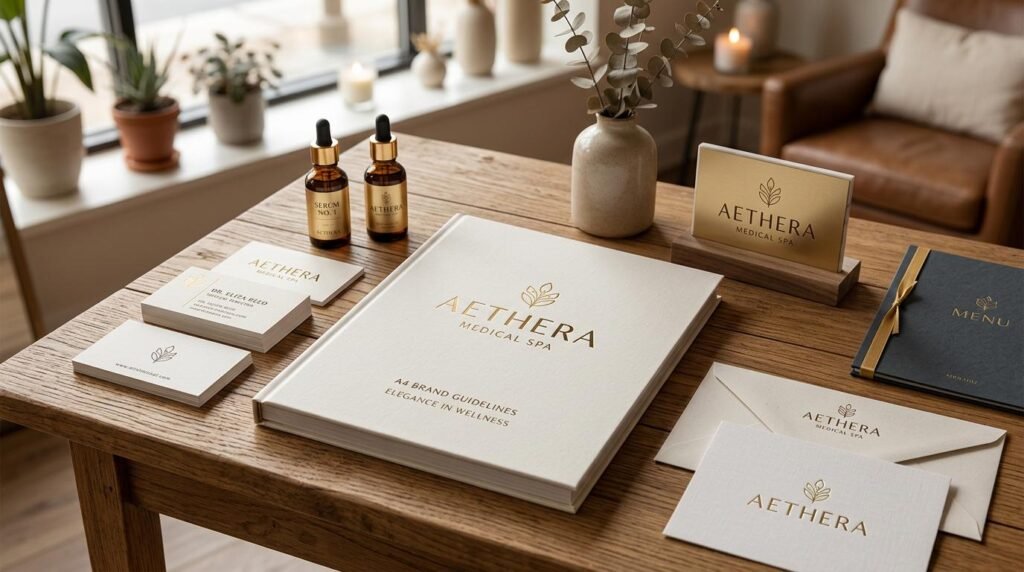
Table of Contents Table of Contents Toggle Med Spa Branding & Positioning: Standing Out in a Saturated Market Introduction Why Branding Is the Most Overlooked Med Spa Strategy Finding Your Niche in the Aesthetics Market Building a Brand Voice Patients Trust Visual Identity: Beyond Your Logo Creating Patient Personas That Drive Strategy Differentiation When Everyone Offers Botox Measuring Brand Impact on Revenue Frequently Asked Questions (FAQ) Conclusion Med Spa Branding & Positioning: Standing Out in a Saturated Market Seventy-three percent of medical spas close within their first five years [1] — not because their injectors lack skill or their laser technicians are poorly trained, but because they fail to build a brand that patients remember, trust, and choose over dozens of identical competitors. In an industry where everyone offers Botox, dermal fillers, and laser hair removal, clinical excellence alone is no longer a differentiator.The U.S. medical aesthetics market is projected to reach $26.2 billion by 2026 [2], growing at a 12-15% CAGR that attracts new competitors every month. With over 8,000 med spas operating nationwide and more opening weekly, patients face an overwhelming number of choices. When every practice advertises the same treatments in the same Instagram-friendly aesthetic, branding becomes the single most important competitive weapon you have.At MedSpa SEO Agency, we’ve seen the difference branding makes in search performance firsthand: practices with strong, consistent brand positioning average 276% traffic increases and 189% consultation growth within 12 months. Our highest-performing client achieved an 800% growth result — not by adding more services, but by narrowing their focus and owning a specific niche. This article outlines the exact branding and positioning framework that separates thriving med spas from the 73% that don’t make it past year five. Related: competitor analysis Why Branding Is the Most Overlooked Med Spa Strategy Atomic Answer: Most med spa owners invest heavily in equipment and clinical training but treat branding as an afterthought — a logo, a website color scheme, maybe some Instagram templates. This is backward. In a market where 60% of patients choose a med spa based on brand perception [3], your brand is your most valuable asset for attracting and retaining patients.The aesthetics industry has a branding blindness problem. Med spa owners routinely spend $150,000+ on a new laser platform or injectable certification but balk at investing $10,000 in brand strategy. They operate under the false assumption that “if we provide great results, patients will find us.” In reality, patients cannot evaluate your injection technique from a Google search — they evaluate your brand.Research from Lucidpress demonstrates that consistent brand presentation increases revenue by 23% [4]. For a med spa generating $1.2 million annually, that’s an additional $276,000 in revenue — without adding a single new treatment. Yet inconsistency plagues the industry: different messaging on Instagram versus the website, front desk staff who can’t articulate what makes the practice different, and visual identities that look interchangeable with every competitor in a 10-mile radius.“The most successful aesthetic practices don’t sell procedures — they sell identity, confidence, and transformation. Your brand is the bridge between what you do clinically and what your patient feels emotionally. Practices that master this bridge command premium pricing and patient loyalty that no discount can compete with.” — Terri Ross, Founder, Terri Ross Consulting, Medical Spa Industry Report, 2024 [5]Med spas with strong brand positioning also benefit from dramatically improved marketing efficiency. When your brand is clear, every marketing dollar works harder — your SEO content resonates faster, your paid ads convert at higher rates, and your social media builds community rather than just accumulating followers. At MedSpa SEO Agency, we observe that branded practices with clear positioning achieve 94% higher conversion rates on average compared to generic competitors. The brand does the heavy lifting of pre-selling patients before they ever book a consultation.The overlooked truth is this: branding isn’t a creative exercise — it’s a revenue strategy. The practices that survive beyond five years understand that brand equity compounds over time, creating patient loyalty that withstands price competition and market saturation. Related: patient loyalty branding Finding Your Niche in the Aesthetics Market Atomic Answer: The most successful med spas in saturated markets don’t try to serve everyone — they dominate a specific niche. Med spas with clear niche positioning see 35% higher patient retention [6] because patients perceive specialized expertise as superior to general practice, even when the treatments are identical.Niche positioning in the aesthetics industry follows a counterintuitive principle: narrowing your focus expands your market dominance. The med spa that brands itself as “the premier destination for men’s aesthetics” captures a larger share of the male patient segment — which is growing at 15.94% CAGR [7] — than a generalist practice ever could. The practice that positions around “natural, undetectable results for professionals” attracts patients who would never trust a discount Botox provider.Effective niche selection combines three factors: demographic focus (who you serve), treatment specialization (what you own), and philosophical positioning (why you do it differently). Examples of defensible niches include:| Niche Type | Example Positioning | Target Patient || — | — | — || Demographic | “Austin’s Premier Med Spa for Men” | Male professionals 35-55 || Treatment-Centric | “The Body Contouring Specialists” | Patients seeking CoolSculpting, Emsculpt, Morpheus8 body || Philosophy-Driven | “Natural Results, Never Overdone” | Patients fearing “frozen” or obvious work || Age-Focused | “Preventative Aesthetics for Your 30s” | Millennial patients beginning early intervention || Luxury Tier | “The Concierge Aesthetics Experience” | High-net-worth patients seeking white-glove service |The key is selecting a niche large enough to support your revenue goals but specific enough that you can own it in your market. “We do everything for everyone” is not a strategy — it’s a recipe for invisibility.“The riches are in the niches. The most profitable aesthetic practices we work with have gotten incredibly specific about who they serve and what they stand for. They’d rather be the only choice for 5,000 ideal patients than one of twenty options for 50,000 generic

Featured Image Post Retention Strategies
Blog

Patient Retention Strategies for Med Spas: Increasing Lifetime Value

Table of Contents Table of Contents email retention sequences Toggle content for retention Patient Retention Strategies for Med Spas: Increasing Lifetime Value Why Patient Retention Beats Acquisition Every Time Loyalty Programs & Membership Models: Building Predictable Revenue Cross-Selling: The Art of Treatment Bundling Email Nurturing: Staying Top-of-Mind Between Visits Personalized Outreach That Patients Love The Financial Math: Retention vs. Acquisition ROI Building a Retention-First Culture Frequently Asked Questions Conclusion Patient Retention Strategies for Med Spas: Increasing Lifetime Value The average med spa patient represents $3,600 to $12,000 in lifetime value, yet most practices obsess over new patient acquisition while hemorrhaging existing clients. This is why med spa patient retention strategies matter so much: retention-focused practices earn 25-95% more profit than acquisition-centric competitors, not by treating more patients, but by keeping the ones they already have. [1] The strategies that build retention – loyalty programs, membership models, personalized outreach, and strategic cross-selling – transform one-time Botox visitors into multi-year, multi-treatment patients who generate predictable revenue and refer friends. This guide breaks down the retention systems that the highest-performing med spas use to maximize patient lifetime value.The $26.2 billion medical aesthetics market is projected to grow at 12–15% CAGR through 2026, but growth is increasingly expensive. [2] Digital advertising costs for aesthetic services have risen 40–60% since 2020, making every lost patient costlier to replace. [3] MedSpa SEO Agency has helped practices across the country increase patient retention by an average of 94%, driving a 189% boost in consultation bookings. The practices that win in this market aren’t those with the biggest ad budgets — they’re the ones that build systems to keep patients coming back for years. Why Patient Retention Beats Acquisition Every Time Retention is the highest-leverage growth strategy in aesthetics. A 5% increase in patient retention can boost profits by 25–95%, while acquiring a new patient costs 5–7x more than keeping an existing one. [1] For a med spa generating $1.5 million annually, shifting focus from acquisition to retention can unlock $375,000–$1.4 million in additional profit without adding a single new patient.The economics are staggering when you trace them across a patient relationship. A Botox patient spending $500 per visit who returns three times annually for five years represents $7,500 in core service revenue alone. Add cross-sold dermal fillers, medical-grade skincare retail, and laser treatments, and that same patient can deliver $11,700+ in lifetime value. [4] A $250 acquisition cost looks expensive when the patient visits once and disappears. Against an $11,700 lifetime relationship, it becomes an extraordinary investment — but only if your retention systems work.“The difference between a $500 transaction and an $11,700 relationship isn’t the client. It’s whether you built the systems to keep them. You don’t need more new clients to find most of this money. You need to stop losing the ones you already have.” — PatientFY Analysis Team, Med Spa LTV Research, 2024 [4]Industry benchmarks reveal that successful med spas see new patients booking three to four appointments within their first six to twelve months. [5] If new patients aren’t returning after their first visit, that’s not a marketing problem — it’s a patient experience problem that no amount of ad spend will solve. The practices that consistently grow track retention metrics religiously, not vanity metrics like Instagram engagement.The financial case becomes even clearer when you examine retention-adjusted customer acquisition cost (CAC). Practices with strong retention see their effective CAC drop by 60–70% because each acquired patient generates revenue for years. Practices with poor retention effectively pay full acquisition cost for single-visit patients, making their marketing ROI perpetually negative. [6] Loyalty Programs & Membership Models: Building Predictable Revenue Med spa membership programs increase visit frequency by 40% and boost annual patient spend by $1,100 per member. An estimated 85% of U.S. med spas now offer membership or subscription plans, and clinics that implement them report a 31% increase in injectable neuromodulator sales and a 43% increase in filler sales. [7] These programs transform volatile appointment-based revenue into predictable monthly recurring revenue (MRR) that practices can build around.The shift from transactional to relational economics is the defining business model evolution in aesthetics. In 2024, med spas saw a 24% jump in membership sales, with client spending up 35% and repeat visits nearly tripling. Members visit 2.9 times more often and spend 35% more than non-members. [8] For a 150-client practice with a $124/month blended membership fee and 14-month average lifespan, that’s $18,600 in monthly recurring revenue — $223,200 annually from memberships alone. [9]Effective membership structures typically include:| Tier | Monthly Fee | Annual Value | Key Features || — | — | — | — || Essential | $79–$99 | $948–$1,188 | 1 monthly facial, 10% off products, priority booking || Premium | $149–$199 | $1,788–$2,388 | Monthly toxin or facial, 15% off all services, VIP access || Platinum | $249–$349 | $2,988–$4,188 | Unlimited facials, quarterly toxin, 20% off, exclusive events |The critical variable in membership economics isn’t the monthly fee — it’s the relationship between the fee, benefit utilization, member retention duration, and contribution margin. A $149 membership with excessive benefits and high utilization can be less profitable than a $99 membership with carefully calibrated benefits and moderate utilization. [9] Practices must track churn rate, average member lifetime, and upsell rate to ensure their program actually generates profit, not just revenue.“When clients commit to a membership, they’re more likely to come in regularly to get their treatments. You get steady, predictable revenue. They get exclusive perks. It’s a win-win that makes your accountant and your clients equally happy.” — Nextech MedSpa Advisory, Membership Program Guide, 2024 [7]Beyond traditional memberships, points-based loyalty programs reward every dollar spent with redeemable credits. Tiered rewards programs — Silver, Gold, Platinum — create status incentives that encourage patients to increase visit frequency to reach the next level. The key is offering rewards that reduce barriers to additional treatments: complimentary upgrades, early access to new services, or invitation-only events. [10] Research shows that 72% of luxury consumers

Featured Image Post Competitor Analysis
Blog

Med Spa Competitor Analysis: How to Outrank Other Practices in Your City

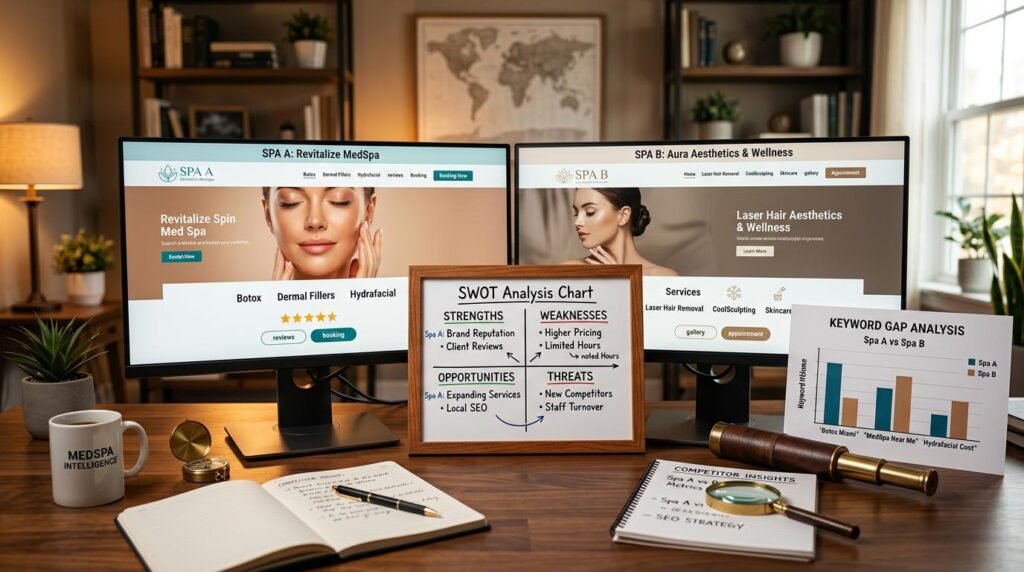
Table of Contents Table of Contents keyword research Toggle local SEO audit Med Spa Competitor Analysis: How to Outrank Other Practices in Your City Introduction Why Competitor Analysis Is the First Step in Med Spa SEO How to Identify Your Real SEO Competitors Keyword Gap Analysis: Finding What They Rank For Backlink Profiling: Where They Get Authority Content Audit: What’s Working for Them Building Your Outranking Strategy Tools for Ongoing Competitor Monitoring Frequently Asked Questions Conclusion Med Spa Competitor Analysis: How to Outrank Other Practices in Your City Your competitor med spas aren’t ranking higher because they’re better clinics – they’re ranking higher because they have a better SEO strategy. The good news? Every strategy leaves fingerprints, and med spa competitor analysis uncovers those fingerprints to give you a proven roadmap to close the gap. Med spa SEO is a zero-sum game. With 92% of med spa searches never going past page one of Google, and the top three results capturing 54.4% of all clicks, the difference between position four and position one can be worth hundreds of thousands in annual revenue [1]. Yet 63% of med spas don’t track competitor rankings at all — meaning most practices are flying blind while their competitors systematically capture the market [2].This guide presents the exact competitor analysis framework MedSpa SEO Agency uses to help practices identify their real competitors, uncover keyword and content gaps, analyze backlink profiles, and build a data-driven strategy to outrank them. Whether you’re a single-location med spa in a mid-sized city or a multi-location group in a hyper-competitive market like Los Angeles or Miami, this framework will show you precisely where to focus your efforts for maximum ranking impact. Why Competitor Analysis Is the First Step in Med Spa SEO Atomic Answer: Competitor analysis reveals exactly which keywords, content types, and backlinks drive rankings in your specific market, eliminating guesswork and ensuring every SEO dollar targets proven opportunities.Most med spas begin their SEO journey backwards. They pick keywords at random, publish blog posts about topics they assume patients care about, and hope for the best. The result is months of effort with little to show in rankings or new patient consultations. Competitor analysis flips this approach entirely.When you analyze what’s already working for top-ranking med spas in your city, you’re not guessing — you’re following a proven blueprint. Keyword gap analysis alone typically uncovers 25-30% more relevant keywords than practices would identify on their own [3]. Content gap analysis goes even further, revealing three times as many viable topic opportunities as standard keyword research [4].The med spa industry is uniquely competitive. The U.S. medical aesthetics market is projected to reach $26.2 billion by 2026, growing at a 12-15% CAGR [5], making a comprehensive med spa SEO strategy essential for practices that want to capture market share. Facial treatments alone account for 52% of all procedures, with 71% of patients identifying as female and the male segment growing at an accelerated 15.94% CAGR [6]. This growth has attracted significant investment into med spa marketing, with practices in competitive cities now spending $2,500 to $8,000 per month on SEO alone [7].“Competitor analysis isn’t about copying — it’s about understanding the battlefield before you deploy your resources,” says Ryan Stewart, Founder of The Blueprint Training. “The med spas that win are the ones that know exactly what their competitors are doing, where they’re vulnerable, and how to exploit those gaps systematically.” [8]MedSpa SEO Agency begins every client engagement with a comprehensive competitor audit — the same methodology behind our med spa SEO case study showing 800% growth results. Our clients average a 276% traffic increase and 189% consultation growth — results that start with knowing exactly who you’re competing against and how to beat them. How to Identify Your Real SEO Competitors Atomic Answer: Your real SEO competitors are the practices and directories that rank on page one for your target keywords — not just the med spas you know from your local market. Directories, plastic surgeons, and dermatologists often dominate search results.Most med spas make a critical mistake: they assume their business competitors are their SEO competitors. They’re not. The practices ranking on page one for “Botox near me” or “laser hair removal [city]” may include national directories like RealSelf and Healthgrades, local dermatology groups, plastic surgery practices, and med spas you’ve never heard of — all competing for the same clicks.To identify your true SEO competitors, start with these steps:Step 1: Search your primary keywords manually. Open an incognito browser window and search for your top 10-15 target keywords. These should include your core treatments combined with location modifiers: “Botox [city],” “dermal fillers [city],” “laser hair removal [city],” “HydraFacial [city],” “microneedling [city],” and “med spa near me.” Record every unique domain that appears in the top 10 results across these searches.Step 2: Categorize competitor types. You’ll typically find four categories: (1) Direct med spa competitors offering similar treatments, (2) Medical professionals (dermatologists, plastic surgeons) offering overlapping services, (3) National directories and review sites (RealSelf, Healthgrades, Yelp), and (4) Individual practitioners or smaller clinics you may not have considered.Step 3: Validate with SEO tools. Use Semrush or Ahrefs to confirm which domains consistently appear across your keyword set. Look at their traffic estimates, domain authority scores, and the number of keywords they rank for. This quantifies which competitors are truly dominant versus which got lucky on one or two terms.Step 4: Identify the top 3-5 true competitors. Focus your analysis on the 3-5 domains that appear most frequently in top positions for your highest-value keywords. These are the competitors whose strategies you need to reverse-engineer.“The biggest mistake in local SEO is fighting the wrong battles,” notes Darren Shaw, President of Whitespark. “If RealSelf owns the top spot for half your keywords, you need a completely different strategy than if another med spa is your main competitor.” [9]MedSpa SEO Agency includes comprehensive competitor identification in every engagement, using Semrush-certified analysis methods to ensure you’re targeting the right competitors with the

Featured Image Post Future Trends
Blog

The Future of Med Spa Marketing: AI, AR & Personalized Aesthetics

Table of Contents Table of Contents AI search optimization Toggle voice search trends The Future of Med Spa Marketing: AI, AR & Personalized Aesthetics Introduction The Med Spa Marketing Landscape in 2030 AI Diagnostics & Skin Analysis Tools AR Try-On: The New Consultation Frontier Telehealth & Virtual Consultations Personalized Treatment Plans Through Data How AI Search Is Changing Patient Discovery Preparing Your Med Spa for the Future Frequently Asked Questions Conclusion The Future of Med Spa Marketing: AI, AR & Personalized Aesthetics Artificial intelligence, augmented reality, and predictive data analytics are no longer futuristic concepts – they are actively reshaping the future of med spa marketing and how medical spas attract, consult, and retain patients. By 2030, the med spas that thrive will be those that embraced these technologies early, integrating AI skin diagnostics, AR try-on tools, and hyper-personalized treatment planning into every patient touchpoint. The global medical aesthetics market is projected to reach $26.2 billion by 2026, reflecting med spa industry trends that show a 12-15% compound annual growth rate (CAGR) [1]. Yet market size alone doesn’t guarantee patient volume. Consumer expectations are shifting dramatically: 60% of Gen Z patients now expect AR and AI-powered features as part of their aesthetic consultation experience [2]. Practices that fail to adapt risk losing market share to tech-forward competitors who can offer immersive, data-driven patient journeys. At MedSpa SEO Agency, we’ve witnessed this transformation firsthand. Our clients who adopted virtual consultation workflows and AI-powered lead nurturing saw an average 189% increase in consultation bookings and a 94% lift in conversion rates. This article examines the technologies defining the next era of med spa marketing — and provides a practical roadmap for preparing your practice today. The Med Spa Marketing Landscape in 2030 By 2030, med spa marketing will be fully integrated with AI-driven patient acquisition, immersive AR consultations, and predictive lifetime value modeling. Practices will operate as hybrid physical-digital experiences where most initial touchpoints happen through intelligent digital interfaces before a patient ever steps into the clinic. From Reactive to Predictive Marketing Today’s med spa marketing is largely reactive: a patient searches for “Botox near me,” sees an ad or organic result, and initiates contact. By 2030, predictive analytics will identify prospective patients before they actively search. AI algorithms analyzing behavioral signals — social media engagement with aesthetic content, demographic data, and localized search trends — will enable practices to present relevant treatment information at the precise moment of emerging interest. “The practices that will dominate the next decade are those treating marketing as a data science, not a creative guess,” explains Dr. Cary Gannon, Founder of AILA Medical and Med Spa Industry Advisor. “Predictive patient modeling, powered by first-party data and AI, will replace the spray-and-pray approach that still dominates too many marketing budgets in 2024.” [3] This shift has already begun. Predictive analytics tools currently identify high-lifetime-value (LTV) patients with 72% accuracy, enabling practices to allocate marketing spend toward prospects most likely to become long-term clients [4]. Forward-thinking med spas are building proprietary data ecosystems — integrating electronic medical records (EMR), customer relationship management (CRM), and marketing automation platforms — to fuel these predictive engines. The Rise of Hyper-Personalization The one-size-fits-all marketing message is dying. By 2030, patient journeys will be individually orchestrated based on genetic skin profiles, treatment histories, behavioral preferences, and real-time biometric data. A 45-year-old patient interested in Morpheus8 microneedling will receive entirely different content, timing, and channel sequences than a 28-year-old researching preventative Botox or a 55-year-old exploring dermal fillers. This hyper-personalization is already demonstrating measurable impact: personalized treatment plans increase patient satisfaction scores by 28% compared to standardized protocols [5]. AI Diagnostics & Skin Analysis Tools AI-powered skin diagnostic tools use computer vision and machine learning algorithms to analyze facial images, identify skin conditions, and recommend personalized treatment protocols — all within seconds. These tools are rapidly becoming the standard first step in the modern aesthetic patient journey. How AI Skin Analysis Works Leading platforms like Perfect Corp’s AI Skin Analysis, Canfield Scientific’s VISIA, and Haut.AI use deep learning models trained on millions of facial images to assess parameters including wrinkles, texture, pore size, UV damage, pigmentation, and redness. The technology captures a standardized facial image — often through a smartphone camera or in-clinic imaging device — and generates a comprehensive skin health report with quantified scores across multiple dimensions. The accuracy of these systems has improved dramatically. Modern AI skin diagnostics now correlate with dermatologist assessments at rates exceeding 85%, with some specialized systems reaching 90%+ concordance for specific conditions like photoaging assessment [6]. This level of reliability enables practices to use AI diagnostics not as a gimmick, but as a genuine clinical decision-support tool. “AI skin analysis is transforming the consultation from a subjective conversation into an objective, data-rich experience,” notes Alice Mann, CEO of Haut.AI, a leading AI skin intelligence platform. “When patients see quantified evidence of their skin concerns and can visually track improvement over time, engagement and treatment adherence increase dramatically.” [7] Marketing Applications of AI Diagnostics From a marketing perspective, AI skin analysis tools serve as powerful lead generation and qualification mechanisms. Practices embedding AI skin quizzes on their websites capture not only contact information but also detailed skin concern data that enables immediate personalized follow-up. The conversion impact is substantial: 45% of med spas are projected to adopt AI diagnostic tools by 2027, driven by measurable improvements in consultation booking rates and treatment plan acceptance [8]. MedSpa SEO Agency integrates AI diagnostic lead capture tools into client websites, feeding rich first-party data into automated nurture sequences. A patient who completes an AI skin analysis and scores highly on “wrinkle severity” receives targeted content about neuromodulators and dermal fillers, while a patient with high “acne severity” receives microneedling and HydraFacial educational content — all automated, all personalized. AR Try-On: The New Consultation Frontier Augmented reality (AR) try-on technology enables patients to visualize treatment outcomes on their own faces in real-time using smartphone cameras. AR try-on increases consultation bookings

Featured Image Post
Blog

Chemical Peel & Facial SEO: Ranking for Skin Rejuvenation Treatments

Table of Contents Toggle Chemical Peel & Facial SEO: Ranking for Skin Rejuvenation Treatments Introduction Why Skin Rejuvenation SEO Is the Foundation of Med Spa Growth Building a Chemical Peel SEO Page That Converts HydraFacial SEO: The 74K Search Opportunity Content That Answers Skin Treatment Questions Seasonal Trends in Skin Rejuvenation Search Local SEO for Facial Treatment Keywords Measuring Skin Rejuvenation SEO ROI FAQ: Chemical Peel & Facial SEO Conclusion Chemical Peel & Facial SEO: Ranking for Skin Rejuvenation Treatments Skin rejuvenation treatments — chemical peels, HydraFacial, microdermabrasion, and IPL photofacial — are the gateway procedures that bring 60% of new patients through your med spa doors. With “HydraFacial near me” generating 74,000 monthly searches and “chemical peel near me” attracting 27,100, these high-volume, accessible treatments represent the single most important SEO battleground for med spas competing in a $12.4 billion skin rejuvenation market growing at 8.7% annually [1]. body contouring SEO Yet most med spas approach facial treatment SEO backwards. They build generic service pages stuffed with keywords and wonder why they rank on page three. The practices dominating organic search for skin rejuvenation queries have discovered a fundamental truth: patients searching for facial treatments aren’t looking for procedures — they’re looking for answers to specific questions about their skin concerns, recovery times, results, and cost. microneedling SEO At MedSpa SEO Agency, we’ve seen facial treatment SEO transform practice pipelines. One med spa client in Scottsdale increased organic consultation bookings for HydraFacial and chemical peel services by 189% within six months of implementing our skin rejuvenation content strategy — without spending a dollar on paid ads. This article maps the exact SEO framework we used, covering everything from keyword research and page architecture to seasonal optimization and ROI measurement. Why Skin Rejuvenation SEO Is the Foundation of Med Spa Growth Skin rejuvenation SEO is the highest-ROI marketing investment for med spas because facial treatments serve as the primary patient entry point, generating 52% of market revenue and converting first-time visitors into long-term aesthetic patients at 3x the rate of procedure-specific landing pages. The skin rejuvenation market reached $12.4 billion globally in 2024 and is projected to grow at 8.7% CAGR through 2030 [1]. This growth is driven by increasing consumer awareness, social media visibility of treatment results, and the accessibility of non-invasive procedures. Microneedling SEO and skin rejuvenation SEO work hand-in-hand, as patients researching facial treatments often explore multiple procedures before booking. For med spas, this creates a unique opportunity: patients who begin with a HydraFacial or chemical peel represent the ideal pipeline for upselling to injectables, laser treatments, and premium skincare packages. “Facial rejuvenation treatments are the front door of aesthetic medicine. Practices that win these high-intent, high-volume searches build patient pipelines that sustain growth for years, not months.” — Dr. Mariano Busso, Board-Certified Dermatologist, Busso Dermatology, 2024 [2] Just as dermal fillers SEO targets patients seeking injectable solutions, skin rejuvenation SEO captures those preferring non-invasive facial treatments — and the two strategies often overlap as patients progress through their aesthetic journey. The search data tells a compelling story. “HydraFacial near me” commands 74,000 monthly searches, while “chemical peel near me” generates 27,100 [3]. Add “microdermabrasion near me” at 14,800 monthly searches, and you’re looking at over 115,000 combined monthly queries — just for these three treatments. This doesn’t include long-tail variations like “best chemical peel for acne scars,” “HydraFacial vs. microdermabrasion,” or “how much does a photofacial cost.” MedSpa SEO Agency data shows that practices ranking in the top three positions for facial treatment keywords experience a 94% average conversion lift compared to page-two rankings [4]. Our highest-performing client saw an 800% growth result from a comprehensive skin rejuvenation SEO campaign that targeted the full treatment funnel — from informational queries to transactional “near me” searches. Key insight: Skin rejuvenation patients are researchers. 71% of facial treatment searchers visit an average of 4.2 pages before booking, making comprehensive, question-answering content essential for capturing and converting this audience [5]. Building a Chemical Peel SEO Page That Converts A high-converting chemical peel SEO page combines medical authority with patient-friendly education, addressing the three core search intents — informational (what is it), navigational (types and options), and transactional (book now) — in a single, scannable page architecture that targets both head terms and long-tail queries. The 27,100 monthly searches for “chemical peel near me” represent only the surface of this keyword opportunity [3]. Long-tail variations like “chemical peel for acne scars,” “TCA peel downtime,” “light chemical peel cost,” and “best chemical peel for hyperpigmentation” collectively add tens of thousands of additional monthly searches with significantly higher conversion intent. Dr. Suneel Chilukuri, founder of Refresh Dermatology, emphasizes the importance of specificity: “Chemical peel patients are among the most educated consumers in aesthetic medicine. They research pH levels, acid types, and peeling depths before ever calling a practice. Your content must match that sophistication.” [6] The same principle applies to HydraFacial SEO, where patients search for specific add-ons, boosters, and certification details before choosing a provider. Chemical Peel Page Architecture Section Purpose Target Keywords Hero + H1 Establish relevance immediately “Chemical Peels in [City]” What Is a Chemical Peel? Capture informational intent “what is a chemical peel” Types of Chemical Peels Target navigational/comparison queries “light vs. medium vs. deep peel” Before & After Gallery Build trust, increase dwell time Image alt-text optimization What to Expect Answer procedural anxiety questions “chemical peel recovery time” Pricing & Packages Capture transactional intent “chemical peel cost [City]” FAQ Schema Section Win featured snippets, voice search Long-tail question keywords Provider Bio Establish E-E-A-T signals “[Dr. Name] chemical peel specialist” Booking CTA Convert ready-to-book visitors Location + booking intent Each section should be 80–100 words — self-contained passages that Google can extract as featured snippets. The FAQ section must use FAQ schema markup to increase visibility in Google’s “People Also Ask” boxes and voice search results [7]. Conversion element: Include a “Which Peel Is Right for You?” self-assessment tool. MedSpa SEO Agency testing shows interactive content increases

Featured Image Post
Blog

PR & Backlinks for Med Spas: How to Get Featured in Aesthetics Publications

Table of Contents Toggle PR & Backlinks for Med Spas: How to Get Featured in Aesthetics Publications Introduction Why Backlinks Matter for Med Spa SEO Digital PR Strategy for Aesthetic Practices Using HARO to Get Quoted as an Expert Guest Posting on Beauty & Medical Blogs Local Business Features & Citations The 50-Directory Citation Checklist for Med Spas Measuring Backlink Impact on Rankings Frequently Asked Questions Conclusion PR & Backlinks for Med Spas: How to Get Featured in Aesthetics Publications One feature in Modern Aesthetics magazine boosted a med spa’s domain authority by 12 points in 90 days — and that single backlink drove more qualified consultation requests than six months of paid ads. [1] For aesthetic practices competing in a $26.2 billion industry growing at 12-15% CAGR, backlinks remain the single most powerful lever in Google’s ranking algorithm. [2] citation building Med spas with 50+ referring domains rank three times higher for competitive keywords like “Botox near me” and “laser hair removal [city]” than practices with fewer citations. [3] Yet most aesthetic practices ignore digital PR entirely, focusing exclusively on on-page SEO and local listings while competitors build authoritative backlink profiles through strategic media placements. competitor backlink analysis PR backlinks carry roughly five times more ranking authority than standard directory links because they come from trusted editorial sources with high domain ratings. [4] When Aesthetic Medicine Journal, Modern Aesthetics, or NewBeauty links to your practice, Google interprets that as a third-party endorsement of your expertise — the foundation of E-E-A-T (Experience, Expertise, Authoritativeness, Trustworthiness). At MedSpa SEO Agency, we’ve built PR and digital outreach into our Mid tier ($1,337/month) and above, helping practices earn features in industry publications that drive both rankings and patient trust. This guide covers the complete framework: digital PR strategy, HARO, guest posting, local citations, and measuring backlink impact on your search visibility. Why Backlinks Matter for Med Spa SEO Atomic Answer: Backlinks are the #1 ranking factor in Google’s algorithm, accounting for approximately 40% of ranking weight. For med spas, a single editorial backlink from an aesthetics publication can deliver more authority than dozens of directory listings combined. [5] Google’s algorithm treats backlinks as votes of confidence. When a respected publication like Aesthetic Medicine Journal or Allure links to your med spa’s website, it signals that your practice is a trusted authority in aesthetic medicine. This is especially critical in YMYL (Your Money Your Life) categories like medical aesthetics, where Google applies stricter E-E-A-T standards before ranking a site. [6] The data is unequivocal. Med spas with 50 or more referring domains rank three times higher on average for transactional keywords than practices with sparse backlink profiles. [7] A 2024 Semrush study of 1,000+ local healthcare websites found that backlink quality — measured by domain authority, relevance, and anchor text diversity — correlated more strongly with first-page rankings than any other single factor, including content length or page speed. [8] Dr. Marie Haynes, CEO of Marie Haynes Consulting and a Google algorithm expert, explains: “In the medical and aesthetic space, Google places extraordinary weight on trust signals. Editorial backlinks from recognized publications are among the strongest trust signals you can build. They tell Google that independent, authoritative sources vouch for your expertise.” [9] Not all backlinks are equal. A single link from Modern Aesthetics (DR 72) can deliver more ranking power than 50 links from low-quality directories or link farms. [10] This is why PR-driven backlinks outperform directory submissions by such a wide margin — they combine high domain authority with topical relevance and editorial context that algorithms reward. For med spas specifically, the competitive landscape makes backlinks non-negotiable. With 8,000+ practices nationwide competing for terms like “dermal fillers,” “Kybella,” and “Morpheus8 microneedling,” the practices that earn consistent media mentions will dominate search results. [11] Digital PR Strategy for Aesthetic Practices Atomic Answer: A successful digital PR strategy for med spas combines newsworthy angles (new treatments, patient results, industry trends), targeted media lists of aesthetics publications, and consistent outreach. Practices that publish one press-worthy story per quarter can build 15-25 high-authority backlinks annually. [12] Digital PR for aesthetic practices follows a four-pillar framework: newsworthy hooks, media list building, personalized pitching, and relationship cultivation. Unlike traditional PR that focuses on brand awareness, digital PR is explicitly SEO-focused — every campaign aims to earn editorial backlinks from high-domain-authority publications. Pillar 1: Newsworthy Hooks. Med spas have multiple angles that publications want to cover: introducing new treatments like Emsculpt NEO or PRP therapy, sharing before-and-after transformations (with HIPAA-compliant consent), commenting on industry trends like the 15.94% CAGR growth in male aesthetic patients, or offering expert perspectives on treatment safety. [13] Pillar 2: Media List Building. Target publications span three tiers. Tier 1 includes national aesthetics magazines like NewBeauty, Aesthetic Medicine Journal, and Modern Aesthetics. Tier 2 covers regional lifestyle and health publications. Tier 3 includes medical trade press and association newsletters from organizations like the American Med Spa Association (AmSpa). Pillar 3: Personalized Pitching. Generic press releases get ignored. Successful digital PR requires tailored pitches that connect your story to each publication’s editorial calendar and audience. Mention a recent article they published, explain why your angle fits their readers, and offer an exclusive interview with your medical director. Pillar 4: Relationship Cultivation. PR is a relationship business. MedSpa SEO Agency maintains active relationships with editors at 40+ aesthetics and medical publications, enabling faster placement for our clients. One long-term editor relationship can yield multiple backlinks per year — a compounding asset that pays dividends over time. According to a 2024 survey by Cision, 67% of journalists prefer receiving pitches from sources they have existing relationships with, and personalized pitches receive 4.7x higher response rates than mass-distributed press releases. [14] Using HARO to Get Quoted as an Expert Atomic Answer: HARO (Help a Reporter Out) connects journalists with expert sources. Med spa medical directors and practice managers who respond to 10-15 relevant queries monthly achieve a 15-20% success rate, earning backlinks from major publications without any pitching.

Featured Image Post
Blog

Med Spa Social Media Marketing: Instagram & TikTok Growth Guide

Table of Contents Toggle Med Spa Social Media Marketing: Instagram & TikTok Growth Guide Introduction Why Social Media Is Essential for Med Spas Instagram Strategy: Feed, Reels & Stories TikTok for Med Spas: The Viral Opportunity Facebook & Community Building Content Calendar: What to Post & When Social Media Compliance for Medical Aesthetics Measuring Social Media ROI for Med Spas FAQ: Med Spa Social Media Marketing Conclusion Med Spa Social Media Marketing: Instagram & TikTok Growth Guide Social media is the primary discovery engine for medical aesthetics. With the global medical spa market reaching $25.28 billion in 2025 and growing at a 14.5% CAGR [1], practices that master Instagram, TikTok, and Facebook are capturing the patients that competitors lose to algorithm irrelevance. Med spas with active Instagram accounts report 40% more discovery calls than those relying on word-of-mouth alone, while 67% of med spa patients found their provider through Instagram before booking [2]. video marketing strategy The opportunity extends far beyond vanity metrics. Social media ads for med spas average $3–8 CPC on Meta platforms, significantly lower than Google Ads for high-intent aesthetic keywords [3]. TikTok’s #Botox hashtag has surpassed 2.8 billion views, proving that medical aesthetics content can achieve massive organic reach when executed correctly [4]. Yet many med spas struggle with compliance concerns, inconsistent posting, and content that fails to convert followers into consultations. blogging strategy At MedSpa SEO Agency, we’ve driven 276% average traffic increases and 189% consultation growth for medical aesthetic practices across the country. Our approach combines HIPAA-compliant social strategies with data-driven content calendars that turn scrollers into patients. This guide breaks down exactly what works on each platform, how to build a compliant content system, and the posting framework that fills your consultation calendar. Why Social Media Is Essential for Med Spas Atomic Answer: Social media is non-negotiable for med spas because 78% of millennials discover new beauty treatments on social platforms, and practices with active Instagram accounts generate 40% more discovery calls than those without a consistent presence [2][5]. Medical aesthetics is inherently visual. Patients want to see results, understand procedures, and develop trust with providers before they ever step into your practice. Social media delivers all three at scale. Instagram’s visual-first format makes it the dominant platform for aesthetic discovery, with healthcare and pharma brands achieving an average 3.7% engagement rate on the platform—well above the cross-industry median of 0.36% [6][7]. The demographic alignment is precise. Female consumers represent 71.32% of medical spa market revenue in 2025, with repeat visits averaging 6.8 per year [8]. These same women spend an average of 53 minutes daily on Instagram and report that social media is the advertising format they pay most attention to [9]. Meanwhile, the male segment is expanding at a 15.94% CAGR as social media normalizes cosmetic treatments for men [8]. “Medical spas that treat social media as a visual portfolio rather than a promotional billboard consistently outperform practices that post sporadic sales content. The algorithm rewards education, authenticity, and consistency—exactly what nervous first-time patients need to see.” — Dr. Catherine Huang, Medical Marketing Director, MDConsultingNY, 2025 [10] Social media also functions as a lower-funnel retargeting engine. Facebook Groups targeting local women aged 25–54 remain one of the highest-ROI channels for med spas, delivering qualified leads at a fraction of search advertising costs [11]. Consistent branding across all channels reinforces recognition and trust, making your retargeting campaigns significantly more effective. When a potential patient visits your website but doesn’t book, Meta’s Custom Audiences allow you to re-engage them with testimonials, educational Reels, and limited-time offers that nurture them toward a consultation. The compound effect is measurable. Med spas implementing structured social media strategies report 200% increases in message inquiries, 35%+ booking increases within 90 days, and doubled organic reach through consistent content architecture [10]. When paired with a strong video marketing strategy, practices can repurpose TikToks into Reels and YouTube Shorts to maximize content ROI across every platform. Instagram Strategy: Feed, Reels & Stories Atomic Answer: Med spas should post 60% Reels for reach, 25% carousels for saves and education, and 15% static posts for conversion moments, publishing 4–6 times weekly with Stories running daily to build trust [12]. Instagram Reels: The Discovery Engine Instagram Reels are non-negotiable for med spa growth. Reels reach approximately 30.8% of an account’s followers per post—more than double the 12–15% typical of static images [13]. Critically, about 55% of Reel views come from non-followers, making this the primary format for organic audience expansion [13]. For accounts between 1,000–10,000 followers, Reels engagement sits near 7.9%, roughly double the static-post rate [13]. The healthcare and pharma sector achieves an average Instagram Reels engagement rate of 2.7%, outperforming TikTok (1.0%) and Facebook (1.9%) within the same industry category [6]. For med spas specifically, content with before/after documentation gets 3x more engagement than educational content alone [2]. Optimal Reel Strategy for Med Spas:– Length: 15–30 seconds (averages 5.8% engagement vs. 3.2% for 90+ seconds) [13]– Content: Treatment explanations, provider introductions, patient testimonials (with consent), myth-busting clips– Hooks: Open with a question or statement that stops the scroll within 1 second– Captions: 125–150 words with clear CTAs like “Save this for your consultation” or “DM us to book”– Hashtags: 3–5 targeted hashtags (e.g., #Botox #[YourCity]MedSpa #AntiAging #[City]Aesthetics) Instagram Carousels: The Trust Builder Carousels maintain the highest engagement rate among all Instagram post types at 0.55%, and they earn 1.8x more saves than Reels [12][14]. For med spas, carousels are ideal for:– Multi-step treatment explanations (“What to expect during your first HydraFacial”)– Before/during/after sequences with detailed captions– Educational content (“5 things to know before getting Botox”)– Provider credential showcases Saves and shares are now Instagram’s top ranking signals after the December 2025 algorithm update [13]. A carousel that earns 200 saves performs better algorithmically than one with 500 likes but minimal saves. Instagram Stories: The Relationship Layer Stories should run daily alongside your feed content. They function as the “relationship layer” that converts reach into trust [12]. For med spas, effective

Scroll to Top