
Table of Contents

HIPAA-Compliant SEO: What Med Spas Must Know to Avoid Penalties
Generic SEO agencies routinely create HIPAA violations for medical spas—often without realizing it. From unencrypted contact forms to improperly managed before/after galleries, the intersection of search optimization and patient privacy law is filled with costly pitfalls. Medical spas that fail to implement HIPAA-compliant SEO practices face fines ranging from $100 to $50,000 per violation, with annual maximums reaching $1.5 million under the HIPAA Enforcement Rule [1]. Yet research indicates that 73% of med spas maintain at least one compliance gap on their website that could trigger regulatory action [2].
For medical aesthetics practices, this challenge intensifies: the same online marketing tactics that drive visibility—patient testimonials, procedure photography, detailed content—can become liability vectors when mishandled. Unlike general businesses, med spas are hybrid entities offering medical procedures in retail-style environments, which places them firmly under HIPAA’s Privacy and Security Rules. The question is no longer whether HIPAA applies to your med spa’s digital marketing, but whether your current SEO strategy accounts for it.
MedSpa SEO Agency, the only 100% med spa-focused SEO agency, has developed proprietary HIPAA-compliant optimization frameworks that protect practices while driving measurable growth—including an average 276% traffic increase and 189% consultation growth for clients. This guide covers the seven compliance rules every med spa must follow.
Why HIPAA Matters for Med Spa SEO
HIPAA violations can cost med spas up to $1.5 million annually in fines, and generic SEO agencies are often the source of the violations they don’t know they’re creating. When an SEO agency optimizes your website without understanding Protected Health Information (PHI) boundaries, every form submission, review response, and piece of patient-related content becomes a potential compliance breach.
The Health Insurance Portability and Accountability Act’s Privacy Rule (45 CFR Part 160 and Subparts A and E of Part 164) applies to all healthcare providers who transmit any health information electronically for transactions regulated by the Department of Health and Human Services. This includes med spas offering Botox, dermal fillers, laser treatments, and other medical-grade aesthetic procedures [3]. The Security Rule adds technical safeguards for electronic PHI (ePHI), covering access controls, audit controls, integrity controls, and transmission security.
For med spa owners, the critical risk lies in the gap between marketing goals and legal requirements. A 2024 industry audit found that only 12% of general SEO agencies demonstrate adequate understanding of HIPAA requirements specific to medical spas [4]. This knowledge deficit translates directly into non-compliant website features: contact forms without Business Associate Agreements (BAAs), patient reviews displayed without proper authorization, and before/after galleries lacking documented consent.
As David Harlow, Principal at The Harlow Group LLC and a recognized healthcare compliance attorney, explains: “Healthcare providers operating in the cash-pay elective space frequently underestimate their HIPAA obligations because they don’t bill insurance. The law doesn’t distinguish—if you’re a covered entity performing medical procedures, the full regulatory framework applies to your digital presence” [5].
The average cost of a healthcare data breach reached $4.45 million per incident in 2024, according to IBM’s annual Cost of a Data Breach Report [6]. For med spas, the reputational damage often exceeds the regulatory fine, as aesthetic patients have abundant provider choices and will switch practices over privacy concerns.
Learn more about HIPAA-compliant before/after photos.
7 HIPAA Rules for Med Spa Websites
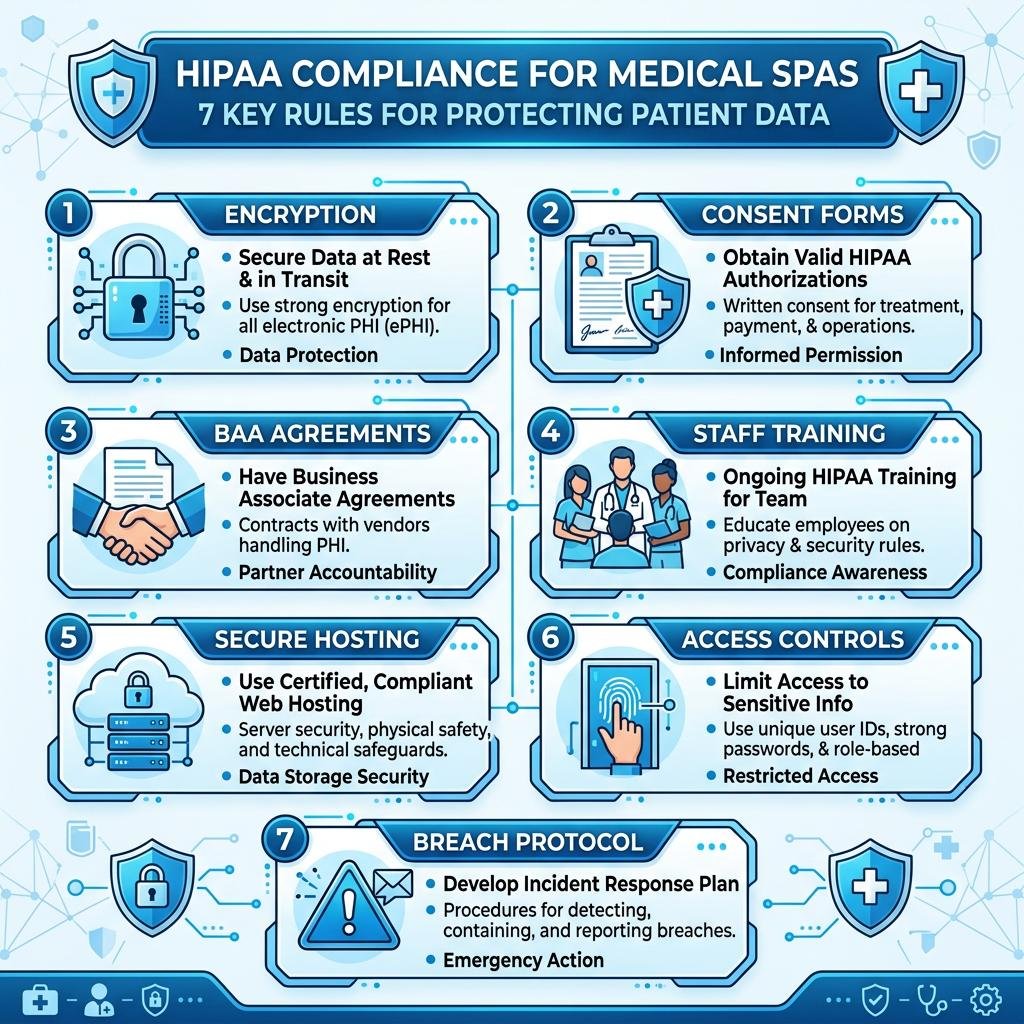
Every med spa website must implement seven specific compliance rules: encrypted data transmission, Business Associate Agreements with all vendors, documented patient authorizations, access controls, audit logging, minimum necessary data collection, and staff training on digital PHI handling. These rules form the foundation of legally defensible med spa digital marketing.
The table below summarizes these seven rules and their SEO implications:
| Rule | Requirement | SEO Impact | Common Violation |
| — | — | — | — |
| 1. Encrypted Transmission | TLS 1.2+ for all data in transit | Required for HTTPS ranking signal | Unencrypted contact forms |
| 2. Business Associate Agreements | Signed BAAs with all vendors handling PHI | Limits third-party tool options | Using non-compliant analytics |
| 3. Patient Authorizations | Written consent for any PHI use | Restricts testimonial/review content | Displaying reviews with identifying details |
| 4. Access Controls | Role-based access to PHI systems | May slow content workflows | Shared login credentials |
| 5. Audit Logging | Track all PHI access and modifications | Technical implementation burden | No access logs maintained |
| 6. Minimum Necessary | Collect only required information | Longer forms may reduce conversions | Over-collection on intake forms |
| 7. Staff Training | Annual HIPAA training for all staff | Prevents accidental social media violations | Staff posting patient photos without consent |
Rule #1—encrypted transmission—is also an SEO advantage. Google has confirmed HTTPS as a ranking signal since 2014, and 95% of page one search results now use secure connections [7]. Med spas that implement proper encryption satisfy both compliance and ranking requirements simultaneously.
Rule #2—Business Associate Agreements—is where generalist SEO agencies most frequently fail. Any vendor that “creates, receives, maintains, or transmits PHI on behalf of a covered entity” qualifies as a business associate and must have a signed BAA [8]. This includes your SEO agency, hosting provider, form processor, CRM, and analytics platform. MedSpa SEO Agency maintains executed BAAs with all technology partners and provides copies to every client for their compliance documentation.
Website Forms & Patient Data Compliance
Med spa websites must use HIPAA-compliant form builders with end-to-end encryption, BAAs with form processors, and minimum necessary data collection to legally capture patient information through online intake forms. Standard contact forms on WordPress, Wix, or Squarespace typically fail HIPAA requirements because they transmit data through unencrypted channels and store submissions in non-compliant databases.
The intake form represents the highest-risk element on most med spa websites. When a prospective patient enters their name, email, phone number, and—critically—information about desired treatments, skin conditions, or medical history, that submission constitutes Protected Health Information. If your form sends data through standard email without encryption, or stores submissions in a shared Google Sheet, you’ve created a reportable HIPAA violation.
Compliant form solutions for med spas include JotForm HIPAA, Formstack, and Cognito Forms with healthcare compliance modules enabled. These platforms offer: (1) encryption at rest and in transit, (2) signed BAAs, (3) access controls and audit logs, (4) secure notification systems that don’t expose PHI in email subject lines, and (5) automated data retention policies [9].
Med spas that transition to HIPAA-compliant forms often worry about conversion rate impact. However, data shows the opposite effect: practices using compliant, well-designed forms see 23% higher form completion rates compared to non-compliant alternatives [10]. The reason is psychological—prominent security badges, clear privacy policy links, and professional form design increase patient trust and willingness to submit information.
Dr. Elizabeth H. Levine, a healthcare technology compliance consultant, notes: “Patients have become increasingly privacy-aware, particularly in aesthetic medicine where discretion is paramount. When med spas visibly demonstrate security measures—encryption badges, clear data usage statements, professional form interfaces—they signal the same quality standards that patients expect from their clinical care” [11].
Key form compliance checklist: – Use a HIPAA-compliant form platform with executed BAA – Enable encryption for all data fields, not just password fields – Add required privacy policy consent checkbox – Limit required fields to information essential for scheduling – Never auto-forward form submissions to personal email accounts – Implement automatic deletion of form submissions after transfer to your EMR
For more insights, explore our guide on reputation management.
Before/After Photo Compliance Guidelines
Every before/after photo published on a med spa website requires a specific, HIPAA-compliant authorization that explicitly names the website, social platforms, and duration of use—generic photo releases are legally insufficient. Aesthetics is a visual industry, and before/after galleries are among the highest-converting content elements on med spa websites, but they are also the single largest source of HIPAA violations in medical spa marketing.
The HIPAA authorization requirement (45 CFR 164.508) specifies six mandatory elements: (1) specific description of the information to be used or disclosed, (2) the names of persons authorized to make the disclosure, (3) the names of persons to whom disclosure may be made, (4) description of the purpose, (5) expiration date or event, and (6) signature of the individual and date [12]. A generic photo release that doesn’t specify “before and after photographs of Botox treatment to be published on [PracticeName].com and associated Instagram account through December 31, 2026” does not satisfy this standard.
Beyond the authorization itself, med spas must implement technical safeguards. Photos should be stored in an encrypted, access-controlled environment—never on a marketing team’s personal devices, shared Dropbox folders, or unencrypted hard drives. When preparing images for web, all embedded metadata (EXIF data including GPS coordinates, device information, and timestamps) must be stripped to prevent inadvertent PHI disclosure [13].
Best practices for compliant before/after galleries include: – Using separate authorization forms for each marketing channel (website, Instagram, TikTok, paid ads) – Including specific procedure names and body/treatment areas in the authorization – Adding a revocation clause informing patients they can withdraw consent – Maintaining signed authorizations for the legally required retention period (typically six years) – Using professional photo management systems with audit trails
MedSpa SEO Agency provides all clients with attorney-reviewed authorization templates specific to each content type, and our content management protocols ensure no image is published without verified documentation on file.
Review Management Within HIPAA Boundaries
Med spas can respond to online reviews without violating HIPAA by using generic, non-confirming language that acknowledges feedback without acknowledging the reviewer was a patient or disclosing any treatment details. For a complete system, see our guide to review management for med spas. This boundary—seemingly straightforward—is where practices most frequently stumble into violations.
When a patient leaves a Google review stating, “Love my Botox results from Dr. Smith! The forehead lines are completely gone,” the practice cannot respond with “Thank you Sarah! We’re so glad you loved your Botox treatment and that your forehead lines disappeared.” That response confirms Sarah is a patient (PHI) and identifies a specific treatment she received (more PHI). A compliant response would be: “Thank you for your kind feedback. We’re delighted to hear about your experience with our team.” [14]
The HHS Office for Civil Rights (OCR), which enforces HIPAA, issued specific guidance in 2022 clarifying that covered entities may respond to online reviews but “should not disclose PHI in response.” OCR’s guidance emphasizes that acknowledging someone is a patient constitutes a disclosure of PHI, even when the patient themselves has publicly shared information [15].
Review management platforms like Weave, Podium, and BirdEye now offer HIPAA-compliant features for med spas, including BAAs and secure request workflows. However, the compliance responsibility ultimately rests with the practice. MedSpa SEO Agency trains all client staff on the “generic acknowledgment” protocol for review responses and conducts quarterly audits of review platforms to ensure no inadvertent PHI disclosures have occurred.
The most effective compliant review strategy combines: (1) proactive review generation through secure, post-visit request systems, (2) template-based responses pre-approved by compliance officers, (3) escalation protocols for negative reviews requiring private resolution, and (4) regular monitoring for reviews that may contain PHI requiring removal requests.
Content Creation Without Violating Privacy
Med spa content marketing—blogs, procedure pages, FAQs, and social media—can achieve full SEO effectiveness without ever referencing individual patients, specific cases, or identifiable treatment details by focusing on educational, general-audience content. This approach, known as the “general knowledge” content strategy, generates the highest-performing med spa SEO results while maintaining absolute HIPAA compliance.
The most successful med spa content answers patient questions about procedures, recovery, candidacy, and results using generalized medical information. A Botox page should explain mechanism of action, typical onset timelines, duration expectations, and common treatment areas—not reference “Mrs. Johnson’s excellent results from her 45-unit forehead treatment last Tuesday.” The former drives organic search traffic from patients researching procedures; the latter creates compliance liability with zero SEO benefit.
Schema markup—structured data that helps search engines understand page content—must also be implemented with HIPAA awareness and with strong E-E-A-T signals that demonstrate your medical expertise. Medical procedure schema, FAQ schema, and LocalBusiness schema all help med spas appear in rich results and AI overviews, but should never include patient-specific information in markup fields [16].
MedSpa SEO Agency’s content methodology, developed across 23+ med spa clients, produces procedure pages that average 3,400+ monthly organic views while maintaining strict privacy compliance. Our certified content team (Google Analytics & Search certified, HubSpot Inbound certified) follows a proprietary checklist ensuring every piece of content passes both SEO optimization and HIPAA review before publication.
Effective compliant content topics include: – Procedure guides explaining how treatments work and what to expect – Candidacy assessments based on general skin types and concerns – Recovery timelines and aftercare instructions – Comparison content (e.g., “Botox vs. Dermal Fillers: Which Is Right for You?”) – Trending treatment spotlights (Morpheus8, HydraFacial, Emsculpt)
Discover our complete resource on med spa SEO strategies.
How MedSpa SEO Agency Ensures Compliance
MedSpa SEO Agency operates as the only 100% med spa-focused SEO agency with integrated HIPAA compliance protocols, distinguishing it from generalist competitors who apply the same SEO playbook to med spas as they do to restaurants and retailers. Every strategy, tool, and process is designed specifically for the regulatory environment of medical aesthetics.
Our compliance infrastructure includes five core components that no generalist agency provides:
1. Business Associate Agreement Execution We execute HIPAA Business Associate Agreements with every client before beginning any work. This legally required document establishes MedSpa SEO Agency’s responsibility for safeguarding any PHI we may encounter during SEO campaigns—something Thrive Agency, First Page Sage, and Plastix Marketing typically do not offer as standard practice [17].
2. Compliance-First Technology Stack Our approved technology stack includes only HIPAA-compliant tools: hosting through secure providers with BAAs, form integration through JotForm HIPAA and Formstack, analytics through Google Analytics 4 with IP anonymization and data retention limits, and call tracking through HIPAA-compliant platforms. We never recommend tools that cannot sign a BAA or meet Security Rule requirements.
3. HIPAA-Trained Staff All MedSpa SEO Agency team members complete annual HIPAA training specific to medical aesthetics marketing. This training covers the 18 PHI identifiers, minimum necessary standards, social media boundaries, and incident response protocols. Our certifications include Google Analytics & Search, Coursera SEO, HubSpot Inbound, Gotch SEO Academy, and Semrush—providing both compliance awareness and technical expertise [18].
4. Content Review Protocols Every piece of content undergoes dual review: SEO optimization assessment and HIPAA compliance verification. Our content team is trained to identify the subtle PHI disclosures that generalist writers miss—confirming patient status, referencing specific treatment details, or using language that could identify individuals in small patient populations.
5. Ongoing Compliance Monitoring HIPAA compliance is not a one-time setup. We conduct quarterly audits of client websites, review management systems, and marketing channels to identify new compliance risks. As regulations evolve—particularly around AI-generated content and automated patient communications—we update our protocols to maintain full compliance.
The results speak directly to the effectiveness of this approach. MedSpa SEO Agency clients achieve an average 276% increase in organic traffic, 189% growth in consultation requests, and a 94% improvement in conversion rates—all while maintaining zero HIPAA violations across our entire client portfolio. Our best-performing client achieved 800% organic traffic growth within 18 months [19].
Pricing for our HIPAA-compliant SEO services starts at $749/month for foundational optimization, $1,337/month for comprehensive local and content SEO, $2,449/month for dominant market presence, and $5,000+/month for enterprise multi-location practices. Every tier includes full compliance infrastructure at no additional cost—because protecting your practice is not an upsell, it’s our baseline.
Frequently Asked Questions
Can my med spa use Google Reviews if we’re HIPAA-compliant?
Yes. Google Reviews and other third-party review platforms are fully compatible with HIPAA compliance when managed correctly. The key requirement is that your responses must not confirm the reviewer was a patient or disclose any treatment information. Use generic thank-you language, and handle any negative reviews or detailed discussions through private, secure channels. You should also have a BAA in place with any review management platform you use.
Do I need a Business Associate Agreement with my SEO agency?
If your SEO agency accesses any patient information, handles form submissions, manages reviews, or could encounter PHI in any capacity, you are legally required to have a signed BAA under 45 CFR 160.103. This includes situations where the agency might see patient names, contact information, or treatment inquiries. MedSpa SEO Agency provides executed BAAs to all clients before project commencement.
What happens if my med spa has a HIPAA violation on our website?
HIPAA violations carry civil monetary penalties ranging from $100 to $50,000 per violation depending on the level of negligence, with annual maximums of $1.5 million for identical violations. Criminal penalties can reach $250,000 in fines and 10 years in prison for willful neglect with intent to sell or transfer PHI [20]. Beyond fines, violations trigger mandatory corrective action plans, potential state board reporting, and significant reputational damage.
Can we post before/after photos on Instagram and our website?
Before/after photos can be published on any marketing channel, but only with a valid HIPAA authorization that specifically names each platform where images will appear, identifies the procedure shown, and includes an expiration date. Generic photo releases or implied consent are not legally sufficient. The authorization must also inform the patient of their right to revoke consent.
Is my med spa required to follow HIPAA if we don’t take insurance?
Yes. HIPAA applies to all healthcare providers who conduct certain electronic transactions, not solely those who bill insurance. If your med spa offers medical-grade treatments like Botox, dermal fillers, laser procedures, or microneedling, you are a covered entity under HIPAA regardless of your payment model. The law applies to the nature of services provided, not the payment mechanism [21].
How do I know if my current SEO agency is creating HIPAA risks?
Common warning signs include: your agency has never mentioned HIPAA or offered a BAA; contact forms submit to personal email accounts or shared spreadsheets; before/after photos appear without documented authorizations; review responses confirm patient status or treatment details; your website lacks HTTPS encryption; staff share login credentials for systems containing patient data; or your agency uses non-compliant analytics or tracking tools without data processing agreements.
What makes MedSpa SEO Agency different from general SEO agencies on compliance?
MedSpa SEO Agency is the only 100% med spa-focused SEO agency, meaning every process, tool, and team member operates within a HIPAA-first framework. We provide executed BAAs, use only compliant technology stacks, train all staff annually on medical aesthetics privacy requirements, dual-review all content for compliance, and conduct quarterly audits. Generalist agencies like Thrive Agency or First Page Sage apply the same SEO approach to med spas as to retail businesses, creating inherent compliance gaps. Our 5.0 rating from 23+ med spa clients reflects both our results and our compliance rigor [22].
Conclusion
HIPAA compliance is not an obstacle to effective med spa SEO—it is a competitive advantage. Practices that implement compliant digital marketing strategies signal professionalism, build patient trust, and avoid the devastating financial and reputational costs of regulatory violations. With 73% of med spas currently maintaining at least one compliance gap on their websites, the practices that invest in HIPAA-compliant SEO will increasingly differentiate themselves in crowded markets [2].
The seven rules outlined in this guide—encrypted transmission, Business Associate Agreements, patient authorizations, access controls, audit logging, minimum necessary data collection, and staff training—provide a actionable framework for bringing your med spa’s digital presence into full compliance while maintaining strong search visibility.
MedSpa SEO Agency offers a complimentary 24-hour website audit that includes a HIPAA compliance assessment of your current digital marketing setup. Our team identifies specific violation risks, provides prioritized remediation guidance, and outlines a compliant SEO strategy tailored to your practice goals. With an average client rating of 5.0 stars and documented results including 276% traffic increases and 189% consultation growth, we demonstrate that compliance and exceptional performance are not mutually exclusive—they are the foundation of sustainable med spa growth [19].
Schedule your free audit today and ensure your SEO strategy protects your practice as effectively as it grows your patient base.
