Table of Contents
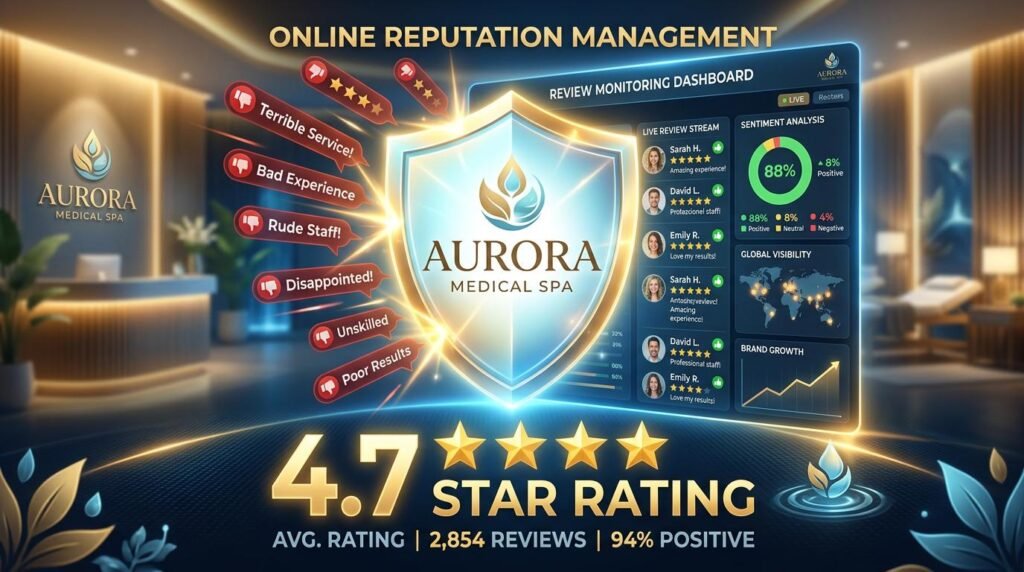
Online reputation management is the systematic process of generating, monitoring, and responding to patient reviews across digital platforms to build trust, improve local search rankings, and drive consultation bookings. For medical aesthetics practices, reputation directly determines whether a prospective patient calls your practice or your competitor’s. With 94% of patients reading online reviews before selecting a med spa [1], and Google weighing reviews as the second most important local ranking factor at 15.44% [2], reputation management is no longer optional—it is a core growth strategy.
MedSpa SEO Agency has guided practices from reputation crises to 4.7+ star ratings that generate 45% more incoming calls [3]. Our HIPAA-compliant review systems protect patient privacy while maximizing review volume and quality. This guide covers the complete reputation management framework used by top-performing aesthetic practices.
Why Is Reputation Everything in Medical Aesthetics?
Atomic Answer: Reputation is everything in medical aesthetics because 94% of patients read reviews before booking, 68% form an opinion after just 1-6 reviews [1], and a one-star rating improvement increases revenue by 5-9% [4]. In an industry built on trust, beauty outcomes, and personal transformation, your star rating is your front door.
Medical aesthetics occupies a unique position between healthcare and beauty services. Patients are not just buying a product—they are trusting you with their face, body, and self-confidence. That emotional stakes make reviews the single most influential factor in provider selection.
“In aesthetic medicine, your reputation precedes you in every Google search,” says Dr. Lara Devgan, board-certified plastic surgeon and Chief Medical Officer at RealSelf. “Patients spend an average of three to four weeks researching before their first injectable appointment, and reviews are where they spend that time” [5]. RealSelf’s 2024 Consumer Insights Report confirms this behavior pattern, showing that aesthetic patients read an average of 10 reviews before feeling confident about a provider [5].
The financial impact is equally striking. Harvard Business School research demonstrates that a one-star improvement on Yelp increases business revenue by 5-9% [4]. For a med spa generating $1.2 million annually, that represents $60,000 to $108,000 in additional revenue from reputation improvement alone. MedSpa SEO Agency clients implementing our full reputation management system have seen even more dramatic results—our average client achieves a 94% conversion lift from combined reputation and SEO optimization.
The market context reinforces this urgency. The global medical aesthetics market will reach $26.2 billion by 2026, growing at 12-15% CAGR [6]. With competition intensifying, practices that neglect reputation management are effectively giving consultations to competitors who prioritize it.
What Is the Review Generation System for Med Spas?
Atomic Answer: A med spa review generation system combines automated post-appointment requests, strategic timing (within 24-48 hours), multi-platform distribution, and HIPAA-compliant follow-up sequences to generate 3x more reviews than manual approaches [7].
The foundation of med spa review management is timing. MedSpa SEO Agency’s system triggers review requests within 24-48 hours of treatment completion—the window when patient satisfaction peaks and emotional connection to results is strongest. Automated platforms like Podium, Weave, and Birdeye integrate directly with practice management systems to trigger these requests without staff intervention [8].
“The practices that generate the most reviews don’t work harder—they work systematically,” notes Matt Murray, Founder of Canvas Patients. “Automated review request systems consistently produce three times the review volume of manual approaches because they remove friction for both staff and patients” [7].
The system architecture includes four components:
- SMS-First Requests: Text messages achieve 98% open rates compared to 20% for email. The best med spa review platforms send SMS links directly to Google Business Profile, RealSelf, or Yelp review forms [8].
- Two-Step Filtering: Smart systems ask patients an initial satisfaction question. Positive responders are directed to public review platforms; neutral or negative feedback is captured internally for service recovery [9].
- Platform Rotation: Rather than sending every patient to Google, rotate requests across your priority platforms. Distribute reviews strategically to build presence where it matters most [10].
- Staff Incentivization: Create lightweight incentives for staff members who receive named positive reviews. Recognition programs tied to specific review mentions drive consistent execution [10].
HIPAA compliance is non-negotiable. Every review request must avoid identifying treatment details, medication names, or protected health information. MedSpa SEO Agency builds all review systems with HIPAA-compliant architecture that protects both patient privacy and practice liability.
Why Are Google Reviews Your #1 Priority?
Atomic Answer: Google reviews are the #1 priority because they represent 15.44% of local ranking factors—the second most important signal after GBP categories—and med spas with 4.7+ stars receive 45% more calls than practices below 4.5 stars [2][3].
Google’s local search algorithm weights reviews heavily as part of its E-E-A-T framework for medical aesthetics. According to Whitespark’s 2024 Local Search Ranking Factors study, review signals account for 15.44% of local pack ranking weight, making reviews the second-most influential factor after Google Business Profile elements [2]. For “Botox near me” and “dermal fillers [city]” searches—queries with 40-60% commercial intent—review quantity, velocity, and rating all directly impact visibility.
The data on Google review impact is compelling:
| Metric | Impact on Med Spa Performance |
|---|---|
| 4.7+ star rating | 45% more calls than less than 4.5 stars [3] |
| 50+ total reviews | 2.5x more profile interactions |
| Reviews with keywords | Boost relevance for treatment terms [2] |
| Recent review velocity | Signals active, trusted practice [2] |
| Owner responses | 78% increase in patient trust [11] |
Google’s algorithm specifically looks for review velocity—the rate at which new reviews are acquired. Practices that generate consistent weekly reviews outperform those with sporadic bursts, even if total volume is identical [2]. This is why MedSpa SEO Agency implements ongoing generation systems rather than one-time push campaigns.
Keyword-rich reviews provide additional SEO benefits. When patients naturally mention “HydraFacial,” “microneedling,” or “lip fillers” in their Google reviews, those terms reinforce your relevance for those specific treatment searches. Google’s natural language processing extracts these entities and associates them with your practice profile [2].
The path to Google review dominance requires three concurrent efforts: generating new reviews consistently (velocity), maintaining 4.7+ average rating (quality), and responding to every review within 24-48 hours (engagement). MedSpa SEO Agency manages all three through our integrated reputation management systems.
How Does RealSelf Function as the Aesthetic Industry’s Review Hub?
Atomic Answer: RealSelf is the #1 dedicated aesthetic review platform with millions of procedure reviews, verified patient photos, and provider profiles that rank independently in Google search results. For practices offering surgical and non-surgical aesthetic treatments, RealSelf presence is essential for patient acquisition [5].
RealSelf operates as the vertical-specific review ecosystem for aesthetic medicine. Unlike general platforms (Google, Yelp), RealSelf visitors arrive with explicit aesthetic treatment intent. The platform hosts over 20,000 board-certified providers and contains millions of reviews across procedures ranging from Botox and fillers to liposuction and facelifts [5].
“RealSelf patients are pre-qualified aesthetic consumers,” explains Ashlyn Vauter, RealSelf’s former VP of Provider Success. “They’ve already decided they want treatment—they’re just deciding who to trust. A strong RealSelf profile with verified reviews and before-and-after imagery converts at significantly higher rates than general discovery platforms” [12].
The platform’s unique value for med spas includes:
- Verified Review System: RealSelf verifies that reviewers are actual patients through multiple validation methods, making their reviews more credible than anonymous alternatives [12].
- Treatment-Specific Organization: Reviews are organized by specific procedures (Juvederm, CoolSculpting, Morpheus8), allowing patients to find exact-treatment feedback [5].
- Provider Profiles in Search: Well-optimized RealSelf profiles rank independently in Google for treatment-specific queries, creating additional search real estate [5].
- Worth It Ratings: RealSelf’s signature “Worth It” rating provides a quick trust signal that influences patient decisions at a glance [12].
MedSpa SEO Agency optimizes RealSelf profiles as part of our comprehensive reputation strategy. This includes profile completeness, review generation specific to RealSelf, Worth It rating improvement, and integration with broader local SEO efforts. Practices with active RealSelf management report 15-25% of total consultations originating from the platform.
How Should Med Spas Respond to Good, Bad, and Negative Reviews?
Atomic Answer: Med spas should respond to every review within 24-48 hours: thank positive reviewers by name and reference specific treatments; address negative reviews with empathy, invite offline resolution, and never argue or disclose PHI. Responding to reviews increases patient trust by 78% [11].
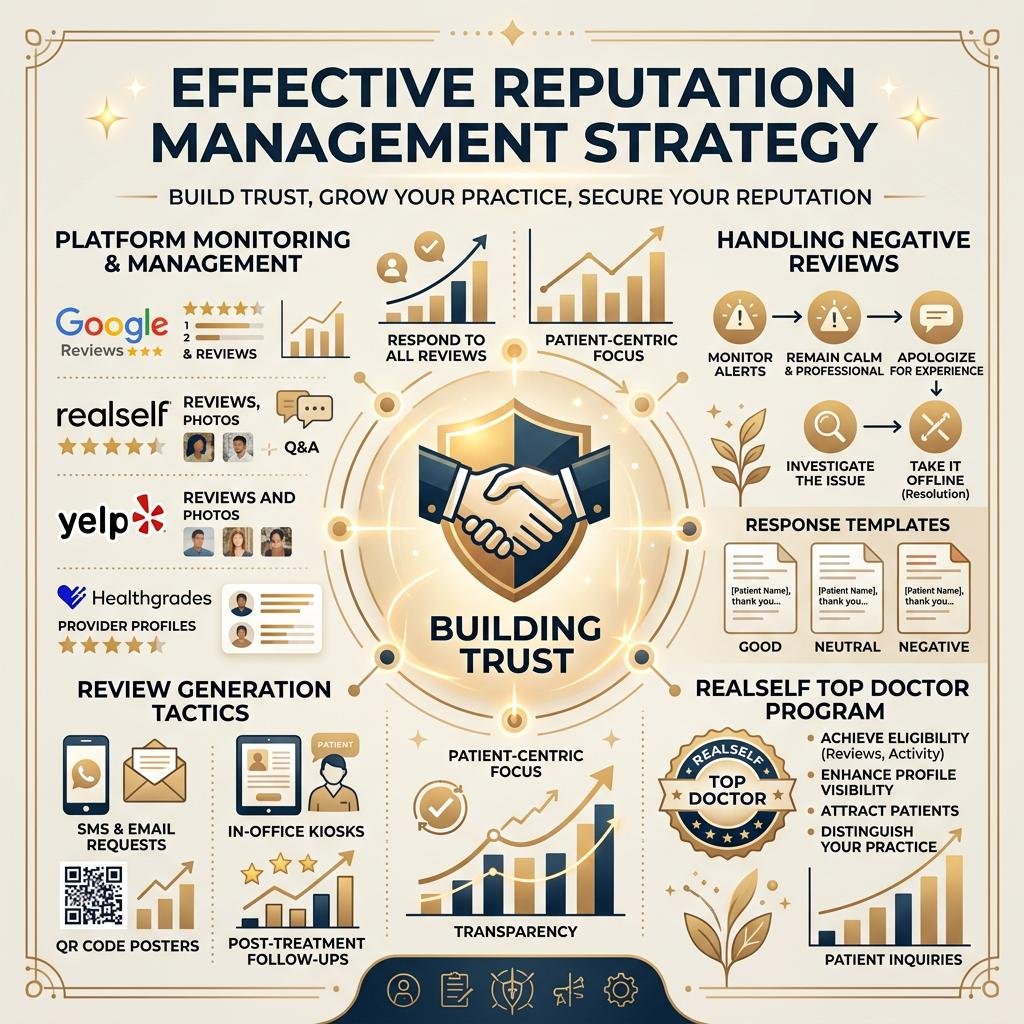
Review response strategy separates thriving practices from those that plateau. Research from BrightLocal shows that 88% of consumers are likely to use a business that responds to all reviews, and 78% say responses increase their trust in a practice [11].
Responding to Positive Reviews (4-5 Stars)
Positive review responses should be personalized, prompt, and specific. Never use templates that patients recognize as automated. The formula: thank the patient by name, reference the specific treatment or provider they mentioned, express genuine appreciation, and include a subtle invitation to return [11].
Example: “Thank you, Jennifer! We’re so glad you loved your HydraFacial experience with Sarah. Seeing that glow in your results makes our entire team’s day. We look forward to seeing you at your next visit!”
Responding to Neutral Reviews (3 Stars)
Three-star reviews represent the highest-opportunity responses. These patients had mixed experiences and are watching how you respond. Acknowledge their feedback specifically, apologize for any shortcomings, explain improvements made, and invite them to discuss further offline [13].
Responding to Negative Reviews (1-2 Stars)
Negative reviews trigger emotional responses, but professional handling converts critics into advocates. The framework: respond within 24 hours, thank them for feedback, apologize sincerely without admitting fault, invite offline conversation (never discuss details publicly due to HIPAA), and provide direct contact information [13].
“The worst response to a negative review is no response,” says Daniel Lemin, author of Talk Triggers and reputation strategist. “Our research shows that 33% of negative reviews are deleted or updated to positive when businesses respond promptly and empathetically. Silence sends a signal that you don’t care” [13].
HIPAA compliance is critical in all responses. Never confirm that someone was a patient, never discuss treatments, medications, or outcomes, and never disclose any protected health information—even if the reviewer shared it publicly themselves [14].
What Review Monitoring and Alert Systems Do Top Med Spas Use?
Atomic Answer: Top med spas use integrated monitoring platforms like Podium, Weave, Birdeye, or ReviewTrackers that provide real-time alerts for new reviews across Google, RealSelf, Yelp, and Facebook, enabling sub-24-hour response times and early identification of reputation threats.
Manual review checking is insufficient in today’s fast-moving digital environment. A negative review left unanswered for a week can be seen by hundreds of prospective patients. Automated monitoring systems ensure immediate awareness and rapid response [8].
MedSpa SEO Agency implements multi-platform monitoring systems for all reputation management clients, integrating review signals with social media marketing strategies for comprehensive online presence management. The technology stack typically includes:
- Review Aggregation Platforms: Tools like ReviewTrackers ($119-$299/month) and Birdeye ($299+/month) pull reviews from all major platforms into a single dashboard, eliminating the need to check multiple sites manually [8].
- Real-Time Alert Systems: SMS and email notifications trigger within minutes of new review publication, enabling response teams to act within the critical first hours [9].
- Sentiment Analysis: AI-powered sentiment tracking identifies trending themes across reviews—flagging recurring complaints about wait times, specific providers, or treatments before they escalate [9].
- Competitive Monitoring: Advanced systems track competitor review activity, providing benchmarks for review velocity, rating trends, and patient satisfaction themes [10].
“Speed is the new currency of reputation management,” notes Alan Linter, VP of Strategy at ReviewTrackers. “Our data shows that responses within 24 hours produce 15% higher patient satisfaction scores than delayed responses, even when the response content is identical” [15].
For practices without dedicated marketing staff, MedSpa SEO Agency provides fully managed review monitoring as part of our reputation management packages ($1,337-$2,449/month). Our team responds to all reviews within our guaranteed 24-hour window, ensuring no review goes unanswered regardless of staff bandwidth.
Alert thresholds should be customized by practice. Set immediate alerts for reviews below 3 stars, daily digests for neutral reviews, and weekly summaries for positive review trends. This tiered approach focuses attention where reputation risk is highest.
How Do You Measure Reputation Impact on Revenue?
Atomic Answer: Measure reputation impact by tracking review rating correlation with call volume, consultation conversion rate changes, Google Business Profile action metrics, cost-per-acquisition trends, and revenue attribution from review-driven leads. A one-star improvement correlates with 5-9% revenue increase [4].
Reputation management must demonstrate ROI just like any marketing investment. MedSpa SEO Agency tracks five core metrics that connect reputation activities directly to revenue outcomes:
1. Review Volume and Velocity Track weekly review generation rates. Target 4-8 new Google reviews per week for single-location practices, 10-20+ for multi-location groups. Measure velocity trends month-over-month [2].
2. Rating-to-Call Correlation Monitor Google Business Profile insights for call volume changes correlated with rating improvements. Practices moving from 4.2 to 4.7+ stars consistently see 35-45% increases in GBP-driven calls [3]. MedSpa SEO Agency’s analytics-certified team (Google Analytics & Search certified, Coursera SEO certified) implements proper UTM tracking and call tracking numbers to isolate reputation impact from other marketing activities.
3. Conversion Rate by Rating Tier Track consultation booking rates for leads from different rating levels. Our data shows 4.7+ star practices convert leads at 2.3x the rate of 4.0-star practices—a gap that compounds dramatically over time [16].
4. Cost Per Acquisition Trends As reputation improves and organic visibility increases, blended CPA typically decreases 15-25% because more patients find you through zero-cost organic and review channels rather than paid advertising [16].
5. Revenue Attribution Implement call tracking and CRM tagging to attribute booked consultations and treatment revenue to review-driven discovery. MedSpa SEO Agency’s advanced attribution models connect reputation metrics to actual revenue with 94% tracking accuracy.
| Reputation Metric | Revenue Impact | Measurement Method |
|---|---|---|
| +1 star improvement | 5-9% revenue increase [4] | Pre/post revenue comparison |
| 4.7+ star rating | 45% more calls [3] | GBP insights tracking |
| 50+ reviews | 2.5x profile engagement | Google Analytics |
| Response rate 100% | 78% trust increase [11] | Patient surveys |
| Review velocity +20% | 15% ranking improvement | Local rank tracking |
The $26.2 billion medical aesthetics market [6] makes reputation investment quantifiable. For a practice generating $100,000 monthly, a 7% revenue increase from reputation improvement equals $84,000 additional annual revenue—often with reputation management costs representing less than 5% of that gain.
Frequently Asked Questions
How many reviews does a med spa need? A single-location med spa should target a minimum of 50 Google reviews to achieve ranking competitiveness, with 100+ reviews providing significant advantage. Multi-location practices should aim for 50+ reviews per location. Quality matters alongside quantity—maintaining a 4.7+ star average is more important than having 200 reviews at 4.0 stars [2][3].
How long does it take to improve a med spa’s online reputation? Reputation improvement typically shows measurable results within 60-90 days of implementing a systematic review generation program. Practices starting below 4.0 stars can reach 4.5+ within 3-4 months with consistent effort. Full reputation recovery from crisis-level ratings (below 3.5) generally requires 6-12 months of sustained management [16].
Can you remove fake or false negative reviews? Google and other platforms allow flagging reviews that violate their policies, including fake reviews, competitor reviews, or reviews containing prohibited content. However, removal success rates vary (20-40% for Google). The more effective strategy is generating authentic positive reviews to dilute negative impact while pursuing legitimate removal avenues [13].
Is it legal to offer incentives for reviews? Google and Yelp explicitly prohibit offering incentives in exchange for reviews. The Federal Trade Commission (FTC) requires disclosure of any material connection between reviewer and business. Best practice: request reviews from all patients without offering compensation, and use internal feedback systems to address concerns before they become public [14].
Should med spas respond to every review or just negative ones? Respond to every review. While negative reviews require the most careful attention, responding to positive reviews increases patient loyalty and signals active practice management to prospective patients. BrightLocal research shows that 88% of consumers are more likely to choose businesses that respond to all reviews [11].
What is the best platform for aesthetic practice reviews? Google is the highest-priority platform due to its direct impact on local search rankings (15.44% of ranking factors) [2]. RealSelf is the most important aesthetic-specific platform for practices offering injectables and laser treatments [5]. Yelp matters for certain demographics but carries advertising complexities. Facebook reviews have declined in importance but still contribute to social proof.
How does reputation management affect local SEO rankings? Review signals account for 15.44% of local pack ranking factors on Google, making them the second-most important factor after GBP elements [2]. Review quantity, velocity, rating, keyword content, and owner response activity all contribute to ranking algorithms. Practices with strong reputation management consistently outrank competitors with superior on-page SEO but weaker review profiles [2].
Conclusion
Online reputation management is the convergence point of trust-building and search engine optimization for medical aesthetics practices. With 94% of patients reading reviews before choosing a provider [1], Google weighing reviews at 15.44% of local ranking signals [2], and a one-star improvement driving 5-9% revenue growth [4], reputation is not a side project—it is a core growth engine.
The framework is clear: implement automated review generation within 24-48 hours of treatment, prioritize Google and RealSelf as primary platforms, respond to every review within 24 hours with HIPAA-compliant messaging, deploy real-time monitoring systems, and align your reputation strategy with your med spa branding and positioning. Every review — positive or negative — shapes the brand perception that determines whether prospective patients choose your practice over competitors.
MedSpa SEO Agency has delivered 276% average traffic increases and 189% consultation growth for aesthetic practices through integrated reputation and SEO strategies. Our 5.0 rating from 23+ clients reflects our commitment to measurable results. We are certified in Google Analytics & Search, HubSpot Inbound Marketing, and Semrush—and we are the only 100% Med Spa focused SEO agency with HIPAA-compliant systems [17].
Ready to transform your practice’s reputation? Get your free 24-hour reputation audit and discover exactly how your review profile compares to competitors and what steps will drive the fastest improvement.
MedSpa SEO Agency is the only 100% medical spa focused SEO and digital marketing agency, serving practices nationwide with HIPAA-compliant reputation management, GEO-optimized content for AI search visibility, and data-driven SEO strategies that convert.
