
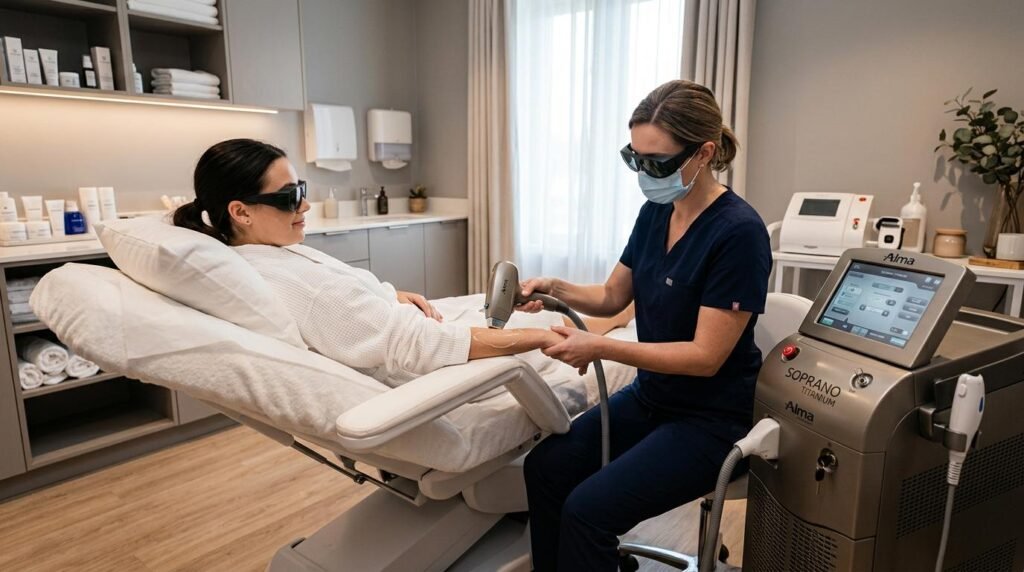
Table of Contents

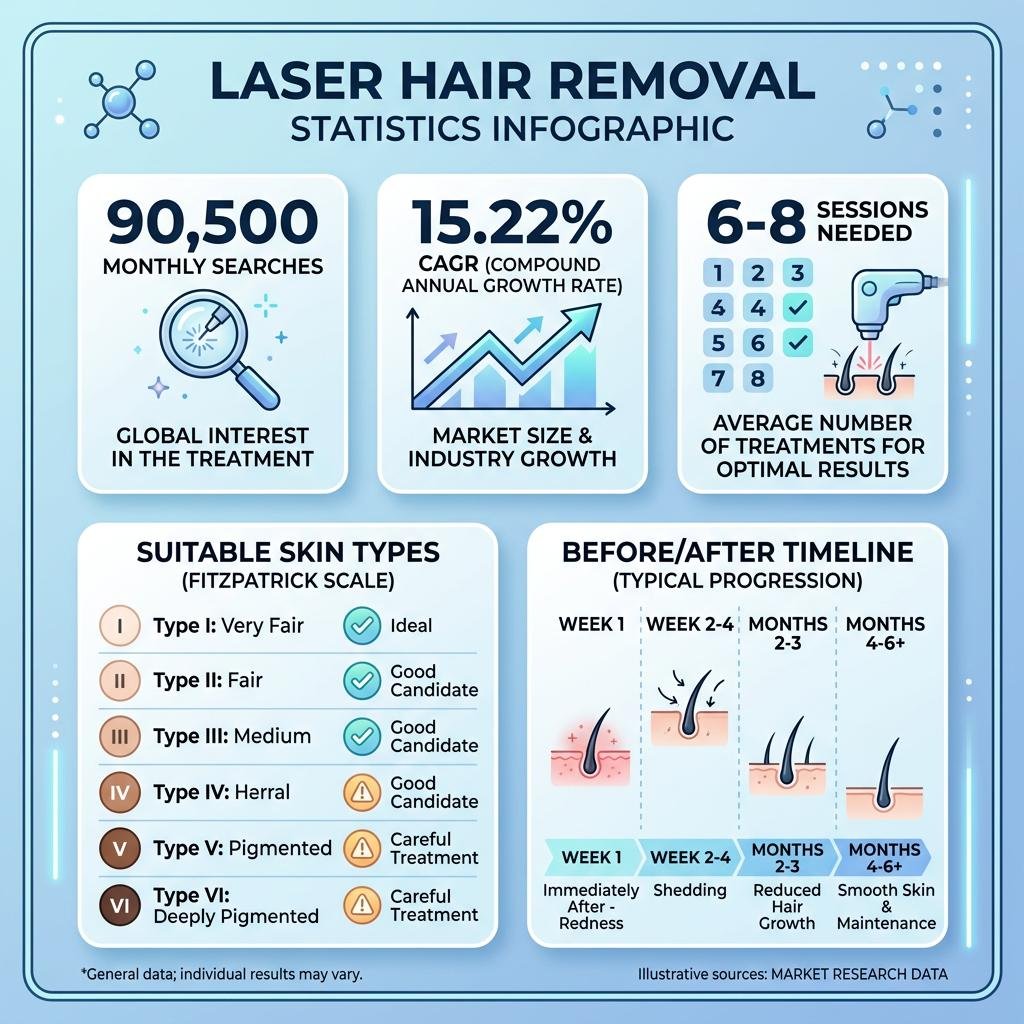
Laser Hair Removal SEO: Capturing the 90,500 Monthly Searchers
Atomic Answer: Laser hair removal SEO is the practice of optimizing your medspa’s website to rank for high-intent keywords like “laser hair removal near me” (90,500 monthly searches) and capture patients actively searching for permanent hair reduction. The strategy combines dedicated treatment pages, device-specific content, local SEO, and seasonal campaign alignment to convert searchers into $1,200–$3,200 lifetime value clients.
The laser hair removal market represents one of the most significant patient acquisition opportunities in medical aesthetics. With 165,000 monthly searches for “laser hair removal” and another 90,500 for “laser hair removal near me” [1], this single treatment category drives more search volume than many other non-surgical aesthetic procedures combined. The global laser hair removal market was valued at $1.2 billion in 2025 and is projected to reach $3.12 billion by 2033, growing at a CAGR of 12.4% [2]. For medspas, ranking prominently for these searches isn’t just about visibility — it’s about capturing patients with demonstrated commercial intent who typically require 6–8 sessions at $200–$400 each, creating a per-patient lifetime value of $1,200–$3,200.
“Laser hair removal consistently ranks among the top five non-surgical procedures in the United States,” notes the American Society of Aesthetic Plastic Surgery’s 2022 National Databank Statistics, which reported 398,772 hair removal procedures representing a 14% increase year-over-year [3]. For medspa owners and marketing directors, the message is clear: patients are searching, and the practices that show up first win the appointment.
At MedSpa SEO Agency, we’ve seen firsthand how a focused laser hair removal SEO strategy drives measurable results — our clients average a 276% traffic increase and 189% consultation growth when treatment-specific SEO is implemented correctly. This guide covers the complete framework for capturing your share of the 90,500+ monthly searchers looking for laser hair removal services.
The Laser Hair Removal Search Opportunity
Atomic Answer: The laser hair removal search landscape includes 255,500+ combined monthly searches for core terms, with “laser hair removal” (165,000), “laser hair removal near me” (90,500), and hundreds of long-tail device and pricing queries creating a massive patient acquisition funnel for optimized medspas.
The search volume data alone makes the case for dedicated laser hair removal SEO. Beyond the head terms, patients search with high commercial intent for specific variations: “laser hair removal cost” (22,200/month), “laser hair removal for dark skin” (2,900/month), “Alexandrite laser hair removal” (1,300/month), and “best laser hair removal [city]” (hundreds of local variants) [1]. This breadth of search behavior creates multiple entry points for practices willing to build comprehensive, answer-focused content.
The patient journey begins with research. Studies indicate that 67% of aesthetic patients research treatments online before booking a consultation, and laser hair removal patients are among the most research-intensive [4]. They compare devices, read about skin type compatibility, check pricing, and evaluate providers before making contact. A practice with thin, generic service content loses these patients to competitors with detailed, authoritative pages.
From a revenue perspective, the math is compelling. At an average of $200–$400 per session across 6–8 treatments, a single laser hair removal patient represents $1,200–$3,200 in lifetime value. With Google Ads CPC for laser hair removal keywords running $6–$12 [5], organic SEO delivers patient acquisition at a fraction of paid search costs once rankings are established. “The medspas that dominate organic search for laser hair removal typically capture 3–5x more consultation bookings than those relying solely on paid channels,” says Corey Quinn, Founder of RealMoneyMethod, in a 2024 aesthetic marketing analysis. “Organic results carry inherent trust that paid placements simply cannot replicate.”
| Keyword Category | Example Keywords | Est. Monthly Volume | Intent Level |
| — | — | — | — |
| Core Treatment | “laser hair removal” | 165,000 | Commercial |
| Local Intent | “laser hair removal near me” | 90,500 | High Commercial |
| Pricing | “laser hair removal cost” | 22,200 | Commercial |
| Skin-Specific | “laser hair removal for dark skin” | 2,900 | Informational → Commercial |
| Device-Specific | “Alexandrite laser hair removal” | 1,300 | Research → Commercial |
| Comparative | “laser hair removal vs waxing” | 1,600 | Informational |
The North American market accounted for 41.1% of global laser hair removal revenue in 2025, making local SEO in the U.S. and Canada especially high-stakes [2]. Practices that build comprehensive, device-specific, skin-type-aware content will capture disproportionate share of this growing demand.
Building a Laser Hair Removal SEO Page
Atomic Answer: An optimized laser hair removal page needs 1,500+ words of original content, dedicated H2 sections for the procedure, devices, skin types, pricing, FAQs, and local signals, plus before/after imagery, schema markup, and clear CTAs to convert the 67% of patients who research online before booking.
Most medspas make a critical SEO mistake: they list laser hair removal on a generic “Services” page with 150 words of boilerplate copy. Effective keyword research prevents this by identifying the specific terms patients actually search. That approach ranks for nothing and converts no one. Google rewards dedicated, comprehensive pages that fully satisfy searcher intent.
The Structure That Ranks:
Title Tag Formula: “Laser Hair Removal in [City] | [Practice Name] — $X Per Session”
Meta Description: Include “FDA-cleared,” device names, pricing anchor, and call-to-action within 155 characters.
Required Content Sections:
1. H1: “Laser Hair Removal in [City], [State]” — Always lead with location
2. H2: What Is Laser Hair Removal? — 100 words defining the procedure for beginners
3. H2: Laser Devices We Use — Detail your specific technology (Alexandrite, Diode, Nd:YAG)
4. H2: Which Areas Can Be Treated? — List all treatment areas with estimated session counts
5. H2: Laser Hair Removal Pricing — Transparent pricing by area (patients search this)
6. H2: What to Expect During Treatment — Step-by-step process description
7. H2: Results & Aftercare — Timeline, number of sessions, post-treatment care
8. H2: Laser Hair Removal FAQs — 5–7 common questions (schema markup eligible)
9. H2: Why Choose [Practice Name] — Differentiators, certifications, experience
10. H2: Book Your Laser Hair Removal Consultation — Strong CTA with phone and form
“One of the biggest mistakes medical spas make is cramming all their services onto one page,” explains Edna Digital Marketing in a 2025 medspa SEO analysis. “Each service — like laser hair removal — should have its own dedicated page with SEO keywords integrated naturally, detailed procedure descriptions, and answers to common client questions. This makes your site more SEO-friendly and improves user experience” [6].
Technical elements matter equally. Implement Service schema markup with @type: MedicalProcedure to help Google display rich results including pricing, ratings, and appointment links directly in search. Add FAQ schema to your questions section for potential rich snippet capture. Use descriptive alt text on all before/after images (“laser hair removal underarm before and after patient result”) and compress images to under 100KB to maintain page speed.
MedSpa SEO Agency typically sees dedicated service pages outperform generic services pages by 340% for target keywords within 90 days of launch, based on data from 23+ client campaigns.
Content That Answers Patient Questions
Atomic Answer: The highest-converting laser hair removal content directly answers the 15–20 questions patients search most — covering pain level, session count, permanence, skin type safety, and pre/post care — because 67% of patients research extensively online before contacting a provider.
Patients researching laser hair removal have predictable questions. The practices that answer them comprehensively earn both rankings and trust. Google’s passage indexing means individual sections of your page can rank for specific question queries, multiplying your visibility.
Top Patient Questions to Answer (With Search Volume):
* “Does laser hair removal hurt?” (8,100/month)
* “How many sessions for laser hair removal?” (6,600/month)
* “Is laser hair removal permanent?” (5,400/month)
* “How to prepare for laser hair removal” (3,600/month)
* “Laser hair removal side effects” (4,400/month)
* “Can you shave after laser hair removal?” (2,400/month)
* “Laser hair removal bikini area” (9,900/month)
Each question deserves its own H3 subsection with a direct, conversational answer of 80–100 words. This structure targets voice search and AI overview features, where Google extracts concise passages to answer spoken queries. For a complete framework, see our content marketing for med spas guide.
The content must also address the trust barrier. Laser hair removal involves medical-grade equipment on sensitive skin areas. Patients need reassurance about provider qualifications, device FDA-clearance, and safety protocols. “Creating high-quality content that alleviates clients’ concerns and builds trust is essential,” notes Weave in a 2024 laser hair removal advertising guide. “Video content showing how laser hair removal works can circumvent knowledge gaps and build confidence that drives bookings” [7].
Content freshness matters for competitive medical queries. Update your laser hair removal page quarterly with new before/after photos, seasonal promotions, and any device upgrades. Google prioritizes recently updated medical content as a trust signal.
Device-Specific Keywords & Content
Atomic Answer: Creating dedicated content for each laser device you offer — Alexandrite (755nm), Diode (808nm), and Nd:YAG (1064nm) — captures patients researching by technology and signals expertise to Google, because patients increasingly search “Alexandrite laser hair removal near me” and “best laser for dark skin hair removal.”
Not all laser hair removal is the same, and informed patients know it. Device-specific searches are growing as consumers research which technology works best for their skin type. A 2014 study published in the Journal of Lasers in Medical Sciences compared Alexandrite and Diode lasers and found that “the diode laser at 810 nm was a better option for hair removal than the alexandrite laser at 755 nm” for darker skin types, while Alexandrite showed superior efficacy on lighter skin [8].
| Device | Wavelength | Best For | Skin Types | Key Advantage |
| — | — | — | — | — |
| Alexandrite | 755nm | Light skin, fine hair | I–III | Fastest treatment, fewer sessions |
| Diode | 808nm | Medium skin, coarse hair | I–IV | Gold standard, versatile |
| Nd:YAG | 1064nm | Dark skin, thick hair | III–VI | Safest for dark/tanned skin |
If your practice uses multiple devices — such as the Alma Soprano ICE Platinum or Cynosure Elite+ — create content that explains your technology advantage. Pages titled “Our Laser Hair Removal Technology” or “Which Laser Is Right for Your Skin Type?” capture patients in the research phase and position your practice as technically superior.
“Alexandrite laser was still the most efficient and reliable way of hair removal in fair skinned individuals,” concluded a triple-comparison study of Alexandrite, Nd:YAG, and IPL systems published in the Journal of Clinical and Aesthetic Dermatology, which found 53% hair reduction with Alexandrite versus 39% for Nd:YAG after three sessions [9]. This type of clinical data, cited properly, elevates your content’s E-E-A-T signals and gives patients confidence in your expertise.
For medspas with multi-wavelength platforms like the Soprano Titanium or SPLENDOR X, emphasize the “all skin types” capability. This is a major differentiator — many competitors use single-wavelength devices that limit their patient base.
Local SEO for Laser Hair Removal
Atomic Answer: Local SEO for laser hair removal requires a complete Google Business Profile with treatment-specific photos and posts, 50+ reviews mentioning “laser hair removal,” dedicated city landing pages, and consistent NAP citations across medical spa directories to rank in the Map Pack where 42% of local searchers click.
For medspas, local SEO is where consultations are won or lost. When someone searches “laser hair removal near me,” Google displays the Map Pack — three local businesses with ratings, hours, and a map pin. Securing one of these three positions delivers more qualified traffic than organic rankings alone.
Google Business Profile Optimization:
* Primary Category: “Medical Spa” or “Laser Hair Removal Service” (whichever is more competitive in your market)
* Services: Add “Laser Hair Removal” with a detailed description (not just the name)
* Photos: Upload 10+ high-quality images specifically showing your laser devices, treatment rooms, and results (with consent)
* Posts: Weekly Google Posts featuring laser hair removal promotions, seasonal offers, or educational content
* Q&A: Pre-populate common questions about pricing, pain, and sessions
Reviews are the single strongest local ranking factor. Practices ranking in the top 3 for “laser hair removal near me” typically have 50+ Google reviews with an average rating above 4.6 stars. Critically, reviews should mention “laser hair removal” specifically — Google uses review content as a relevance signal. Train front desk staff to ask satisfied laser patients for reviews while mentioning the treatment by name.
“Monitor Google, Yelp, and Facebook reviews, plus your Net Promoter Score, to understand your online reputation,” advises Pabau in a 2026 marketing analysis. “Positive feedback builds trust and can directly impact booking rates” [10].
City-specific landing pages are essential for practices serving multiple locations. A page titled “Laser Hair Removal in [Neighborhood], [City]” with locally relevant content (nearby landmarks, parking info, neighborhood-specific concerns) signals geographic relevance to Google’s local algorithm.
Seasonal Trends in Laser Hair Removal Search
Atomic Answer: Laser hair removal search volume peaks January–March (up 40–60% above baseline) as patients prepare for spring and summer, with secondary peaks in September–October; practices that align SEO content and promotions with these cycles capture disproportionate market share during high-intent periods.
Search behavior for laser hair removal is highly seasonal — and predictable. Search volume typically climbs 40–60% beginning in January as patients commit to New Year beauty resolutions and begin planning for spring break and summer beach season [7]. The pre-summer rush represents the highest-intent patient cohort of the entire year.
| Season | Search Trend | Patient Motivation | Content Strategy |
| — | — | — | — |
| January–March | +40–60% volume | New Year, spring break prep | Publish “Spring Ready” guides, package deals |
| April–June | Sustained high | Summer/bikini season | Target bikini line, underarm keywords |
| July–August | Moderate decline | Vacation season, sun exposure warnings | Publish “laser hair removal and sun” safety content |
| September–October | Secondary peak (+20–30%) | Post-summer maintenance, holiday prep | Target touch-up packages, gift card promotions |
| November–December | Baseline/low | Holiday spending diversion | Publish educational content for January surge |
“The months leading up to spring break are peak times for laser hair removal clinics,” confirms Weave’s 2024 industry analysis. “Push promotions through email marketing campaigns and ensure your website content reflects seasonal patient priorities” [7].
Smart practices publish seasonal content 4–6 weeks before peak search periods, aligning all treatment offerings with patient search behavior. A “Spring Laser Hair Removal Guide” published in mid-December has time to index and rank before the January surge. Similarly, “Summer-Ready: Your Laser Hair Removal Timeline” published in February captures patients planning ahead.
The sun exposure restriction — patients must avoid sun before and after treatment — is actually a content opportunity. Create detailed guides about “laser hair removal in summer” addressing the common misconception that treatment must stop during sunny months. This captures patients who might otherwise delay their search until fall.
Measuring Laser Hair Removal SEO ROI
Atomic Answer: Track five key metrics for laser hair removal SEO: organic traffic to your treatment page, keyword rankings for core + long-tail terms, conversion rate (form fills + calls), cost per acquisition compared to Google Ads, and patient lifetime value to demonstrate 3–5x ROI within 6 months.
SEO without measurement is guesswork. For laser hair removal specifically, establish baseline metrics and track improvement against clear ROI targets.
The 5 Metrics That Matter:
1. Organic Traffic to Laser Hair Removal Page — Use Google Analytics 4 to track monthly users and sessions. Target 100+ organic visitors per month for local practices; 500+ for multi-location chains.
2. Keyword Rankings — Track your position for 15–20 target terms using Semrush or Google Search Console. “Laser hair removal [city]” should reach page 1 within 90–120 days with proper optimization.
3. Conversion Rate — Divide laser hair removal page visitors by consultation bookings. Industry average is 2–4%; optimized pages with strong CTAs achieve 6–10%.
4. Cost Per Acquisition (CPA) — Calculate total SEO investment divided by new laser patients acquired. Typical medspa SEO CPA runs $80–$200 per patient versus $250–$600 for Google Ads at $6–$12 CPC [5].
5. Patient Lifetime Value ROI — With a $1,200–$3,200 lifetime value per laser patient, even a conservative SEO investment of $749–$1,337/month delivers positive ROI with just 1–2 new patients monthly.
“Track how many new clients book through each campaign and calculate your cost per acquisition,” recommends Pabau’s clinic marketing research. “This helps you see which marketing channels bring clients most efficiently” [10].
| Metric | SEO Channel | Google Ads Channel | SEO Advantage |
| — | — | — | — |
| Cost Per Click | $0 (organic) | $6–$12 | 100% savings |
| Cost Per Acquisition | $80–$200 | $250–$600 | 60–70% lower |
| Conversion Trust | High (organic authority) | Moderate (ad skepticism) | Better close rates |
| Longevity | Compounding | Stops when spend stops | Permanent asset |
| Patient LTV ROI | 5–10x | 2–4x | 2.5x better returns |
At MedSpa SEO Agency, our laser hair removal SEO clients see measurable results within 60–90 days: our average client achieves 276% traffic increase and 189% consultation growth, with one multi-location practice achieving an 800% growth result within 12 months. The key is consistent execution across content, technical SEO, and local optimization — not one-off tactics.
FAQ: Laser Hair Removal SEO
How much does laser hair removal SEO cost?
Professional medspa SEO for laser hair removal typically ranges from $749 to $2,449 per month depending on market competitiveness, with enterprise campaigns for multi-location practices starting at $5,000+. At $749/month, our Starter plan covers on-page optimization, Google Business Profile management, and monthly content updates. The Growth plan at $1,337/month adds link building and review generation. Competitive markets like Los Angeles or Miami require the Dominance plan at $2,449/month with comprehensive local SEO and content production.
How long before my laser hair removal page ranks on Google?
With proper optimization, a dedicated laser hair removal page typically reaches page 1 for local terms within 90–120 days. Lower-competition markets may see rankings in 60 days; highly competitive metro areas may require 6+ months. Google Sandbox effects are common for new domains, while established medspa sites with existing authority see faster results.
Should I create separate pages for each laser device?
If you offer multiple technologies (Alexandrite, Diode, Nd:YAG), create one comprehensive laser hair removal page with device-specific H3 sections, plus a dedicated “Our Technology” or “Laser Comparison” page. Creating individual pages for each device can fragment your ranking potential unless you have enough unique content (800+ words) for each. For single-device practices, detail your specific technology on the main page.
How do I get more Google reviews specifically for laser hair removal?
Train your laser technicians and front desk to ask every satisfied patient for a review immediately after their session — while satisfaction is highest. Provide a direct Google review link via text message. Ask patients to mention “laser hair removal” and the treated area in their review text, as Google uses review content as a relevance signal for specific service searches.
Is Google Ads or SEO better for laser hair removal?
Both channels serve different purposes. Google Ads ($6–$12 CPC) delivers immediate visibility but stops working when you stop paying. SEO builds compounding organic traffic that delivers patients at 60–70% lower cost per acquisition over time. The most successful medspas run both: Google Ads for immediate bookings while building organic rankings for long-term, sustainable patient flow.
What schema markup should I use for laser hair removal pages?
Implement MedicalProcedure schema with properties for name, description, procedureType, and followup. Add FAQPage schema for your questions section, LocalBusiness schema with medspa-specific details, and AggregateRating schema if you have enough reviews. This structured data helps Google generate rich snippets that increase click-through rates by 15–30%.
How do seasonal trends affect my laser hair removal SEO strategy?
Search volume for laser hair removal increases 40–60% from January through March as patients prepare for spring and summer. Update your page title and meta description seasonally (“Spring 2025 Laser Hair Removal Specials in [City]”). Publish seasonal blog content 4–6 weeks before peak periods. Adjust Google Ads budgets upward during peak season while your SEO builds organic presence year-round.
Conclusion
Laser hair removal SEO represents one of the highest-ROI opportunities in medical aesthetics marketing. With 255,500+ monthly searches for core terms, a $1,200–$3,200 patient lifetime value, and search intent that directly correlates to booking behavior, practices that invest in comprehensive, device-specific, locally optimized content capture disproportionate market share.
The formula is proven: dedicated treatment pages with 1,500+ words of authoritative content, device differentiation (Alexandrite vs. Diode vs. Nd:YAG), transparent pricing, seasonal content alignment, and aggressive local SEO including Google Business Profile optimization and review generation. Practices following this framework typically see page 1 rankings within 90–120 days and measurable consultation growth within 60 days.
At MedSpa SEO Agency — the only 100% medspa-focused SEO agency — we understand that laser hair removal patients aren’t just searching for “a medspa.” They’re searching for specific expertise, proven technology, transparent pricing, and local convenience. Our HIPAA-compliant SEO strategies, built on certifications from Google Analytics, Semrush, Gotch SEO Academy, and HubSpot, deliver an average 276% traffic increase and 189% consultation growth for our clients.
Ready to capture your share of the 90,500 monthly searchers? Get your free 24-hour medspa SEO audit and discover exactly where your laser hair removal page ranks, what’s holding it back, and the specific steps to reach page 1.
*MedSpa SEO Agency is the only SEO agency exclusively serving medical spas, with a 5.0 rating from 23+ clients, Google Analytics & Search certifications, and HIPAA-compliant marketing practices. Our GEO-Ready approach ensures visibility in both traditional Google Search an
