Table of Contents

Med Spa Competitor Analysis: How to Outrank Other Practices in Your City
Your competitor med spas aren’t ranking higher because they’re better clinics – they’re ranking higher because they have a better SEO strategy. The good news? Every strategy leaves fingerprints, and med spa competitor analysis uncovers those fingerprints to give you a proven roadmap to close the gap.
Med spa SEO is a zero-sum game. With 92% of med spa searches never going past page one of Google, and the top three results capturing 54.4% of all clicks, the difference between position four and position one can be worth hundreds of thousands in annual revenue [1]. Yet 63% of med spas don’t track competitor rankings at all — meaning most practices are flying blind while their competitors systematically capture the market [2].
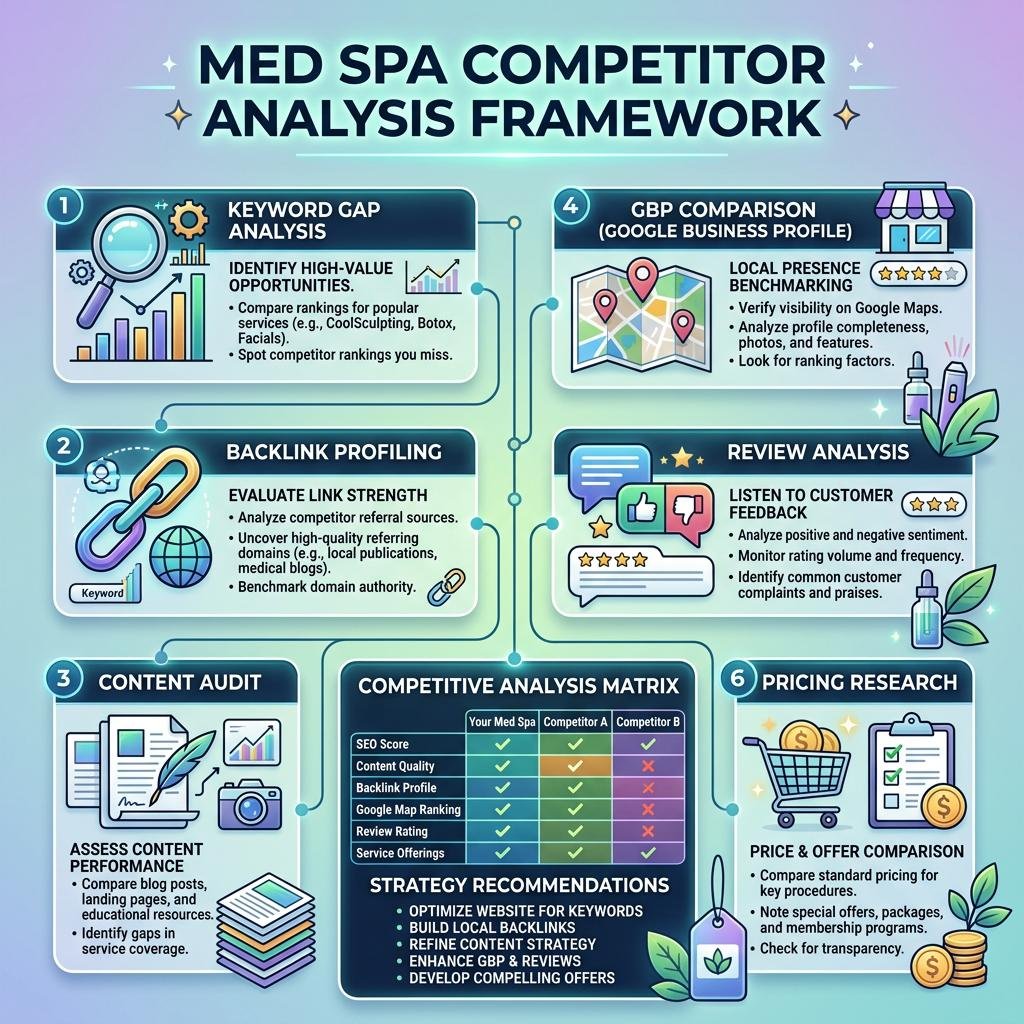
This guide presents the exact competitor analysis framework MedSpa SEO Agency uses to help practices identify their real competitors, uncover keyword and content gaps, analyze backlink profiles, and build a data-driven strategy to outrank them. Whether you’re a single-location med spa in a mid-sized city or a multi-location group in a hyper-competitive market like Los Angeles or Miami, this framework will show you precisely where to focus your efforts for maximum ranking impact.
Why Competitor Analysis Is the First Step in Med Spa SEO
Atomic Answer: Competitor analysis reveals exactly which keywords, content types, and backlinks drive rankings in your specific market, eliminating guesswork and ensuring every SEO dollar targets proven opportunities.
Most med spas begin their SEO journey backwards. They pick keywords at random, publish blog posts about topics they assume patients care about, and hope for the best. The result is months of effort with little to show in rankings or new patient consultations. Competitor analysis flips this approach entirely.
When you analyze what’s already working for top-ranking med spas in your city, you’re not guessing — you’re following a proven blueprint. Keyword gap analysis alone typically uncovers 25-30% more relevant keywords than practices would identify on their own [3]. Content gap analysis goes even further, revealing three times as many viable topic opportunities as standard keyword research [4].
The med spa industry is uniquely competitive. The U.S. medical aesthetics market is projected to reach $26.2 billion by 2026, growing at a 12-15% CAGR [5], making a comprehensive med spa SEO strategy essential for practices that want to capture market share. Facial treatments alone account for 52% of all procedures, with 71% of patients identifying as female and the male segment growing at an accelerated 15.94% CAGR [6]. This growth has attracted significant investment into med spa marketing, with practices in competitive cities now spending $2,500 to $8,000 per month on SEO alone [7].
“Competitor analysis isn’t about copying — it’s about understanding the battlefield before you deploy your resources,” says Ryan Stewart, Founder of The Blueprint Training. “The med spas that win are the ones that know exactly what their competitors are doing, where they’re vulnerable, and how to exploit those gaps systematically.” [8]
MedSpa SEO Agency begins every client engagement with a comprehensive competitor audit — the same methodology behind our med spa SEO case study showing 800% growth results. Our clients average a 276% traffic increase and 189% consultation growth — results that start with knowing exactly who you’re competing against and how to beat them.
How to Identify Your Real SEO Competitors
Atomic Answer: Your real SEO competitors are the practices and directories that rank on page one for your target keywords — not just the med spas you know from your local market. Directories, plastic surgeons, and dermatologists often dominate search results.
Most med spas make a critical mistake: they assume their business competitors are their SEO competitors. They’re not. The practices ranking on page one for “Botox near me” or “laser hair removal [city]” may include national directories like RealSelf and Healthgrades, local dermatology groups, plastic surgery practices, and med spas you’ve never heard of — all competing for the same clicks.
To identify your true SEO competitors, start with these steps:
Step 1: Search your primary keywords manually. Open an incognito browser window and search for your top 10-15 target keywords. These should include your core treatments combined with location modifiers: “Botox [city],” “dermal fillers [city],” “laser hair removal [city],” “HydraFacial [city],” “microneedling [city],” and “med spa near me.” Record every unique domain that appears in the top 10 results across these searches.
Step 2: Categorize competitor types. You’ll typically find four categories: (1) Direct med spa competitors offering similar treatments, (2) Medical professionals (dermatologists, plastic surgeons) offering overlapping services, (3) National directories and review sites (RealSelf, Healthgrades, Yelp), and (4) Individual practitioners or smaller clinics you may not have considered.
Step 3: Validate with SEO tools. Use Semrush or Ahrefs to confirm which domains consistently appear across your keyword set. Look at their traffic estimates, domain authority scores, and the number of keywords they rank for. This quantifies which competitors are truly dominant versus which got lucky on one or two terms.
Step 4: Identify the top 3-5 true competitors. Focus your analysis on the 3-5 domains that appear most frequently in top positions for your highest-value keywords. These are the competitors whose strategies you need to reverse-engineer.
“The biggest mistake in local SEO is fighting the wrong battles,” notes Darren Shaw, President of Whitespark. “If RealSelf owns the top spot for half your keywords, you need a completely different strategy than if another med spa is your main competitor.” [9]
MedSpa SEO Agency includes comprehensive competitor identification in every engagement, using Semrush-certified analysis methods to ensure you’re targeting the right competitors with the right tactics.
Keyword Gap Analysis: Finding What They Rank For
Atomic Answer: Keyword gap analysis compares your keyword profile against competitors’ to identify high-value terms they rank for that you don’t — typically revealing 25-30% untapped keyword opportunities.
Once you’ve identified your true SEO competitors, the next step is understanding exactly which keywords drive their traffic. Keyword gap analysis is the process of comparing your current keyword rankings against your competitors’ to find opportunities they’re capitalizing on that you’ve missed entirely.
This analysis typically reveals that competitors are ranking for 25-30% more relevant keywords than you are — keywords that represent real patient search behavior [3]. These gaps fall into several categories:
Treatment-specific long-tail keywords. Competitors may rank for specific treatment combinations you haven’t targeted, such as “Morpheus8 vs microneedling,” “Juvederm vs Restylane for lips,” or “CoolSculpting vs Emsculpt for abdomen.” These comparison and intent-driven keywords often convert at higher rates because searchers are closer to making a decision.
Question-based keywords. “How long does Botox last,” “what to expect after a chemical peel,” “is laser hair removal permanent” — these informational queries drive significant traffic and position your practice as the educational authority in your market.
Location-modified variations. Competitors may target neighborhood-level keywords you haven’t considered: “med spa [neighborhood name],” “Botox downtown [city],” or “fillers near [local landmark].” These hyper-local terms often have lower competition but strong conversion intent.
Brand and comparison terms. Patients search for specific product brands: “SkinPen microneedling,” “Vivace RF microneedling,” “Kybella vs CoolSculpting for double chin.” Ranking for these terms captures patients who’ve already researched treatments and are choosing providers.
To conduct med spa keyword research gap analysis, use Semrush’s Keyword Gap tool or Ahrefs’ Content Gap feature. Enter your domain plus 2-4 competitor domains, then filter for keywords where competitors rank in the top 20 and you rank below 50 (or don’t rank at all). Prioritize by search volume, keyword difficulty, and commercial intent.
“Keyword gaps are the lowest-hanging fruit in SEO,” says Tim Soulo, CMO at Ahrefs. “If a competitor ranks for a keyword with a mediocre page, you can often outrank them simply by creating something better.” [10]
MedSpa SEO Agency clients typically see 25-30% more keyword opportunities identified through our gap analysis process, contributing to our average 94% conversion lift across campaigns.
Backlink Profiling: Where They Get Authority
Atomic Answer: Backlink profiling reveals which websites link to your competitors, providing a targeted list of link-building opportunities. Competitor backlink analysis typically exposes 40% of viable link opportunities you’d never find otherwise.
Backlinks remain one of the strongest ranking signals in Google’s algorithm. When authoritative websites link to your med spa’s website, Google interprets those links as votes of confidence, boosting your domain authority and rankings. The challenge? Finding quality link opportunities is difficult without a roadmap. Your competitors’ backlink profiles provide exactly that.
Competitor backlink analysis reveals approximately 40% of link opportunities that practices would never discover through independent research [11]. Here’s how to extract these opportunities:
Analyze competitor backlink profiles. Using Ahrefs or Semrush, export the full backlink profiles for each of your top 3-5 competitors. Look for patterns in their link sources: local business directories, medical professional associations, local news outlets, beauty and wellness blogs, sponsorships, and community organizations.
Identify replicable links. Sort the backlink lists by domain authority and relevance. Flag links you can realistically replicate: local directory listings you haven’t claimed, professional associations you can join, sponsorship opportunities, guest posting opportunities on relevant sites, and local business features.
Target local authority sources. For med spas, local relevance is critical. Focus on links from your Chamber of Commerce, local business journals, medical societies (like the American Med Spa Association), PR backlinks for med spas from state medical boards where appropriate, local charity and event sponsorships, and regional lifestyle publications.
Monitor new competitor links. Set up alerts in Ahrefs or Semrush to notify you when competitors earn new backlinks. This creates a continuous pipeline of fresh opportunities and helps you understand their ongoing link-building strategy.
Disavow harmful links. While analyzing competitor links, you’ll also see spammy or low-quality links pointing to their sites. Document these for what NOT to do — and if similar toxic links point to your site, prepare a disavow file for Google Search Console.
“Backlink profiling is like getting your competitor’s playbook,” explains Brian Dean, Founder of Backlinko. “You see exactly where they’re building authority, which relationships matter in your market, and which tactics are actually moving the needle.” [12]
MedSpa SEO Agency includes ongoing backlink monitoring and white-hat link building in all service tiers, starting at $749/month, ensuring practices build sustainable authority without risking Google penalties.
Content Audit: What’s Working for Them
Atomic Answer: A competitive content audit analyzes which content types, topics, and formats drive the most traffic and engagement for your competitors, revealing a proven content roadmap that gap analysis shows delivers 3x more topic opportunities than standalone research.
Your competitors’ content is a goldmine of strategic intelligence. Every blog post, service page, before-and-after gallery, and FAQ section they’ve published has been tested by the market — and Google has voted with rankings. Content gap analysis identifies three times more viable topic opportunities than keyword research alone [4].
Here’s how to conduct a comprehensive competitive content audit:
Catalog competitor content. Use Semrush or Ahrefs to export all pages from your top competitors’ websites, sorted by estimated organic traffic. This immediately shows which content drives the most visits.
Analyze top-performing content types. Look for patterns. Do their highest-traffic pages focus on treatment guides, cost comparisons, recovery timelines, before-and-after showcases, or FAQ compilations? The format matters as much as the topic.
Evaluate content depth and quality. For each top-performing piece, assess: word count and comprehensiveness, use of images and video, patient testimonials and case studies, medical professional credentials and author bios, schema markup and structured data, and internal linking structure.
Identify content gaps on your site. Where competitors have comprehensive guides you lack entirely, note these as priority content opportunities. Pay special attention to comparison content (“Botox vs Dysport,” “Morpheus8 vs traditional microneedling”), pricing transparency pages, treatment combination guides, and seasonal content.
Study their content update patterns. Check publication dates. Are competitors regularly updating existing content? Google favors fresh content, and practices that maintain current, updated resources often outrank those with stale, outdated pages.
Review their multimedia strategy. High-ranking med spas increasingly use video content, interactive treatment selectors, virtual consultation booking, and before-and-after photo galleries. These engagement signals boost rankings and conversions simultaneously.
“The med spas winning at content aren’t just blogging — they’re building comprehensive educational resources that answer every question a potential patient might have,” says Marcus Sheridan, Author of “They Ask, You Answer.” “Your content needs to be so thorough that a competitor would have to work twice as hard to match it.” [13]
MedSpa SEO Agency’s content strategy includes AI search-optimized (GEO) content designed to capture visibility in both traditional Google search and emerging AI search platforms, giving clients a first-mover advantage.
Building Your Outranking Strategy
Atomic Answer: An effective outranking strategy prioritizes quick wins from keyword and content gaps while building long-term authority through superior content and targeted backlink acquisition, typically showing measurable ranking improvements within 60-90 days.
With competitor intelligence in hand, it’s time to build your action plan. The key is strategic prioritization — you can’t close every gap simultaneously, so focus on the opportunities that will move the needle fastest.
Phase 1: Quick Wins (Month 1). Target keywords where you already rank on page two (positions 11-20) and competitors rank on page one. These require the least effort to improve and often deliver the fastest results. Simultaneously, optimize existing pages with missing on-page elements: title tags, meta descriptions, header structure, schema markup, and internal links.
Phase 2: Content Gap Closure (Months 2-3). Publish comprehensive content targeting your highest-priority keyword gaps. Focus on treatment guides, comparison content, and FAQ pages that competitors rank for but you lack entirely. Each piece should exceed competitor content in depth, media, and user experience.
Phase 3: Authority Building (Months 3-6). Execute your backlink strategy by pursuing the replicable link opportunities identified in your competitor analysis. Prioritize local authority sources, professional associations, and relevant industry publications. Simultaneously, enhance your Google Business Profile with regular posts, photo updates, and review generation.
Phase 4: Technical Excellence (Ongoing). Ensure your site’s technical foundation supports your content and authority gains: page speed optimization (critical for Google’s Core Web Vitals), mobile-first design, HIPAA-compliant hosting, proper schema markup for medical practices, and clean site architecture with logical URL structure.
The Budget Reality. Med spas in competitive cities need $2,500-$8,000/month for comprehensive SEO to effectively outrank established competitors [7]. However, MedSpa SEO Agency offers tiered solutions starting at $749/month for practices in less competitive markets or those beginning their SEO journey, scaling to $1,337, $2,449, and $5,000+ tiers for multi-location groups in competitive markets.
| Priority | Tactic | Timeline | Expected Impact |
| — | — | — | — |
| High | Page 2 keyword optimization | 30 days | 15-25 ranking positions |
| High | Content gap closure | 60-90 days | New page 1 rankings |
| Medium | Backlink acquisition | 90-180 days | Domain authority increase |
| Medium | Google Business Profile optimization | 30-60 days | Local pack visibility |
| Ongoing | Content freshness updates | Monthly | Sustained rankings |
MedSpa SEO Agency’s outranking methodology has delivered an 800% growth result for our best-performing client, a multi-location med spa that now dominates page one for over 200 target keywords.
Tools for Ongoing Competitor Monitoring
Atomic Answer: Ongoing competitor monitoring requires a stack of SEO tools including Semrush or Ahrefs for rank tracking and backlink alerts, Google Search Console for performance benchmarking, and local SEO tools for Google Business Profile monitoring — with 63% of med spas currently neglecting this critical practice [2].
Competitor analysis isn’t a one-time project — it’s an ongoing discipline. Your competitors are continuously optimizing, publishing new content, and building links. If you’re not monitoring their activities, you’re falling behind by default.
Essential monitoring tools include:
Semrush or Ahrefs. These all-in-one platforms provide position tracking for your keyword set against competitors, backlink alerts when competitors earn new links, content alerts when competitors publish new pages, and traffic estimates to benchmark your growth against theirs.
Google Search Console. Your free source of truth for actual search performance. Monitor impressions, clicks, average position, and click-through rates for your target queries. Compare month-over-month trends to spot ranking shifts.
Local SEO tools. Tools like BrightLocal or Whitespark track Google Business Profile rankings, local pack positions, and citation consistency. Critical for med spas competing in map pack results.
Review monitoring platforms. Track competitor review velocity and ratings on Google, Yelp, RealSelf, and other platforms. Review signals influence local rankings significantly.
Set up automated reporting. Configure weekly or monthly automated reports from your primary tools to track: keyword position changes for you vs. competitors, new competitor content published, new competitor backlinks acquired, traffic estimate trends, and Google Business Profile insights.
Establish a monthly competitor review ritual. Dedicate 2-3 hours each month to reviewing competitor changes, identifying new opportunities, and adjusting your strategy accordingly. This consistent attention compounds over time into sustained ranking advantages.
“The practices that maintain top rankings aren’t necessarily the ones with the biggest budgets — they’re the ones that monitor, adapt, and iterate fastest,” notes Joy Hawkins, Owner of Sterling Sky. “Competitor monitoring gives you the intelligence to stay ahead of market shifts.” [14]
MedSpa SEO Agency provides monthly competitor intelligence reports as part of all service tiers, giving practices continuous visibility into their competitive landscape without requiring them to manage multiple tools and dashboards.
Frequently Asked Questions
How often should med spas conduct competitor analysis?
Med spas should conduct a comprehensive competitor analysis quarterly, with monthly monitoring of competitor rankings, new content, and backlink acquisition. Markets with high competition, such as Los Angeles, Miami, New York, and Dallas, may require more frequent analysis, an approach supported by Ahrefs’ guide to competitor analysis for SEO. Ongoing monitoring ensures you catch competitor strategy shifts early and can respond before they solidify new ranking positions [2].
What’s the difference between business competitors and SEO competitors?
Business competitors are other med spas or aesthetic practices in your local market that compete for the same patients. SEO competitors are any websites ranking on page one for your target keywords — including dermatologists, plastic surgeons, national directories like RealSelf, and even publishers. Your real SEO competitors may not be who you expect, which is why manual keyword searching combined with tool validation is essential for accurate identification [9].
How long does it take to outrank a competitor?
For quick-win keywords where you already rank on page two, improvements can appear within 30-60 days. For competitive page one keywords, expect 90-180 days of consistent effort. Highly competitive terms in major markets may require 6-12 months. The timeline depends on your starting authority, content quality, backlink profile, and how aggressively your competitors are investing in their own SEO [7].
What’s the most important competitor analysis metric for med spas?
While multiple metrics matter, keyword overlap percentage — how many of your target keywords your competitors also rank for — is the most actionable metric. It quantifies the size of the competitive battlefield and identifies which competitors pose the greatest threat. Combine this with estimated traffic share to understand the revenue impact of ranking changes.
Can small med spas outrank large multi-location competitors?
Yes. Google’s local search algorithm heavily weights proximity and relevance, giving single-location practices advantages for “near me” searches in their immediate area. Small med spas can also move faster on content creation, personalization, and review generation. The key is focusing on niche keywords, hyper-local optimization, and superior content depth rather than trying to outspend larger competitors on every term [9].
What are the biggest mistakes med spas make in competitor analysis?
The most common mistakes include: only analyzing known business competitors instead of true SEO competitors, failing to track competitor activity over time, copying competitor content instead of improving upon it, neglecting backlink analysis entirely, and not prioritizing opportunities by effort vs. impact. Additionally, many practices analyze competitors once and never revisit, missing ongoing strategic shifts.
How much should med spas budget for competitor analysis and SEO?
Med spas in competitive cities typically need $2,500-$8,000/month for comprehensive SEO to effectively outrank established competitors [7]. MedSpa SEO Agency offers solutions starting at $749/month for competitor analysis and foundational SEO, scaling to $1,337, $2,449, and $5,000+ tiers. The investment should be evaluated against lifetime patient value — even one additional consultation per month from organic search often generates positive ROI.
Conclusion
Med spa competitor analysis isn’t optional — it’s the foundation of every successful SEO campaign. With 92% of searches never leaving page one and the top three results capturing more than half of all clicks, the practices that systematically analyze and outmaneuver their competitors are the ones that capture the lion’s share of new patient consultations [1].
The framework outlined in this guide — identifying true SEO competitors, conducting keyword gap analysis, profiling backlink sources, auditing competitor content, building a prioritized outranking strategy, and establishing ongoing monitoring — is the same methodology that drives MedSpa SEO Agency’s client results: 276% average traffic increase, 189% consultation growth, and a 94% conversion lift across campaigns.
The critical first step is simply starting. With 63% of med spas not tracking competitor rankings at all, beginning a structured competitor analysis program immediately puts you ahead of the majority of practices in your market [2].
Ready to see what your competitors are doing — and how to beat them? MedSpa SEO Agency offers a free 24-hour audit that reveals your competitive landscape, keyword opportunities, and a customized outranking strategy. As the only 100% med spa focused SEO agency, with certifications from Google Analytics & Search, Coursera SEO, HubSpot Inbound, Gotch SEO Academy, and Semrush, we understand the unique compliance requirements and competitive dynamics of medical aesthetics marketing. Our 5.0 rating from 23+ clients reflects our commitment to HIPAA-compliant, results-driven SEO strategies that help practices dominate their local markets.
MedSpa SEO Agency — The only SEO agency 100% dedicated to medical spas. From GEO optimization for AI search visibility to traditional Google rankings, we help practices turn searchers into consultations.
