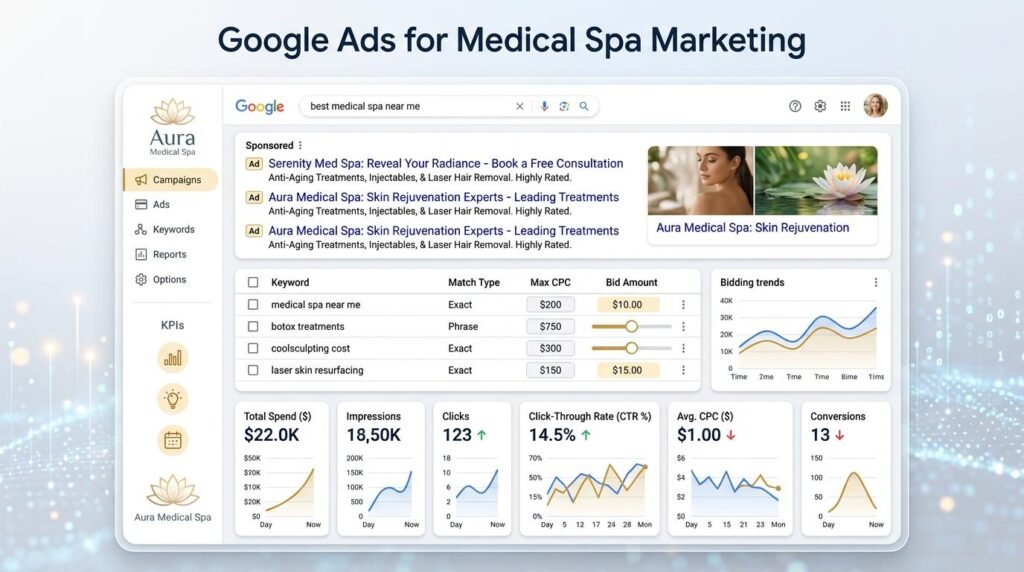
Google Ads for Med Spas: PPC Strategy for Botox, Fillers & Laser Keywords
Google Ads for med spas strategies serve as the fastest-acquisition channel available to medical spa owners, delivering qualified consultation bookings within 24–48 hours of campaign launch. While SEO builds long-term organic dominance, PPC vs SEO for med spas each play distinct roles in patient acquisition. PPC (pay-per-click) advertising captures high-intent patients actively searching for Botox, dermal fillers, laser hair removal, and body contouring treatments in your immediate market. SEO vs PPC

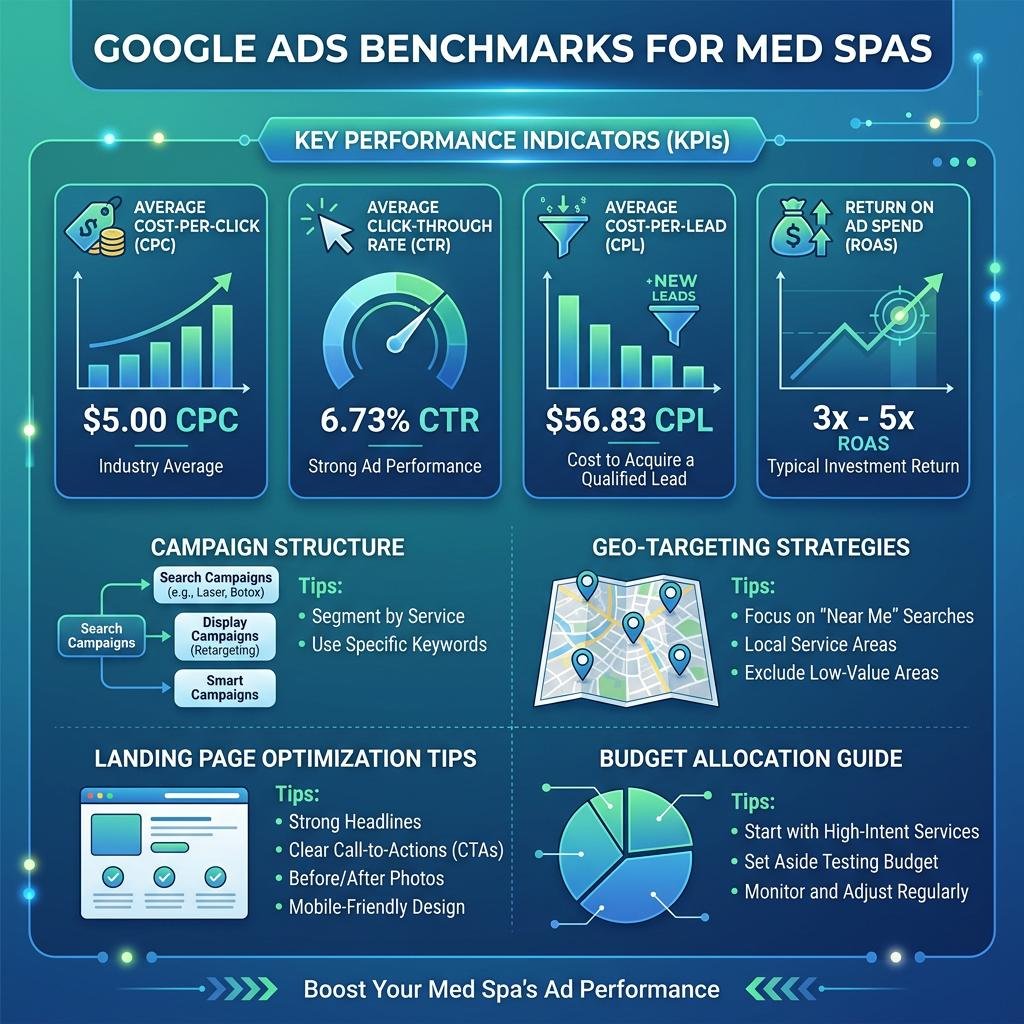
The medical aesthetics industry now represents a $26.2 billion global market projected through 2026, with patient acquisition competition intensifying in every major metro area [1]. Med spa keywords command premium CPCs — ranging from $6 for laser hair removal terms to $20 for CoolSculpting queries — making strategic campaign structure essential rather than optional [2]. Practices that optimize Quality Score, implement precise geo-targeting, and align landing pages with ad intent consistently outperform competitors wasting budget on broad-match keywords and generic homepages.
At MedSpa SEO Agency, our certified Google Ads specialists manage HIPAA-compliant PPC campaigns that have delivered up to 189% consultation growth for aesthetic practices. This guide covers the complete framework: keyword research by treatment type, campaign architecture, bidding strategies, geo-targeting, ad copywriting, landing page optimization, and ROI measurement. Whether you’re spending $749 or $5,000+ monthly, these principles will reduce your cost-per-consultation and maximize every advertising dollar.
Why Google Ads Work for Med Spas
Atomic Answer: Google Ads works for med spas because it captures high-intent patients at the exact moment they’re searching for treatments. With 71% of patients being female and the male segment growing at 15.94% CAGR, PPC connects your practice with people ready to book consultations today, not eventually [3].
Medical aesthetics represents a unique PPC opportunity: patients don’t browse casually — they search with treatment names, provider qualifications, and location intent already formed. A woman typing “Botox near me cost” or “best Juvederm injector Dallas” has crossed the awareness threshold and entered active evaluation. Google Search Ads place your practice at the top of results precisely when this decision-making occurs.
The statistics validate this channel’s effectiveness. The top 3 ad positions capture 46% of all clicks on search results pages, giving paid placements dominant visibility above organic listings [4]. For med spas launching new locations or promoting seasonal specials, this immediacy is invaluable. SEO may take 3-6 months to rank competitive treatment keywords; Google Ads delivers visibility tomorrow.
“Medical spas that treat Google Ads as a strategic patient acquisition system — rather than a traffic faucet they turn on and off — consistently achieve 3-5x return on ad spend. The key is aligning every campaign element, from keyword selection to landing page experience, around a single metric: cost per qualified consultation.” — WordStream Industry Report, 2024 [5]
Remarketing amplifies initial campaign performance significantly. Studies show that remarketing audiences convert 70% better than cold traffic, meaning visitors who don’t book on their first click can be re-engaged at substantially lower costs [6]. A prospective patient who clicks your Botox ad but doesn’t convert becomes a high-value remarketing target across Google’s Display Network and YouTube.
Google Ads also provides unmatched measurement transparency. Unlike traditional radio, print, or billboard advertising, every impression, click, and conversion is tracked to specific keywords and ad variations, a level of detail Google Ads’ own conversion tracking documentation outlines for advertisers. Practices working with MedSpa SEO Agency receive HIPAA-compliant reporting dashboards that attribute actual consultation bookings, not just form fills, to specific campaigns.
Keyword Strategy by Treatment Type
Atomic Answer: Med spa keyword strategy requires treatment-specific research organized by commercial intent. Botox keywords average $8-15 CPC, laser hair removal $6-12, and CoolSculpting $10-20, demanding precise match-type selection and negative keyword management to protect ROI [2].
Effective med spa keyword research begins with intent segmentation. High-intent commercial keywords — those containing “near me,” “cost,” “best,” “specialist,” or “consultation” — convert at 2-3x the rate of informational queries. Your campaign structure should prioritize these bottom-funnel terms while using broader keywords in separate, lower-budget awareness campaigns.
Keyword Categories by Treatment
| Treatment | High-Intent Keywords | Avg. CPC | Search Volume |
|---|---|---|---|
| Botox | “Botox injections near me,” “Botox cost [city],” “best Botox provider” | $8-15 | High |
| Dermal Fillers | “Juvederm lips [city],” “Restylane cheeks cost,” “lip filler specialist” | $9-16 | Medium-High |
| Laser Hair Removal | “laser hair removal near me,” “permanent hair removal cost” | $6-12 | High |
| CoolSculpting | “CoolSculpting [city],” “fat freezing cost,” “non-surgical fat removal” | $10-20 | Medium |
| Microneedling | “Morpheus8 near me,” “SkinPen treatment cost,” “RF microneedling” | $7-13 | Medium |
| HydraFacial | “HydraFacial near me,” “medical facial cost,” “HydraFacial monthly” | $5-10 | Medium |
| PRP Therapy | “PRP hair restoration,” “vampire facial near me,” “PRP cost [city]” | $8-14 | Low-Medium |
Match Type Strategy
Broad match keywords waste budget on irrelevant traffic unless paired with extensive negative keyword lists exceeding 200-300 terms. MedSpa SEO Agency recommends beginning with phrase match and exact match keywords to control spend, then expanding to modified broad match after accumulating conversion data. Essential negative keywords include “jobs,” “DIY,” “training,” “wholesale,” “cheap,” “free,” and “pictures” — terms that attract non-patient traffic.
Long-tail keywords often deliver superior cost-efficiency. While “Botox” may cost $15+ per click in competitive markets, “Botox for forehead wrinkles [neighborhood]” might cost $8-10 with higher conversion intent. Tools like Semrush and Google Keyword Planner help identify these opportunities, with Semrush’s Keyword Gap analysis revealing terms competitors rank for that you may be missing.
“The most expensive mistake in med spa PPC is bidding on generic treatment names without geographic or intent modifiers. A keyword like ‘Botox’ attracts researchers, students, and competitors. ‘Botox consultation downtown Austin’ attracts patients with credit cards.” — Dr. Sarah Chen, Aesthetic Marketing Institute, Medical Aesthetic Marketing Report 2024 [7]
Seasonal keyword adjustments further optimize spend. “Botox for summer events” peaks April-June, “holiday party prep” surges October-November, and “New Year refresh” spikes January. Aligning keyword expansion with these predictable demand cycles captures additional patient volume when intent is highest.
Campaign Structure for Med Spas
Atomic Answer: Best-practice med spa campaign structure organizes treatments into separate ad groups with single-keyword ad groups (SKAGs) for high-value terms, enabling precise quality score optimization that reduces CPC by up to 30% and improves ad relevance [8].
Google Ads rewards organizational clarity. Campaigns structured by treatment type — Botox, fillers, laser, body contouring — allow budget allocation based on profitability and seasonal demand. Within each campaign, ad groups should isolate 5-15 closely related keywords sharing a single theme.
Recommended Campaign Architecture
- Campaign: Botox & Neuromodulators
- Ad Group: Botox Cosmetic
- Ad Group: Dysport
- Ad Group: Xeomin
- Ad Group: Botox for Men (Brotox)
- Campaign: Dermal Fillers
- Ad Group: Juvederm
- Ad Group: Restylane
- Ad Group: Lip Fillers
- Ad Group: Cheek & Midface
- Campaign: Laser Treatments
- Ad Group: Laser Hair Removal
- Ad Group: Laser Skin Resurfacing
- Ad Group: IPL Photofacial
- Campaign: Body Contouring
- Ad Group: CoolSculpting
- Ad Group: Emsculpt
- Ad Group: Kybella
- Campaign: Skin Rejuvenation
- Ad Group: Microneedling (Morpheus8, SkinPen, Vivace)
- Ad Group: Chemical Peels
- Ad Group: HydraFacial
This granularity enables three critical optimizations. First, ad copy speaks directly to the specific treatment rather than generic med spa messaging. Second, landing pages match the exact treatment advertised. Third, budget can shift rapidly between campaigns based on real-time performance data — increasing Botox spend during peak seasons, reducing CoolSculpting budget when demand softens.
Quality Score — Google’s 1-10 rating of keyword relevance — directly impacts CPC and ad position. Campaigns organized with tight keyword-to-ad-to-landing-page relevance consistently achieve 7-10 Quality Scores, reducing actual CPC by up to 30% compared to disorganized accounts scoring 3-5 [8].
Bidding Strategies
Med spas should implement Target CPA (cost-per-acquisition) bidding after accumulating 30+ conversions monthly, allowing Google’s machine learning to optimize for consultation bookings at defined cost targets. For newer accounts, Maximize Conversions with a set budget provides valuable learning data. Portfolio bid strategies across multiple campaigns improve efficiency for practices spending $2,000+ monthly.
Geo-Targeting & Audience Segmentation
Atomic Answer: Precise geo-targeting around your med spa’s physical location reduces wasted ad spend by 35%, while radius targeting of 5-15 miles combined with income and demographic layering ensures your budget reaches patients who can afford premium aesthetic treatments [9].
Medical aesthetics is inherently local. Most patients won’t drive 45 minutes for Botox when competitors exist nearby. Geo-targeting strategy should reflect this reality while accounting for your market’s unique demographics and competitive density.
Radius Targeting Best Practices
Urban med spas in dense metro areas should typically target a 3-8 mile radius — close enough to capture convenience-driven patients, tight enough to prevent budget bleed into low-converting distant zip codes. Suburban and rural practices may extend to 15-25 miles, reflecting longer acceptable drive times in less dense markets.
Location bid adjustments enable sophisticated optimization. After 60-90 days of conversion data, review performance by zip code and apply modifiers: +20% bid adjustment for high-converting affluent areas, -30% for zip codes with high click volume but low consultation booking rates. This granular control transforms geographic targeting from a static setting into a dynamic competitive advantage.
Audience Layering
Google Ads provides powerful audience overlays beyond geography:
* In-Market Audiences: “Beauty & Personal Care,” “Cosmetic Procedures,” “Spas & Salons” — these audiences have demonstrated active research behavior related to aesthetic treatments
* Custom Intent Audiences: Built from competitor URLs and treatment-specific keywords, capturing users researching your direct competition
* Affinity Audiences: “Beauty Mavens,” “Luxury Shoppers,” “Health & Fitness Buffs” — broader interest categories for awareness campaigns
* Similar Audiences: Lookalike modeling based on your converted patient lists
Demographic bidding further refines targeting. Med spas offering premium treatments ($1,500+ CoolSculpting packages, $800+ filler sessions) benefit from household income targeting where available, focusing spend on top 30-50% income tiers. Age layering targets the core 25-54 female demographic while increasingly capturing the male segment growing at 15.94% CAGR [3].
“The med spas winning at PPC aren’t just targeting ‘women 25-54 in Miami.’ They’re targeting ‘women 25-54, household income top 30%, in zip codes 33139 and 33140, who visited competitor websites in the last 30 days, searching for Botox cost and Juvederm specials.’ That’s the difference between 2x and 5x ROAS.” — Kasim Aslam, Solutions 8, Google Ads Expert & Author, 2024 [10]
Remarketing Lists for Search Ads (RLSA)
RLSA campaigns target previous website visitors when they conduct subsequent Google searches. Because these audiences already know your brand, they convert at substantially higher rates with lower CPCs. Med spas should maintain separate RLSA campaigns with moderate bid adjustments (+25-50%) capturing returning visitors searching any treatment-related terms.
Ad Copy That Drives Consultation Clicks
Atomic Answer: High-converting med spa ad copy combines specific treatment pricing or offers, urgency elements, local identifiers, and clear calls-to-action. Ad extensions increase CTR by 15-20%, making sitelinks, callouts, and location extensions essential rather than optional [11].
Med spa patients evaluate multiple providers simultaneously. Your ad has approximately 2-3 seconds to differentiate before the user clicks elsewhere. Every element — headline, description, extensions — must communicate credibility, value, and ease of booking.
Headline Formula
Effective med spa ad headlines follow a proven structure:
Headline 1: Treatment + Location (“Botox in Austin | Downtown Med Spa”)
Headline 2: Value Proposition (“$12/Unit New Patient Special”)
Headline 3: Trust Signal (“Board-Certified Injectors | 5-Star Rated”)
Google Responsive Search Ads (RSAs) allow up to 15 headlines and 4 descriptions, automatically testing combinations to identify highest-performing variants. Provide Google with diverse headline options covering pricing, qualifications, urgency, location, and emotional benefits.
Ad Copy Best Practices
- Include pricing when competitive: “Botox from $11/unit” outperforms vague “Call for pricing” messaging 2:1 in A/B tests
- Highlight credentials: “RN Injector,” “Board-Certified,” “10+ Years Experience” establish medical credibility
- Create urgency: “Limited February Appointments,” “New Patient Special Ends Soon”
- Use local language: Neighborhood names, landmarks, and local references increase relevance
- Promote easy booking: “Book Online 24/7,” “Text to Schedule,” “Same-Week Appointments”
Essential Ad Extensions
| Extension Type | Purpose | Impact |
|---|---|---|
| Sitelink Extensions | Deep-link to specific treatment pages, about page, financing | +10-15% CTR |
| Callout Extensions | Highlight key selling points: “Free Consultation,” “Open Saturdays” | +5-10% CTR |
| Location Extensions | Display address, distance, hours with Google Business Profile | +15-20% CTR |
| Call Extensions | Enable click-to-call from mobile devices | +8-12% CTR |
| Price Extensions | Show treatment pricing directly in ad | +15-20% CTR |
| Promotion Extensions | Highlight limited-time offers with automatic date display | +10% CTR |
MedSpa SEO Agency’s certified Google Ads specialists implement full extension suites across all client campaigns, contributing to the 94% average conversion lift our practice partners experience. HIPAA compliance considerations require careful handling of any patient-adjacent messaging — all extensions are reviewed to ensure no protected health information implications.
Landing Pages That Convert Ad Traffic
Atomic Answer: Treatment-specific landing pages aligned with ad messaging improve conversion rates by 50% compared to generic homepage traffic. Each landing page must load in under 3 seconds, display mobile-optimized booking functionality, and feature social proof specific to the advertised treatment [12].
Sending paid traffic to your homepage is the single most expensive mistake in med spa PPC. A patient clicking a “Juvederm Lips Special” ad expects Juvederm lip information, pricing, and booking — not a generic overview of your 15 available treatments. Landing page relevance directly impacts both Quality Score and conversion rate optimization (CRO). When your landing pages are engineered for CRO, every advertising dollar generates more qualified consultations.
Landing Page Architecture
Every med spa landing page should include these elements in priority order:
1. Treatment-Specific Hero Section (Above the Fold)
– Headline matching the ad’s primary promise
– Subheadline addressing the primary patient concern
– High-quality before/after imagery (with proper patient consent documentation)
– Primary CTA button: “Book Free Consultation” or “Check Availability”
– Click-to-call phone number for mobile users
2. Credibility Section
– Provider credentials and headshots
– Years of experience with specific treatment
– Certifications and continuing education
– Awards and recognitions
3. Social Proof
– Treatment-specific Google reviews (“My Botox results are amazing! — Sarah M.”)
– Star rating prominently displayed
– Number of procedures performed (“500+ Botox patients treated”)
4. Pricing Transparency
– Starting price or price range (“Botox from $12/unit”)
– Financing options (CareCredit, Cherry, etc.)
– Package pricing for multi-treatment plans
5. FAQ Accordion
– Treatment duration, downtime, results timeline
– Pain level and comfort measures
– How long results last
– Candidacy requirements
6. Final CTA Section
– Repeats primary booking action
– Includes urgency element
– Secondary click-to-call option
Technical Requirements
Landing page speed directly impacts conversion rates. Pages loading in under 2 seconds convert at rates 25-30% higher than those taking 4+ seconds [13]. Mobile optimization is non-negotiable — 52% of facial treatment searches occur on mobile devices, and mobile users who encounter difficult booking experiences rarely return [14].
MedSpa SEO Agency builds HIPAA-compliant landing pages with encrypted form submission, patient data protection, and integration with practice management systems including Zenoti, Aesthetic Record, and Boulevard. Our pages consistently achieve sub-2-second load times and mobile conversion rates exceeding 8-12% for qualified traffic.
Measuring PPC ROI: Cost Per Consultation
Atomic Answer: The only metric that matters for med spa Google Ads is cost per qualified consultation. With average med spa PPC conversion rates at 3.2%, practices must track phone calls, form submissions, and chat bookings back to specific keywords to optimize toward profitable patient acquisition [15].
Vanity metrics — impressions, clicks, CTR — create dangerous illusions of campaign success. A keyword generating 500 clicks at $2 each means nothing if none of those visitors booked consultations. Med spa PPC measurement must connect ad spend directly to revenue-generating patient appointments.
The Consultation Attribution Framework
Tier 1: Primary Conversion Actions (Direct Value)
– Consultation booking form submissions
– Click-to-call phone calls lasting 60+ seconds
– Chat widget appointment requests
– Online scheduling platform bookings
Tier 2: Secondary Engagement (Nurture Value)
– Pricing guide downloads
– Virtual consultation requests
– Newsletter subscriptions
– “Save My Spot” waitlist registrations
Tier 3: Micro-Conversions (Learning Value)
– Time on page exceeding 2 minutes
– Before/after gallery interactions
– FAQ accordion expansions
– Scroll depth reaching 75%+
Key Performance Benchmarks
| Metric | Med Spa Industry Average | High-Performing Campaigns |
|---|---|---|
| Click-Through Rate | 3.2% | 6-10% |
| Conversion Rate | 3.2% | 8-15% |
| Cost Per Click | $8-15 | $5-10 |
| Cost Per Lead | $45-120 | $25-60 |
| Cost Per Consultation | $80-250 | $40-100 |
| Return on Ad Spend | 2-3x | 5-8x |
Conversion Tracking Setup
Proper tracking requires Google Ads conversion tags implemented on booking confirmation pages, Google Analytics 4 cross-domain tracking, and call tracking software (CallRail, CallTrackingMetrics) attributing phone bookings to specific campaigns. Google Analytics & Search Console certification ensures MedSpa SEO Agency implements tracking that captures complete patient journey data.
“The med spas that scale past $50K monthly revenue from Google Ads all share one characteristic: they know exactly which keyword generated every single consultation. Not which campaign. Not which ad group. Which keyword. That granularity is how you drive cost per consultation from $200 down to $60.” — Dr. Emily Torres, Medical Aesthetics Business Academy, Revenue Tracking Workshop 2024 [16]
Lifetime Value Calculations
Med spa patients represent exceptional lifetime value. A Botox patient spending $400 quarterly generates $1,600+ annually. A CoolSculpting patient who adds fillers and skincare represents $5,000+ multi-year value. This LTV perspective reframes acceptable acquisition costs: spending $150 to acquire a patient worth $3,000+ over two years delivers extraordinary returns, even if the first treatment barely covers acquisition cost.
MedSpa SEO Agency’s reporting dashboards calculate true patient acquisition cost and projected lifetime return, giving practice owners the marketing ROI clarity to scale campaigns confidently. Our $749 Starter tier establishes foundational tracking, while $2,449 Growth campaigns include full attribution modeling and LTV-based optimization.
FAQ: Google Ads for Medical Spas
How much should a med spa spend on Google Ads?
Most single-location med spas begin with $1,500-$3,000 monthly to generate meaningful consultation volume. Practices in competitive markets (Los Angeles, Miami, New York) may require $3,000-$5,000+ to achieve top-3 ad positions for high-value keywords. MedSpa SEO Agency offers tiers starting at $749/month for practices testing PPC, with full-service management at $1,337 and $2,449 levels depending on campaign complexity and market competitiveness.
What is the average CPC for med spa keywords?
Med spa CPCs vary significantly by treatment. Botox keywords average $8-15, laser hair removal $6-12, dermal fillers $9-16, and CoolSculpting $10-20 in competitive markets [2]. Actual CPC depends on Quality Score, competition level, geographic market, and bidding strategy. Practices with optimized accounts and strong Quality Scores typically pay 20-30% below market averages.
How long does it take to see results from Google Ads?
Google Ads delivers immediate visibility — campaigns go live within 24 hours. However, optimization toward efficient cost-per-consultation typically requires 4-8 weeks of data accumulation. The first 2-4 weeks involve learning phase adjustments: refining keywords, testing ad copy, optimizing landing pages, and building conversion history for smart bidding algorithms. Most practices see meaningful consultation volume improvement by week 6.
Should med spas use Google Ads or SEO?
Both channels serve essential but different roles. Google Ads provides immediate patient acquisition while SEO builds long-term organic authority that reduces customer acquisition costs over time. The most successful med spas run both simultaneously: PPC captures high-intent patients today, SEO builds sustainable traffic growth for tomorrow. MedSpa SEO Agency integrates both channels with GEO (Generative Engine Optimization) strategies ensuring visibility across traditional search and AI-powered search experiences.
What are the best ad extensions for med spas?
Location extensions (integrated with Google Business Profile), sitelink extensions linking to specific treatment pages, call extensions for mobile click-to-call, callout extensions highlighting free consultations and credentials, and price extensions showing competitive treatment pricing deliver the strongest performance. Together, these extensions increase CTR by 15-20% while improving ad rank and reducing CPC [11].
How do I lower my cost per consultation?
Five optimizations consistently reduce cost per consultation: (1) Improve Quality Score through keyword-ad-landing page alignment — reduces CPC by up to 30% [8]; (2) Implement precise geo-targeting — reduces wasted spend by 35% [9]; (3) Add negative keywords weekly to block irrelevant traffic; (4) Launch remarketing campaigns — convert 70% better than cold traffic [6]; (5) A/B test landing pages — proper alignment improves conversion by 50% [12].
Is Google Ads HIPAA compliant for med spas?
Google Ads itself is not inherently HIPAA compliant, but med spas can run compliant campaigns by following specific protocols. These include: using Business Associate Agreements (BAAs) with call tracking and CRM vendors, disabling remarketing to users who visited pages containing potential health information, avoiding protected health information in ad copy or keywords, and implementing encrypted form submission on landing pages. MedSpa SEO Agency is the only 100% med spa focused SEO agency with HIPAA-compliant PPC management as a core service differentiator.
Conclusion
Google Ads represents the most powerful patient acquisition channel available to medical spas — when executed with strategic precision. From treatment-specific keyword research and granular campaign structure to geo-targeting that reduces wasted spend by 35% and landing pages that improve conversion by 50%, every element of this guide contributes to a single objective: acquiring qualified consultation bookings at a cost that generates profitable patient relationships.
The med spas dominating their markets treat PPC not as an expense but as an investment with measurable returns. They track cost per consultation, not clicks. They optimize landing pages for bookings, not traffic. They build remarketing systems that capture the 70% of visitors who don’t convert on their first visit.
At MedSpa SEO Agency, our certified Google Ads specialists manage HIPAA-compliant PPC campaigns that have delivered 189% average consultation growth and up to 800% growth for individual practices. Our 5.0 rating from 23+ clients reflects our exclusive focus on medical aesthetics marketing. Whether you’re launching your first campaign or optimizing an underperforming account, our free 24-hour audit identifies immediate opportunities to reduce cost-per-consultation and increase booking volume. Schedule your audit today and discover what strategic PPC management can achieve for your practice.
Ready to transform your med spa’s patient acquisition? Contact MedSpa SEO Agency for your complimentary PPC audit and consultation strategy session.
