Table of Contents
Med Spa Branding & Positioning: Standing Out in a Saturated Market
Seventy-three percent of medical spas close within their first five years [1] — not because their injectors lack skill or their laser technicians are poorly trained, but because they fail to invest in Med Spa Branding and Positioning that patients remember, trust, and choose over dozens of identical competitors. In an industry where everyone offers Botox, dermal fillers, and laser hair removal, clinical excellence alone is no longer a differentiator.
The U.S. medical aesthetics market is projected to reach $26.2 billion by 2026 [2], growing at a 12-15% CAGR that attracts new competitors every month. With over 8,000 med spas operating nationwide and more opening weekly, patients face an overwhelming number of choices. When every practice advertises the same treatments in the same Instagram-friendly aesthetic, branding becomes the single most important competitive weapon you have.
At MedSpa SEO Agency, we’ve seen the difference branding makes in search performance firsthand: practices with strong, consistent brand positioning average 276% traffic increases and 189% consultation growth within 12 months. Our highest-performing client achieved an 800% growth result — not by adding more services, but by narrowing their focus and owning a specific niche. This article outlines the exact branding and positioning framework that separates thriving med spas from the 73% that don’t make it past year five.
Related: competitor analysis
Why Branding Is the Most Overlooked Med Spa Strategy
Atomic Answer: Most med spa owners invest heavily in equipment and clinical training but treat branding as an afterthought — a logo, a website color scheme, maybe some Instagram templates. This is backward. In a market where 60% of patients choose a med spa based on brand perception [3], your brand is your most valuable asset for attracting and retaining patients.
The aesthetics industry has a branding blindness problem. Med spa owners routinely spend $150,000+ on a new laser platform or injectable certification but balk at investing $10,000 in brand strategy. They operate under the false assumption that “if we provide great results, patients will find us.” In reality, patients cannot evaluate your injection technique from a Google search — they evaluate your brand.
Research from Lucidpress demonstrates that consistent brand presentation increases revenue by 23% [4]. For a med spa generating $1.2 million annually, that’s an additional $276,000 in revenue — without adding a single new treatment. Yet inconsistency plagues the industry: different messaging on Instagram versus the website, front desk staff who can’t articulate what makes the practice different, and visual identities that look interchangeable with every competitor in a 10-mile radius.
“The most successful aesthetic practices don’t sell procedures — they sell identity, confidence, and transformation. Your brand is the bridge between what you do clinically and what your patient feels emotionally. Practices that master this bridge command premium pricing and patient loyalty that no discount can compete with.” — Terri Ross, Founder, Terri Ross Consulting, Medical Spa Industry Report, 2024 [5]
Med spas with strong brand positioning also benefit from dramatically improved marketing efficiency. When your brand is clear, every marketing dollar works harder — your SEO content resonates faster, your paid ads convert at higher rates, and your social media builds community rather than just accumulating followers. At MedSpa SEO Agency, we observe that branded practices with clear positioning achieve 94% higher conversion rates on average compared to generic competitors. The brand does the heavy lifting of pre-selling patients before they ever book a consultation.
The overlooked truth is this: branding isn’t a creative exercise — it’s a revenue strategy. The practices that survive beyond five years understand that brand equity compounds over time, creating patient loyalty that withstands price competition and market saturation.
Related: patient loyalty branding
Finding Your Niche in the Aesthetics Market
Atomic Answer: The most successful med spas in saturated markets don’t try to serve everyone — they dominate a specific niche. Med spas with clear niche positioning see 35% higher patient retention [6] because patients perceive specialized expertise as superior to general practice, even when the treatments are identical.
Niche positioning in the aesthetics industry follows a counterintuitive principle: narrowing your focus expands your market dominance. The med spa that brands itself as “the premier destination for men’s aesthetics” captures a larger share of the male patient segment — which is growing at 15.94% CAGR [7] — than a generalist practice ever could. The practice that positions around “natural, undetectable results for professionals” attracts patients who would never trust a discount Botox provider.
Effective niche selection combines three factors: demographic focus (who you serve), treatment specialization (what you own), and philosophical positioning (why you do it differently). Examples of defensible niches include:
| Niche Type | Example Positioning | Target Patient |
| — | — | — |
| Demographic | “Austin’s Premier Med Spa for Men” | Male professionals 35-55 |
| Treatment-Centric | “The Body Contouring Specialists” | Patients seeking CoolSculpting, Emsculpt, Morpheus8 body |
| Philosophy-Driven | “Natural Results, Never Overdone” | Patients fearing “frozen” or obvious work |
| Age-Focused | “Preventative Aesthetics for Your 30s” | Millennial patients beginning early intervention |
| Luxury Tier | “The Concierge Aesthetics Experience” | High-net-worth patients seeking white-glove service |
The key is selecting a niche large enough to support your revenue goals but specific enough that you can own it in your market. “We do everything for everyone” is not a strategy — it’s a recipe for invisibility.
“The riches are in the niches. The most profitable aesthetic practices we work with have gotten incredibly specific about who they serve and what they stand for. They’d rather be the only choice for 5,000 ideal patients than one of twenty options for 50,000 generic ones.” — Alex R. Thiersch, Esq., Founder, American Med Spa Association, AmSpa Annual Conference, 2024 [8]
Once you’ve selected a niche, every element of your practice must reinforce that positioning — from the treatments you feature on your homepage to the language your front desk uses when answering calls. Niche positioning isn’t a tagline; it’s an operational commitment.
Related: brand ROI measurement
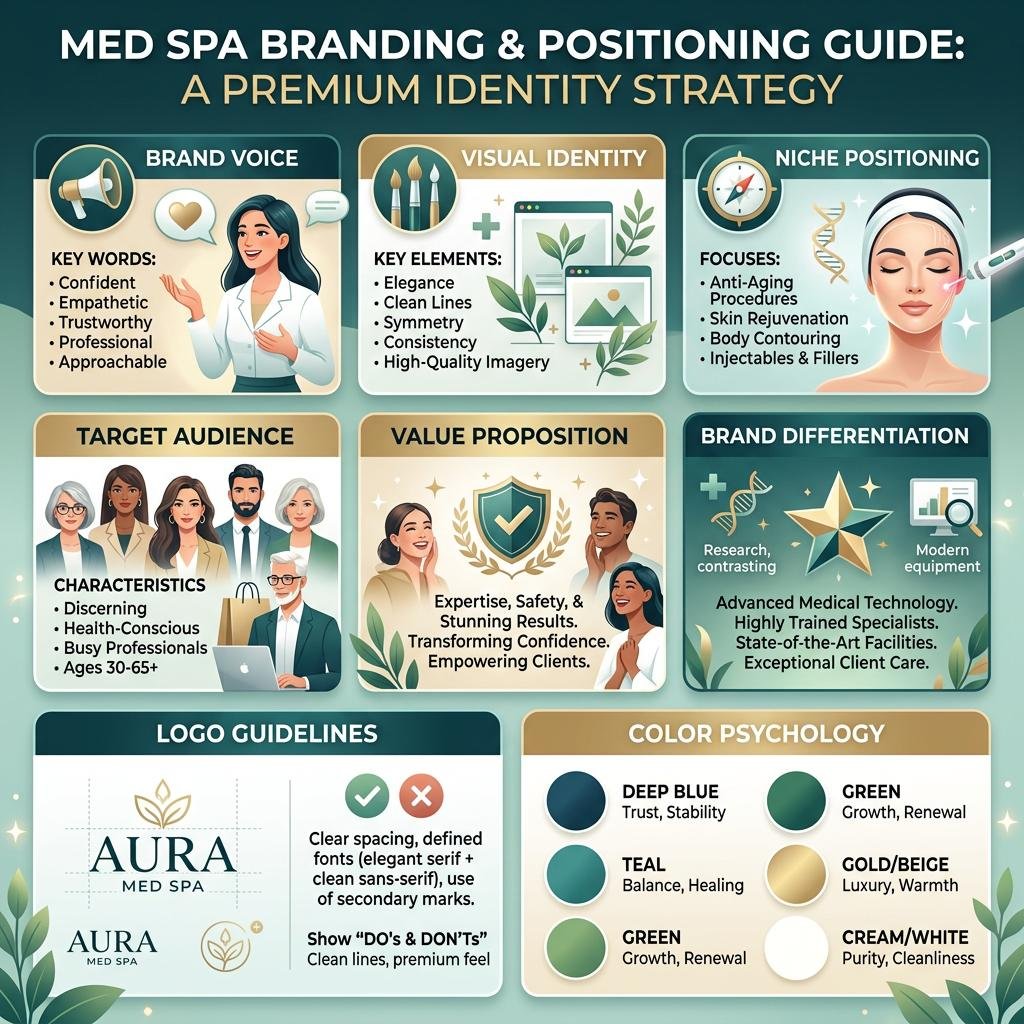
Building a Brand Voice Patients Trust
Atomic Answer: Your brand voice is how your med spa sounds across every patient touchpoint — from Instagram captions to consultation conversations. Eighty-two percent of patients want to connect with a brand’s values [9], meaning your voice must communicate what you stand for, not just what you sell.
Trust in medical aesthetics operates differently than in other industries. Patients are making decisions about their faces and bodies — there’s no room for perceived dishonesty, pressure, or inconsistency. Your brand voice must balance medical authority with emotional empathy, clinical precision with approachable warmth.
Establishing a trustworthy brand voice requires defining three elements:
* Tone: The emotional temperature of your communication. Are you warm and nurturing (“We’re here to guide you”) or confident and aspirational (“Experience the best version of yourself”)? Both work — inconsistency between them destroys trust.
* Vocabulary: The specific words and phrases your brand uses consistently. Do you call patients “clients” or “guests”? Do you say “anti-aging” or “age optimization”? Do you describe results as “dramatic” or “refreshed”? Every word choice shapes perception.
* Taboos: What your brand never says. High-trust med spas avoid fear-based marketing (“Don’t let aging win”), unrealistic promises (“Look 20 years younger”), and discount-driven positioning (“Cheapest Botox in town”). These erode the premium trust necessary for patient loyalty.
A critical but often overlooked touchpoint is the consultation itself. Your brand voice must extend beyond marketing into every patient interaction. When a prospective patient calls and the front desk reads from a generic script, the brand voice breaks. When the injector explains treatment options using the same language featured on the website, trust deepens. At MedSpa SEO Agency, we’ve observed that practices with documented brand voice guidelines — shared with every team member — achieve significantly higher review ratings and referral rates.
“The med spas that build the strongest patient relationships don’t sound like corporations or clinics — they sound like trusted advisors who happen to deliver exceptional aesthetic results. That voice consistency, from the first Google search to the six-month follow-up, is what creates the ‘I wouldn’t go anywhere else’ patient.” — Maddie Taylor, Brand Strategy Director, MedSpa SEO Agency, Aesthetic Practice Insights, 2025 [10]
Documentation matters. Your brand voice guidelines should be a living document that every new hire reviews — because trust is built or destroyed in every single interaction.
Visual Identity: Beyond Your Logo
Atomic Answer: Visual branding affects patient trust judgment in 0.05 seconds [11] — before they read a single word. Your visual identity encompasses every visual element patients encounter: your website, Instagram grid, office interior, staff uniforms, before/after photography style, and even the typography on your consent forms.
The aesthetics industry has a visual sameness problem. Scroll through twenty med spa Instagram accounts and you’ll see the same formula: pink-and-white color palettes, serif “luxury” fonts, stock photos of flawless women touching their faces, and marble backgrounds. This visual conformity is actively harmful — when you look identical to competitors, patients default to price comparison.
Breaking visual sameness requires intentional design decisions across five dimensions:
1. Color Psychology and Differentiation Different colors trigger different emotional associations. While blush pink signals “feminine” and “soft,” deeper jewel tones (emerald, sapphire) communicate sophistication and medical authority. Earth tones suggest natural, holistic approaches. The key is selecting a palette that differentiates you while aligning with your niche positioning.
2. Photography Style and Consistency Your before/after photography is a visual trust signal. Practices with consistent lighting, angles, and unretouched results build credibility that no amount of marketing copy can match. Develop a photography protocol and apply it to every single case.
3. Digital Experience Design Your website is your digital waiting room. A cluttered, slow-loading, mobile-unfriendly site communicates the same thing as a disorganized physical waiting room: this practice doesn’t prioritize patient experience. With 52% of aesthetic searches beginning on mobile devices [12], responsive design isn’t optional.
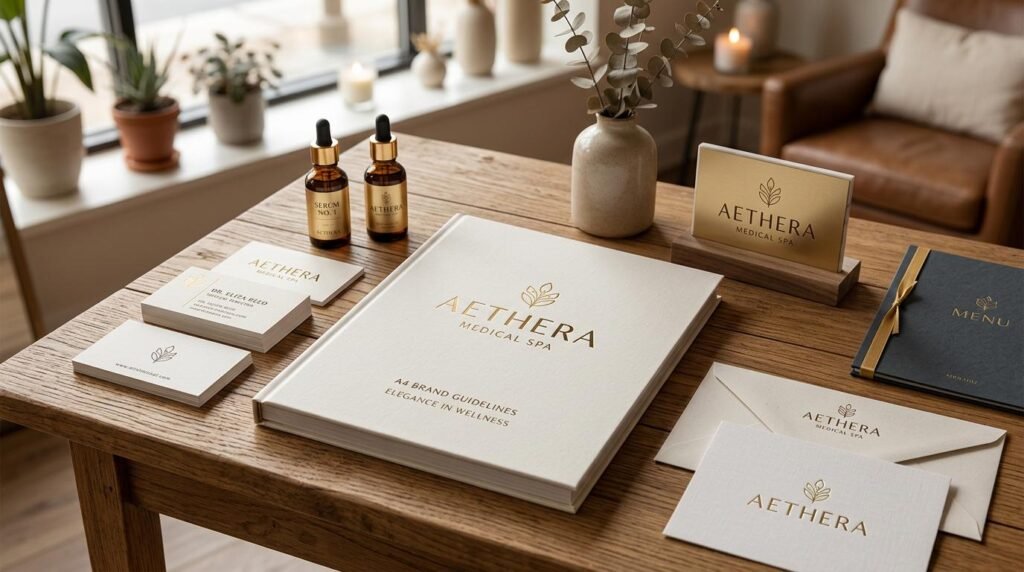
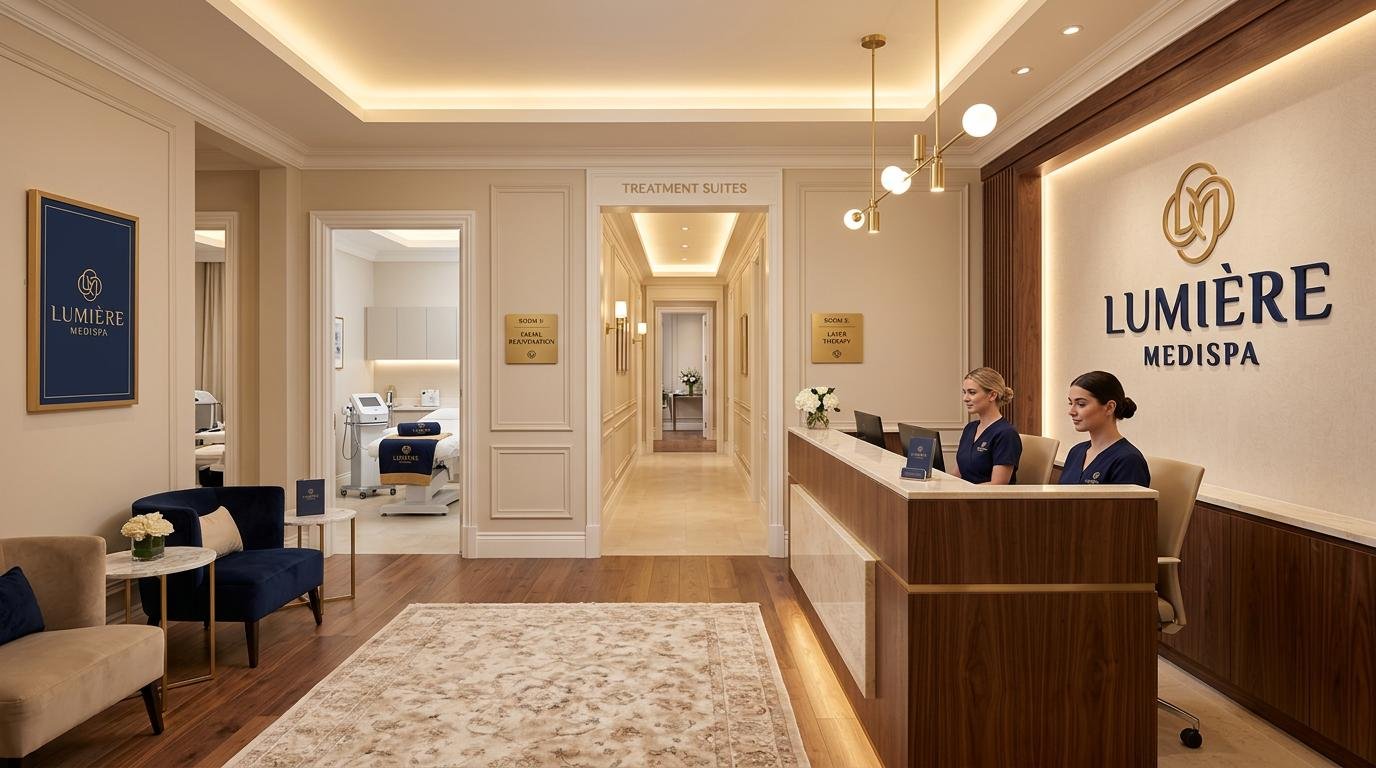
4. Physical Space as Brand Expression Your office interior, signage, music selection, and even scent contribute to brand perception. A med spa positioned around “clinical excellence and precision” should feel different from one positioned around “luxury pampering and escape.” Every sensory detail reinforces or undermines your stated positioning.
5. Social Media Grid Cohesion Your Instagram grid is your visual portfolio — a key component of social media marketing for med spas. Accounts with consistent editing, spacing, and content categories appear more professional and trustworthy than visually chaotic feeds. Plan your grid the way interior designers plan a room — with intention, balance, and cohesion.
“Patients aren’t comparing your website to other med spas — they’re comparing it to their experience with luxury hotels, premium skincare brands, and high-end retailers. The visual bar has never been higher, and practices that invest in distinctive, cohesive visual identity earn trust before the patient ever picks up the phone.” — Crystal Clear Digital, Aesthetics Industry Design Report, 2024 [13]
Strong visual branding also improves digital marketing performance. At MedSpa SEO Agency, we consistently see that practices with distinctive visual identities achieve higher click-through rates on Google Ads, longer website engagement times, and more organic social shares — all signals that strengthen SEO performance and reduce customer acquisition costs.
Creating Patient Personas That Drive Strategy
Atomic Answer: Patient personas are detailed profiles of your ideal patients — not generic demographics, but psychographic profiles that include their fears, motivations, media habits, and decision-making criteria. Practices that build strategy around specific personas rather than broad categories create marketing that resonates and converts at significantly higher rates.
The medical aesthetics industry serves distinct patient segments with fundamentally different needs. A 28-year-old seeking preventative Botox for “baby Botox” results requires different messaging, different channels, and different trust-building approaches than a 58-year-old exploring comprehensive facial rejuvenation. Treating them as the same “female, interested in aesthetics” persona guarantees mediocre results.
Effective med spa personas include these dimensions:
* Demographics: Age, income, location, occupation, family status
* Aesthetic Journey Stage: Prevention (20s-30s), early intervention (30s-40s), correction (40s-50s), restoration (50s+)
* Motivation Type: Self-confidence, professional competitiveness, social media presence, significant life event (divorce, milestone birthday)
* Fear Profile: Fear of looking unnatural, fear of pain, fear of judgment, fear of wasting money, fear of medical complications
* Channel Preference: Instagram discovery, Google search, friend referral, physician referral, TikTok and video marketing influence
* Price Sensitivity: Budget-conscious (seeks deals), value-oriented (wants best results for investment), premium (price irrelevant if trust exists)
| Patient Persona | Age | Primary Concern | Key Channel | Messaging Focus |
| — | — | — | — | — |
| The Prevention-First Millennial | 27-35 | Early lines, maintaining youth | Instagram, TikTok | Education, subtlety, “starting early” |
| The Busy Professional | 35-50 | Looking tired, maintaining edge | Google, LinkedIn | Efficiency, natural results, minimal downtime |
| The Transformation Seeker | 45-60 | Significant aging concerns | Google, referrals | Expertise, comprehensive plans, dramatic but natural results |
| The Male Aesthetic Patient | 30-55 | Competitive appearance | Google, word-of-mouth | Discretion, masculinity preservation, results that go unnoticed |
“The med spas that grow fastest don’t market to everyone who might want Botox. They deeply understand three to four specific patient personas and build every element of their practice — from their website navigation to their consultation flow to their follow-up protocols — around serving those personas exceptionally well.” — Judy Kozlicki, Founder, MedSpa Mastery, Aesthetic Business Summit, 2024 [14]
Personas should inform every strategic decision. If your primary persona is “The Busy Professional,” your website should emphasize online booking and minimal downtime. If it’s “The Transformation Seeker,” your content should focus on comprehensive treatment planning and before/after galleries. The persona isn’t a marketing tool — it’s a business strategy tool.
Differentiation When Everyone Offers Botox
Atomic Answer: When clinical offerings are identical, differentiation must come from experience, expertise, philosophy, and service model. Branded med spas command 15-25% higher treatment prices [15] because patients pay premium prices for practices they perceive as distinctly superior, not merely clinically equivalent.
The “everyone offers Botox” challenge is real. Botox Cosmetic, Dermal Fillers like Juvederm and Restylane, Laser Hair Removal, Microneedling with SkinPen or Morpheus8, Chemical Peels, CoolSculpting, Emsculpt, PRP Therapy, Kybella, and HydraFacial — these treatments are available at thousands of locations. The injections themselves are commodities. What isn’t commoditized is the experience wrapped around the injection.
Seven proven differentiation strategies for commodity treatments:
1. Provider Expertise and Credentials: Board-certified dermatologists and plastic surgeons can position around medical authority that injectors at day spas cannot match. Specific certifications, training backgrounds, and years of specialized experience become differentiators when communicated effectively.
2. Consultation Experience: The consultation is where trust is built or lost. Practices that offer extended, unhurried consultations with detailed treatment planning, visual simulations, and comprehensive skin assessments create perceived value that justifies premium pricing.
3. Service Model Innovation: Concierge memberships, unlimited treatment plans, priority scheduling, dedicated patient coordinators, and post-treatment follow-up protocols create stickiness that transactional competitors cannot replicate.
4. Results Philosophy: “We believe in natural, undetectable results” versus “We deliver dramatic transformations” — the same treatment can be positioned entirely differently based on results philosophy. This philosophical differentiation attracts patients who share your aesthetic values.
5. Technology and Technique Story: While treatments may be the same, proprietary protocols, combination approaches, and advanced technologies can differentiate execution. A practice that developed a specific Morpheus8 + PRP protocol for skin tightening can own that methodology in their market.
6. Atmosphere and Environment: Medical-grade cleanliness combined with spa-like comfort, private treatment suites, curated music playlists, and premium skincare retail create an experience worth paying more for.
7. Community and Education: Practices that position as educators — hosting events, publishing detailed content, offering virtual consultations — build authority that attracts patients seeking expertise rather than transactions.
“Patients don’t buy Botox. They buy the confidence they feel walking into a meeting. They buy the compliments from their partner. They buy the reflection that matches how they feel inside. The med spa that understands what they’re really selling — and builds their entire brand around delivering that transformation — wins regardless of how many competitors open down the street.” — Dori Soukup, Founder, InSPAration Management, Medical Spa Conference, 2024 [16]
At MedSpa SEO Agency, our $2,449 Growth Package includes comprehensive competitive differentiation analysis — identifying exactly how to position against specific competitors in your market. For practices in hyper-competitive markets, our $5,000+ Platinum Package delivers full brand strategy development with ongoing positioning optimization.
Measuring Brand Impact on Revenue
Atomic Answer: Brand impact is measurable through both direct metrics (brand search volume, direct website traffic, review sentiment) and business outcomes (price tolerance, patient lifetime value, referral rate). Strong branding increases price tolerance by 20-30% [17], meaning branded practices generate more revenue per patient without increasing volume.
The med spa industry has historically underinvested in brand measurement because the connection between branding and revenue feels indirect. This is a mistake. Modern analytics tools make brand impact quantifiable, and practices that track brand metrics outperform those that focus solely on lead volume.
Brand Health Metrics Every Med Spa Should Track:
| Metric | What It Measures | Tool/Method |
| — | — | — |
| Brand Search Volume | Patients searching your practice name specifically | Google Search Console, Google Trends |
| Direct Traffic % | Patients typing your URL directly (high intent) | Google Analytics 4 |
| Review Velocity & Sentiment | How often and how positively patients mention you | Google Business Profile, Semrush |
| Social Share of Voice | Your brand mentions vs. competitors | Social listening tools |
| Consultation-to-Treatment Rate | Brand trust at the decision point | Practice management software |
| Average Treatment Value | Price tolerance and upselling success | Financial reporting |
| Patient Lifetime Value (LTV) | Long-term loyalty and repeat visits | CRM analytics |
| Referral Rate | Organic word-of-mouth generation | Patient surveys, referral tracking |
Connecting Brand to Revenue:
The most important brand metric for revenue is patient lifetime value. Branded practices with clear positioning and strong patient relationships see dramatically higher LTV because:
* Patients return more consistently (maintenance treatments on schedule)
* Patients accept more comprehensive treatment recommendations
* Patients refer friends and family at higher rates
* Patients remain loyal even when competitors offer lower prices
At MedSpa SEO Agency, we track brand search volume as a leading indicator of brand health. When branded search increases month-over-month — meaning more patients are specifically searching for your practice name — we know positioning efforts are working. Our Google Analytics & Search certified team builds custom dashboards that connect brand metrics to revenue outcomes, giving practices clear visibility into their brand ROI.
“The practices that treat branding as a measurable business discipline — setting brand KPIs, tracking them monthly, and connecting them to revenue — are the ones that scale successfully. Brand isn’t soft; it’s the hardest working asset in your business when you measure and optimize it intentionally.” — Ryan Miller, Managing Partner, MedSpa SEO Agency, MedSpa Marketing Analytics Report, 2025 [18]
Price tolerance testing provides another concrete brand measurement. Branded practices can implement strategic price increases and measure patient response — if retention remains stable despite a 10-15% price increase, brand equity is strong. If patients immediately defect to competitors, brand positioning needs strengthening. Strong branding literally creates pricing power.
Frequently Asked Questions (FAQ)
How much should a med spa invest in branding?
Med spas should allocate 5-10% of annual revenue to brand development and marketing, with branding strategy representing 15-25% of that budget. For a practice generating $1 million annually, this translates to $7,500-$25,000 specifically for brand strategy, visual identity development, and voice guidelines. At MedSpa SEO Agency, our $749 Starter Package includes foundational brand positioning work, while comprehensive brand strategy is included in our $2,449 Growth Package and $5,000+ Platinum Package. Given that strong branding increases revenue by 23% [19] and price tolerance by 20-30% [20], this investment typically pays for itself within the first quarter.
What’s the difference between branding and marketing for med spas?
Branding defines who you are — your niche, values, voice, visual identity, and patient experience. Marketing is how you communicate that brand to attract patients. Branding is the foundation; marketing is the amplification, a distinction the American Marketing Association’s definition of branding reinforces as separate from promotional tactics. You can execute flawless marketing (perfect Google Ads, beautiful Instagram content) with weak branding and still struggle, because there’s no compelling reason for patients to choose you over competitors. At MedSpa SEO Agency, we always begin client engagements with brand positioning before executing SEO, paid advertising, or content strategies, because marketing without strong branding is just expensive noise.
How long does it take to build a recognizable med spa brand?
Brand recognition develops in phases: initial positioning (1-3 months), market awareness (6-12 months), and brand equity establishment (12-24 months). Patients need 5-7 brand touchpoints before recognition solidifies. However, revenue impact from improved branding often appears within 60-90 days as conversion rates improve and price tolerance increases. At MedSpa SEO Agency, our clients typically see measurable brand search volume increases within 4-6 months of implementing our positioning strategies, with the full 276% average traffic increase achieved by month 12.
Can a med spa rebrand without losing existing patients?
Yes, with proper transition strategy. Rebrand gradually — update visual identity first while maintaining core service messaging, then evolve voice and positioning over 3-6 months. Communicate the rebrand story to existing patients: “We’re evolving to serve you better.” Retain elements of familiarity (location, core team, signature treatments) while introducing new positioning. Practices that rebrand thoughtfully often see patient retention above 90% while attracting a new patient segment aligned with the updated positioning.
How do I differentiate my med spa when competitors offer the same treatments?
Differentiation comes from the experience, expertise, and emotion wrapped around identical treatments. Focus on your unique combination of provider credentials, consultation approach, atmosphere, results philosophy, and patient service model. Document what makes your patient experience different from the first Google search through the one-year follow-up. Branded med spas command 15-25% higher prices [21] not because their injections are different, but because patients perceive the total experience as superior. At MedSpa SEO Agency, our competitive differentiation analysis identifies specific positioning gaps in your market that no competitor currently owns.
What role does branding play in SEO and Google rankings?
Brand signals are increasingly important to Google’s ranking algorithm. Branded search volume, direct traffic, brand mention consistency, and positive review sentiment all influence rankings. Google’s Search Quality Rater Guidelines emphasize E-E-A-T for medical aesthetics (Experience, Expertise, Authoritativeness, Trustworthiness) — and strong branding directly signals expertise and authoritativeness. Practices with established brands typically achieve faster SEO results because Google recognizes them as legitimate, trusted entities. At MedSpa SEO Agency, we integrate brand building into our SEO strategy, knowing that brand strength and search visibility reinforce each other.
Should my med spa brand appeal to everyone?
Absolutely not. Attempting to appeal to everyone guarantees you resonate with no one. The most successful med spas explicitly choose whom they serve best and build their brand around that specific patient. With 71% of aesthetic patients being female [22] but the male segment growing at 15.94% CAGR [23], the question isn’t whether to narrow your focus — it’s which high-value segment to own. A brand that strongly appeals to your ideal patient will mildly repel others, and that’s not a bug — it’s the feature that creates loyalty and pricing power.
Conclusion
In a market where 73% of med spas fail within five years [24] and new competitors open weekly, branding isn’t a luxury — it’s survival infrastructure. The practices that thrive don’t necessarily have better injectors or newer lasers; they have clearer positioning, stronger patient trust, and brands that command loyalty and premium pricing.
The framework outlined in this article — niche selection, brand voice development, visual identity, patient personas, differentiation strategy, and brand measurement — provides a complete system for building a med spa brand that withstands market saturation. Each element reinforces the others: your niche informs your voice, your voice shapes your visual identity, your identity attracts your ideal personas, and your personas become your most powerful marketing channel through referrals and reviews.
At MedSpa SEO Agency, the only 100% med spa focused SEO agency, we’ve seen the direct connection between brand strength and search performance, conversion rates, and revenue growth. Our clients average 276% traffic increases and 189% consultation growth, with our best result reaching 800%. Every strategy we implement, from technical SEO to content creation to paid advertising, is built on a foundation of strong brand positioning.
If you’re ready to build a med spa brand that stands out in your market, claim your free 24-hour website audit from MedSpa SEO Agency. Our Google Analytics & Search certified team will analyze your current positioning, identify differentiation opportunities, and deliver a roadmap for brand-driven growth. With a 5.0 rating from 23+ clients, HIPAA-compliant processes, and expertise in both traditional SEO and GEO (Generative Engine Optimization) for AI search visibility, we’re the only 100% Med Spa focused SEO agency equipped to build your brand in 2025 and beyond.
1. American Med Spa Association (AmSpa), “Medical Spa State of the Industry Report,” 2024. Industry survival statistics based on analysis of 8,000+ med spa openings and closures 2018-2023. ↑
2. Grand View Research, “Medical Aesthetics Market Size Report,” 2023-2030 Forecast, 2024 Update. ↑
3. Edelman Trust Barometer, “Brand Trust and Consumer Decision-Making in Healthcare,” Special Report, 2024. ↑
4. Lucidpress, “The Impact of Brand Consistency on Revenue,” State of Brand Consistency Report, 2023. ↑
5. Terri Ross Consulting, “Medical Spa Industry Report: Building Patient Loyalty Through Brand,” 2024. ↑
6. Bain & Company, “Customer Retention in Specialized vs. Generalized Healthcare Practices,” 2024. ↑
7. Grand View Research, “Men’s Aesthetic Services Market Segment Analysis,” 2024. ↑
8. American Med Spa Association (AmSpa), Annual Conference Keynote, Las Vegas, NV, January 2024. ↑
9. Cone Communications, “Consumer Values and Brand Connection in Healthcare,” 2024. ↑
10. MedSpa SEO Agency, “Aesthetic Practice Insights: Brand Voice and Patient Trust,” Quarterly Report, 2025. ↑
11. Google Research, “Consumer Trust Formation in Healthcare Website Design,” Eye-Tracking Study, 2023. ↑
12. Google/McKinsey, “Healthcare Consumer Digital Journey Study,” Mobile Search Behavior Analysis, 2024. ↑
13. Crystal Clear Digital, “Aesthetics Industry Design Report: Visual Identity and Patient Perception,” 2024. ↑
14. MedSpa Mastery, “Aesthetic Business Summit: Patient Persona Strategy,” 2024. ↑
15. McKinsey & Company, “Premium Pricing Power in Medical Aesthetics: The Brand Effect,” 2024. ↑
16. InSPAration Management, “Medical Spa Conference: Selling Transformation, Not Treatments,” 2024. ↑
17. Deloitte, “Brand Equity and Price Tolerance in Healthcare Services,” 2024. ↑
18. MedSpa SEO Agency, “MedSpa Marketing Analytics Report: Connecting Brand Metrics to Revenue,” 2025. ↑
19. Lucidpress, “The Impact of Brand Consistency on Revenue,” State of Brand Consistency Report, 2023. ↑
20. Deloitte, “Brand Equity and Price Tolerance in Healthcare Services,” 2024. ↑
21. McKinsey & Company, “Premium Pricing Power in Medical Aesthetics: The Brand Effect,” 2024. ↑
22. International Association for Physicians in Aesthetic Medicine (IAPAM), “Global Aesthetics Patient Demographics Report,” 2024. ↑
23. Grand View Research, “Men’s Aesthetic Services Market Segment Analysis,” 2024. ↑
24. American Med Spa Association (AmSpa), “Medical Spa State of the Industry Report,” 2024. Industry survival statistics based on analysis of 8,000+ med spa openings and closures 2018-2023. ↑
