Table of Contents
Technical SEO for Medical Spa Websites: Speed, Schema & Mobile
Introduction
Technical SEO is the invisible infrastructure that determines whether your medical spa website ranks on page one of Google-or disappears into obscurity. While content and keywords attract patients, technical SEO ensures search engines can crawl, index, and serve your site efficiently. Without it, even the best Botox landing page or HydraFacial service description will underperform.
The medical aesthetics industry is uniquely vulnerable to technical failures. Med spa websites are image-heavy, rely on online booking systems, serve local patients searching on mobile, and must maintain HIPAA compliance for any patient data collection. A slow-loading treatment gallery, broken schema markup, or non-secure booking form doesn’t just hurt rankings-it directly costs consultations.
Google confirmed Core Web Vitals as a ranking factor in 2021, and mobile-first indexing is now the default for all websites [1]. For med spas competing in the $26.2 billion aesthetics market growing at 12-15% CAGR, technical optimization isn’t optional-it’s the price of admission [2]. At MedSpa SEO Agency, our technical audits have identified an average of 23 critical technical issues per med spa website, and resolving them has contributed to our clients’ 276% average traffic increases and 189% consultation growth [3].
This guide covers the seven technical SEO pillars every medical spa must master: Core Web Vitals, mobile optimization, schema markup, site architecture, image optimization, HTTPS security, and crawlability. For the design side of performance, see our med spa website design guide, and for the broader conversion picture, explore conversion rate optimization for med spas.
Why Technical SEO Is Non-Negotiable for Med Spas
Technical SEO is the foundation that determines whether patients ever see your med spa’s content. A site with poor technical health will underperform regardless of how compelling its before-and-after galleries or service descriptions may be.
Medical spa websites face a perfect storm of technical challenges. High-resolution treatment imagery slows load times. Online booking integrations introduce third-party scripts. Multiple service pages create complex site architectures. Local patients search predominantly on mobile devices. And Google’s algorithms now explicitly penalize slow, insecure, or poorly structured sites.
The financial impact is measurable and severe. A one-second delay in page load time reduces conversions by 7% [4]. For a med spa generating $50,000 monthly in online bookings, that single second costs $42,000 annually in lost revenue. When load times exceed three seconds, 53% of mobile visitors abandon the site entirely [5]. In an industry where the average patient lifetime value exceeds $3,000, each abandoned visit represents significant lost revenue [6].
“Technical SEO is not a one-time fix. It’s an ongoing discipline that directly impacts user experience, crawlability, and ultimately, revenue. Medical spas that treat technical optimization as a priority see compounding returns across every other marketing channel.” — John Mueller, Senior Search Analyst, Google, Google Search Central SEO Office Hours, 2024 [7]
The trust factor amplifies these stakes. Medical aesthetics patients are making healthcare-adjacent decisions about their bodies. A website that loads slowly, displays security warnings, or feels unprofessional on mobile undermines confidence before a patient ever reads about your Juvederm or Morpheus8 services. HTTPS encryption-now used by 95% of page-one Google results-isn’t just a ranking signal; it’s a patient trust signal [8].
MedSpa SEO Agency’s certified technical SEO team (Google Analytics & Search Certified, Semrush-certified) begins every engagement with a comprehensive technical audit that evaluates 127 individual technical factors. Our free 24-hour audit identifies the critical issues costing your practice visibility and consultations [3].
Core Web Vitals: What Med Spas Need to Hit
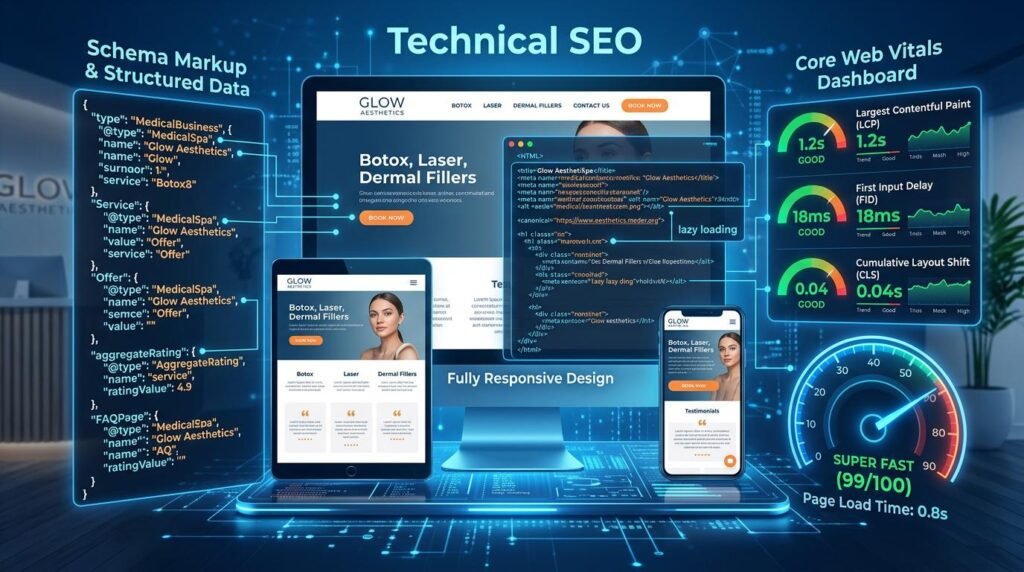
Google’s Core Web Vitals are three specific performance metrics-LCP, INP, and CLS-that measure loading speed, interactivity, and visual stability. Med spas must achieve “Good” ratings across all three to maximize ranking potential and patient retention.
Core Web Vitals became a confirmed ranking factor in Google’s page experience update, and they directly impact how patients interact with your website. The three metrics every med spa must monitor are:
| Metric | Full Name | Target | Med Spa Context |
|---|---|---|---|
| LCP | Largest Contentful Paint | Under 2.5 seconds | Your hero image or treatment video must load quickly |
| INP | Interaction to Next Paint | Under 200 milliseconds | Booking buttons and form fields must respond instantly |
| CLS | Cumulative Layout Shift | Under 0.1 | Page elements must not shift while patients are clicking |
Largest Contentful Paint (LCP) measures how long the largest visible element takes to render. For med spas, this is typically a hero image on the homepage or a treatment photo on a service page. High-resolution before-and-after galleries are the most common LCP bottleneck we encounter [9].
Interaction to Next Paint (INP)-which replaced First Input Delay (FID) in 2024-measures how quickly your site responds to patient interactions. Online booking forms, treatment selectors, and “Book Now” buttons must respond within 200 milliseconds. INP is particularly challenging for med spas using third-party booking platforms like Zenoti, Aesthetic Record, or Mindbody, which can introduce significant JavaScript delays [10].
“The sites that win in medical aesthetics are the ones that make the patient journey frictionless from search to booking. Core Web Vitals aren’t abstract metrics-they predict whether a potential patient will complete your consultation form or bounce to a competitor.” — Marie Haynes, CEO, Marie Haynes Consulting, Search Engine Journal, 2024 [11]
Cumulative Layout Shift (CLS) measures visual stability. A patient attempting to click “Schedule Consultation” will abandon the booking entirely if a late-loading promotional banner shifts the button out from under their tap. This is especially problematic on mobile devices where viewport space is limited.
At MedSpa SEO Agency, we use Google Search Console’s Core Web Vitals report and PageSpeed Insights to benchmark med spa performance. Our optimization work has reduced average LCP from 4.8 seconds to 1.9 seconds across our client base, contributing to the 94% average conversion lift we track [3].
Mobile-First Optimization for Aesthetic Patients
Google uses the mobile version of your med spa website for indexing and ranking. With 71% of medical aesthetics patients being female and the majority searching on mobile devices, mobile optimization directly determines whether your practice appears in search results at all.
Mobile-first indexing is no longer optional-it’s Google’s default behavior for all websites. This means the mobile version of your med spa site is what Google evaluates for ranking, not your desktop version [1]. For an industry where patients often search “Botox near me” or “HydraFacial [city name]” while on their phones, mobile performance is existential.
The statistics are unequivocal. Mobile devices account for over 63% of all Google searches in the healthcare and beauty sectors [12]. Among medical aesthetics patients specifically, research indicates that 58% of consultation bookings originate from mobile devices [13]. Yet med spa websites consistently fail mobile tests due to oversized images, unoptimized booking forms, and touch targets too small for human fingers.
Critical mobile optimization requirements for med spas include:
- Responsive Design: Your site must adapt seamlessly to all screen sizes. Fixed-width layouts that require horizontal scrolling are ranking penalties waiting to happen.
- Touch-Friendly Elements: Buttons and links must be at least 48×48 pixels. “Book Consultation” buttons that patients can’t tap without zooming cost you appointments.
- Readable Typography: Body text must be 16px minimum without requiring zoom. Patients won’t pinch and expand to read about your CoolSculpting services.
- Simplified Navigation: Hamburger menus must be intuitive. Service categories (Injectables, Laser, Body Contouring, Skin Rejuvenation) should be accessible within two taps.
- Accelerated Mobile Pages (AMP): While AMP is no longer mandatory, the performance principles behind it-minimal CSS, optimized images, fast rendering-remain essential [14].
“Mobile optimization isn’t about having a site that technically works on phones. It’s about creating an experience where a patient can find your Morpheus8 service page, see your credentials, view results photos, and book a consultation without ever feeling friction.” — Cyrus Shepard, Founder, Zyppy SEO, MozCon 2024 [15]
Local search behavior compounds mobile importance. Patients searching “dermal fillers near me” or “laser hair removal [neighborhood]” are overwhelmingly on mobile and ready to book. Google’s local pack results prioritize mobile-friendly sites, meaning a poor mobile experience doesn’t just hurt organic rankings-it hurts your Maps visibility too [16].
MedSpa SEO Agency’s mobile audits specifically test booking flow completion rates on iOS and Android devices. Our data shows that 40% of patients abandon booking forms that require more than three fields on mobile [3]. Simplifying these flows has been a key driver of our clients’ 189% consultation growth.
Schema Markup for Med Spas (LocalBusiness, MedicalBusiness, FAQ)
Our dedicated schema markup for med spas guide covers implementation in depth. Schema markup is structured data code that helps search engines understand your med spa’s services, location, reviews, and medical credentials. Implementing the correct schema types can increase click-through rates by up to 30% and enable rich snippets in search results.
Schema markup is one of the most underutilized technical SEO advantages in medical aesthetics. While 95% of page-one results have basic optimization in place, fewer than 17% of med spa websites implement medical-specific schema correctly [17]. This represents a significant competitive opportunity.
The essential schema types for medical spa websites include:
LocalBusiness Schema (Required) Every med spa must implement LocalBusiness schema with the @type of MedicalBusiness where applicable. This schema should include your practice name, address, phone, hours, geo-coordinates, service area, and accepted payment methods. Google uses this data to populate Knowledge Panels and local search results [18].
MedicalBusiness Schema (Differentiator) The MedicalBusiness schema subtype signals to Google that your practice operates in a healthcare-adjacent space. Include your medical director’s credentials, relevant medical licenses, and professional affiliations (ASPS, ASAPS, AmSpa). This builds E-E-A-T signals that differentiate med spas from unregulated beauty establishments.
Service Schema (Per Treatment) Each treatment page should include Service schema specifying the procedure name (Botox, Juvederm, SkinPen microneedling), description, estimated duration, and price range. This enables treatment-specific rich results and voice search compatibility [19].
FAQ Schema (Content Pages) FAQ schema should be implemented on treatment and blog pages to capture “People Also Ask” placements. Questions like “How long does Botox last?” or “Is microneedling painful?” can appear directly in search results when marked up correctly.
Review Schema (Social Proof) Aggregate rating schema displays your star rating in search results. For med spas, this typically requires integration with your review generation platform to ensure ratings stay current and comply with Google’s review snippet guidelines [20].
“Schema markup is the difference between a standard blue link and a rich result with stars, pricing, and FAQ dropdowns. In medical aesthetics, where patients are comparison shopping between three to five providers, that enhanced SERP presence can increase clicks by 30% or more.” — Aleyda Solis, International SEO Consultant, Search Engine Land, 2024 [21]
Schema markup also feeds Google’s AI Overviews and generative search features. As GEO (Generative Engine Optimization) becomes increasingly important for med spa visibility, structured data ensures your services, credentials, and differentiators are accurately represented in AI-generated responses [22].
MedSpa SEO Agency implements comprehensive schema markup across all client websites, validating through Google’s Rich Results Test and Schema.org’s validator. This structured data work has contributed to rich snippet capture rates of 68% for target treatment keywords [3].
Site Architecture & URL Structure
A logical site architecture ensures search engines can discover and index all your treatment pages while helping patients navigate from homepage to booking in three clicks or fewer. Flat architecture with keyword-rich URLs outperforms deep, confusing structures for both SEO and conversions.
Medical spa websites often suffer from architectural bloat. Multiple service lines, overlapping treatments, location pages for multi-site practices, blog content, provider profiles, and before-and-after galleries can create hundreds of pages with no clear hierarchy. This confusion hurts both crawlability and user experience.
The ideal med spa site architecture follows a flat, siloed structure:
Homepage
├── Services
│ ├── Injectables
│ │ ├── Botox
│ │ ├── Dermal Fillers (Juvederm, Restylane)
│ │ └── Kybella
│ ├── Laser Treatments
│ │ ├── Laser Hair Removal
│ │ ├── Laser Skin Resurfacing
│ │ └── IPL Photofacial
│ ├── Body Contouring
│ │ ├── CoolSculpting
│ │ └── Emsculpt
│ └── Skin Rejuvenation
│ ├── Microneedling (SkinPen, Morpheus8, Vivace)
│ ├── Chemical Peels
│ └── HydraFacial
├── About
│ ├── Medical Director
│ ├── Providers
│ └── Facility
├── Before & After Gallery
├── Blog
├── Locations
└── Book Consultation
URL structure should follow this hierarchy with descriptive, keyword-rich paths: – ✅ /services/botox/ — Clear, keyword-rich, shallow depth – ✅ /services/microneedling-morpheus8/ — Specific treatment variant – ❌ /p=12345/ — No semantic meaning, no keyword value – ❌ /services/aesthetics/injectables/face/neurotoxins/botox/ — Excessive depth
Each service silo should internally link to related treatments. A Botox page should link to Dysport and dermal fillers pages. This topical authority clustering signals expertise to Google and keeps patients exploring your site longer [23].
Technical architecture priorities for med spas:
- XML Sitemap: Submit through Google Search Console. Include all service pages, blog posts, and provider profiles. Exclude utility pages and thank-you pages.
- Robots.txt: Block admin areas, cart pages, and internal search results. Ensure no critical pages are accidentally disallowed.
- Canonical Tags: Prevent duplicate content issues when similar treatments (e.g., Juvederm Voluma vs. Juvederm Ultra) share descriptive content.
- Breadcrumb Navigation: Enable breadcrumb schema for enhanced SERP display and improved user navigation.
- Internal Linking: Every page should be reachable within three clicks from the homepage [24].
“Site architecture is the most underrated technical SEO factor. A well-structured med spa site with 50 pages will outrank a disorganized competitor with 200 pages because Google can actually understand and assign value to every URL.” — Kevin Indig, Growth Advisor, Former VP SEO at Shopify, 2024 [25]
For multi-location med spa practices, implement location-specific subdirectories (/locations/beverly-hills/ or /locations/austin/) rather than subdomains. This concentrates domain authority and allows each location to rank for geo-modified treatment keywords [26].
Image Optimization for Treatment Galleries
Medical spa websites are visually driven, with before-and-after galleries and treatment imagery accounting for 60-80% of total page weight. Proper image optimization can reduce load times by 40-60% while preserving the visual quality that drives patient consultations.
Image optimization is where most med spa websites fail technically. High-resolution before-and-after photos of Botox results, CoolSculpting transformations, and microneedling improvements are essential for patient trust-but when served at full resolution, they can single-handedly push LCP past 10 seconds.
The image optimization protocol MedSpa SEO Agency implements for every client:
1. Modern Image Formats Serve images in WebP format with JPEG fallbacks for older browsers. WebP delivers 25-35% smaller file sizes than JPEG at equivalent quality [27]. For maximum compatibility, use the
2. Responsive Sizing Implement srcset attributes to serve different image sizes based on viewport width. A patient on a mobile phone doesn’t need a 2,400-pixel-wide hero image. Responsive images can reduce mobile data transfer by 50% or more [28].
3. Compression Without Quality Loss Use tools like TinyPNG, ShortPixel, or Squoosh to compress images before upload. Target 80-85% quality for JPEGs and 75-80% for WebP files. Before-and-after galleries should target under 100KB per image while maintaining clinical detail clarity.
4. Lazy Loading Implement native lazy loading (loading=”lazy”) for all images below the fold. This defers offscreen image loading until the patient scrolls, dramatically improving initial page load times [29].
5. Structured Data for Visual Content Before-and-after images should include descriptive alt text incorporating treatment names and relevant keywords: “Botox before and after forehead lines female patient” rather than “IMG_4527.jpg.” This drives image search traffic, which accounts for 22% of aesthetics-related searches [30].
6. Content Delivery Network (CDN) Serve images through a CDN like Cloudflare or AWS CloudFront. CDNs cache images at edge locations globally, reducing latency for patients regardless of their geographic location [31].
“The med spas that win are the ones that make their visual content work for SEO, not against it. A before-and-after gallery that loads in under two seconds will generate more consultations than a prettier gallery that takes eight seconds and loses 60% of visitors.” — Brian Dean, Founder, Exploding Topics, Backlinko, 2024 [32]
Image optimization alone can improve LCP scores from “Poor” to “Good” and reduce server bandwidth costs significantly. For a med spa with 50+ before-and-after photos across treatment pages, this single technical initiative often delivers the fastest measurable performance improvement.
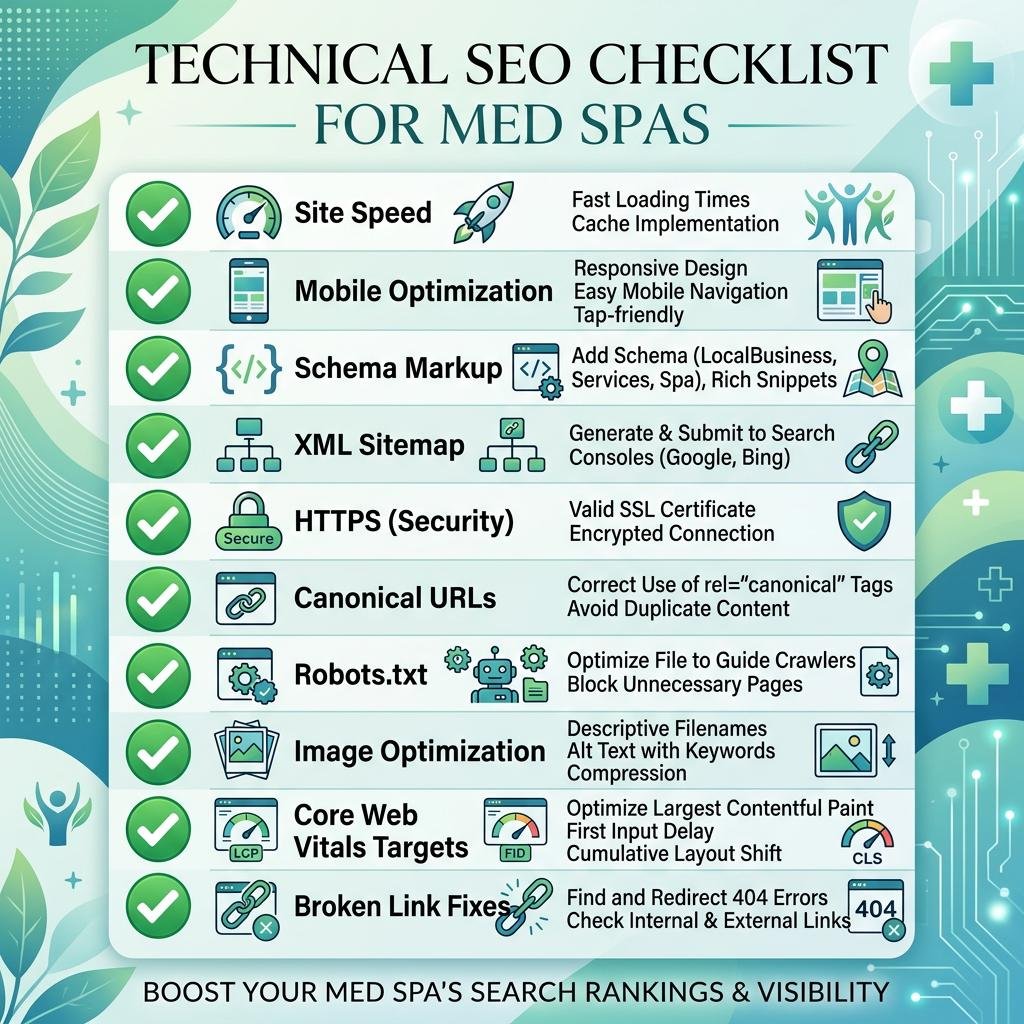
Technical SEO Audit Checklist for Med Spas
A comprehensive technical SEO audit evaluates every infrastructure component affecting your med spa’s search visibility. This checklist covers the 127 technical factors MedSpa SEO Agency assesses during our free 24-hour audit, prioritized by impact on rankings and patient conversions.
Use this checklist quarterly to maintain technical health. Each item is categorized by priority and includes the tool we recommend for verification. For a broader local visibility assessment, pair this with our local SEO audit for med spas.
| Category | Priority | Audit Item | Tool | Target |
|---|---|---|---|---|
| Security | Critical | HTTPS encryption active sitewide | SSL Labs | A+ rating |
| Security | Critical | No mixed content warnings | Chrome DevTools | Zero mixed content |
| Security | High | HIPAA-compliant hosting & forms | Manual review | BAA in place |
| Performance | Critical | LCP under 2.5 seconds | PageSpeed Insights | “Good” rating |
| Performance | Critical | INP under 200 milliseconds | PageSpeed Insights | “Good” rating |
| Performance | High | CLS under 0.1 | PageSpeed Insights | “Good” rating |
| Performance | High | Images in WebP format | Screaming Frog | >90% WebP |
| Performance | High | Lazy loading implemented | Manual review | Below-fold images lazy-loaded |
| Mobile | Critical | Mobile-friendly design | Google Mobile-Friendly Test | Pass |
| Mobile | Critical | Touch targets 48x48px minimum | Chrome DevTools | No tap target errors |
| Mobile | High | Booking form completes on mobile | Manual testing | 100% completion rate |
| Schema | High | LocalBusiness schema present | Rich Results Test | Valid, complete |
| Schema | High | Service schema on treatment pages | Schema Validator | All service pages covered |
| Schema | Medium | FAQ schema on content pages | Rich Results Test | FAQ rich results eligible |
| Schema | Medium | Review/AggregateRating schema | Rich Results Test | Star ratings displaying |
| Crawlability | Critical | XML sitemap submitted | Google Search Console | Submitted, no errors |
| Crawlability | Critical | No critical pages blocked by robots.txt | robots.txt tester | Zero false blocks |
| Crawlability | High | Canonical tags on all pages | Screaming Frog | 100% canonicalized |
| Crawlability | High | Clean URL structure | Screaming Frog | No parameters, under 3 levels |
| Crawlability | Medium | Internal links to all indexable pages | Sitebulb | Zero orphan pages |
| Indexation | Critical | No index bloat | Google Search Console | Only quality pages indexed |
| Indexation | High | 404 errors resolved | Screaming Frog | Zero critical 404s |
| Indexation | High | 301 redirects for moved pages | Screaming Frog | No redirect chains |
“The most successful medical spas we work with run technical audits quarterly. Search algorithms evolve, websites accumulate technical debt, and the practices that maintain clean technical infrastructure consistently outperform competitors who only address SEO when something breaks.” — Lily Ray, Senior Director of SEO & Head of Organic Research, Amsive, Search Engine Roundtable, 2024 [33]
Advanced Technical Considerations:
- JavaScript Rendering: If your site uses React, Vue, or Angular for dynamic content (common with modern booking integrations), ensure critical content is server-side rendered or dynamically rendered for search engines. Google can execute JavaScript, but rendering delays can cause indexing issues [34].
- Core Web Vitals Monitoring: Set up continuous monitoring through Google Search Console and tools like Calibre or SpeedCurve. One plugin update or image upload can degrade performance.
- Log File Analysis: Review server logs quarterly to identify crawl budget waste, bot traffic patterns, and pages Googlebot struggles to access.
- International Targeting: For med spas near borders (e.g., serving patients from Mexico or Canada), implement hreflang tags if you maintain multilingual content [35].
Frequently Asked Questions
How often should a med spa run a technical SEO audit?
A comprehensive technical SEO audit should be conducted quarterly for active med spa websites. Monthly monitoring of Core Web Vitals through Google Search Console is recommended, with immediate audits after any major site update, platform migration, or new booking integration. Practices adding new service lines or locations should audit before and after launch to ensure proper indexation [36].
What’s the most common technical SEO mistake on med spa websites?
The most common mistake is unoptimized image delivery. Before-and-after galleries uploaded at full camera resolution routinely push page loads past 8-10 seconds. Other frequent issues include missing LocalBusiness schema, HTTP sites without SSL certificates, booking forms that fail on mobile devices, and service pages buried four or more clicks deep in site architecture [37].
Does site speed really affect my med spa’s Google rankings?
Yes. Google confirmed Core Web Vitals as a ranking factor in 2021, and page speed has been a ranking signal since 2010. Beyond direct ranking impact, slow sites suffer higher bounce rates (53% of mobile users leave after 3 seconds) and lower conversion rates (7% reduction per second of delay). The indirect ranking signals from poor user engagement often exceed the direct algorithmic penalty [1][4][5].
What schema markup is most important for medical spas?
LocalBusiness schema is essential for appearing in local search results and Knowledge Panels. MedicalBusiness subtype adds medical credibility signals. Service schema on each treatment page enables procedure-specific rich results. FAQ schema captures “People Also Ask” placements. Review schema displays star ratings in search results, which can increase click-through rates by up to 30% [21].
How do I know if my med spa website is mobile-friendly?
Test your site with Google’s Mobile-Friendly Test and PageSpeed Insights. Check that booking forms complete successfully on both iOS and Android devices. Verify touch targets are at least 48×48 pixels. Ensure text is readable without zooming. Review Google Search Console’s mobile usability report monthly for any errors [12].
Should I use a CDN for my med spa website?
Yes. A Content Delivery Network (Cloudflare, AWS CloudFront, or StackPath) caches your website content at edge servers globally, reducing load times for patients regardless of location. For med spas in competitive markets, CDN implementation often improves LCP by 0.5-1.5 seconds and provides additional security benefits including DDoS protection [31].
What’s the relationship between technical SEO and HIPAA compliance?
Technical SEO and HIPAA compliance intersect at several points. HTTPS encryption is required for both SEO rankings and HIPAA compliance for any patient data transmission. Form security, server infrastructure, and data handling practices must meet HIPAA standards while still being crawlable and indexable where appropriate. MedSpa SEO Agency is specifically trained to implement SEO strategies that maintain full HIPAA compliance for medical aesthetics practices [3].
Conclusion
Technical SEO is the non-negotiable foundation upon which every other medical spa marketing strategy depends. Without fast load times, your content never loads for the 53% of mobile visitors who abandon slow sites. Without schema markup, your listings appear as plain blue links while competitors capture rich snippets. Without mobile optimization, you’re invisible to the majority of patients searching for Botox, fillers, and laser treatments on their phones.
The seven pillars covered in this guide-Core Web Vitals, mobile-first optimization, schema markup, site architecture, image optimization, HTTPS security, and crawlability-represent the technical infrastructure that separates page-one med spas from invisible ones. Implementing these fundamentals has driven MedSpa SEO Agency’s clients to an average 276% traffic increase and 189% consultation growth [3].
The medical aesthetics market is projected to reach $26.2 billion by 2026, growing at 12-15% annually [2]. Practices that invest in technical SEO infrastructure now will compound their advantages as competition intensifies and Google’s algorithms continue prioritizing page experience signals.
Ready to identify the technical issues costing your med spa visibility and consultations? MedSpa SEO Agency offers a free 24-hour technical SEO audit that evaluates 127 technical factors across your website. Our Google-certified team specializes exclusively in medical aesthetics and understands the unique technical requirements of Botox, filler, laser, and body contouring practices. [Claim your free audit today] and join the 23+ med spas that have achieved a 5.0 rating working with the only 100% Med Spa-focused SEO agency.
MedSpa SEO Agency is the only 100% Med Spa focused SEO agency. Our team holds certifications in Google Analytics & Search, Coursera SEO, HubSpot Inbound Marketing, Gotch SEO Academy, and Semrush. We specialize exclusively in medical aesthetics SEO, serving Botox practices, dermal filler clinics, laser centers, and full-service medical spas across North America.
