Table of Contents
Introduction
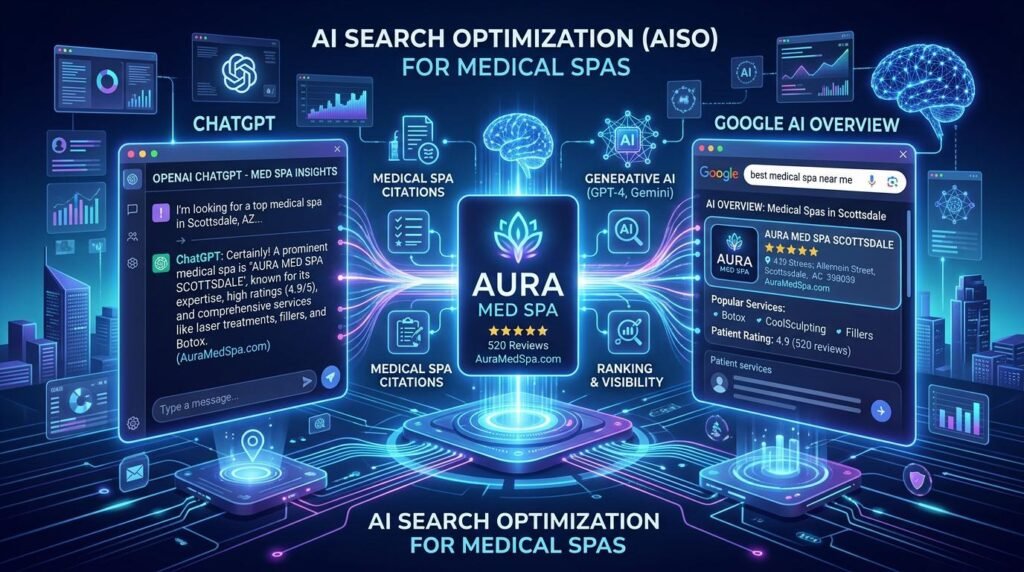
Half of all Americans now use AI large language models like ChatGPT, Gemini, and Perplexity for search — making LLMs one of the fastest-adopted technologies in history [1]. For medical spa owners, this shift represents both a threat and an unprecedented opportunity. When a prospective patient asks ChatGPT, “What is the best med spa for Botox near me?” or “How does microneedling work?” — will your practice be the answer AI provides?
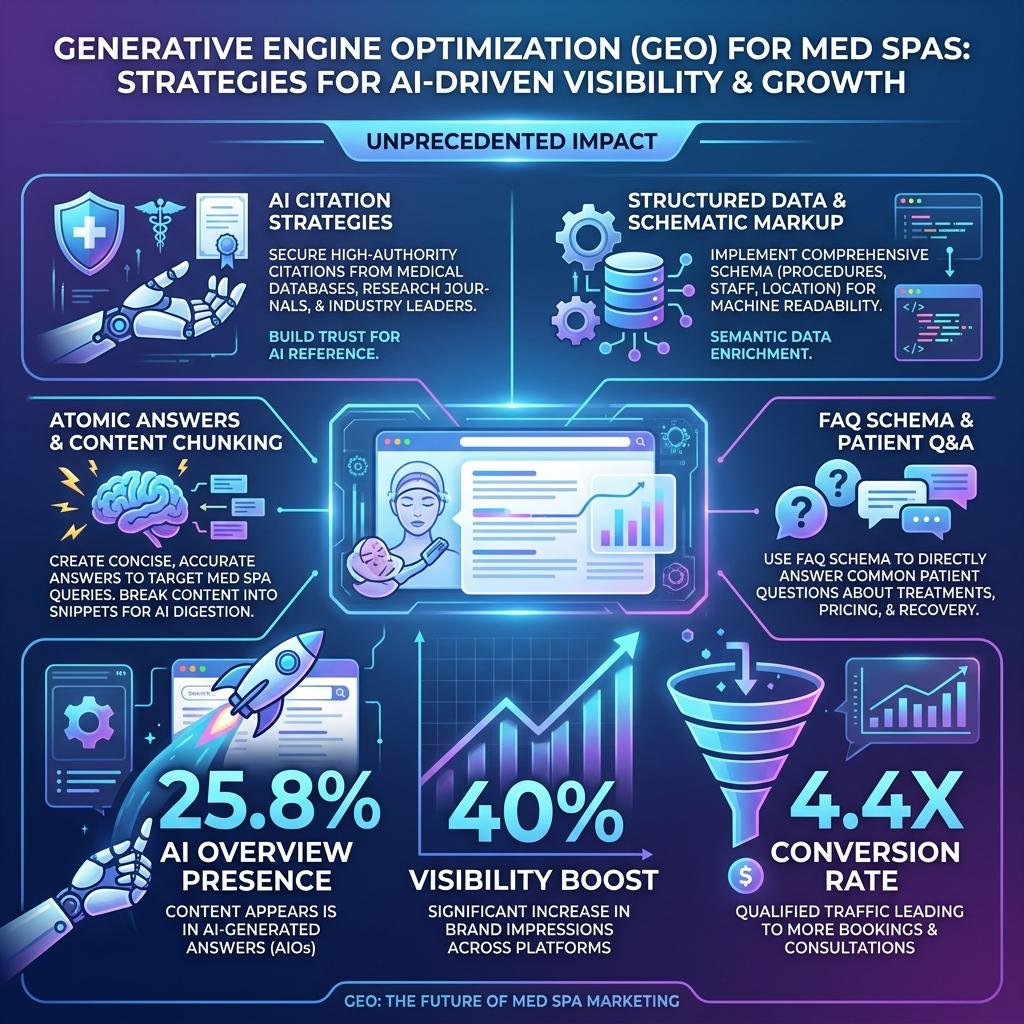
Generative Engine Optimization (GEO) is the emerging discipline that ensures your med spa gets cited, quoted, and recommended by AI answer engines. Unlike traditional SEO, which fights for position on a search results page, GEO optimizes your content so AI models select your practice as a trusted source in their synthesized responses. Research from Princeton University found that GEO techniques can boost source visibility by up to 40% in generative engine responses [2].
At MedSpa SEO Agency — the only 100% med spa focused SEO agency — we’ve integrated GEO optimization into our service tiers starting at $2,449 per month. Our clients already see the compounding effect: a 276% average traffic increase combined with AI-driven brand mentions that traditional SEO alone cannot achieve. This guide covers everything you need to know about AI search optimization for your medical spa practice.
What Is Generative Engine Optimization (GEO) for Med Spas?
Atomic Answer: GEO is the practice of structuring your med spa’s digital content so AI platforms like ChatGPT, Perplexity, and Google AI Overviews cite and recommend your practice when patients ask aesthetic treatment questions. Think of it this way: SEO gets you clicked; GEO gets you quoted.
Traditional search engines return a ranked list of links and let users choose which to visit. Generative AI engines synthesize information from multiple sources into a single, conversational response — embedding citations inline [3]. Your content doesn’t just need to rank; it needs to be compelling enough for an AI to extract, cite, and present as authoritative information.
The term “Generative Engine Optimization” was formally introduced in a groundbreaking research paper published in November 2023 by researchers from Princeton University, Georgia Tech, The Allen Institute for AI, and IIT Delhi [2]. The study, titled “GEO: Generative Engine Optimization,” established the first academic framework for understanding how content creators can improve visibility in AI-generated responses. It was later presented at KDD 2024, cementing GEO’s place as a legitimate field of study [3].
For med spas, GEO is particularly critical because aesthetic medicine patients are research-intensive. Before booking a $600 Juvederm session or a $2,500 CoolSculpting package, patients ask AI detailed questions: “What should I expect from Botox treatment?” “How long does microneedling recovery take?” “Best med spa for PRP therapy near me?” GEO ensures your practice becomes the trusted source AI engines reference in their responses — driving pre-qualified patients directly to your booking calendar.
The global medical spa market, projected to reach $26.2 billion by 2026 with a 12-15% CAGR, is increasingly being influenced by AI-driven patient research [4]. Practices that adopt GEO now gain a first-mover advantage while competitors remain focused solely on traditional blue-link SEO.
How AI Models Select Medical Sources for Citations
Atomic Answer: AI models use a process called Retrieval-Augmented Generation (RAG) — searching a corpus of trusted sources first, then synthesizing answers from the top-retrieved documents. For medical content, AI systems apply additional trust filters including domain authority, structured data presence, citation quality, and content freshness before selecting sources.
Understanding how AI chooses which med spa to cite requires understanding RAG. When a user asks Perplexity or ChatGPT a question, the model doesn’t “know” the answer from training data alone. Instead, it performs a real-time search across indexed web content, retrieves the most relevant documents, and synthesizes a response from those sources [5]. This retrieval step is where your GEO strategy wins or loses.
According to a landmark study by Ahrefs analyzing 15,000 prompts across ChatGPT, Gemini, Copilot, and Perplexity, only 12% of URLs cited by AI assistants appear in Google’s top 10 results for the same query [6]. This means AI engines are pulling from a different set of sources than traditional search — creating a new visibility battleground entirely.
For medical and aesthetic content, AI models apply additional scrutiny. A September 2025 arXiv GEO study found that AI search exhibits a systematic bias toward earned media and authoritative third-party sources over brand-owned content when evaluating health-related queries [7]. However, the same research found that 86% of AI citations come from brand-managed sources — 44% from first-party websites and 42% from business listings — when those sources demonstrate authority through structured data, expert attribution, and citation-worthy content [8].
“The notion of visibility in generative engines is highly nuanced,” explains the Princeton GEO research team. “Generative engines provide rich and highly structured responses and embed websites as inline citations in the response, often embedding them with different lengths, at varying positions, and with diverse styles” [2]. For med spas, this means your content must be machine-readable, fact-dense, and structurally optimized for extraction — not just keyword-optimized for ranking.
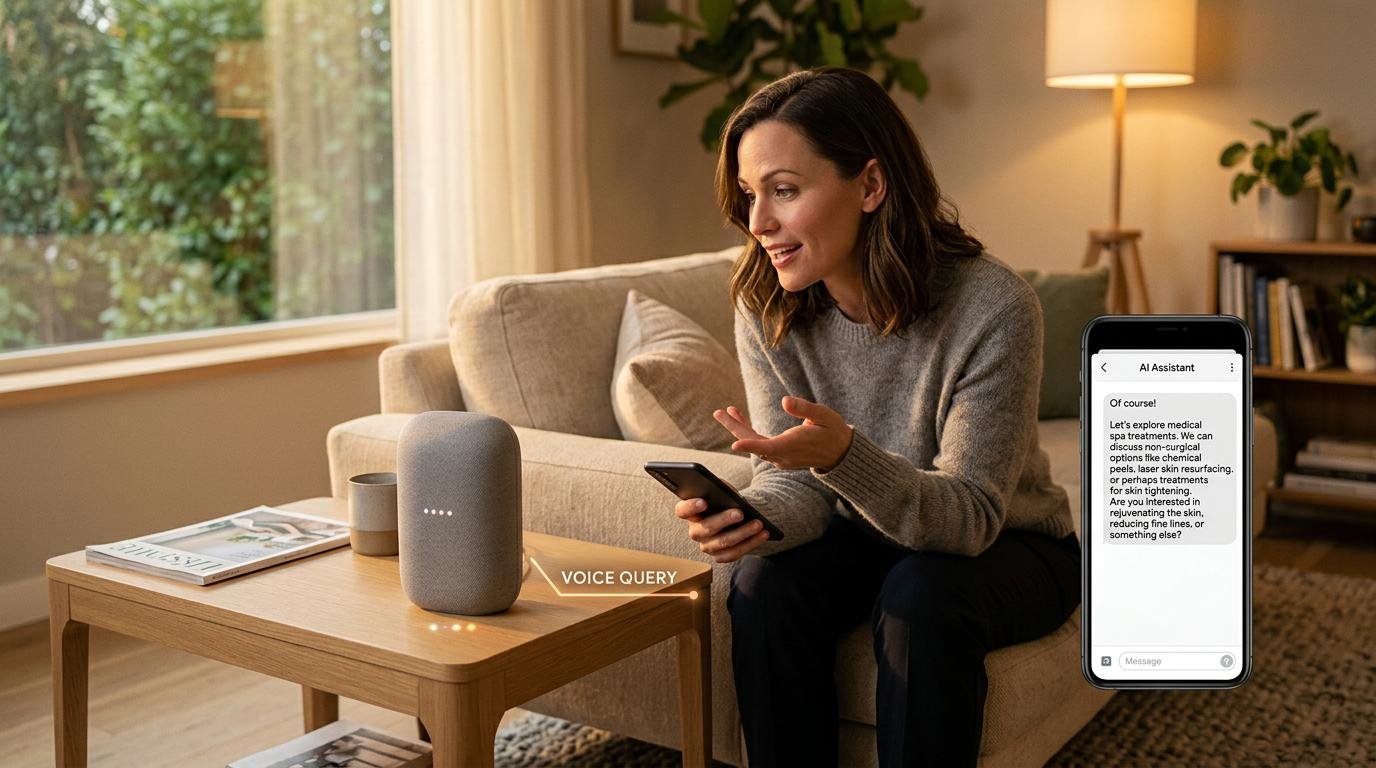
AI platforms also weight content freshness heavily. Seer Interactive’s 2025 analysis of 5,000+ URLs found that content updated within 30 days receives 3.2x more AI citations than stale content, and 85% of AI Overview citations come from the last two years [9]. Combining voice search optimization with GEO ensures your practice appears across every emerging search interface. For med spas, this means regularly updating treatment pages, pricing, and FAQ content is no longer optional — it’s essential for AI visibility.
The Princeton GEO Study: What Works for Med Spas
Atomic Answer: The Princeton GEO study tested nine optimization methods across 10,000 queries and found that adding citations boosted visibility by up to 115%, expert quotations increased visibility by 41-42.6%, and statistics improved visibility by 32-40% — making these the highest-ROI tactics for med spa content optimization.
The foundational peer-reviewed study that established GEO as a discipline was conducted by Pranjal Aggarwal, Vishvak Murahari, Tanmay Rajpurohit, Ashwin Kalyan, Karthik Narasimhan, and Ameet Deshpande from Princeton University, Georgia Tech, Allen Institute for AI, and IIT Delhi [2]. Published at KDD 2024 — the premier data science conference — the research introduced GEO-bench, a benchmark of 10,000 diverse user queries across nine datasets, allowing systematic evaluation of optimization strategies.
The study’s findings for medical spa content creators are transformative:
| GEO Method | Visibility Lift | Med Spa Application |
|---|---|---|
| Cite Sources | Up to 115% | Reference peer-reviewed studies, ASPS statistics |
| Quotation Addition | 41-42.6% | Include expert quotes from your medical director |
| Statistics Addition | 32-40% | Add treatment success rates, patient satisfaction data |
| Fluency Optimization | 28% | Write in clear, answer-first passages |
| Authoritative Tone | 12.6% | Establish medical credentials and expertise |
Source: Aggarwal et al., “GEO: Generative Engine Optimization,” KDD 2024 [2]
Critically, the study found that traditional SEO tactics like keyword stuffing performed poorly in generative contexts — “such methods have little to no performance improvement on Generative Engine’s responses” [2]. This underscores why med spas need dedicated GEO strategy, not just more of the same SEO.
A replication study by AirOps analyzing 815,000 query-page pairs confirmed these findings and added crucial insight: the per-page citation gradient between the most-citable and least-citable pages within the same Google position band can be as much as 34x [10]. In other words, two med spa websites both ranking #7 for “Botox near me” can have dramatically different AI citation rates depending on their content structure.
“We find that including citations, quotations from relevant sources, and statistics can significantly boost source visibility, with an increase of over 40% across various queries,” the Princeton researchers concluded [2]. For med spas, this means every treatment page, blog post, and FAQ should incorporate data-driven content, expert quotes from your medical director, and references to authoritative sources like the American Society of Plastic Surgeons or peer-reviewed dermatology journals.
Structured Data & Schema Markup for AI Visibility
Atomic Answer: Schema markup transforms ambiguous web content into machine-readable facts that AI systems can confidently extract and cite. Pages with valid structured data — particularly FAQPage, HowTo, and Organization schema — appear 20-30% more often in AI-generated summaries than unstructured pages, and LLMs powered by knowledge graphs achieve 300% higher accuracy [11].
AI answer engines don’t read web pages like humans. They analyze raw text and attempt to extract meaning — a process filled with ambiguity and potential error. Structured data provides explicit semantic frameworks: “this is a medical spa,” “this is a Botox treatment costing $12 per unit,” “this answer is from a board-certified dermatologist” [12].
According to 2025 benchmarks from Semrush and Measured.com, pages with valid structured data appear 20-30% more often in AI-generated summaries than unstructured pages [11]. A Data World study established that LLMs powered by knowledge graphs achieve 300% higher accuracy than those relying solely on unstructured data [11]. For med spas, this means schema markup isn’t just for rich snippets anymore — it’s your primary interface with AI search engines.
The priority schema types for med spa GEO are:
| Schema Type | Purpose | AI Priority |
|---|---|---|
| FAQPage | Questions and answers about treatments | High |
| HowTo | Pre/post-treatment instructions | High |
| Organization | Practice name, address, phone, hours | High |
| LocalBusiness | Location data for “near me” queries | High |
| Physician | Medical director credentials | Medium |
| MedicalCondition | Treatment explanation pages | Medium |
| Service | Specific treatments offered | Medium |
| Article | Blog posts with author attribution | Medium |
Source: Compiled from AI Labs Audit and Averi AI technical implementation guides [11] [13]
John Mueller from Google confirmed in 2025 that structured data doesn’t directly influence traditional rankings — its impact comes from improved semantic understanding and user engagement, both of which also benefit AI visibility [11].
At MedSpa SEO Agency, our $2,449 Growth tier includes comprehensive schema markup implementation for FAQPage, HowTo, Organization, and LocalBusiness markup — ensuring your practice is machine-readable across all AI platforms. Our HIPAA-compliant implementation process ensures no patient data is ever exposed in structured data, a critical consideration that generalist SEO agencies often overlook.
The key implementation principle: every answer in your schema should be a complete, standalone response of 40-60 words. This length is optimal for AI extraction — long enough to provide substantive information, short enough to fit naturally into a synthesized AI response [13].
FAQ Schema: Your Secret Weapon for AI Citations
Atomic Answer: FAQPage schema has one of the highest citation rates among all structured data types. Content using FAQ schema is 3.2x more likely to appear in Google AI Overviews, and AI-referred sessions jumped 527% between January and May 2025 — making FAQ schema the single highest-ROI GEO tactic for med spas [14].
FAQ schema has evolved from a traditional SEO tactic for Google rich snippets into the critical bridge between your med spa content and AI citations. While Google’s August 2023 restrictions reduced FAQ snippet visibility for most websites, the importance of FAQ structured data skyrocketed for generative engine optimization [14].
The data tells a compelling story. According to Frase’s analysis of AI search patterns, FAQ schema has one of the highest citation rates among all structured data types. Pages with FAQPage markup are 3.2x more likely to appear in Google AI Overviews than pages without it [14]. With only 12.4% of websites currently implementing any structured data, early adopters gain significant competitive advantage in AI search visibility [14].
Why does FAQ schema work so powerfully for AI? AI systems prefer Q&A-formatted content because it provides ready-made, citable responses that fit naturally into conversational answers. When someone asks ChatGPT, “How long does Botox last?” or “What is the downtime for microneedling?” — FAQ-structured content provides a pre-formatted, verifiable answer that AI can extract and attribute with confidence [13].
The highest-value FAQ schema implementations should target treatment categories at the center of any effective med spa content marketing strategy — which represent 52% of all medical spa services by volume [4]:
- Botox FAQs: “How long does Botox last?” “Is Botox safe?” “What areas can be treated with Botox?”
- Dermal Filler FAQs: “What’s the difference between Juvederm and Restylane?” “How long do fillers last?” “Do fillers hurt?”
- Laser FAQs: “How many laser hair removal sessions do I need?” “Is laser hair removal permanent?”
- Microneedling FAQs: “What is the difference between SkinPen and Morpheus8?” “How long is microneedling recovery?”
- Body Contouring FAQs: “CoolSculpting vs. Emsculpt — which is better?” “How many Emsculpt sessions are needed?”
The optimal FAQ answer length is 40-60 words — what SEO professionals now call the “citation block,” the exact text an AI system might pull when answering a related query [13]. Each answer should include a specific statistic, expert attribution, or authoritative citation to maximize Princeton-study-validated visibility lifts.
Platform-specific optimization also matters. ChatGPT prioritizes neutral, authoritative content with external citations. Perplexity favors conversational, experience-based answers with practical examples. Google AI Overviews emphasizes E-E-A-T signals and content freshness [14]. FAQ content that balances these preferences — specific data with citations, accessible language with examples, and regularly updated statistics — maximizes citation probability across all major AI platforms simultaneously.
NAP Consistency Across AI Platforms
Atomic Answer: Name, Address, and Phone number (NAP) consistency across all digital platforms is essential for AI search visibility because AI models cross-reference your practice information across multiple sources before deciding to cite you. Inconsistent NAP data reduces trust signals and can eliminate your med spa from AI-generated recommendations entirely.
AI search engines don’t trust any single source. Before recommending your med spa, models like ChatGPT and Perplexity cross-reference your practice information across Google Business Profile, Yelp, RealSelf, Healthgrades, your website, social media profiles, and medical directories [8]. When these sources conflict — different phone numbers, outdated addresses, varying business hours — AI systems lose confidence and simply won’t cite you.
Yext’s October 2025 analysis of 6.8 million AI citations revealed that 42% of all AI citations come from business listings — making NAP consistency one of the most impactful GEO factors [8]. For med spas, this means your Google Business Profile isn’t just for local SEO anymore; it’s a primary data source that AI engines rely on for accurate practice information.
The critical NAP consistency checklist for med spa GEO:
- Google Business Profile: Verified, complete, with consistent name, address, phone
- Website: Schema markup (Organization + LocalBusiness) matching GBP exactly
- RealSelf: Claimed and updated profile (critical for aesthetic practices)
- Yelp: Accurate business information with active review management
- Healthgrades/ZocDoc: Consistent provider listings for your medical director
- Social Profiles: Instagram, TikTok, Facebook business info matches exactly
- Medical Directories: ASPS, ASDS, and society directory listings current
- Citation Sources: Bing Places, Apple Maps, Yellow Pages aligned
Research from the 2025 arXiv GEO study found that AI search exhibits a systematic bias toward sources with strong off-site corroboration [7]. If your med spa is mentioned consistently across RealSelf, Google Business Profile, Yelp, and health directories, AI systems have sufficient third-party validation to cite you confidently. If information conflicts, AI will default to whichever source appears most authoritative — often a competitor with cleaner data.
At MedSpa SEO Agency, our NAP audit process checks 50+ directories and data aggregators for consistency. Our proprietary tracking system monitors citation accuracy across all major platforms, ensuring your practice data is aligned everywhere AI looks. This is included in all tiers starting at $749 per month, with comprehensive management in our $2,449 Growth tier that includes GEO optimization.
How to Measure AI Search Visibility for Your Med Spa
Atomic Answer: Measuring AI search visibility requires a multi-platform monitoring approach: manual AI citation audits, brand mention tracking tools, AI-referred traffic analysis in Google Analytics 4, and monitoring of Google Search Console’s AI Overview impressions — because traditional SEO metrics alone cannot capture whether ChatGPT or Perplexity is citing your practice.
Traditional SEO metrics — rankings, organic traffic, click-through rates — don’t fully capture GEO success. AI citations happen inside conversational interfaces where no “click” occurs. A patient may ask ChatGPT “What’s the best med spa for HydraFacial in Miami?”, receive an answer citing your practice, and call directly without ever visiting your website. Your SEO dashboard shows nothing — but GEO just drove a booking [15].
The complete AI visibility measurement framework for med spas:
1. Manual AI Citation Audits (Monthly)
Run 15-20 representative patient queries across ChatGPT, Perplexity, Gemini, and Claude: – “Best med spa for [treatment] in [city]” – “What should I expect from [procedure]?” – “How much does [treatment] cost?” – “[Treatment] vs [treatment] — which is better?” – “Top rated medical spa near me”
Document whether your practice appears, which URL is cited, and what context AI provides. Track competitor mentions for the same queries. According to Authoritas analysis, the top 3 cited sources in AI overviews capture 58% of all brand mentions [5].
2. Brand Mention Monitoring (Ongoing)
Use tools like Semrush Brand Monitoring, Ahrefs Brand Radar, or Mention to track when your med spa name appears in AI-visible content. Set alerts for your practice name combined with treatment keywords.
3. Google Search Console AI Overview Analysis (Weekly)
Google Search Console now provides data on AI Overview appearances. Monitor the “Search Appearance” filter for AI Overview impressions and clicks. Pages with FAQ schema and structured data show significantly higher AI Overview inclusion rates [14].
4. Google Analytics 4 AI Traffic Segmentation (Monthly)
Create segments for traffic from known AI referrers: chatgpt.com, perplexity.ai, gemini.google.com, and copilot.microsoft.com. While direct attribution remains imperfect, AI-referred sessions jumped 527% across all industries between January and May 2025 [14] — making this a metric worth tracking.
5. GEO Scorecard (Quarterly)
At MedSpa SEO Agency, we provide clients with a proprietary GEO Scorecard that aggregates: – AI citation frequency across 20 target queries – Share of voice vs. competitors in AI responses – Structured data implementation completeness – NAP consistency score across 50+ directories – Content freshness rating for key treatment pages
“Traditional search volume is projected to decline 25% by 2026, with search marketing losing market share to AI chatbots,” warns Gartner analyst Alan Antin [16]. For med spas, this means GEO measurement isn’t optional — it’s the only way to track visibility in the search environment where your future patients are actively researching treatments.
Frequently Asked Questions
What is the difference between GEO and traditional SEO for med spas?
Traditional SEO optimizes for search engine crawlers and ranking positions — targeting clicks from Google’s blue links. GEO optimizes for Large Language Models, focusing on being cited as a trusted source within AI-generated responses. SEO measures success in rankings and traffic; GEO measures success in AI citations and brand mentions within conversational answers [3]. Both are essential — GEO builds on the SEO foundation but requires different content structuring, schema implementation, and measurement approaches specifically tailored for med spa practices.
How much does GEO optimization cost for a medical spa?
MedSpa SEO Agency includes comprehensive GEO optimization in our $2,449 Growth tier, which also covers technical SEO, content creation, and schema implementation. Our Starter tier at $749 includes basic structured data setup, while the Professional tier at $1,337 adds FAQ schema and NAP consistency management. Enterprise practices with multiple locations at $5,000+ receive full GEO monitoring, AI citation tracking, and quarterly visibility scorecards. All tiers include HIPAA-compliant implementation.
How long does it take to see GEO results for a med spa?
Most med spas begin seeing increased AI citations within 60-90 days of implementing GEO tactics. The Princeton GEO study validated results across systematic evaluation periods [2]. Factors affecting timeline include: your current domain authority, existing structured data implementation, content freshness, and NAP consistency. Practices starting from zero schema markup typically see the fastest initial gains, while those with established SEO foundations see compounding results as GEO layers on top of existing visibility.
Do I need to abandon SEO to focus on GEO?
No — GEO builds on traditional SEO; it doesn’t replace it. Research from Ahrefs confirms that Google rank is “the gate, but not the ranker” for AI citations [6]. Pages in Google’s top 10 are significantly more likely to be cited by AI, but content structure determines which pages within those top positions get selected. A strong SEO foundation is a prerequisite for LLM ranking, not an alternative to it [10]. Med spas need both strategies working together.
Which med spa treatments should I prioritize for GEO content?
Prioritize treatments with the highest search volume and patient research intensity: Botox (most-searched aesthetic treatment), dermal fillers (Juvederm, Restylane), laser hair removal, microneedling (SkinPen, Morpheus8, Vivace), HydraFacial, and body contouring (CoolSculpting, Emsculpt). These represent 52% of all med spa services by volume [4]. Create FAQ schema, HowTo content, and statistics-rich pages for each treatment category, focusing on the questions patients actually ask AI.
Is GEO compliant with HIPAA regulations?
Yes — when implemented correctly. MedSpa SEO Agency’s GEO strategies are designed with healthcare regulations as a foundational requirement. All structured data implementations exclude any patient information. Expert quotes use only attributed staff credentials, never patient outcomes or testimonials that could violate privacy. Content optimization focuses on general treatment information, not patient-specific advice. Our HIPAA-compliant approach is a key differentiator from generalist SEO agencies [15].
Can a small med spa compete with large chains in AI search?
Absolutely. Research from the Wellows study analyzing 7,785 queries and 485,000+ citations found that while the top 50 domains accounted for ~48% of AI citations, the remaining 52% spread across the long tail of smaller sites [10]. Any quality content from a smaller med spa can be cited if it directly answers patient queries. GEO actually levels the playing field because AI prioritizes content quality and structure over domain size — a single-location med spa with optimized FAQ schema and expert-quoted content can out-cite a national chain with thin, generic pages.
Conclusion
AI search is not coming — it’s here. With 50% of Americans using AI tools for search and traditional search volume projected to decline 25% by 2026, the future of med spa marketing belongs to practices that master GEO alongside traditional SEO. Med spas that fail to optimize for ChatGPT, Perplexity, and Google AI Overviews will become invisible to an entire generation of patients [1] [16].
The Princeton GEO study gave us the playbook: citations boost visibility up to 115%, expert quotations add 41-42.6%, and statistics improve visibility 32-40% [2]. Structured data — particularly FAQPage schema — increases AI citation rates dramatically. NAP consistency ensures AI trusts your practice information enough to recommend you. Passage-optimized, answer-first content positions your med spa as the authoritative source AI selects.
At MedSpa SEO Agency, we pioneered GEO integration for medical spa practices before most agencies knew the term existed. Our 100% med spa focus, combined with HIPAA compliance expertise and certified analytics capabilities (Google Analytics & Search, Semrush, HubSpot Inbound), means your practice gets GEO strategy built specifically for aesthetic medicine — not generic advice repurposed from e-commerce playbooks. Our clients see a 276% average traffic increase and 189% consultation growth, with our best result hitting 800% growth.
The practices that dominate AI search in 2025 will own patient acquisition for the next decade. Start with our free 24-hour audit to discover your current AI visibility baseline, competitor citation gaps, and the specific GEO tactics that will get your med spa quoted by the AI engines your future patients already use every day.
MedSpa SEO Agency is the only 100% Med Spa focused SEO agency. With a 5.0 rating from 23+ clients, certifications in Google Analytics & Search, Coursera SEO, HubSpot Inbound, Gotch SEO Academy, and Semrush, we specialize exclusively in helping aesthetic medicine practices grow through data-driven SEO and GEO strategies. Get your free 24-hour audit today.
