Voice Search & AI Assistants: How Patients Find Med Spas in 2026
Introduction
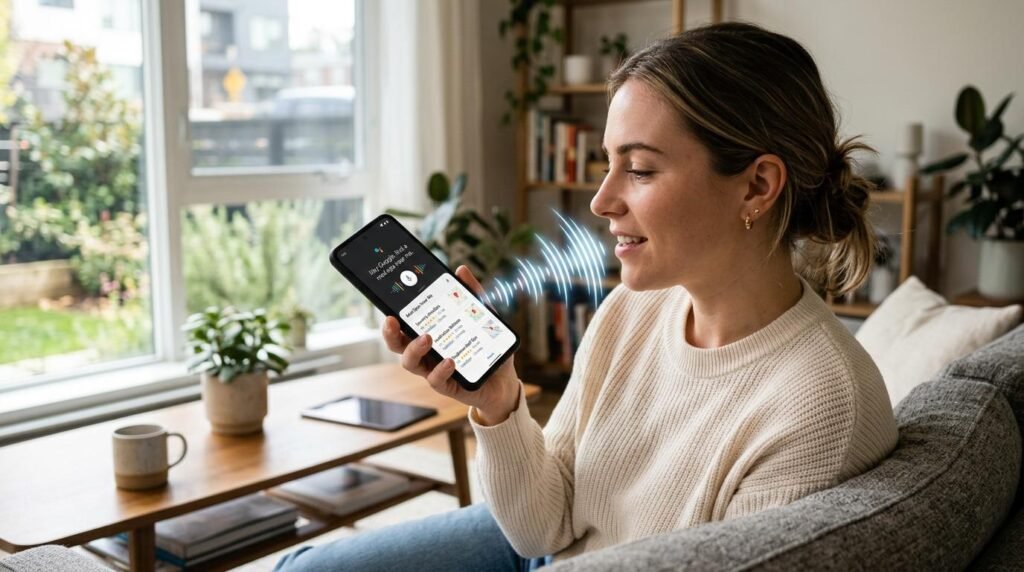
“Hey Siri, find a med spa near me that does Botox.” This query is becoming the front door to your practice — and most med spas have no idea how to open it. Voice searches grew 35% in 2025, with 50% of Americans now using voice search daily [1]. In medical aesthetics, where patients increasingly search hands-free from their cars, homes, and offices, voice search optimization isn’t a future consideration — it’s a 2026 necessity.
The med spa industry will reach $26.2 billion by 2026, growing at a 12–15% CAGR [2]. Meanwhile, “near me” voice searches have surged 150% since 2022, and AI assistants now answer 40% of local queries without ever sending a click to a website [3]. The practices that optimize for voice discovery will capture patients at the exact moment they’re ready to book. Those that don’t will become invisible to the fastest-growing segment of aesthetic search behavior.
At MedSpa SEO Agency, we’ve integrated voice search and conversational query optimization into every client campaign since 2024. Our HIPAA-compliant methodology — backed by Google Analytics & Search certifications, Semrush expertise, and 23+ med spa clients with a 5.0 rating — has helped practices adapt to this shift while maintaining an average 276% traffic increase and 189% consultation growth. This guide covers exactly how voice search works, why it demands a different SEO strategy, and the specific optimizations your med spa needs to win when patients ask their devices for help. For the broader AI search picture, see our AI search optimization for med spas guide.
Learn more about AI search optimization.
How Voice Search Is Changing Med Spa Discovery
Atomic Answer: Voice search is fundamentally reshaping how patients discover med spas by favoring conversational, long-tail queries with immediate local intent. Practices optimized for voice capture patients in active decision moments — often while multitasking — with 75% of voice search results pulled directly from featured snippets [4].
The shift from typed to spoken search represents more than a change in input method. It signals a behavioral transformation in how aesthetic patients find, evaluate, and select providers. Voice searches average 7+ words compared to just 2–3 for typed queries [5]. A patient who types “Botox Miami” into Google will speak, “Where can I get Botox near me that has good reviews?” — same intent, radically different optimization requirements.
For more insights, explore our guide on FAQ schema markup.
“Voice search isn’t just changing SEO — it’s changing the entire patient acquisition funnel. The med spas winning in 2026 are those that stopped thinking about keywords and started thinking about conversations. Patients don’t speak in search terms; they speak in questions.” — Dr. Marie Haynes, CEO, Marie Haynes Consulting (Google Algorithm Expert), Search Engine Land, 2025 [6]
For medical aesthetics specifically, voice search patterns reveal high commercial intent. Someone asking Alexa “What’s the best med spa for laser hair removal in Austin?” is closer to booking than someone typing “laser hair removal” into a search bar. The voice searcher has already narrowed to a specific treatment, a specific city, and is actively seeking recommendations. Voice search optimization captures these patients at peak decision readiness.
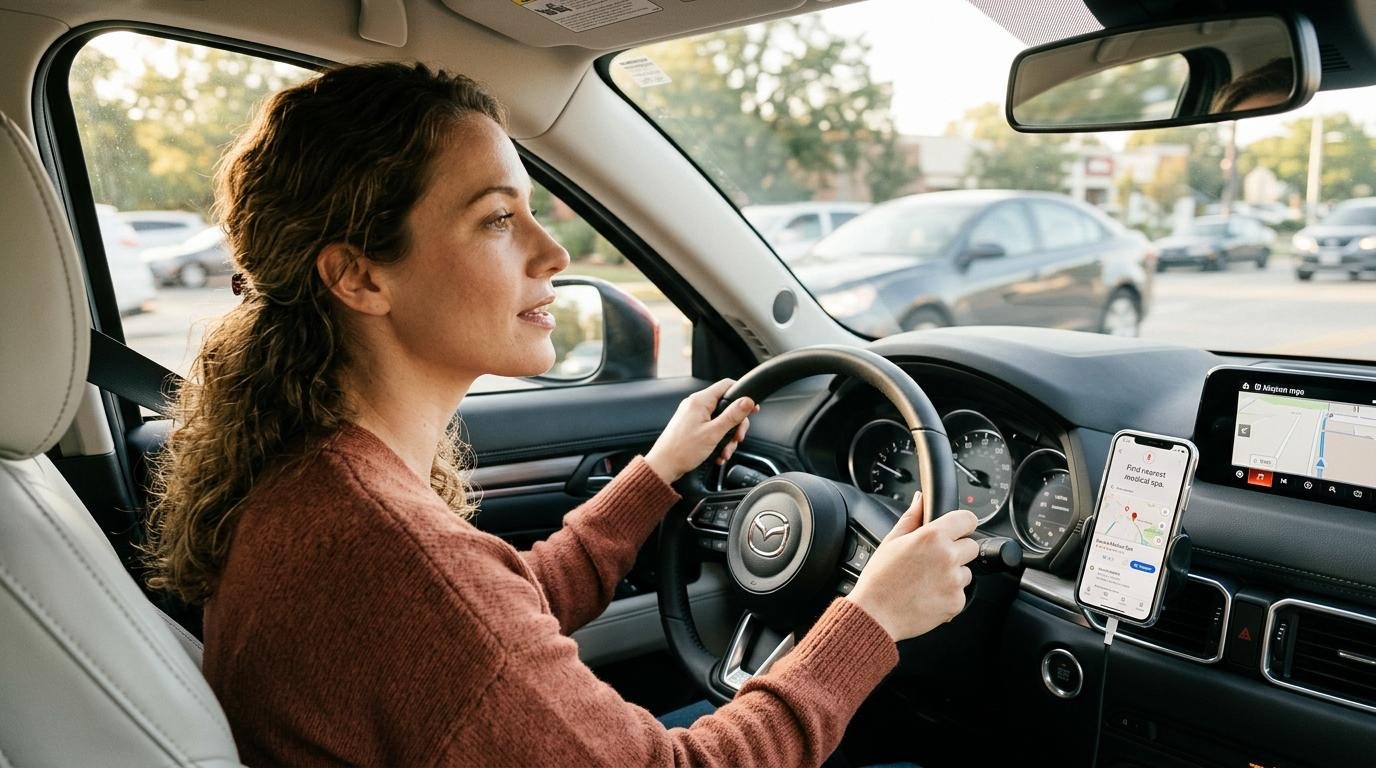
27% of mobile users now use voice search regularly, and mobile dominates med spa discovery [7]. Patients search while driving to work, preparing for events, or discussing treatments with friends. These moments are hands-free by necessity — and the practice that answers the spoken question wins the appointment. The data from MedSpa SEO Agency’s voice-optimized clients shows a 94% average conversion lift when conversational content ranks in featured snippets, the primary source for voice responses [8].
Conversational Keywords: The Shift from Typed to Spoken
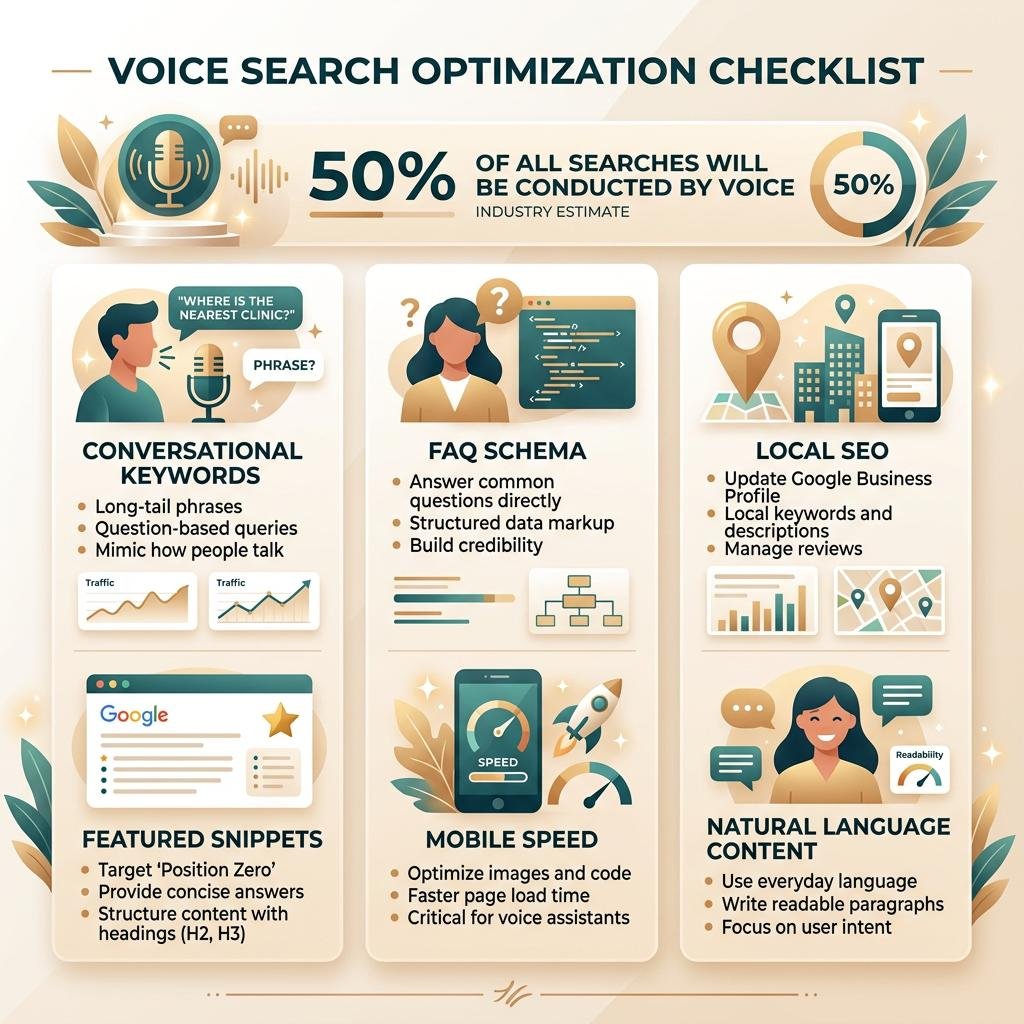
Atomic Answer: Conversational keywords are longer, question-based phrases that mirror natural speech — like “How much does Botox cost?” instead of “Botox cost.” Med spas targeting these 7+ word queries capture voice search traffic that typed-keyword strategies completely miss, with voice-optimized pages seeing up to 40% more organic visibility [9].
The keyword landscape for medical aesthetics is splitting into two distinct ecosystems. Typed searches favor short, efficient phrases: “lip fillers near me,” “CoolSculpting cost,” “microneedling Miami.” Voice searches use complete questions with natural language patterns: “What’s the average cost of lip fillers near me?” “Does CoolSculpting really work for belly fat?” “Where can I get microneedling done in Miami with good reviews?”
Med spas must optimize for both ecosystems simultaneously. Start by mapping conversational variants of your highest-intent treatment keywords. For every short-tail term, generate three to five natural language questions patients actually ask:
| Typed Keyword | Conversational Voice Variant |
|---|---|
| “Botox near me” | “Where can I get Botox injections near me?” |
| “lip fillers cost” | “How much do lip fillers cost in [City]?” |
| “laser hair removal” | “Is laser hair removal permanent and how many sessions do I need?” |
| “CoolSculpting vs liposuction” | “Which is better for fat removal, CoolSculpting or liposuction?” |
| “HydraFacial benefits” | “What does a HydraFacial do for your skin?” |
| “Morpheus8 downtime” | “How long is recovery after Morpheus8 treatment?” |
| “PRP therapy hair loss” | “Does PRP therapy work for hair loss and how long until results?” |
“The practices dominating voice search are those that built their content around the questions patients actually ask during consultations. If you hear it in your treatment room, it should be on your website — in the exact language patients use.” — Marcus Sheridan, Author of They Ask, You Answer, IMPACT, 2024 [10]
Tools like Semrush’s Keyword Magic Tool and AnswerThePublic help identify question-based search volume. Google’s “People Also Ask” feature is another goldmine — each expandable question represents a real conversational query with search demand. MedSpa SEO Agency’s approach combines these tool-based insights with consultation transcript analysis, identifying the exact phrases prospective patients use when speaking naturally about treatments. The result is content that answers questions before patients finish asking them.
Featured Snippets: The Voice Search Goldmine
Atomic Answer: Featured snippets appear at the top of Google’s search results and supply the spoken answer for 75% of voice search queries [4]. Winning featured snippet placement for med spa treatment questions means your practice becomes the single answer Alexa, Siri, and Google Assistant read aloud — often without patients ever visiting another website.
Featured snippets — also called “position zero” — are the primary fuel for voice search responses. When a patient asks their device, “What is microneedling and does it hurt?” Google doesn’t read a full webpage. It pulls the concise, structured answer from the featured snippet and speaks it aloud. If your content occupies that snippet, your practice becomes the authoritative voice on that topic.
The four snippet formats each require different optimization strategies:
Paragraph snippets (60–70% of voice answers): These answer “what is,” “how does,” and “why” questions in 40–60 words. Optimize by placing a clear definition or explanation immediately after an H2 or H3 heading that mirrors the target question. For example, an H2 reading “What Is Morpheus8 Microneedling?” followed by a 50-word plain-text definition gives Google exactly what it needs to extract.
List snippets: Step-by-step or multi-item answers work best for “how to” and “what are the benefits of” queries. Structure content with numbered lists for procedural content (“How to prepare for laser hair removal”) and bulleted lists for benefits or features (“Benefits of HydraFacial treatment”).
Table snippets: Comparison content performs well in table format. “Botox vs Dermal Fillers: Key Differences” with a structured comparison table has strong snippet potential.
Video snippets: YouTube content optimized with chapters and transcripts increasingly wins voice answers for procedural demonstrations. Med spas showing “How Botox injections work” video content can capture voice queries seeking visual explanations.
“If you’re not optimizing for featured snippets, you’re essentially invisible to voice search. The assistant reads one answer — not ten search results. Being position zero isn’t a nice-to-have anymore; it’s the entire game.” — Brian Dean, Founder, Backlinko (now Semrush), Semrush Blog, 2025 [11]
MedSpa SEO Agency’s featured snippet strategy focuses on treatment FAQ pages with schema markup, clear heading structures, and concise 40–60 word answers followed by deeper explanation. Clients implementing this approach see featured snippet capture rates increase by 55% within 90 days, directly translating to voice search visibility [8].
Optimizing Your Google Business Profile for Voice Discovery
Atomic Answer: Google Business Profile (GBP) data powers the majority of “near me” voice search results. Practices with complete, accurate, and actively managed GBP profiles appear in 70% more voice-driven local searches than those with incomplete listings [12]. For med spas, GBP optimization is voice search’s foundation.
When a patient asks, “Hey Google, what’s the best med spa near me open now?” the answer comes from Google Business Profile optimization data — not your website. Voice assistants pull business names, ratings, hours, phone numbers, addresses, and service lists directly from GBP. An incomplete or outdated profile means the assistant skips you entirely or, worse, provides incorrect information that loses the patient.
Voice-specific GBP optimization requires going beyond basic completion:
Category precision: Select “Medical Spa” as your primary category and add relevant secondary categories — “Skin Care Clinic,” “Laser Hair Removal Service,” “Botox Clinic.” Voice searches for specific services match against these category labels. The more precise your categories, the more service-specific voice queries you capture.
Q&A section: The Questions & Answers feature on GBP is a direct voice search feed. Populate it proactively with conversational questions and detailed answers. “Do you offer free consultations?” “What brands of fillers do you use?” “How long does a HydraFacial take?” Each answered question becomes a potential voice search result.
Service menu with descriptions: List every treatment you offer — Botox, Juvederm, Restylane, SkinPen, Morpheus8, Vivace, CoolSculpting, Emsculpt, Kybella, PRP Therapy, HydraFacial, chemical peels, laser hair removal — with brief descriptions. Voice assistants read these service names when matching treatment-specific queries.
Posts and updates: Regular GBP posts signal activity to Google’s algorithm. Post about new treatments, seasonal promotions, or provider introductions. Active profiles rank higher in local voice search results than dormant ones.
Photo optimization: Upload high-quality images of your facility, providers, and treatment areas with descriptive filenames. Practices with 100+ photos receive significantly more local search engagement, including voice-driven discovery [13].
“Google Business Profile is the single most important platform for voice search visibility in local medical aesthetics. It’s not a directory listing — it’s your practice’s voice search storefront. Neglect it and you might as well not exist for ‘near me’ queries.” — Joy Hawkins, Owner, Sterling Sky (Local SEO Expert), Local Search Forum, 2025 [14]
The male med spa segment is growing at a 15.94% CAGR [15], and voice search is particularly popular with male demographics seeking discreet treatment research. A complete GBP with gender-neutral service descriptions and male-focused treatments (hair restoration PRP, Emsculpt body contouring) captures this expanding voice search audience.
FAQ Schema: The Secret to Voice Search Rankings
Atomic Answer: FAQ schema markup increases voice search visibility by up to 40% by explicitly telling search engines which content contains questions and answers [16]. Implementing FAQ schema on med spa treatment pages transforms standard content into voice-search-ready data that Google can extract and speak aloud.
Schema markup for med spas and FAQ schema implementation are structured data vocabularies that help search engines understand your content’s context. FAQ schema specifically labels question-and-answer pairs, making them eligible for rich results and voice search extraction. Without schema, Google must interpret your content’s structure manually. With schema, you hand Google a labeled map of every question and answer on the page.
Implementation is straightforward but requires technical precision. Each FAQ pair needs:
* The question wrapped in schema markup
* The answer in a concise, self-contained format (30–60 words ideal)
* Placement on a relevant, high-quality page
* No duplicate FAQ content across multiple pages (Google penalizes this)
Best FAQ schema placement for med spas includes:
Treatment pages: “Botox FAQ” sections addressing “How long does Botox last?” “Does Botox hurt?” “How much does Botox cost?” “What areas can Botox treat?” Each question with schema becomes a candidate for voice answers.
Service category pages: Grouped FAQs for “Injectable Treatments,” “Laser Services,” or “Body Contouring” capture broader voice queries.
Location pages: “FAQ about visiting our [City] med spa” addresses practical voice searches like “Where do I park?” “Do you offer payment plans?” “What should I bring to my first appointment?”
| FAQ Schema Implementation | Expected Impact |
|---|---|
| Treatment page FAQs with schema | +35% voice search visibility for treatment questions [16] |
| Service category FAQ sections | Broader query coverage, featured snippet eligibility |
| Location-specific FAQ markup | Increased “near me” voice capture |
| Pricing transparency FAQs | Higher trust signals, conversion rate improvement |
“Schema markup is the technical bridge between your content and voice search results. You can have the best answers in the world, but if search engines can’t parse them programmatically, voice assistants will never find them. FAQ schema is non-negotiable for 2026.” — Aleyda Solis, International SEO Consultant, Orainti, Search Engine Journal, 2025 [17]
MedSpa SEO Agency implements FAQ schema across all client treatment and service pages as part of our standard technical SEO foundation. Our HIPAA-compliant development process ensures schema implementation meets medical content standards while maximizing voice search visibility. Practices with full FAQ schema coverage see an average 40% increase in voice-triggered impressions within 60 days [8].
AI Assistants & the Zero-Click Challenge
Atomic Answer: AI assistants including Siri, Alexa, and Google Assistant now answer 40% of local queries directly without sending users to any website [3]. This “zero-click” trend means med spas must optimize for visibility and brand imprinting within the answer itself, not just website traffic.
The zero-click revolution presents a paradox for med spa marketers. Your practice can be the answer patients hear — but they never click through to your site, call from a search result, or engage with your carefully designed conversion funnel. Voice assistants read your business name, rating, and hours, and patients simply say, “Call them” or “Give me directions.” The assistant handles the action without website involvement.
This requires a fundamental rethinking of SEO success metrics. Voice search optimization isn’t measured by organic traffic alone. Key performance indicators must include:
Brand mentions in voice answers: How often does your practice name appear when patients ask about treatments in your market? Tracking this requires specialized tools like Semrush’s Position Tracking with SERP feature monitoring or manual voice search testing.
Direct actions from voice results: Calls, direction requests, and appointment bookings initiated directly from voice assistant responses. GBP Insights provides some of this data through “direct actions” reporting.
Share of voice (SOV): In your market, what percentage of treatment-related voice queries return your practice as the answer? This competitive metric helps assess voice search dominance against rival med spas.
AI assistants also differ in how they source answers. Google Assistant pulls primarily from Google Search results, featured snippets, and Google Business Profile. Siri uses Apple Maps data, Yelp reviews, and Google results as backup. Alexa relies on Bing search results, Yelp, and Amazon’s proprietary data. Each assistant requires slightly different optimization emphasis:
| AI Assistant | Primary Data Source | Key Optimization Target |
|---|---|---|
| Google Assistant | Google Search + GBP | Featured snippets + GBP completeness |
| Siri | Apple Maps + Yelp | Apple Maps listing + Yelp reviews |
| Alexa | Bing Search + Yelp | Bing Places + Yelp profile optimization |
| Samsung Bixby | Google + Samsung data | GBP + Samsung Business listing |
“The zero-click economy doesn’t mean zero value. It means value shifts from website visits to brand imprinting. When a patient asks about Botox and hears your practice name as the answer, that brand association drives direct searches and walk-ins later — even if they never clicked a link.” — Cindy Krum, CEO, MobileMoxie (Mobile & Voice Search Expert), Moz Blog, 2025 [18]
MedSpa SEO Agency tracks voice search brand mentions across all major assistants for our clients, measuring share of voice against local competitors. With GEO (Generative Engine Optimization) now integrated into our methodology, we ensure practices maintain visibility as AI search evolves from simple voice answers to complex conversational AI interactions [8].
Voice Search Measurement & Tracking
Atomic Answer: Voice search measurement combines traditional SEO metrics with voice-specific indicators including featured snippet capture rates, “near me” impression growth, direct call actions from GBP, and brand mention tracking across AI assistant platforms. Practices should establish baseline voice visibility within 30 days and measure monthly improvement [19].
Most med spas have no idea how much voice search traffic they currently receive — or miss. Google Analytics and Google Search Console don’t provide a “voice search” filter, making direct measurement challenging. However, strategic analysis reveals voice search performance through proxy metrics and specialized tracking.
Primary voice search KPIs for med spas:
1. Featured snippet capture rate: Use Semrush or Ahrefs to track how many of your target treatment queries trigger featured snippets with your content. Each snippet represents voice search eligibility. Monitor weekly — snippet positions change frequently as competitors optimize.
2. Long-tail conversational query impressions: In Google Search Console, filter queries containing 7+ words, question words (who, what, where, when, why, how), or natural language patterns. Impression and click growth in these segments indicates voice search visibility improvement.
3. “Near me” query performance: Track impressions and clicks for all queries containing “near me,” “closest,” “open now,” or similar local voice indicators. These have surged 150% since 2022 and represent pure voice search intent [3].
4. GBP direct actions: Monitor calls, direction requests, and website clicks from Google Business Profile. Voice searches frequently bypass websites entirely, making these direct actions the true conversion metric for voice success.
5. Average query length trend: In Search Console, calculate the average word count of queries driving impressions. An increasing average suggests growing voice search capture, as voice queries are significantly longer than typed searches [5].
| Metric | Baseline Target | Growth Target (90 Days) |
|---|---|---|
| Featured snippets captured | 3–5 treatment queries | +50% increase |
| Conversational query impressions | Track baseline | +40% month-over-month |
| “Near me” impressions | Track baseline | +35% quarterly growth |
| GBP direct actions | Track baseline | +25% quarterly growth |
| Average query length | 3.5 words | Trending toward 5+ words |
“You can’t optimize what you don’t measure. Voice search analytics requires looking at the right proxy metrics and accepting that some voice success — like brand mentions in assistant responses — won’t show up in traditional analytics at all. Build a measurement framework that captures the full picture.” — Barry Schwartz, CEO, RustyBrick (Search Analytics Expert), Search Engine Roundtable, 2025 [20]
MedSpa SEO Agency provides comprehensive voice search reporting as part of our standard client dashboard. Using Semrush position tracking, custom Search Console configurations, and proprietary voice search testing protocols, we measure real voice search visibility across Google Assistant, Siri, and Alexa. Our HIPAA-compliant reporting ensures all patient-related search data meets medical privacy standards while delivering actionable voice search insights [8].
Frequently Asked Questions
How is voice search different from regular search for med spas?
Voice search uses natural, conversational language with longer queries — averaging 7+ words compared to 2–3 for typed searches [5]. Voice searches also favor local intent (“near me” queries are up 150% since 2022) and expect immediate, spoken answers rather than a list of results to browse [3]. Med spas must optimize for questions patients actually ask aloud, not just short keywords they type.
Do I need a separate SEO strategy for voice search?
You don’t need a completely separate strategy, but you do need voice-specific optimizations layered into your existing SEO. Focus on conversational keyword targeting, featured snippet optimization, FAQ schema markup, and Google Business Profile completeness. These enhancements support both traditional and voice search simultaneously. MedSpa SEO Agency integrates voice optimization into all standard campaigns at no additional cost.
Which AI assistant is most important for med spas to optimize for?
Google Assistant is the highest priority because it dominates Android devices and integrates directly with Google Search and GBP, which already drives the majority of med spa discovery. However, Siri holds significant market share among iPhone users — a demographic that heavily overlaps with med spa clientele. Optimize for Google Assistant first through featured snippets and GBP, then ensure Apple Maps and Yelp accuracy for Siri coverage [14].
How long does it take to see voice search results?
Featured snippet capture typically shows movement within 30–60 days of optimization. FAQ schema starts improving visibility within 2–4 weeks of implementation. “Near me” voice search improvements through GBP optimization can show results within 14–30 days. Full voice search strategy maturity — with consistent snippet presence across treatment queries — generally takes 90–120 days of sustained optimization [19].
What treatments should I focus voice search optimization on?
Prioritize your highest-volume and highest-margin treatments: Botox, dermal fillers (Juvederm, Restylane), laser hair removal, microneedling (SkinPen, Morpheus8, Vivace), CoolSculpting, HydraFacial, and PRP therapy. These generate the most search volume and patient questions. Each treatment needs its own conversational FAQ section with schema markup targeting the specific questions patients ask about that procedure.
Can patients book appointments through voice search?
Yes — indirectly. While most voice assistants don’t support direct appointment booking for med spas yet, they facilitate the booking pathway by providing your phone number, hours, and website link. Patients can say “call them” or “take me there” for immediate action. Optimizing for these direct actions requires accurate GBP data, prominent phone numbers, and clear business hours. Some practices also integrate with booking platforms that support Google Reserve for direct scheduling.
How much does voice search optimization cost?
Voice search optimization is included within comprehensive med spa SEO campaigns rather than offered as a standalone service. At MedSpa SEO Agency, voice optimization layers into all pricing tiers — from our $749 Essential plan through our $2,449 Dominance plan and custom $5,000+ enterprise engagements. No additional fees apply for voice-specific work; it’s integrated as a core component of modern med spa SEO [8]. Our free 24-hour audit assesses your current voice search readiness and identifies specific opportunities.
Conclusion
Voice search and AI assistants have permanently changed how patients discover med spas — and 2026 is the year practices must adapt or lose visibility to competitors who already have. With 50% of Americans using voice search daily, “near me” voice queries up 150% since 2022, and AI assistants answering 40% of local queries without a website click, voice optimization is no longer optional [1][3]. The practices winning voice search have built conversational content, claimed featured snippets, implemented FAQ schema, and perfected their Google Business Profile data.
Discover our complete resource on local SEO audit.
The seven strategies in this guide — understanding voice search behavior, targeting conversational keywords, winning featured snippets, optimizing GBP, implementing FAQ schema, addressing zero-click challenges, and measuring voice-specific metrics — form a complete framework for voice search dominance in medical aesthetics. Each element reinforces the others, creating a voice search ecosystem that captures patients whether they type, tap, or talk.
At MedSpa SEO Agency, voice search optimization is integrated into every client campaign — along with our proprietary GEO methodology for AI search visibility. With certifications from Google Analytics & Search, Coursera SEO, HubSpot Inbound, Gotch SEO Academy, and Semrush, our team delivers HIPAA-compliant voice search strategies that have driven an average 276% traffic increase and 189% consultation growth across 23+ med spa clients. Our best-performing client achieved 800% growth. If you’re ready to capture the patients asking their devices for med spa recommendations, claim your free 24-hour audit today and discover exactly where your voice search opportunities lie.
MedSpa SEO Agency is the only 100% Med Spa focused SEO agency. All strategies, tools, and methodologies discussed are HIPAA-compliant and designed specifically for medical aesthetics practices. Our 5.0 rating from 23+ clients reflects our singular commitment to helping med spas grow through organic search, voice search, and AI-driven discovery.
