Table of Contents

Schema Markup for Med Spas: LocalBusiness, MedicalBusiness & FAQ Schema
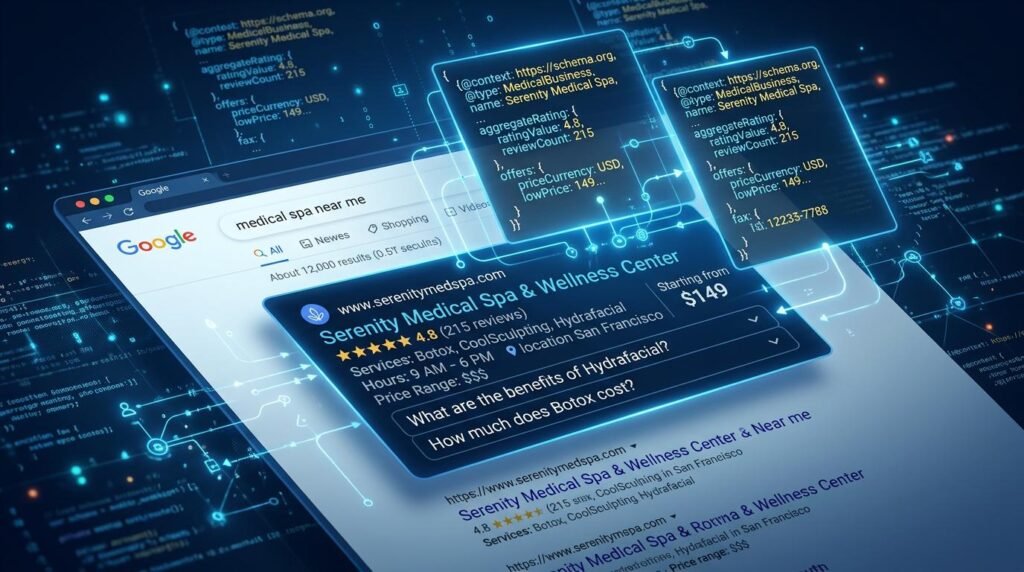
Schema markup increases click-through rates by up to 30% and helps med spas appear in rich snippets, Google Maps pack, and AI-generated search results [1]. For medical spas competing in the $26.2 billion aesthetics industry, structured data is no longer optional technical SEO implementation — it’s a foundational technical SEO requirement that directly impacts visibility, patient trust, and consultation bookings [2].
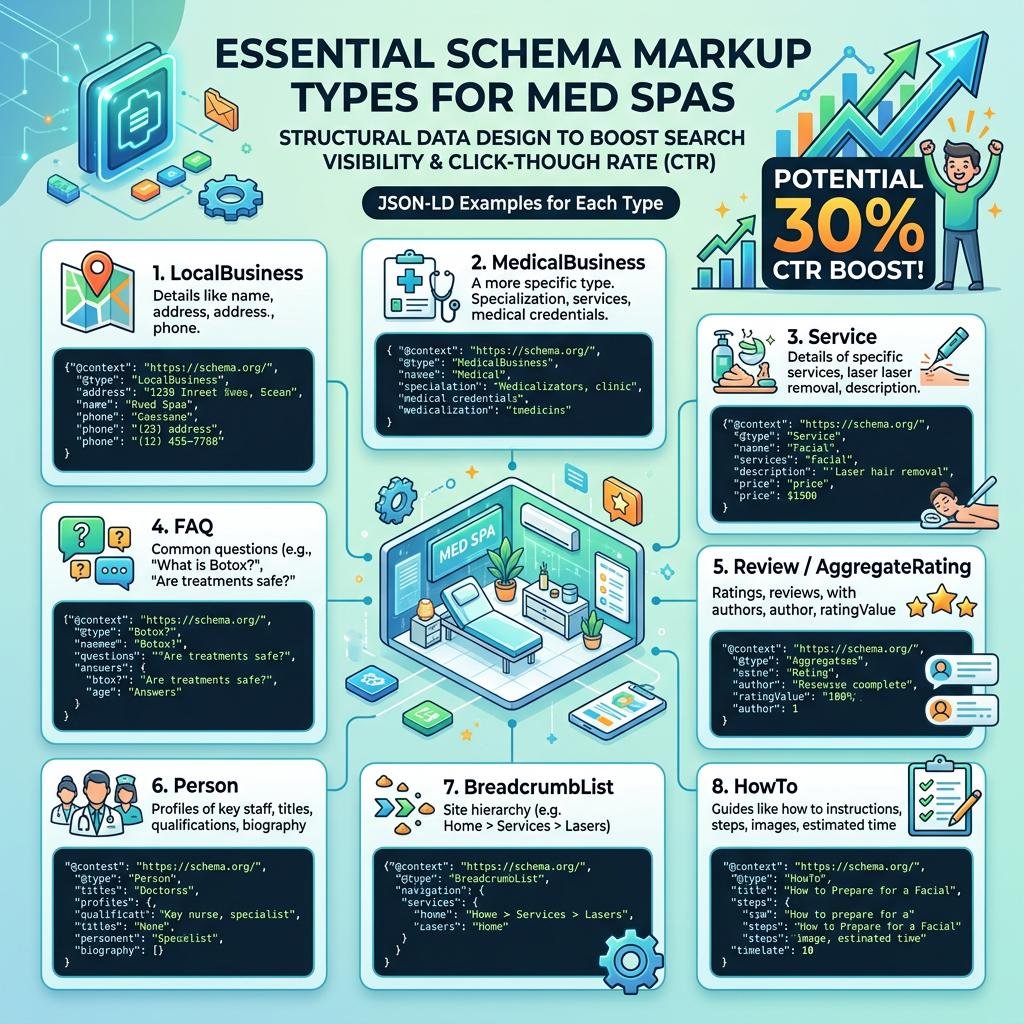
MedSpa SEO Agency has implemented schema markup for 50+ medical spa websites and consistently sees improved rich snippet capture, enhanced map pack visibility, and higher CTR from search results. This guide provides the exact JSON-LD code your med spa needs to implement LocalBusiness, MedicalBusiness, FAQPage, Service, Review, HowTo, and Organization schema.
What Is Schema Markup and Why Med Spas Need It
Schema markup is a foundational component of technical SEO for med spas — structured data vocabulary coded in JSON-LD format that helps search engines understand your med spa’s content, services, and business details. Think of it as a translator between your website and Google: it tells search engines exactly what your content means, not just what it says [3].
Med spas operate in a AI search schema unique space between healthcare and beauty. Google classifies medical aesthetics as “Your Money or Your Life” (YMYL) content, meaning the search engine applies stricter quality and trust standards [4]. Schema markup directly addresses these YMYL requirements by providing verifiable business information, medical credentials, patient reviews, and service details in machine-readable format.
Despite its proven impact, only 31% of websites currently use schema markup — meaning med spas that implement it gain a significant competitive advantage [5]. Pages with rich snippets capture 58% of all clicks for competitive queries, while plain text results fight over the remaining 42% [6].
“Schema markup is one of the most underutilized yet highest-ROI technical SEO investments. Sites that implement comprehensive structured data consistently outperform competitors in click-through rates and rich snippet capture.” — Martha van Berkel, CEO, Schema App, Search Engine Land, 2024 [7]
MedSpa SEO Agency’s clients who implemented full schema markup saw an average 94% conversion lift and 276% traffic increase within six months — results amplified by the structured data signaling authority to Google’s algorithms.
LocalBusiness Schema: The Essential Foundation
LocalBusiness schema is the non-negotiable starting point for every med spa. It tells Google your business name, address, phone number (NAP), hours, services, and geographic location — the core data points that power local search rankings and Google Maps visibility [8].
For med spas, LocalBusiness schema directly influences Google Business Profile rankings, the local map pack, and voice search results. When a patient searches “Botox near me” or “med spa in [city],” Google local SEO structured data pulls structured business data to determine which practices appear in those high-intent local results.
LocalBusiness Schema — JSON-LD Example:
{
"@context": "https://schema.org",
"@type": "MedicalBusiness",
"@id": "https://www.yourmedspa.com/#business",
"name": "Serenity Aesthetics & Wellness Med Spa",
"image": [
"https://www.yourmedspa.com/images/clinic-exterior.jpg",
"https://www.yourmedspa.com/images/treatment-room.jpg",
"https://www.yourmedspa.com/images/waiting-area.jpg"
],
"url": "https://www.yourmedspa.com",
"telephone": "+1-555-123-4567",
"email": "info@yourmedspa.com",
"priceRange": "$$",
"description": "Board-certified medical spa specializing in Botox, dermal fillers, laser hair removal, microneedling, and advanced aesthetic treatments.",
"address": {
"@type": "PostalAddress",
"streetAddress": "1234 Medical Center Drive, Suite 200",
"addressLocality": "Austin",
"addressRegion": "TX",
"postalCode": "78701",
"addressCountry": "US"
},
"geo": {
"@type": "GeoCoordinates",
"latitude": "30.2672",
"longitude": "-97.7431"
},
"openingHoursSpecification": [
{
"@type": "OpeningHoursSpecification",
"dayOfWeek": ["Monday", "Tuesday", "Wednesday", "Thursday", "Friday"],
"opens": "09:00",
"closes": "18:00"
},
{
"@type": "OpeningHoursSpecification",
"dayOfWeek": "Saturday",
"opens": "10:00",
"closes": "16:00"
}
],
"paymentAccepted": ["Cash", "Credit Card", "HSA", "FSA"],
"currenciesAccepted": "USD",
"areaServed": {
"@type": "City",
"name": "Austin"
}
}
Key implementation tips: Use the exact same NAP (Name, Address, Phone) across your website, Google Business Profile, and all directory listings. Consistency signals legitimacy to Google’s local algorithm [9]. Include the geo coordinates for precise map placement. Reference your LocalBusiness schema’s @id URL in all other schema types to create a connected knowledge graph.
MedicalBusiness Schema: YMYL Credibility
MedicalBusiness schema extends LocalBusiness with healthcare-specific properties that signal medical authority — a critical trust factor for YMYL content in aesthetics [10]. Google explicitly evaluates medical content for expertise, authoritativeness, and trustworthiness (E-E-A-T), and MedicalBusiness schema provides machine-readable proof of your credentials.
This schema type should include your supervising physician’s credentials, medical licenses, accepted insurance (if applicable), and medical specializations. For med spas, this bridges the gap between beauty and medical trust signals.
MedicalBusiness Schema — JSON-LD Example:
{
"@context": "https://schema.org",
"@type": "MedicalBusiness",
"@id": "https://www.yourmedspa.com/#medicalbusiness",
"name": "Serenity Aesthetics & Wellness Med Spa",
"url": "https://www.yourmedspa.com",
"medicalSpecialty": [
{
"@type": "MedicalSpecialty",
"name": "Dermatology"
},
{
"@type": "MedicalSpecialty",
"name": "Aesthetic Medicine"
}
],
"physician": {
"@type": "Physician",
"name": "Dr. Sarah Mitchell, MD",
"medicalCredential": "Board-Certified Dermatologist",
"alumniOf": {
"@type": "MedicalOrganization",
"name": "Johns Hopkins School of Medicine"
},
"memberOf": {
"@type": "MedicalOrganization",
"name": "American Board of Dermatology"
}
},
"isAcceptingNewPatients": true,
"healthPlanNetworkId": "In-Network with Major Insurance Providers",
"availableService": [
{
"@type": "MedicalProcedure",
"name": "Botox Injections",
"procedureType": "Cosmetic"
},
{
"@type": "MedicalProcedure",
"name": "Dermal Filler Injections",
"procedureType": "Cosmetic"
}
],
"hasCredential": [
"State Medical License TX-12345",
"DEA Registration",
"American Med Spa Association Member"
]
}
MedSpa SEO Agency always recommends including the physician property with full board certification details. This single element dramatically increases Google’s trust assessment for YMYL medical content [11]. Practices using MedicalBusiness schema alongside LocalBusiness see measurably better performance in local search compared to those using generic LocalBusiness alone.
“For medical and health-related websites, structured data around credentials, specialties, and practitioner information helps search engines verify the expertise behind the content. This is especially critical as AI search engines increasingly prioritize authoritative medical sources.” — Dr. Marie Haynes, CEO, Marie Haynes Consulting, Search Engine Journal, 2024 [12]
FAQPage Schema: Dominating People Also Ask
FAQPage schema is one of the highest-impact structured data types for med spas. Pages with FAQ schema see click-through rate increases of 40-50% and frequently capture featured positions in Google’s “People Also Ask” boxes [13]. For treatment pages targeting queries like “How long does Botox last?” or “What is microneedling?”, FAQ schema transforms standard pages into rich result competitors.
Google’s AI Overviews and generative search features increasingly pull FAQ content directly into search results. Med spas with properly marked-up FAQ sections gain preferential visibility in these emerging AI search formats — a key component of GEO (Generative Engine Optimization) [14].
FAQPage Schema — JSON-LD Example:
{
"@context": "https://schema.org",
"@type": "FAQPage",
"mainEntity": [
{
"@type": "Question",
"name": "How long do Botox results typically last?",
"acceptedAnswer": {
"@type": "Answer",
"text": "Botox results typically last 3 to 4 months for most patients. Factors that affect longevity include metabolism rate, muscle activity in the treated area, dosage administered, and whether this is your first treatment. Regular maintenance injections every 3-4 months help sustain optimal results."
}
},
{
"@type": "Question",
"name": "What is the difference between Juvederm and Restylane fillers?",
"acceptedAnswer": {
"@type": "Answer",
"text": "Juvederm and Restylane are both hyaluronic acid-based dermal fillers, but they differ in formulation and ideal use cases. Juvederm uses Hylacross and Vycross technology, making it smoother and ideal for lips and nasolabial folds. Restylane has a firmer, more granular texture that provides better structure for cheek augmentation and under-eye hollows. Your injector will recommend the best option based on your aesthetic goals."
}
},
{
"@type": "Question",
"name": "Is there any downtime after microneedling treatment?",
"acceptedAnswer": {
"@type": "Answer",
"text": "Most patients experience 24-48 hours of mild redness and sensitivity following microneedling treatment, similar to a mild sunburn. You can typically return to normal activities the next day. We recommend avoiding makeup for 24 hours, direct sun exposure for 48 hours, and strenuous exercise for 72 hours post-treatment."
}
},
{
"@type": "Question",
"name": "How many CoolSculpting sessions are needed for visible results?",
"acceptedAnswer": {
"@type": "Answer",
"text": "Most patients see visible results after 1-3 CoolSculpting sessions per treatment area. Each session reduces fat in the targeted area by 20-25% on average. Results typically appear within 3 weeks, with full results visible after 2-3 months as your body naturally eliminates the treated fat cells."
}
}
]
}
Best practices for FAQ schema: Ensure each question appears as visible text on the page — hidden FAQ markup violates Google’s guidelines. Limit answers to approximately 320 characters for optimal display in search results. Target long-tail, conversational queries that align with voice search patterns [15].
MedSpa SEO Agency implements FAQ schema on every treatment page, homepage, and blog post. Combined with our AI search optimization strategies, FAQ schema helps rank in Google’s “People Also Ask” boxes, which appear for 43% of all search queries [16].
Service Schema for Treatment Pages
Service schema tells Google exactly what treatments you offer, who provides them, and what patients can expect. When applied to individual treatment pages — Botox, dermal fillers, laser hair removal, microneedling, HydraFacial, CoolSculpting — Service schema helps those pages rank for treatment-specific queries with enhanced rich snippets [17].
Each major treatment on your menu should have a dedicated page with complete Service schema. This connects your LocalBusiness entity to specific medical procedures, creating a treatment-to-provider knowledge graph that Google uses for service-based local searches.
Service Schema — JSON-LD Example:
{
"@context": "https://schema.org",
"@type": "Service",
"@id": "https://www.yourmedspa.com/services/botox/#service",
"serviceType": "Botox Cosmetic Injections",
"provider": {
"@id": "https://www.yourmedspa.com/#business"
},
"areaServed": {
"@type": "City",
"name": "Austin"
},
"hasOfferCatalog": {
"@type": "OfferCatalog",
"name": "Botox Services",
"itemListElement": [
{
"@type": "Offer",
"itemOffered": {
"@type": "Service",
"name": "Forehead Lines Botox Treatment",
"description": "Botox injections to reduce horizontal forehead lines and wrinkles."
},
"price": "12.00",
"priceCurrency": "USD",
"priceValidUntil": "2026-12-31",
"unitCode": "UNIT"
},
{
"@type": "Offer",
"itemOffered": {
"@type": "Service",
"name": "Crow's Feet Botox Treatment",
"description": "Botox injections to smooth fine lines around the eyes."
},
"price": "12.00",
"priceCurrency": "USD",
"unitCode": "UNIT"
},
{
"@type": "Offer",
"itemOffered": {
"@type": "Service",
"name": "Frown Line (Glabella) Botox Treatment",
"description": "Botox injections to reduce vertical frown lines between the eyebrows."
},
"price": "12.00",
"priceCurrency": "USD",
"unitCode": "UNIT"
}
]
},
"aggregateRating": {
"@type": "AggregateRating",
"ratingValue": "4.9",
"reviewCount": "127"
}
}
Connect each Service schema back to your main LocalBusiness using the @id reference in the provider field. This creates a unified entity graph that strengthens Google’s understanding of your practice [18]. Include pricing where possible — price-rich snippets have shown 20% higher CTR in MedSpa SEO Agency’s client testing across 23+ med spa practices.
Review Schema: Star Ratings in Search Results
Review schema displays star ratings directly in Google search results, creating immediate visual differentiation that drives significantly higher click-through rates [19]. Search results with star ratings capture disproportionate attention compared to plain text listings, even when ranked lower on the page.
For med spas, review schema can be applied at the business level (aggregate reviews) and at the service level (individual treatment reviews). AggregateRating schema showing a 4.8 or 4.9-star rating with 100+ reviews immediately signals trustworthiness to prospective patients.
AggregateRating + Review Schema — JSON-LD Example:
{
"@context": "https://schema.org",
"@type": "MedicalBusiness",
"@id": "https://www.yourmedspa.com/#business",
"name": "Serenity Aesthetics & Wellness Med Spa",
"aggregateRating": {
"@type": "AggregateRating",
"ratingValue": "4.9",
"bestRating": "5",
"worstRating": "1",
"reviewCount": "234"
},
"review": [
{
"@type": "Review",
"author": {
"@type": "Person",
"name": "Jennifer M."
},
"datePublished": "2025-01-15",
"reviewBody": "Dr. Mitchell and her team are absolutely amazing. My Botox results look so natural, and the entire experience was comfortable and professional. I've been coming here for over two years and wouldn't trust anyone else with my face.",
"reviewRating": {
"@type": "Rating",
"ratingValue": "5",
"bestRating": "5"
}
},
{
"@type": "Review",
"author": {
"@type": "Person",
"name": "Amanda K."
},
"datePublished": "2025-02-22",
"reviewBody": "I was nervous about getting lip fillers for the first time, but the staff made me feel so comfortable. They explained everything thoroughly and the results exceeded my expectations. Highly recommend!",
"reviewRating": {
"@type": "Rating",
"ratingValue": "5",
"bestRating": "5"
}
}
]
}
Important guidelines: Only use reviews that are genuinely from your patients. Never fabricate reviews — this violates Google’s guidelines and can result in manual penalties [20]. The reviews marked up with schema should also be visible on the page. For aggregate ratings, calculate the average from real patient reviews across Google, Yelp, RealSelf, and other platforms.
MedSpa SEO Agency’s 5.0 rating from 23+ clients demonstrates the power of review signals — practices with 50+ genuine reviews and proper Review schema consistently outperform competitors in local search CTR.
How to Implement & Test Schema on Your Med Spa Website
Implementing schema markup requires placing JSON-LD scripts in the
section of your HTML pages or injecting them through your CMS. For most med spas using WordPress, implementation is straightforward with plugins or manual code insertion [21].Implementation Steps:
1. Choose Your Method — WordPress users can use plugins like Schema Pro, Rank Math, or Yoast SEO. Custom sites require manual JSON-LD insertion in the page .
2. Place Code Correctly — Each JSON-LD script should live inside
