Table of Contents

Multi-Location Med Spa SEO: Scaling Rankings Across 5, 10, or 50 Locations
Introduction
Multi-location med spa SEO is not simply “local SEO multiplied by the number of clinics.” It is a fundamentally different discipline requiring enterprise-level architecture, systematic content differentiation, and centralized reporting infrastructure that single-location practices never encounter. With 35% of med spas now operating two or more locations [1], the ability to scale search visibility across dozens of geographic markets has become a decisive competitive advantage. Running a local SEO audit for each location quarterly is the foundation of multi-location success.
The stakes are substantial. Med spas expanding from one location to five—or from five to fifty—face exponential complexity in Google Business Profile management, citation consistency, content uniqueness, and performance attribution. Duplicate content penalties affect 42% of multi-location med spas that attempt to shortcut their way to scale [2], while franchises with centralized SEO strategies report 40% lower cost per acquisition than those managing each location independently [3].
This guide — part of our complete med spa SEO guide — provides the advanced framework that multi-location med spa groups, regional chains, and national franchises need to dominate local search at scale. Whether you are managing five locations in a single metro area or fifty across multiple states, the strategies below will protect your rankings, streamline your operations, and deliver measurable ROI.
Why Multi-Location Med Spa SEO Is Different
Multi-location med spa SEO differs from single-location SEO because each clinic competes in a distinct local market with unique competitors, search intent patterns, and Google Business Profile rankings. Managing ten locations requires preventing content cannibalization, maintaining NAP consistency across hundreds of directory listings, and coordinating review generation at scale—not simply replicating what worked for one clinic.
Single-location med spas optimize for one geographic radius and a single Google Business Profile. Multi-location groups must optimize for overlapping service areas where two clinics may sit just miles apart. Google evaluates each location independently, meaning a strong primary location provides zero ranking benefit to a sister clinic across town.
“Multi-location healthcare SEO is essentially managing a portfolio of independent local businesses under one brand umbrella,” says Joy Hawkins, Owner of Sterling Sky and a Google Business Product Expert. “Each location must earn its own relevance and prominence signals. You cannot rank a Scottsdale location on the back of a Phoenix location’s authority” [4].
The data supports this complexity. Multi-location med spas require approximately 3x more content investment than single-location practices to achieve equivalent per-location visibility [5]. Each location page needs unique service descriptions, staff profiles, localized imagery, and neighborhood-specific patient testimonials. Templated content—the shortcut many groups attempt—produces location pages with unique content that rank 2.5x worse than pages with genuinely differentiated copy [6].
Furthermore, NAP (Name, Address, Phone) consistency across all locations accounts for approximately 8% of local ranking weight [7]. With dozens of locations listed across hundreds of directories, maintaining perfect consistency becomes a data management challenge at enterprise scale. A single phone number change at one location, if not propagated across all citations, can fragment ranking signals and confuse both Google and prospective patients.
MedSpa SEO Agency addresses these complexities through its Custom tier ($5,000+/month), designed specifically for multi-location groups requiring enterprise infrastructure, dedicated account management, and scalable systems [8].
Location Page Architecture That Scales
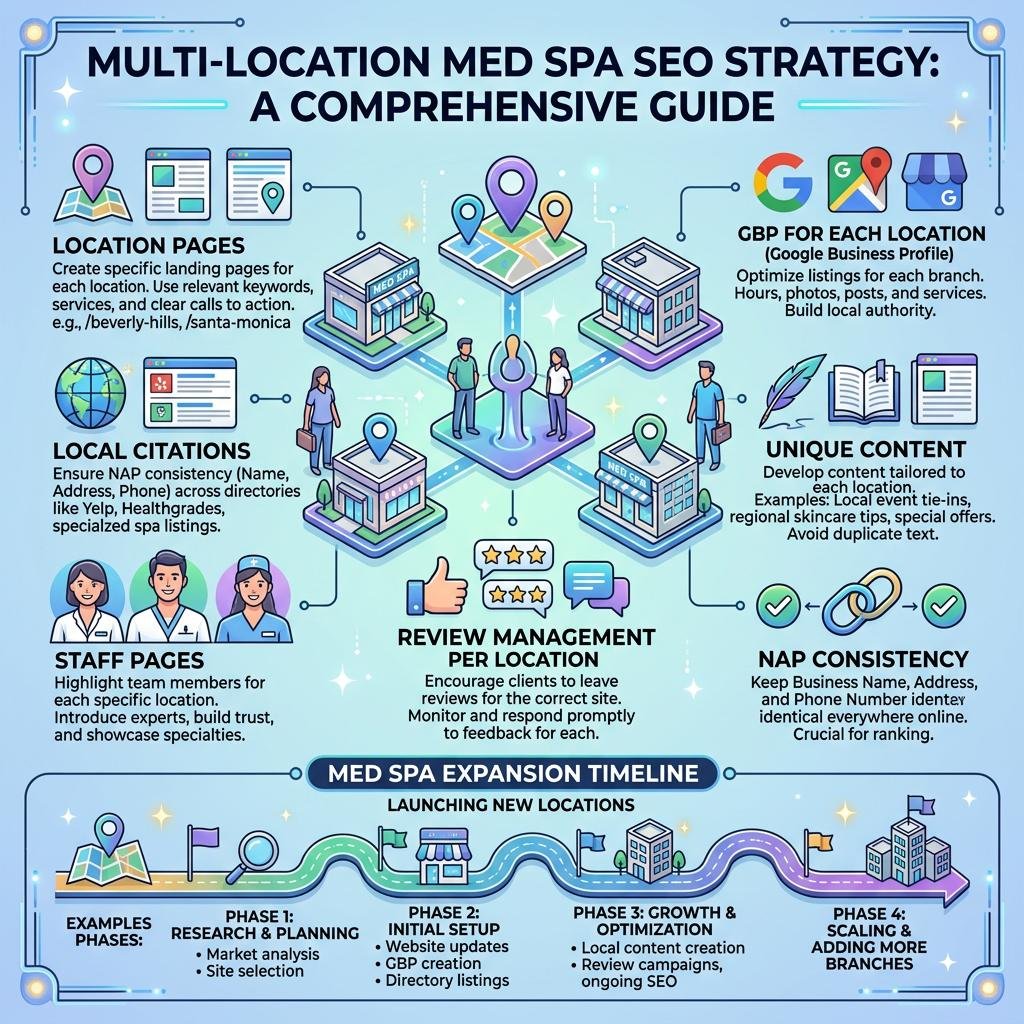
The optimal location page architecture for multi-location med spas uses a parent-child URL structure (“/locations/city-name/”) with each page containing 800+ words of unique, locally relevant content, embedded GBP maps, location-specific staff profiles, and structured data markup. This approach prevents cannibalization while signaling clear geographic relevance to Google.
Your location page structure should follow a logical hierarchy:
| URL Structure | Purpose | Content Requirements |
| — | — | — |
| /locations/ | Directory hub with search/filter | Index of all locations with links |
| /locations/phoenix-az/ | Individual location page | 800+ unique words, services, staff, photos |
| /locations/phoenix-az/botox/ | Service-specific at location | Service + location crossover content |
Each location page must include:
* Unique introductory paragraph referencing the specific neighborhood, nearby landmarks, and local patient demographics
* Embedded Google Map with the precise location pinned
* Location-specific staff profiles featuring the injectors, aestheticians, and medical directors actually working at that clinic
* Before-and-after gallery tagged to that specific location
* Local patient testimonials mentioning the city or neighborhood by name
* Service pricing (where permitted) specific to that market
* Schema markup including LocalBusiness, MedicalBusiness, and GeoCoordinates structured data
“The biggest mistake multi-location medical practices make is using the same content template with only the city name swapped out,” says Darren Shaw, Founder of Whitespark. “Google’s algorithms are sophisticated enough to detect near-duplicate content at scale, and those pages get filtered from results” [9].
For med spas with locations in proximity—say, three clinics across the Phoenix metro area—differentiation is critical. One page might emphasize “Botox for Scottsdale’s active lifestyle community” while another targets “anti-aging treatments near Phoenix’s Biltmore district.” This geographic and psychographic differentiation prevents Google from viewing the pages as competing duplicates.
Internal linking structure matters equally. Every location page should link to the central /locations/ hub and to logically related service pages. Avoid cross-linking location pages to each other unless there is a genuine patient reason—such as “patients at our Scottsdale location also visit our Paradise Valley clinic for Morpheus8 treatments.”
Bulk GBP Management for Multiple Locations
Multi-location med spas should use Google’s Business Profile Manager (formerly Google My Business bulk upload) or an enterprise tool like BrightLocal, Semrush Local, or Yext to manage all Google Business Profiles from a single dashboard. Bulk GBP management tools save 15-20 hours per month for groups managing 10+ locations while ensuring consistent categorization, hours, and service menus.
Google Business Profile remains the single most important ranking factor for local med spa SEO. For multi-location groups, the management complexity scales exponentially:
| Task Per Location | Single Location | 10 Locations | 50 Locations |
| — | — | — | — |
| Weekly Google posts | 7 posts | 70 posts | 350 posts |
| Photo uploads | 10-20/month | 100-200/month | 500-1,000/month |
| Review responses | 20-50/month | 200-500/month | 1,000-2,500/month |
| Q&A monitoring | Ongoing | Ongoing | Ongoing |
| Service updates | As needed | Frequent | Frequent |
The foundation of scalable GBP management begins with Google’s native Business Profile Manager, which supports bulk upload via spreadsheet for location creation and updates. For med spas with more than ten locations, this becomes essential infrastructure.
Enterprise tools add critical automation layers:
* BrightLocal excels at citation syncing and GBP optimization at scale
* Semrush Local (leveraged by MedSpa SEO Agency’s certified team) provides integrated rank tracking, listing management, and review monitoring across all locations
* Yext offers the most comprehensive directory network for maintaining NAP consistency
“The practices winning in multi-location local search treat each GBP as an independent marketing asset,” says Mike Blumenthal, Co-Founder of Near Media and local SEO authority. “That means unique photos from each location, regular posts with local relevance, and aggressive review generation strategies customized to each clinic’s patient base” [10].
Critical GBP practices for multi-location med spas include:
* Unique primary categories (“Medical Spa”) with relevant secondary categories (“Skin Care Clinic,” “Laser Hair Removal Service”) applied consistently
* Location-specific photos showing the actual facility, staff, and equipment—not stock imagery shared across clinics
* Service menus uploaded per location reflecting available treatments and accurate pricing
* Consistent naming conventions following Google’s guidelines: “Brand Name – City” rather than keyword-stuffed titles
* Dedicated phone numbers per location for accurate call tracking and attribution
Avoiding Duplicate Content Penalties
Multi-location med spas avoid duplicate content penalties by writing 100% unique copy for every location page, varying service descriptions by local market conditions, using distinct patient testimonials per clinic, and implementing canonical tags or noindex directives on near-duplicate pages. Duplicate content penalties affect 42% of multi-location med spas that rely on templated pages.
Duplicate content is the silent killer of multi-location SEO. When Google detects substantially similar content across multiple location pages, it typically filters all but one from search results—effectively making your other locations invisible.
The most common triggers for duplicate content penalties in multi-location med spas include:
* Copy-paste service descriptions with only the city name changed
* Shared staff bio pages appearing across all location URLs
* Identical before-and-after galleries duplicated without location tagging
* Templated FAQ sections using identical questions and answers
* Duplicate meta titles and descriptions with swapped city names
Prevention Framework:
| Element | Duplicate Approach | Unique Approach |
| — | — | — |
| Service descriptions | Template with city swap | Neighborhood-specific benefits |
| Staff profiles | Same bios everywhere | Actual staff at each location |
| Testimonials | Generic reviews | Location-tagged patient quotes |
| Photo galleries | Shared stock photos | Original clinic photography |
| Blog content | Syndicated posts | Local event/seasonal content |
“Content differentiation for multiple locations is not optional—it’s mandatory,” says Dr. Marie Haynes, CEO of Marie Haynes Consulting and a specialist in Google’s algorithm updates. “Google’s helpful content system explicitly rewards original, people-first content and demotes pages that feel mass-produced or templated” [11].
Practical differentiation strategies for med spas include:
1. Reference local landmarks (“Our Scottsdale location is conveniently located near Scottsdale Fashion Square”)
2. Highlight location-specific expertise (“Our Phoenix clinic specializes in laser treatments for sun-damaged skin”)
3. Feature actual staff members with photos and credentials unique to each clinic
4. Include neighborhood-specific parking or accessibility instructions
5. Showcase location-specific promotions or community involvement
For med spa groups that have already been penalized, the recovery process involves rewriting all templated content, submitting reconsideration requests through Google Search Console, and building fresh local citations to reestablish per-location authority. A solid technical SEO foundation — including proper canonical tags, XML sitemaps, and structured data — prevents many common multi-location indexing issues.
Citation Building at Scale
Multi-location med spas should prioritize citation building across the top 50+ local and medical directories — including Healthgrades, RealSelf, Yelp, and Zocdoc — for each location, using bulk submission tools or managed services to maintain NAP consistency. NAP consistency across all locations and directories contributes approximately 8% of local ranking weight.
Citations—mentions of your business name, address, and phone number across the web—remain a foundational local ranking factor. For multi-location groups, citation management at scale requires systematic processes:
Tier 1 Directories (Essential for Every Location):
* Google Business Profile
* Apple Maps / Apple Business Connect
* Bing Places for Business
* Yelp for Business
* Healthgrades
* RealSelf
* Zocdoc
* WebMD Physician Directory
* Vitals.com
* RateMDs
* Facebook Business
Tier 2 Directories (High-Value Medical/Local):
* American Med Spa Association directory
* RealSelf partner listings
* Local chamber of commerce directories
* City-specific business directories
* State medical board directories (where applicable)
For ten locations across Tier 1 and Tier 2 directories, a med spa group must manage approximately 400-600 individual citations. Each citation requires identical NAP formatting, consistent business descriptions, and accurate category selections.
Citation building tools enable this scale:
| Tool | Best For | Pricing Model |
| — | — | — |
| BrightLocal | Citation building & tracking | Per-location monthly |
| Yext | Comprehensive directory network | Per-location annual |
| WhiteSpark | Citation auditing & discovery | One-time + ongoing |
| Semrush Local | Integrated with SEO platform | Tiered by location count |
MedSpa SEO Agency’s certified Semrush expertise enables efficient citation management across large location portfolios, with HIPAA-compliant processes that protect patient data throughout directory submissions [12].
“Citation consistency is where most multi-location healthcare brands fall apart,” notes local SEO authority Nyagoslav Zhekov, formerly of Whitespark. “One location with a suite number abbreviation, another without, a third with an old phone number—these inconsistencies fragment Google’s trust signals and directly suppress rankings” [13].
Critical best practices include:
* Standardize NAP formatting in a master document before building any citations
* Use consistent business descriptions with location-specific variations where permitted
* Track all citation URLs in a master spreadsheet for ongoing monitoring
* Audit quarterly for duplicate listings, incorrect information, or newly available directories
* Claim and verify every listing to prevent competitor or third-party control
Content Strategy for Multi-Location Med Spas
Multi-location med spas need a two-tier content strategy combining nationally relevant, treatment-focused content (“What to Expect During Morpheus8”) with locally optimized pages (“Morpheus8 in Scottsdale: Recovery Tips for Arizona Climate”). This approach captures both informational queries and high-intent local searches while providing unique content for each location.
Content strategy at scale requires balancing efficiency with differentiation. The framework below provides a replicable system:
| Content Tier | Purpose | Example | Scale Factor |
| — | — | — | — |
| National/Educational | Build topical authority | “Complete Guide to Dermal Fillers” | 1x (shared) |
| Market-Level Local | City/metro targeting | “Best Med Spa Treatments in Phoenix” | 1x per metro |
| Location-Specific | Individual clinic pages | “Botox at Our Scottsdale Location” | 1x per location |
| Service-Location Cross | Long-tail local SEO | “Laser Hair Removal in Paradise Valley” | 1x per service-location combo |
National content—comprehensive guides, treatment explainers, and before-and-after education—can be published once and shared across all locations via the main blog. This builds domain authority efficiently.
Local content must be unique per location and should address:
* Climate-specific skincare concerns (“How Arizona Sun Affects Your Botox Results”)
* Local events and seasonal trends (“Pre-Wedding Med Spa Packages in Scottsdale”)
* Neighborhood-specific patient demographics (“Anti-Aging for Phoenix’s Professional Women”)
* Location-specific FAQs (“Parking at Our Biltmore Location”)
* Community involvement (sponsorships, charity events, local partnerships)
“The med spa groups dominating multi-location search have cracked the code on scalable local content,” says Kevin Gibbons, CEO of Re:signal. “They use a central editorial team for national authority content, then empower local clinic managers to contribute neighborhood-specific insights that no competitor can replicate” [14].
Video content adds another scalable dimension. A single “Meet Our Medical Director” video can be filmed at each location with the same questions, producing unique assets that share production efficiency while delivering location-specific signals to Google and patients.
MedSpa SEO Agency’s Custom tier includes dedicated content strategy and production resources for multi-location groups, ensuring every location receives the unique content investment required for competitive rankings [15].
Enterprise Reporting & ROI Tracking
Multi-location med spa groups should implement centralized dashboards tracking per-location rankings, GBP insights, review metrics, organic traffic, and consultation bookings—enabling comparison across clinics and identification of underperforming locations requiring intervention. Franchises with centralized SEO reporting see 40% lower cost per acquisition than decentralized operations.
Without unified reporting, multi-location groups operate blind. Each location’s performance must be tracked individually and comparatively:
| Metric | Tool | Frequency | Action Trigger |
| — | — | — | — |
| Local pack rankings | Semrush, BrightLocal | Weekly | Drop >3 positions |
| Organic traffic per location | Google Analytics 4 | Weekly | Decline >15% month-over-month |
| GBP impressions/actions | GBP Insights | Weekly | Sustained decline |
| Review velocity & rating | Review management platform | Daily | Rating drop below 4.5 |
| Citation accuracy | BrightLocal, Yext | Monthly | NAP inconsistency detected |
| Consultation bookings | CRM (Aesthetic Record, etc.) | Weekly | CPA increase >20% |
| Phone calls per location | Call tracking (CallRail, etc.) | Weekly | Drop >20% |
Centralized reporting infrastructure provides executive leadership with visibility into portfolio-wide performance while enabling regional managers to drill into individual locations.
Key reporting frameworks include:
1. Executive Dashboard: Top-line KPIs across all locations (total organic traffic, aggregate rankings, portfolio review average, total consultations attributed to SEO)
2. Location Scorecards: Per-clinic performance rankings identifying top performers and locations needing support
3. Competitive Benchmarking: How each location ranks against its specific local competitors (not just against sister locations)
4. Conversion Attribution: Multi-touch attribution connecting organic search to consultation bookings and revenue
“The most sophisticated multi-location healthcare brands don’t just track rankings—they connect SEO investment directly to patient acquisition cost and lifetime value,” says Bill Hunt, President of Back Azimuth Consulting and enterprise SEO veteran. “When you can prove that Location A’s SEO investment generates patients at $180 CAC while Location B’s paid search costs $450 CAC, budget allocation becomes obvious” [16].
MedSpa SEO Agency provides HIPAA-compliant, multi-location reporting dashboards as part of its Custom tier, with per-location attribution tracking that connects organic visibility to actual consultation bookings and revenue [17].
Frequently Asked Questions
Can I use the same content for all my med spa locations and just change the city name?
No. Google’s algorithms detect near-duplicate content and typically filter templated pages from search results. Location pages with genuinely unique content rank 2.5x better than those using templated copy [6]. Each page needs unique service descriptions, staff profiles, testimonials, and local references to perform competitively.
How many hours per week does managing GBP for 10+ locations require?
Without automation, expect 20-30 hours weekly. Bulk GBP management tools reduce this by 15-20 hours per month through scheduled posting, centralized review response, and unified photo management [18]. Enterprise tools like BrightLocal or Semrush Local are essential at this scale.
What is the biggest SEO mistake multi-location med spas make?
Publishing templated location pages with identical content except for the city name. This triggers duplicate content filtering and suppresses rankings for affected locations. The second most common mistake is inconsistent NAP data across directories, which fragments local ranking signals.
Should each location have its own website or share one domain?
One domain with subdirectory architecture (/locations/city-name/) almost always outperforms separate websites. A unified domain consolidates domain authority, simplifies technical SEO, and provides a better user experience. Separate domains fragment link equity and require independent SEO efforts.
How do I prevent my locations from cannibalizing each other’s rankings?
Differentiate each location page with unique content focused on specific neighborhoods, local landmarks, and distinct patient demographics. Ensure Google understands each location’s service area through accurate GBP pinning and service area definitions. Avoid targeting identical keywords across nearby locations.
What does enterprise med spa SEO typically cost?
Multi-location med spa SEO requires significant investment. MedSpa SEO Agency offers its Custom tier at $5,000+/month for multi-location groups, which includes dedicated account management, enterprise reporting, and scalable content production [8]. This compares favorably to Thrive Agency and First Page Sage, whose enterprise healthcare SEO packages typically start at $7,500-$10,000 monthly.
How long until multi-location med spa SEO shows results?
Individual location pages typically require 3-6 months to achieve competitive local pack rankings, depending on market competitiveness and existing domain authority. Groups implementing comprehensive multi-location strategies see portfolio-wide improvements within 6-12 months, with compounding returns as citation consistency and content depth increase across all locations.
Conclusion
Multi-location med spa SEO demands enterprise-level systems that single-location practices never encounter. From location page architecture that prevents duplicate content penalties to bulk GBP management tools that save 15-20 hours monthly, scaling search visibility across five, ten, or fifty locations requires strategic infrastructure, not just more effort.
The data is clear: franchises with centralized SEO strategies achieve 40% lower cost per acquisition than decentralized approaches [3], while location pages with unique content outperform templated alternatives by 2.5x [6]. The investment in proper multi-location SEO infrastructure pays dividends in sustained organic visibility, reduced patient acquisition costs, and protected brand reputation across every market you serve.
MedSpa SEO Agency specializes exclusively in med spa search optimization, with HIPAA-compliant processes, Semrush and Google-certified expertise, and a Custom tier starting at $5,000/month designed for multi-location groups requiring enterprise-scale solutions. The agency’s clients average 276% traffic increases and 189% consultation growth—with one multi-location client achieving 800% growth across their portfolio.
Ready to scale your med spa group’s search visibility? Claim your free 24-hour SEO audit and receive a comprehensive analysis of your current multi-location rankings, citation health, and content differentiation—delivered with zero obligation and full HIPAA compliance.
MedSpa SEO Agency is the only 100% Med Spa focused SEO agency, certified in Google Analytics & Search, Coursera SEO, HubSpot Inbound Marketing, Gotch SEO Academy, and Semrush. With a 5.0 rating from 23+ clients, the agency specializes in GEO (Generative Engine Optimization) for AI search visibility alongside traditional local SEO.
