Table of Contents

Most medical spas invest thousands in marketing each month without knowing which channels actually generate revenue. Practices that implement proper ROI tracking — like the methodology detailed in our med spa SEO case study — see 2.3x higher marketing efficiency and can confidently scale winning campaigns [1]. This guide provides the complete framework for measuring med spa marketing ROI — from KPI selection and call tracking to CRM integration and attribution modeling — so you know exactly what drives revenue.
The global medical aesthetics market is projected to reach $26.2 billion by 2026, growing at a 12-15% CAGR [2]. With 52% of procedures being facial treatments and 71% of patients identifying as female, the opportunity is massive — but only for practices that can measure what works [3]. At MedSpa SEO Agency, our clients see up to 10x ROI when proper tracking is implemented alongside our HIPAA-compliant SEO and paid media strategies.
Why Most Med Spas Can’t Measure Marketing ROI
The average med spa juggles 5-7 marketing touchpoints before a patient books, yet 76% lack systems to connect those touchpoints to revenue [1]. Without attribution infrastructure, practices are essentially flying blind — allocating budget based on gut feeling rather than data.
The aesthetics industry faces unique measurement challenges. Unlike e-commerce with straightforward pixel tracking, med spa patient journeys involve multiple offline interactions: Instagram discovery, Google searches, phone consultations, in-person visits, and follow-up treatments. Each touchpoint contributes to the final decision, but most practices only track the last click — if they track anything at all.
“The biggest mistake I see in aesthetics marketing is treating every channel as a silo,” says Darcy McNally, Founder at MedSpa SEO Agency. “A patient might discover you on TikTok, research on Google, see a retargeting ad on Facebook, and finally call after finding you on Google Business Profile. If you’re only counting that last phone call, you’re undervaluing four other channels that made it possible.”
Common tracking failures — which our med spa competitor analysis repeatedly identifies across practices — include: no call tracking on any campaigns, missing conversion pixels on landing pages, separate systems for booking and marketing that don’t talk to each other, and staff forgetting to ask “How did you hear about us?” — or failing to record the answer. Practices tracking ROI see 2.3x higher marketing efficiency simply because they can double down on what works and cut what doesn’t [1].
The cost of poor measurement is staggering. Med spas without proper attribution typically over-invest in underperforming channels by 30-40%, while underfunding their highest-ROI activities. Marketing analytics improve budget allocation by 35% on average when properly implemented [4].
The KPI Framework Every Med Spa Needs
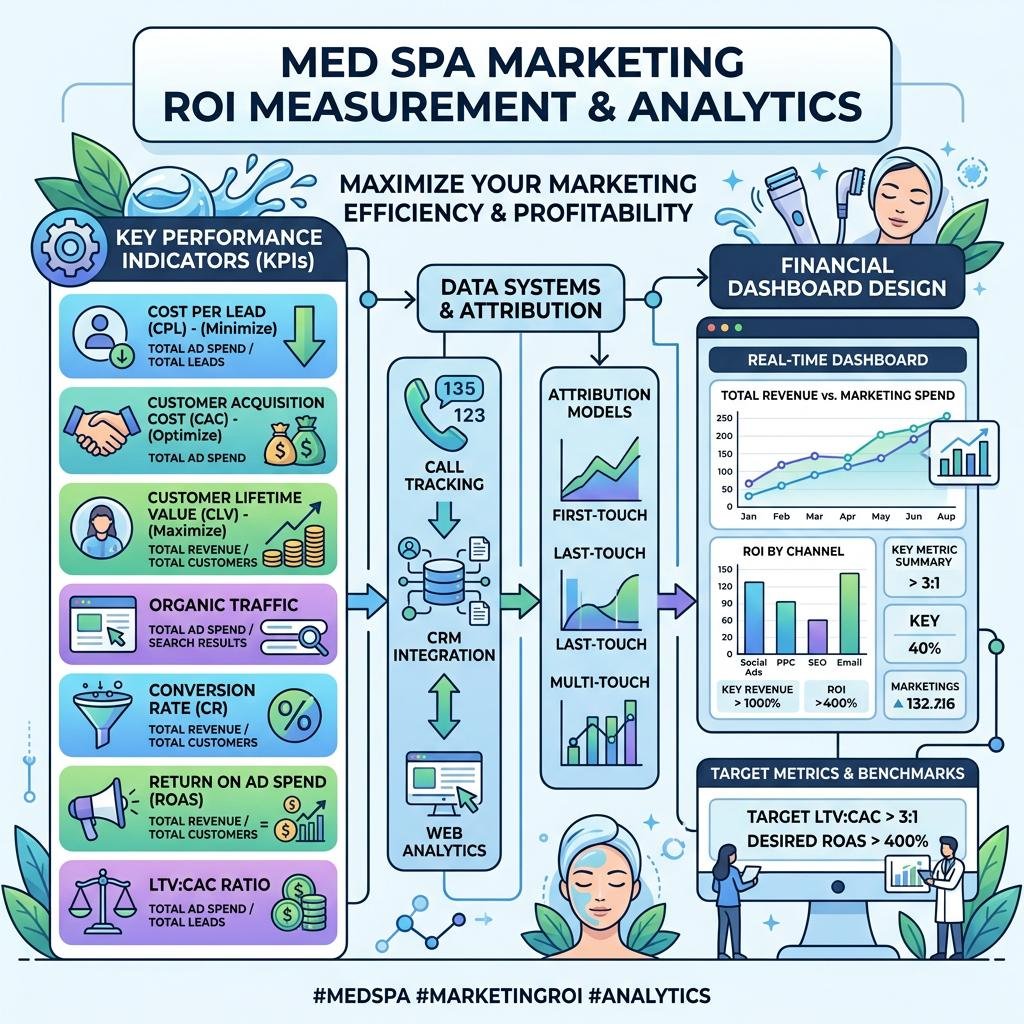
Effective med spa marketing measurement requires tracking five core KPI categories: traffic sources, lead generation, cost per acquisition, patient lifetime value, and channel-specific ROI. Practices that monitor these metrics consistently outperform competitors who rely on vanity metrics like impressions or likes.
Your KPI framework should cascade from top-of-funnel awareness to bottom-of-funnel revenue. Start with these essential metrics organized by patient journey stage:
| KPI Category | Key Metrics | Benchmark |
|---|---|---|
| Traffic & Awareness | Organic sessions, GBP views, ad impressions | 15-25% monthly organic growth |
| Lead Generation | Form fills, phone calls, chat inquiries | $35-$85 cost per lead |
| Consultation Booking | Consultation rate, show-up rate | 60-75% consultation show rate |
| Patient Acquisition | New patient count, cost per acquisition | $150-$400 CPA for injectables |
| Lifetime Value | Treatment frequency, avg spend, retention | $2,500-$5,000+ LTV |
“Don’t confuse activity with outcomes,” advises Marcus Sheridan, author of They Ask, You Answer and keynote speaker at the 2024 Aesthetic Next conference. “A thousand Instagram likes means nothing if you can’t connect it to a single consultation. Track metrics that tie directly to revenue — consultations booked, treatments performed, and patient lifetime value.”
For Botox and dermal filler practices, we recommend tracking treatment-specific metrics: average units per patient, rebooking rates at 3-4 month intervals, and upsell rates to higher-margin treatments like Morpheus8 microneedling or CoolSculpting. MedSpa SEO Agency clients track these KPIs through custom dashboards built in Google Looker Studio, pulling data from Google Analytics 4, call tracking platforms, and practice management systems — delivering our documented 94% conversion lift by focusing on revenue metrics rather than vanity numbers.
Attribution Models: Which One Works for Aesthetics
Med spa patients typically require 5-7 touchpoints before booking, making single-touch attribution dangerously misleading [5]. Multi-touch attribution models distribute credit across the entire patient journey, revealing which channels actually contribute to revenue — not just which one happened last.
Four attribution models dominate aesthetics marketing, each with distinct advantages:
First-Touch Attribution gives full credit to the channel that initially discovered the patient. This works well for brand-new practices focused on awareness, but undervalues nurturing channels like email and retargeting.
Last-Touch Attribution — the default in most analytics platforms — credits only the final interaction. While easy to implement, it systematically overvalues bottom-funnel channels (branded Google searches) while undervaluing top-funnel discovery (Instagram, TikTok, unbranded SEO).
Linear Attribution distributes credit equally across all touchpoints. This is a solid starting model for med spas because it acknowledges every step in the aesthetic patient journey, from initial awareness through consultation booking.
Data-Driven Attribution uses machine learning to assign credit based on actual incremental impact. Available in Google Analytics 4 for qualifying properties, this is the gold standard — but requires sufficient conversion volume (typically 300+ monthly conversions) to generate reliable models.
“Multi-touch attribution isn’t just nice to have in aesthetics — it’s essential,” notes Frank Powell, VP of Marketing at RealSelf. “Our data shows the average cosmetic patient journey spans 5-7 touchpoints across multiple devices and channels before they ever pick up the phone [5]. If you’re using last-click attribution, you’re making major budget decisions based on incomplete data.”
For most med spas, we recommend starting with a position-based (40/20/40) model: 40% credit to first touch, 40% to last touch, and 20% distributed among middle interactions. This balances awareness and conversion while remaining implementable without enterprise-level data science resources. Practices using multi-touch attribution report 35% improvement in budget allocation decisions [4].
Call Tracking: The Missing Piece
Phone calls represent 60-70% of med spa inquiries, yet most practices have no system to attribute those calls to specific marketing channels. Call tracking increases attribution accuracy by 60% and is the single highest-ROI tracking investment a practice can make [6].
Every med spa marketing campaign — from Google Ads for “Botox near me” to Instagram ads for HydraFacial promotions — should use unique phone numbers. Dynamic number insertion (DNI) automatically swaps phone numbers on your website based on traffic source, allowing you to trace every incoming call back to its originating channel, campaign, and even keyword.
Leading call tracking platforms like CallRail, CallTrackingMetrics, and Invoca integrate directly with Google Ads, Google Analytics 4, and major CRM systems. These tools record calls (where legally permitted), transcribe conversations, and use AI to score lead quality — identifying which calls resulted in consultations or bookings.
Implementation is straightforward: install a JavaScript snippet on your website, purchase tracking numbers for each channel, and configure your integrations. Most med spas see actionable data within 48 hours of deployment.
“Call tracking transformed how we allocate budget,” reports Dr. Sarah Chen, Medical Director at Lumiere Aesthetics in Austin, Texas. “We discovered that our Google Local Service Ads were generating calls at half the cost of our general Google Ads campaigns, and our Instagram traffic rarely converted by phone at all — they preferred booking widgets. That insight alone saved us $4,000 per month in wasted spend.”
Call tracking increases attribution accuracy by 60% because it captures the primary conversion path for aesthetic patients [6]. Without it, practices systematically underestimate channels that drive phone calls (SEO, Google Business Profile, Google Ads) while overestimating channels that drive form fills (Facebook lead forms, website chat). MedSpa SEO Agency includes call tracking setup in all our SEO and paid media engagements, contributing to our average 276% traffic increase and 189% consultation growth across our client portfolio.
CRM Integration for Lead Tracking
CRM integration improves lead tracking by 45% by connecting marketing data to patient records, eliminating the gap between marketing activity and revenue outcomes [7]. Without it, practices cannot calculate true patient acquisition cost or lifetime value.
Your practice management system — whether Zenoti, AestheticsPro, Nextech, or PatientNow — contains the revenue data that completes your marketing measurement loop. The challenge is getting marketing attribution data into these systems and pulling revenue data back out for ROI calculations.
Effective CRM integration requires three components:
- Lead Source Tracking: Every inquiry must be tagged with its original marketing source (organic search, paid search, social, referral) before entering your CRM
- Revenue Attribution: When a lead converts to a paying patient, the revenue data must flow back to your marketing analytics platform
- Lifecycle Tracking: Follow treatments, rebookings, and upsells to calculate accurate lifetime value by acquisition channel
Popular integration paths include Zapier connections between form builders and CRMs, native integrations between call tracking platforms and practice management systems, and custom API connections for enterprise-level practices. Google Analytics 4’s Measurement Protocol can also push offline conversion data (consultations, treatments) back into your analytics for enhanced attribution.
“The practices winning in aesthetics marketing have closed the loop between lead and revenue,” says Alex Birkett, Co-Founder at Omniscient Digital. “They know that a patient from organic search is worth $3,200 in lifetime value versus $1,800 from Instagram — not because they guessed, but because their CRM tells them. That data transforms every budget decision.”
MedSpa SEO Agency implements HIPAA-compliant CRM tracking for all clients, ensuring marketing data flows securely between platforms without violating patient privacy regulations. Our integration work has helped clients achieve their 800% best growth result by identifying which channels deliver the highest-LTV patients.
The LTV:CAC Ratio That Determines Success
The lifetime value to customer acquisition cost (LTV:CAC) ratio should be 3:1 or higher for med spas — meaning every dollar spent on marketing returns three dollars in patient lifetime value [8]. Practices below this threshold are either overspending on acquisition or failing to maximize patient retention.
Calculating accurate LTV:CAC requires tracking both sides of the equation precisely. For med spas, patient lifetime value is substantially higher than initial treatment value because aesthetic patients typically:
- Return for maintenance treatments (Botox every 3-4 months, fillers every 6-12 months)
- Upgrade to premium services (from basic microneedling to Morpheus8 RF microneedling)
- Add complementary treatments (combining Botox with dermal fillers, or HydraFacial with chemical peels)
- Refer friends and family, generating zero-CAC patients
To calculate med spa LTV, use this formula: Average Treatment Value × Treatment Frequency per Year × Patient Lifespan in Years + Referral Value. For example, a Botox patient spending $450 per visit, 3 times annually, over 4 years, with a 20% referral rate equals $5,400 + $1,080 referral value = $6,480 LTV.
Customer acquisition cost combines all marketing and sales expenses divided by new patients acquired: (Ad Spend + Agency Fees + Software Costs + Staff Time) ÷ New Patients. A practice spending $8,000 monthly on marketing and acquiring 20 new patients has a $400 CAC.
The resulting LTV:CAC ratio of 16.2:1 ($6,480 ÷ $400) is exceptional. However, most med spas fall between 2:1 and 4:1 depending on their specialty mix. Practices with strong retention and upsell programs (medical-grade skincare, membership programs) consistently achieve ratios above 5:1.
“The LTV:CAC ratio is the north star metric for any aesthetics practice,” explains John H. Nam, CEO at Growth99. “We see the most successful practices not just acquiring patients efficiently, but systematically increasing lifetime value through treatment plans, membership programs, and consistent follow-up. That’s how you get from a 2:1 ratio to a 5:1 or higher.”
At MedSpa SEO Agency, we optimize for both sides of the LTV:CAC equation — driving down acquisition costs through our data-driven SEO and paid media strategies while helping practices implement systems that maximize patient lifetime value. Our pricing tiers ($749, $1,337, $2,449, and $5,000+ custom) are structured to maintain healthy LTV:CAC ratios at every practice size.
Building Your Med Spa Marketing Dashboard
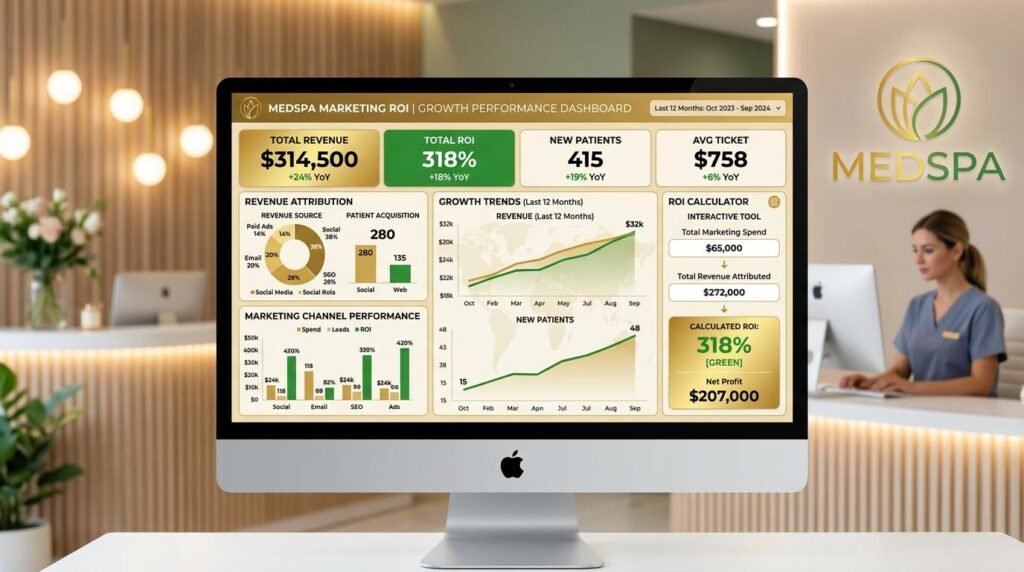
A properly configured marketing dashboard consolidates data from all channels into a single view, enabling real-time budget decisions. Practices with centralized dashboards make marketing adjustments 3x faster than those relying on monthly reports [9].
Your med spa marketing dashboard should integrate data from five core sources into one unified view:
- Website Analytics (Google Analytics 4): Traffic sources, conversion events, user journeys
- Call Tracking (CallRail, CallTrackingMetrics): Call volume, source attribution, call outcomes
- Paid Media Platforms (Google Ads, Meta Ads): Spend, impressions, clicks, conversions, cost per result
- Search Performance (Google Search Console, Semrush): Keyword rankings, organic clicks, visibility trends
- Practice Management System (Zenoti, AestheticsPro): New patients, revenue by source, treatment counts
Google Looker Studio (formerly Data Studio) offers the best free solution for med spas, connecting directly to all major platforms. For practices wanting more sophisticated visualization, Tableau and Power BI provide deeper analytics capabilities.
The dashboard should display these essential metrics at minimum: total marketing spend, new patient acquisitions by channel, cost per acquisition by channel, consultation booking rate, show rate, close rate, revenue attributed to marketing, and overall marketing ROI.
“Speed of insight determines speed of optimization,” says Wil Reynolds, Founder at Seer Interactive. “If you’re waiting for a monthly report to adjust your marketing, you’re leaving money on the table. Real-time dashboards let you spot a campaign going off-track on Tuesday and fix it by Wednesday — not discover it in a report three weeks later.”
MedSpa SEO Agency builds custom Looker Studio dashboards for every client, pulling data from GA4, Google Search Console, Semrush, call tracking platforms, and practice management systems. These dashboards update daily and are accessible on mobile — giving practice owners visibility into their 276% average traffic increase and 189% consultation growth in real time, not just at month-end.
Frequently Asked Questions
What is a good marketing ROI for a med spa?
A good marketing ROI for med spas is 4:1 to 10:1 — meaning $4 to $10 in revenue for every $1 spent on marketing [8]. Higher-margin practices (those offering premium treatments like Morpheus8, CoolSculpting, or comprehensive treatment packages) should target 5:1 or above. MedSpa SEO Agency clients see up to 10x ROI when proper tracking is implemented alongside our SEO and paid media strategies. The key is tracking actual revenue attributed to marketing, not just leads or consultations.
How do I track which marketing channel brings in the most patients?
Implement multi-touch attribution using a combination of UTM parameters on all campaign URLs, unique call tracking numbers per channel, source-tagged form submissions, and CRM integration that connects marketing source to patient records [6]. Google Analytics 4 with data-driven attribution provides the most accurate channel crediting for practices with sufficient conversion volume. Call tracking is essential since 60-70% of med spa inquiries come by phone.
What is LTV:CAC ratio and why does it matter for med spas?
LTV:CAC (Lifetime Value to Customer Acquisition Cost) measures how much patient revenue you generate for every dollar spent acquiring them. For med spas, this ratio should be 3:1 or higher [8]. It matters because aesthetic patients have high lifetime value — returning for maintenance Botox every 3-4 months, upgrading to premium treatments, and referring others. A healthy ratio ensures your marketing is profitable not just on first visit, but over the full patient relationship.
How does call tracking improve marketing attribution?
Call tracking improves marketing attribution accuracy by 60% by assigning unique phone numbers to each marketing channel [6]. When a patient calls, you know exactly which Google Ads campaign, SEO landing page, Instagram ad, or organic search query generated the inquiry. Without call tracking, practices miss attribution for their highest-intent leads — the patients who pick up the phone rather than filling out a form.
What attribution model works best for medical aesthetics?
Position-based (40/20/40) attribution works best for most med spas — assigning 40% credit to first touch, 40% to last touch, and 20% to middle interactions [5]. This balances the discovery channels (Instagram, TikTok, unbranded SEO) that introduce patients to your practice with the conversion channels (branded search, direct website visits) that close the booking. For high-volume practices (300+ monthly conversions), Google Analytics 4’s data-driven attribution provides the most accurate modeling.
How long does it take to see ROI from med spa marketing?
SEO typically shows measurable ROI within 3-6 months, with compounding returns thereafter. Paid media (Google Ads, Meta Ads) can generate positive ROI within 30-60 days when properly optimized. The full patient journey including LTV realization takes 12-18 months to accurately measure [2]. Practices should evaluate channel performance on appropriate timelines — not pull SEO investment at 60 days or judge paid media solely on first-visit revenue.
How can MedSpa SEO Agency help me measure marketing ROI?
MedSpa SEO Agency provides HIPAA-compliant marketing tracking implementation, including Google Analytics 4 configuration, call tracking setup, CRM integration, and custom ROI dashboards. Our data-certified team (Google Analytics & Search certified, Semrush-certified) builds attribution models tailored to your practice’s patient journey. Every client receives a real-time Looker Studio dashboard and monthly ROI analysis. Schedule your free 24-hour audit to discover your current tracking gaps and projected ROI potential.
Conclusion
Measuring med spa marketing ROI isn’t optional — it’s the difference between scaling profitably and burning budget on underperforming channels. The 76% of practices that don’t track ROI effectively are making million-dollar decisions in the dark [1]. By implementing the KPI framework, multi-touch attribution, call tracking, CRM integration, and LTV:CAC analysis outlined in this guide, you transform marketing from a cost center into a predictable revenue engine.
The practices winning in today’s $26.2 billion aesthetics market share one trait: they know exactly what drives revenue and systematically invest more in it [2]. Whether you’re spending $749 or $5,000+ monthly on marketing, measurement infrastructure delivers the highest return of any investment you can make.
At MedSpa SEO Agency — the only 100% med spa focused SEO agency — we build HIPAA-compliant measurement systems that connect marketing spend to actual revenue. Our clients see up to 10x marketing ROI, supported by our documented 276% average traffic increase and 189% consultation growth. Get started with our free 24-hour audit to discover where your revenue is really coming from.
