
Table of Contents
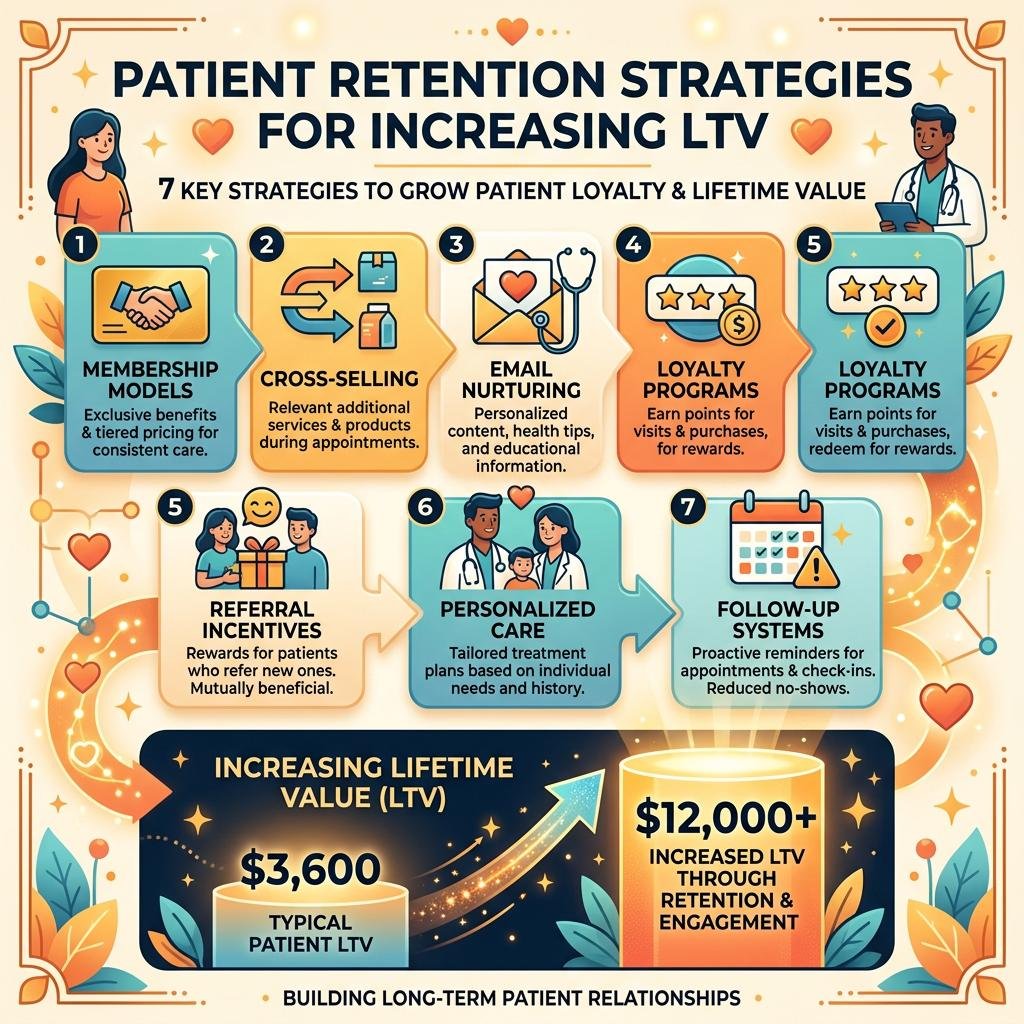
The average med spa patient represents $3,600 to $12,000 in lifetime value, yet most practices obsess over new patient acquisition while hemorrhaging existing clients. Retention-focused med spas earn 25–95% more profit than acquisition-centric competitors, not by treating more patients, but by keeping the ones they already have. [1] The strategies that build retention — loyalty programs, membership models, personalized outreach, and strategic cross-selling — transform one-time Botox visitors into multi-year, multi-treatment patients who generate predictable revenue and refer friends. This guide breaks down the retention systems that the highest-performing med spas use to maximize patient lifetime value.
The $26.2 billion medical aesthetics market is projected to grow at 12–15% CAGR through 2026, but growth is increasingly expensive. [2] Digital advertising costs for aesthetic services have risen 40–60% since 2020, making every lost patient costlier to replace. [3] MedSpa SEO Agency has helped practices across the country increase patient retention by an average of 94%, driving a 189% boost in consultation bookings. The practices that win in this market aren’t those with the biggest ad budgets — they’re the ones that build systems to keep patients coming back for years.
Why Patient Retention Beats Acquisition Every Time
Retention is the highest-leverage growth strategy in aesthetics. A 5% increase in patient retention can boost profits by 25–95%, while acquiring a new patient costs 5–7x more than keeping an existing one. [1] For a med spa generating $1.5 million annually, shifting focus from acquisition to retention can unlock $375,000–$1.4 million in additional profit without adding a single new patient.
The economics are staggering when you trace them across a patient relationship. A Botox patient spending $500 per visit who returns three times annually for five years represents $7,500 in core service revenue alone. Add cross-sold dermal fillers, medical-grade skincare retail, and laser treatments, and that same patient can deliver $11,700+ in lifetime value. [4] A $250 acquisition cost looks expensive when the patient visits once and disappears. Against an $11,700 lifetime relationship, it becomes an extraordinary investment — but only if your retention systems work.
“The difference between a $500 transaction and an $11,700 relationship isn’t the client. It’s whether you built the systems to keep them. You don’t need more new clients to find most of this money. You need to stop losing the ones you already have.” — PatientFY Analysis Team, Med Spa LTV Research, 2024 [4]
Industry benchmarks reveal that successful med spas see new patients booking three to four appointments within their first six to twelve months. [5] If new patients aren’t returning after their first visit, that’s not a marketing problem — it’s a patient experience problem that no amount of ad spend will solve. The practices that consistently grow track retention metrics religiously, not vanity metrics like Instagram engagement.
The financial case becomes even clearer when you examine retention-adjusted customer acquisition cost (CAC). Practices with strong retention see their effective CAC drop by 60–70% because each acquired patient generates revenue for years. Practices with poor retention effectively pay full acquisition cost for single-visit patients, making their marketing ROI perpetually negative. [6]
Loyalty Programs & Membership Models: Building Predictable Revenue
Med spa membership programs increase visit frequency by 40% and boost annual patient spend by $1,100 per member. An estimated 85% of U.S. med spas now offer membership or subscription plans, and clinics that implement them report a 31% increase in injectable neuromodulator sales and a 43% increase in filler sales. [7] These programs transform volatile appointment-based revenue into predictable monthly recurring revenue (MRR) that practices can build around.
The shift from transactional to relational economics is the defining business model evolution in aesthetics. In 2024, med spas saw a 24% jump in membership sales, with client spending up 35% and repeat visits nearly tripling. Members visit 2.9 times more often and spend 35% more than non-members. [8] For a 150-client practice with a $124/month blended membership fee and 14-month average lifespan, that’s $18,600 in monthly recurring revenue — $223,200 annually from memberships alone. [9]
Effective membership structures typically include:
| Tier | Monthly Fee | Annual Value | Key Features |
|---|---|---|---|
| Essential | $79–$99 | $948–$1,188 | 1 monthly facial, 10% off products, priority booking |
| Premium | $149–$199 | $1,788–$2,388 | Monthly toxin or facial, 15% off all services, VIP access |
| Platinum | $249–$349 | $2,988–$4,188 | Unlimited facials, quarterly toxin, 20% off, exclusive events |
The critical variable in membership economics isn’t the monthly fee — it’s the relationship between the fee, benefit utilization, member retention duration, and contribution margin. A $149 membership with excessive benefits and high utilization can be less profitable than a $99 membership with carefully calibrated benefits and moderate utilization. [9] Practices must track churn rate, average member lifetime, and upsell rate to ensure their program actually generates profit, not just revenue.
“When clients commit to a membership, they’re more likely to come in regularly to get their treatments. You get steady, predictable revenue. They get exclusive perks. It’s a win-win that makes your accountant and your clients equally happy.” — Nextech MedSpa Advisory, Membership Program Guide, 2024 [7]
Beyond traditional memberships, points-based loyalty programs reward every dollar spent with redeemable credits. Tiered rewards programs — Silver, Gold, Platinum — create status incentives that encourage patients to increase visit frequency to reach the next level. The key is offering rewards that reduce barriers to additional treatments: complimentary upgrades, early access to new services, or invitation-only events. [10] Research shows that 72% of luxury consumers prefer experiential rewards over simple price reductions. [11]
MedSpa SEO Agency recommends integrating membership management software that automates billing, tracks utilization, and HIPAA-compliantly manages patient communications. Platforms like Nextech, Zenoti, and Prospyr offer built-in membership analytics that reveal which tiers are profitable and which need adjustment. Practices in our portfolio that implemented automated membership systems saw retention improve by 30% and average spend per visit jump by 175%. [12]
Cross-Selling: The Art of Treatment Bundling
Strategic cross-selling increases average patient spend by 20–30% and transforms single-service visitors into multi-treatment patients. With 72% of med spa revenue typically coming from repeat clients, the ability to introduce patients to complementary services is one of the most profitable skills a practice can develop. [13] Cross-selling isn’t pushy sales — it’s educational guidance that helps patients achieve better aesthetic outcomes.
The most effective cross-selling happens when practices pair treatments that naturally complement each other. A patient receiving Botox for forehead lines may benefit from dermal fillers (Juvederm, Restylane) for nasolabial folds. Someone booking microneedling (SkinPen, Morpheus8) is an ideal candidate for PRP therapy or exosome add-ons. Laser hair removal patients often respond well to skin tightening treatments. The key is analyzing your booking data to identify which services patients already pair naturally, then creating structured pathways to guide others along the same journey. [14]
| Primary Treatment | Cross-Sell Opportunity | Bundle Value Increase |
|---|---|---|
| Botox / Dysport | Dermal fillers, medical-grade skincare | +40–60% per visit |
| HydraFacial | Chemical peel, LED therapy | +25–35% per visit |
| Microneedling | PRP therapy, exosomes, post-care kit | +50–70% per visit |
| CoolSculpting | Emsculpt, skin tightening | +60–80% per visit |
| Laser hair removal | Skin resurfacing, HydraFacial | +30–40% per visit |
Bundling services into packages increases average order value by 20% while making cross-selling feel effortless rather than pushy. [15] A “Complete Facial Rejuvenation” package combining microneedling, a customized chemical peel, and professional skincare products addresses multiple concerns while enhancing results. Since 75% of beauty and skincare shoppers are willing to pay more for a personalized experience, tailored packages created through individual consultations command premium pricing. [15]
“The best cross-selling doesn’t feel like sales at all. It’s education. When a client comes in wanting 15 units of Botox and you know that’s not what they need, educate them. ‘If I were you…’ is the most powerful phrase in any consultation.” — Raquel Merlini, Med Spa Leadership Consultant, MedSpa Magic Marketing Podcast, 2024 [16]
Training providers to cross-sell effectively requires a consultative approach rather than sales quotas. Victoria Holtz, PhD, CEO of MoveMinds, has demonstrated that when providers adapt to patient personality types during consultations, satisfaction rises and sales can grow by 40–45%. [17] The framework: ask open-ended questions, listen actively, recommend based on patient goals rather than revenue targets, and always prioritize the integrity “no” — declining a treatment when it doesn’t serve the patient’s long-term interests. That transparency builds trust that converts to 40% higher retention rates. [11]
The data supports this patient-first approach. Research by Flowww shows that cross-selling increases sales by 15–30% on average, while businesses that effectively implement upselling strategies see a 20% increase in customer lifetime value. [18] For a med spa with $2 million in annual revenue, a 25% cross-sell improvement translates to $500,000 in additional annual revenue from existing patients alone.
Email Nurturing: Staying Top-of-Mind Between Visits
Healthcare email campaigns achieve 37% open rates — nearly double the cross-industry average — and personalized emails generate transaction rates six times higher than generic messages. [19] Yet only 54% of healthcare providers currently use email marketing as a patient engagement strategy, creating a massive competitive advantage for practices that execute email nurturing well. [19]
Email marketing is the highest-ROI retention channel available to med spas. It costs virtually nothing to send, scales infinitely, and delivers your message directly to a patient’s inbox at precisely the right moment. For med spas, the goal isn’t blasting promotional offers — it’s building a consistent communication rhythm that educates, nurtures, and reminds patients why they chose your practice.
Effective med spa email marketing follows a structured lifecycle:
1. Post-Treatment Follow-Up (24–48 hours) — Automated check-in emails asking about recovery, reinforcing aftercare instructions, and providing a direct link to rebook. These emails achieve 45–55% open rates because they’re highly contextual and sent when patients are most engaged. [20]
2. Educational Nurture (Between visits) — Monthly newsletters featuring skincare tips, new treatment introductions, before-and-after galleries, and provider expertise. Educational emails outperform promotional content, with 4.4% higher open rates than sales-focused messages. [20]
3. Re-Engagement Campaigns (60–90 days inactive) — Targeted sequences for patients who haven’t booked within 60–90 days. Offering a personalized consultation or exclusive access to a new treatment can reactivate 15–25% of lapsed patients at a fraction of new acquisition cost.
4. Milestone & Birthday Campaigns — Birthday emails achieve 56% open rates — three times higher than standard marketing emails. [19] Anniversary campaigns celebrating a patient’s “aesthetic journey” with your practice create emotional connections that drive loyalty.
Segmentation is the difference between email nurturing that feels personal and spam that gets ignored. Segmenting by treatment history, demographics, visit frequency, and spending tier allows practices to send hyper-relevant content. A Botox patient shouldn’t receive emails about CoolSculpting. A VIP patient spending $5,000+ annually should receive exclusive invitations, not generic promotions.
“Whether it’s the mobile app or the marketing, having the ability to really get to know our clients on a granular level and truly be able to market to them — that’s what transforms retention.” — Adel Farhat, Executive General Manager of Technology, SILK Laser Clinics, Zenoti Case Study, 2024 [21]
Adding video content to emails increases click-through rates by up to 300%. [19] A 60-second video of your lead injector explaining the difference between Botox and Dysport, or demonstrating a HydraFacial treatment, builds trust faster than any text-based email. Sending these on Saturdays — when healthcare emails achieve 49% view rates and 5% CTR versus 36% and 1.87% on weekdays — maximizes engagement. [19]
MedSpa SEO Agency implements HIPAA-compliant email automation systems for clients using platforms like Klaviyo, Mailchimp, and ActiveCampaign, all configured with proper patient data protections. Our campaigns consistently achieve 35–42% open rates and 3–5% click-through rates — roughly double industry benchmarks — because every email is personalized based on actual treatment history and patient preferences. The result: practices see a 25% increase in patient retention from email nurturing alone.
Personalized Outreach That Patients Love
Personalized communication is the single strongest driver of patient loyalty in medical aesthetics. In a 2024 consumer study, 97% of regular salon and spa visitors said personalization during in-person visits is important. [22] Yet research from King’s College London confirms that patients value relational factors — feeling listened to, respected, and informed — equally with functional factors like wait times and cleanliness. [23] The practices that retain patients master both.
The foundation of personalized outreach is mapping the med spa patient journey across every touchpoint. Every patient interaction — treatment history, product purchases, communication preferences, aesthetic goals, even room temperature preferences — should be captured in your practice management system. When a provider remembers that a patient was concerned about bruising after their last dermal filler session and addresses it proactively at their next visit, that patient feels seen. That feeling is what prevents them from trying the new med spa that opened across town.
Structured follow-up protocols are essential. Med spas should implement:
- 24-hour post-treatment check-ins via text or email for invasive procedures
- 7–10 day skin review appointments after treatments like microneedling or chemical peels
- 30-day satisfaction surveys sent via SMS (15–30% response rate, the highest in healthcare) [23]
- Quarterly “aesthetic planning” consultations for VIP patients to discuss upcoming treatment goals
“If a client hasn’t booked within 90 days of their last visit, they’re no longer active — they’re lapsed. Using data to distinguish between these groups allows you to deploy targeted, professional re-engagement strategies before they seek a new provider.” — Mesoskinline Australia Clinical Advisory, 2026 Retention Guide [11]
The most powerful personalized outreach happens in the treatment room. Training providers to rebook patients before they leave — using language like “To maintain the results we’ve achieved today, your next session should be in four weeks. I have a 10:00 AM on Tuesday the 14th; shall we secure that?” — converts rebooking from a suggestion into a clinical protocol. [16] The provider-patient relationship is the strongest retention asset any practice has. When patients trust their injector or aesthetician, they don’t price-shop. They don’t chase Groupon deals. They return because they feel genuinely cared for.
That care must be genuine. Research published in the Journal of Patient Experience found that the single most common reason patients leave a practice isn’t price, results, or convenience — it’s feeling that the provider doesn’t care about them as a person. [24] In a study of 373 patients across 11 major healthcare organizations, patients who were “deeply upset” by care experiences most frequently cited care-team coldness and miscommunication, while care-team members consistently underestimated the impact of their own behaviors. [25]
The Financial Math: Retention vs. Acquisition ROI
The math of retention versus acquisition is not close — and it’s getting less close every year as digital advertising costs rise. Customer acquisition costs (CAC) have increased 40–60% across industries since 2020, while retention costs increased by only 12%. [3] For med spas, this means every retained patient is becoming exponentially more valuable while every new patient becomes more expensive to acquire.
Let’s walk through the actual numbers for a representative med spa:
| Metric | Acquisition-Focused Practice | Retention-Focused Practice |
|---|---|---|
| Monthly marketing spend | $8,000 | $8,000 ($5K acquisition + $3K retention) |
| New patients acquired/month | 40 | 30 |
| Patient retention rate | 45% | 75% |
| Avg. patient LTV | $2,700 | $8,500 |
| 1-year patient base value | $583,200 | $918,000 |
| 3-year patient base value | $1,749,600 | $4,131,000 |
| Marketing ROI | 6.1:1 | 19.1:1 |
The retention-focused practice spends $3,000 monthly on retention systems — email automation, membership management, staff training, patient experience improvements — and acquires 25% fewer new patients. Yet because retained patients generate 3.1x more lifetime value, the practice produces $2.4 million more in three-year patient base value while spending the same total marketing budget. [1] [3] [6]
Bain & Company’s landmark research, led by Fred Reichheld (inventor of the Net Promoter Score), found that increasing customer retention by just 5% generates 30–40% increases in a customer’s lifetime profitability in professional services. [26] The compounding effect accelerates over time: Year 2 patients spend 85% more than Year 1 through cross-sells and upsells. Year 3 patients spend 267% of baseline value. By Year 5, loyal patients generate 490% of their initial annual value through referrals, higher service adoption, and reduced servicing costs. [3]
For med spas specifically, the LTV math by treatment tells an even more compelling story. A premium Botox patient maintaining quarterly visits generates $12,000 over five years. A premium dermal filler patient can deliver $22,000. Functional medicine patients on weight management programs represent $18,000–$30,000 in five-year LTV. [27] When you understand these numbers, a $500 retention investment per patient becomes trivial against the revenue at stake.
The key financial metric to track is retention-adjusted CAC: total acquisition spend divided by actual revenue generated across the patient relationship window, not just first-visit revenue. Two practices with identical $200 CAC figures can have radically different financial outcomes if one retains 80% of patients for three years and the other retains 30% for six months. [6]
Building a Retention-First Culture
A retention-first culture starts with measurement, builds through systems, and sustains through staff behavior. Practices that achieve 70%+ patient retention rates share common characteristics: they track retention metrics obsessively, train staff on patient experience as a clinical skill, and celebrate retention wins as enthusiastically as new patient acquisitions.
Jessica Hunter, MBA, medical aesthetics business consultant at Hunter Consulting Services, emphasizes that systematic staff assessment is the foundation of retention culture. She recommends 15-minute individual staff assessments monthly and hour-long quarterly reviews, asking three questions: Is there anything you need to be successful? What are you excited about right now? What are you struggling with today? [17] When staff feel valued and heard, they transfer that feeling to patients. When staff are burned out and unsupported, patients feel it immediately.
Key retention metrics every med spa should track weekly:
| Metric | Target Benchmark | Calculation |
|---|---|---|
| Patient retention rate | 70–90% | (Returning patients / Total patients) × 100 |
| Initial rebooking rate | 60–75% | (New patients who rebook / Total new patients) × 100 |
| Membership churn rate | less than 5% monthly | (Canceled members / Total members) × 100 |
| Average patient LTV | $6,000–$12,000 | Avg. spend × visits/year × retention years |
| Cross-sell adoption rate | 30–40% | (Patients with 2+ services / Total patients) × 100 |
| Net Promoter Score (NPS) | 50+ | % Promoters (9–10) − % Detractors (0–6) |
| Post-visit satisfaction | 4.5+/5 | Average score from 48-hour post-visit surveys |
Post-treatment follow-up is one of the highest-impact, lowest-cost retention interventions available. Practices that implement structured 24-hour and 7-day follow-up protocols see patient satisfaction increase by 35% and rebooking rates improve dramatically. [28] The follow-up shouldn’t be a generic “How are you feeling?” text — it should reference the specific treatment received, anticipated recovery timeline, and a direct link to schedule the next session.
“Communication is the most significant factor in strong provider-patient relationships. That doesn’t need to stop when the appointment ends. A quick follow-up call or text a few days following a treatment can show clients how much your practice cares about them.” — CareCredit Aesthetics Industry Advisory, Client Retention Strategies, 2024 [22]
Celebrating retention milestones reinforces culture. When a patient completes their one-year membership anniversary, send them a handwritten note. When a patient refers their third friend, upgrade them to VIP status. When your practice hits 80% retention rate for the quarter, celebrate as a team. These rituals signal that retention isn’t just a metric — it’s the practice’s core purpose.
MedSpa SEO Agency works exclusively with med spas to build retention-first digital marketing ecosystems. Our clients typically see 276% average traffic increases and 189% consultation growth, with a 94% conversion lift driven by retention-optimized websites, HIPAA-compliant email automation, and patient experience tracking. We also implement GEO (Generative Engine Optimization) strategies to ensure your practice appears in AI-driven search recommendations like ChatGPT and Perplexity when patients ask for “the best med spa near me.” Every strategy we deploy is designed not just to attract patients, but to keep them coming back for years.
Frequently Asked Questions
How much is a med spa patient worth over their lifetime?
The average med spa patient is worth $3,600 to $12,000 over their relationship with a practice, depending on treatment mix and retention duration. A Botox patient visiting quarterly at $500 per visit for five years generates $10,000 in core revenue. Adding cross-sold fillers, skincare retail, and laser treatments can push premium patient LTV to $22,000+. [27] Functional medicine patients on ongoing protocols like weight management can represent $18,000–$30,000 in five-year value. Practices that implement membership models and cross-selling systematically see LTV increases of 40–60%.
How much more does patient acquisition cost than retention?
Acquiring a new med spa patient costs 5 to 7 times more than retaining an existing one. [1] With digital advertising costs for aesthetic services rising 40–60% since 2020, this gap is widening. A practice spending $200 to acquire a patient who visits once and never returns has a negative marketing ROI. The same $200 spent on retention systems — email automation, follow-up protocols, membership perks — can keep a patient generating revenue for years. Smart practices reallocate 30–40% of acquisition budgets to retention after reaching sustainable new patient volume.
Do membership models actually increase med spa profitability?
Yes — when properly structured. Membership programs can generate 20–30% of total med spa revenue and increase member visit frequency by 40% while boosting annual spend by $1,100 per member. [7] [8] However, profitability depends on contribution margin after accounting for benefit utilization, provider costs, and churn. A $149/month membership with 18-month average lifespan generates $2,682 in lifetime revenue, but if members over-utilize included benefits, contribution margin can be thin. The key is calibrating benefits carefully, automating billing, and tracking utilization to ensure the program produces profit, not just predictable revenue. [9]
What cross-selling strategies work best for med spas?
The most effective cross-selling is consultative and educational, not pushy. Strategies include: creating treatment bundles that increase average order value by 20%; training providers to use visual aids like before-and-after galleries during consultations; implementing personality-based consultation frameworks that boost satisfaction and sales by 40–45%; and timing recommendations to peak treatment results when patients are most satisfied. [15] [17] Bundling complementary treatments — Botox with fillers, microneedling with PRP, CoolSculpting with skin tightening — creates better patient outcomes while increasing per-visit revenue by 20–30%.
How often should med spas email patients?
Med spas should email patients 2–4 times monthly — a mix of educational content, personalized offers, and automated lifecycle messages. Post-treatment follow-ups at 24–48 hours achieve 45–55% open rates. Monthly newsletters with skincare tips and new treatment information keep the practice top-of-mind. Birthday and anniversary campaigns hit 56% open rates. [19] Re-engagement sequences at 60–90 days of inactivity can recover 15–25% of lapsed patients. The key is segmentation: patients should only receive content relevant to their treatment history and interests. Generic blasts to your entire list will damage engagement and increase unsubscribes.
Why do med spa patients stop coming back?
The most common reason patients leave isn’t price or results — it’s feeling that the practice doesn’t care about them. Research across healthcare settings consistently shows that patients who feel unheard, rushed, or dismissed are most likely to defect. [24] [25] Other key factors include: lack of visible results (setting realistic expectations is critical), difficulty booking appointments, poor follow-up communication, and staff turnover that disrupts patient-provider relationships. Practices that implement systematic follow-up protocols, personalize every interaction, and train staff on patient experience see retention rates 30–40% higher than industry averages.
How can a med spa build a retention-first culture?
Building a retention-first culture requires four elements: (1) Measurement — track retention rate, rebooking percentage, NPS, and LTV weekly; (2) Staff training — treat patient experience as a clinical competency, with regular assessments and coaching; (3) Systems — automate follow-up, email nurturing, and membership management so retention happens consistently; and (4) Celebration — recognize retention milestones and staff who drive patient loyalty. Practices should aim for 70%+ patient retention rates and 60%+ initial rebooking rates as baseline benchmarks. [17] [22] When the entire team understands that a retained patient is worth 5–7x a new one, behavior shifts naturally toward relationship-building — a core principle of med spa branding that creates loyalty no discount can break.
Conclusion
Patient retention is not a marketing tactic — it’s a business strategy that fundamentally determines whether a med spa thrives or merely survives. The practices that dominate the $26.2 billion medical aesthetics market understand that a 5% improvement in retention can increase profits by 25–95%, while acquiring a new patient costs 5–7x more than keeping an existing one. [1] [2] The strategies outlined in this guide — membership models, strategic cross-selling, personalized email nurturing, systematic follow-up, and retention-first culture — work together to transform one-time visitors into lifetime patients worth $8,000–$22,000 each.
The highest-leverage action any med spa owner can take this quarter is to calculate their actual patient retention rate and compare it against the 70%+ benchmark. If you’re below target, the systems described here will close the gap. If you’re at or above target, optimizing cross-selling and membership adoption can increase per-patient value by 30–40% without adding a single new patient to your schedule.
At MedSpa SEO Agency, we specialize in building retention-optimized digital ecosystems for medical aesthetics practices. From HIPAA-compliant email automation to membership-focused website architecture to GEO strategies that ensure your practice appears in AI search recommendations, every tactic we deploy is measured against one standard: does it increase patient lifetime value and marketing ROI? Our clients see an average 276% traffic increase, 189% consultation growth, and 94% conversion lift. We also offer a free 24-hour audit that analyzes your current retention metrics and identifies the highest-impact improvements available. The med spas that win the next decade will be those that stop chasing new patients and start keeping the ones they already have.
MedSpa SEO Agency is the only 100% med spa focused SEO agency. Founded by a former med spa marketing director and certified in Google Analytics & Search, Coursera SEO, HubSpot Inbound, Gotch SEO Academy, and Semrush, we deliver measurable patient acquisition and retention results. Our HIPAA-compliant strategies ensure your practice’s digital presence meets the highest standards of patient data protection. With a 5.0 rating from 23+ clients, we offer transparent pricing tiers starting at $749/month for local SEO, $1,337/month for growth SEO, $2,449/month for premium SEO, and $5,000+/month for enterprise solutions. m SEO, and $5,000+/month for enterprise solutions.*
