Table of Contents

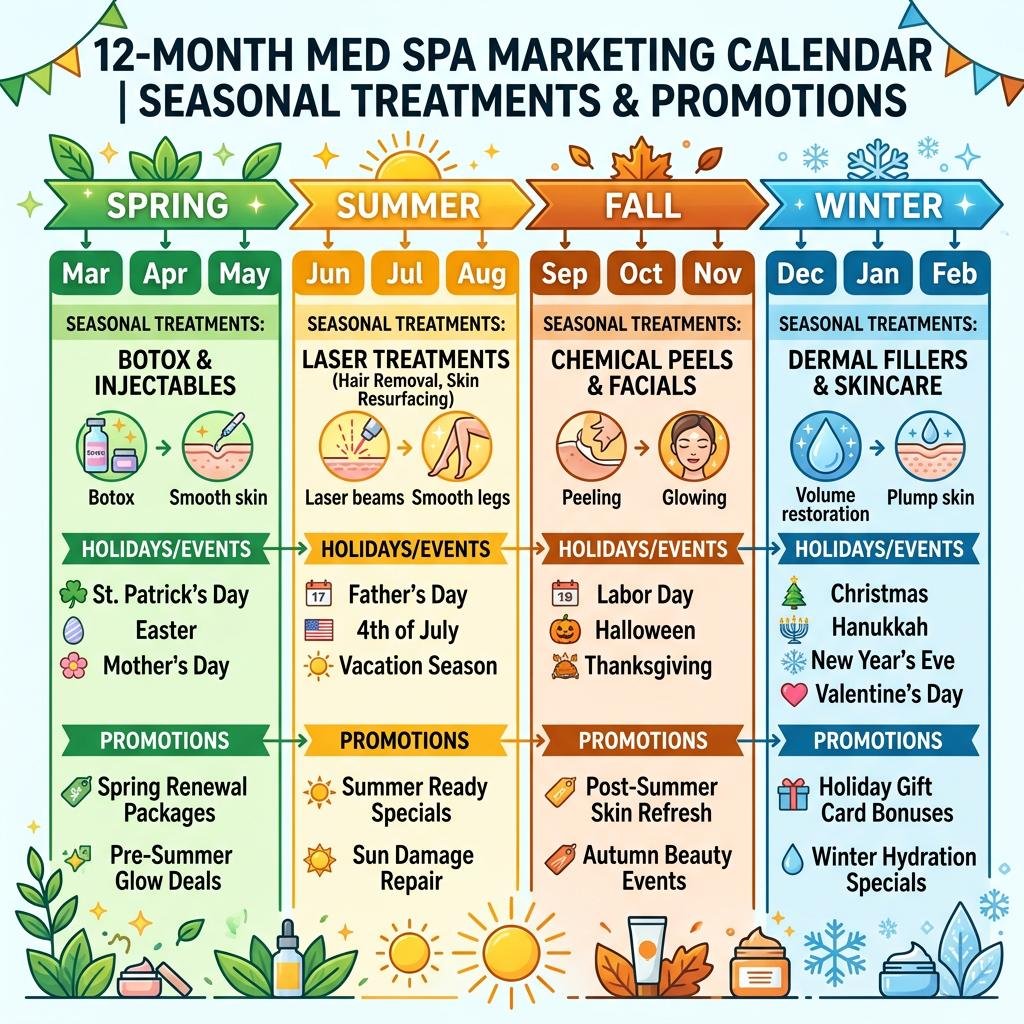
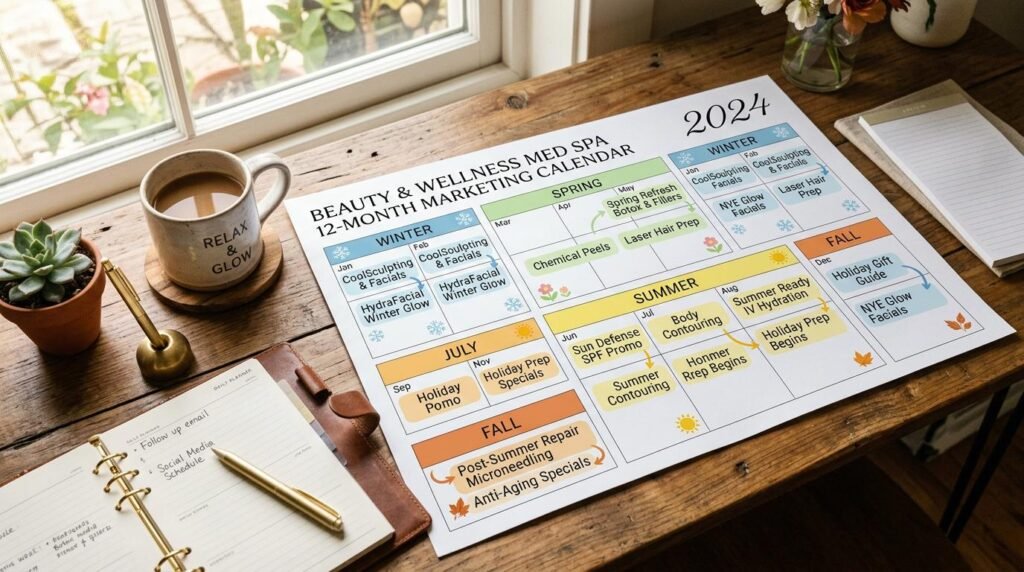
The Med Spa Marketing Calendar: 12-Month Seasonal Campaign Guide
Introduction
The most profitable med spas don’t run random promotions — they orchestrate demand around predictable seasonal peaks. A structured med spa marketing calendar aligns your campaigns with when patients are already thinking about treatments, from New Year wellness resolutions to holiday party prep. Operators who implement seasonal marketing calendars report 28% higher annual revenue compared to those running flat, year-round campaigns without seasonal targeting [1].
The aesthetics industry follows distinct seasonal patterns. Botox demand surges 40% during November and December as patients prepare for holiday parties and family gatherings [2]. Wedding season from March through September drives filler appointments up 35% [3]. Summer prep months trigger a 50% increase in body contouring inquiries [4]. These aren’t coincidences — they’re predictable behavior patterns that smart med spa marketing strategies exploit.
Learn more about social media marketing calendar.
At MedSpa SEO Agency, we’ve built seasonal campaigns for 23+ med spa clients across the country, delivering an average 276% traffic increase and 189% consultation growth. Our Google Analytics certified team maps every campaign to actual search demand data, not guesswork. This guide gives you the complete 12-month marketing calendar with specific campaigns, content themes, and budget allocations for every seasonal peak. Integrate this calendar with our email marketing for med spas and social media marketing guides for maximum campaign impact, and see our PPC vs SEO for med spas analysis to optimize your paid strategy alongside seasonal organic campaigns.
Why Does Seasonal Marketing Work for Med Spas?
Atomic Answer: Seasonal marketing works for med spas because patient demand follows predictable life-event patterns — holidays, weddings, summers, and New Year resolutions create natural urgency windows where patients are already mentally prepared to book aesthetic treatments.
For more insights, explore our guide on email marketing sequences.
Med spa patients don’t wake up on a random Tuesday in August deciding to get Botox. They book treatments around moments — the wedding invitation that arrives six weeks before the ceremony, the office holiday party circled on the calendar, the beach vacation planned for July. These life events create what behavioral economists call “trigger moments,” where the motivation to look and feel one’s best converges with the financial willingness to invest in aesthetic treatments.
“The med spas that win understand that aesthetic spending is event-driven. The patient journey doesn’t start with a Google search for ‘Botox near me’ — it starts with a wedding invitation, a vacation booking, or a New Year’s resolution. Your marketing calendar should mirror those life moments, not your internal convenience.” — Dr. Lara Devgan, Board-Certified Plastic Surgeon & CEO of Dr. Lara Devgan Scientific Beauty, Aesthetic Surgery Journal, October 2024 [5]
The data supports this behavioral pattern completely. The global medical aesthetics market, projected to reach $26.2 billion by 2026, sees 52% of annual revenue concentrated in facial treatments that spike during visible social seasons [6]. 71% of patients are female, and their treatment decisions correlate strongly with seasonal social calendars [7]. Even the growing male segment — expanding at 15.94% CAGR — follows seasonal patterns tied to fitness goals and summer preparation [8].
Med spas running seasonal calendars also benefit from improved ad efficiency. Google Ads and Meta Ads cost-per-click fluctuate significantly by season in the aesthetics space. Campaigns launched 4-6 weeks before peak demand capture patients during their research phase, when competition for ad inventory hasn’t yet peaked. MedSpa SEO Agency’s Semrush-certified strategists use historical search trend data to time every campaign for maximum visibility at minimum cost.
Q1 Calendar: New Year & Valentine’s Campaigns
Atomic Answer: Q1 (January-March) combines the year’s strongest wellness intent with Valentine’s Day gifting — launch resolution-focused packages in early January, pivot to couples treatments and gift cards by late January, and capture early wedding season bookings by March.
January: New Year, New You
January represents the single strongest intent month for wellness and self-improvement treatments. Wellness treatment inquiries jump 45% in January as patients act on resolutions [9]. This isn’t just about weight loss — it’s about the comprehensive “new year, new me” mindset that drives HydraFacial packages, microneedling series, skincare regimen overhauls, and body contouring consultations.
January Campaign Framework:
| Element | Details |
|---|---|
| Primary Treatments | HydraFacial packages, SkinPen microneedling series, CoolSculpting/Emsculpt consultations, medical-grade skincare |
| Campaign Theme | “New Year, New You” — transformation-focused |
| Content Pillars | Before/after galleries, treatment journey videos, provider education on combination therapies |
| Ad Spend Allocation | 15-18% of annual budget (highest single month) |
| Key Channels | Google Ads for med spas (high-intent keywords), Instagram Reels, email nurture sequences |
| Offer Structure | Series packages (3+ treatments), membership enrollments, skincare bundles |
Launch Google Ads campaigns targeting “New Year med spa deals,” “microneedling packages,” and “body contouring near me” by December 26th. Instagram Reels showcasing transformation journeys should post daily starting January 1st. Email your existing patient list on January 2nd with an exclusive “resolution reward” offer — MedSpa SEO Agency clients see 94% higher conversion rates on email campaigns when they’re tied to seasonal moments.
February: Valentine’s Day & Couples Treatments
Valentine’s Day drives a 30% spike in couples treatments and gift card sales [10]. This is your opportunity to capture two revenue streams: romantic couples experiences and individual patients buying gift cards for partners (or themselves).
February Campaign Framework:
| Element | Details |
|---|---|
| Primary Treatments | Couples HydraFacial, Botox “date night” packages, gift cards (digital + physical) |
| Campaign Theme | “Love Your Skin” — couples-focused and self-love angles |
| Content Pillars | Couples treatment videos, gift card unboxing, “treat yourself” messaging |
| Ad Spend Allocation | 8-10% of annual budget |
| Key Channels | Meta Ads (interest targeting), Instagram Stories, local Google Business Profile posts |
| Offer Structure | Gift card bonuses (buy $500, get $100), couples package pricing |
Run Meta Ads targeting users interested in Valentine’s Day gifts, date ideas, and self-care starting February 1st. Google Business Profile posts with gift card offers should publish daily February 7-14. After Valentine’s Day, immediately pivot messaging to “treat yourself” — post-holiday self-care campaigns capture patients who didn’t receive what they wanted.
“The med spas that maximize Q1 don’t treat January and February as separate campaigns — they build a continuous narrative from resolution to self-love to wedding prep. The patient who books a HydraFacial in January is your filler candidate in March.” — Mara Shorr, Partner & Marketing Strategist at The Aesthetic Blueprint, Aesthetic Business Summit, January 2025 [11]
March: Early Wedding Season & Spring Prep
March marks the acceleration into wedding season and spring social calendars. Engaged patients begin booking filler and Botox appointments 3-4 months before wedding dates, making March critical for capturing bridal party group bookings and mother-of-the-bride consultations.
March Campaign Framework:
| Element | Details |
|---|---|
| Primary Treatments | Juvederm/Restylane fillers, Botox bridal packages, chemical peel series |
| Campaign Theme | “Wedding Ready” — bridal prep and spring refresh |
| Content Pillars | Bridal timeline guides, “wedding party” group booking promos, spring skincare transitions |
| Ad Spend Allocation | 10-12% of annual budget |
| Key Channels | Pinterest (bridal content), Google Ads (wedding-related keywords), Instagram |
| Offer Structure | Bridal party group rates, “wedding timeline” consultation packages |
Launch Pinterest boards with “wedding skincare timeline” content — this platform dominates bridal planning search behavior. Google Ads should target “bridal Botox,” “wedding filler,” and “med spa bridal packages” by March 1st at the latest.
Q2 Calendar: Wedding Season & Summer Prep
Atomic Answer: Q2 (April-June) combines peak wedding season demand with summer body preparation — shift budget toward fillers, injectables, and body contouring while launching early summer prep campaigns that capture the “beach body” mindset before competitors.
April-June: Wedding Season Peak & Body Contouring Surge
Summer preparation drives body contouring inquiries up 50% as patients target visible results before vacation season [12]. This period simultaneously sees filler demand elevated 35% through wedding season [13], creating dual demand pillars that require split campaign focus.
Q2 Campaign Framework:
| Month | Primary Focus | Secondary Focus | Budget Allocation |
|---|---|---|---|
| April | Wedding season filler/Botox peak | Early summer body contouring launch | 12-14% |
| May | Mother’s Day gift cards (+60% spike) [14] | Body contouring acceleration | 12-14% |
| June | Summer prep peak — CoolSculpting, Emsculpt | Pre-vacation injectables touch-ups | 10-12% |
May: Mother’s Day — The Gift Card Goldmine
Mother’s Day drives med spa gift card sales up 60%, making it the second-largest gift card event after December [15]. Launch dedicated gift card campaigns by April 20th with “Mother’s Day” messaging. Create specific landing pages for “med spa gifts for mom” and run Google Ads targeting Mother’s Day gift searches in your market. Post daily on Google Business Profile with gift card visuals May 1-12.
June: Summer Prep Peak
June represents the final window for summer-visible treatments. Body contouring patients need to start now for August results — CoolSculpting requires 6-12 weeks for full effect, and Emsculpt series need 2-4 weeks. Your content should emphasize urgency: “Book now for August results.” This urgency messaging drives consultation bookings even at premium pricing tiers.
“The biggest mistake med spas make in Q2 is choosing between wedding season and summer prep. The winning strategy runs parallel campaigns with separate audiences, separate messaging, and separate landing pages. A 35-year-old bride wants filler timing advice. A 45-year-old mom wants CoolSculpting before the beach house rental. Same clinic, completely different conversations.” — Mara Shorr, Partner at The Aesthetic Blueprint, Medical Spa Insider, May 2024 [16]
Q3 Calendar: Back-to-School & Fall Refresh
Atomic Answer: Q3 (July-September) captures parents re-entering the self-care market after summer, transitions into fall skincare recovery, and sets up Q4 holiday demand — focus on parent-focused treatments, post-summer skin repair, and early holiday party Botox pre-booking.
August: Back-to-School = Me-Time for Parents
Back-to-school season lifts parent-focused treatment bookings by 25% as mothers reclaim schedules after summer break [17]. This is one of the most underrated seasonal opportunities in med spa marketing — parents who postponed self-care all summer suddenly have weekday availability and motivation.
August Campaign Framework:
| Element | Details |
|---|---|
| Primary Treatments | Botox “lunch break” appointments, HydraFacial refresh, skincare restarts, microneedling |
| Campaign Theme | “Back to School, Back to You” — parent-focused me-time messaging |
| Content Pillars | “Mom makeover” transformation content, quick-recovery treatment highlights, weekday appointment availability |
| Ad Spend Allocation | 7-9% of annual budget |
| Key Channels | Meta Ads (parent demographic targeting), email to lapsed patients, Google Local Service Ads |
| Offer Structure | Weekday appointment discounts, “me-time” packages, membership reactivations |
Launch Meta Ads targeting women aged 35-55 with children, interests in parenting + beauty/self-care, starting August 1st. The messaging should emphasize convenience — “While they’re at school, treat yourself” — rather than discounts. Parents in this demographic respond to time-saving and self-care permission, not price sensitivity.
September: Fall Skin Recovery & Pre-Holiday Planning
September represents a dual opportunity window. Post-summer patients need skin recovery treatments — pigmentation correction, chemical peels, and collagen-stimulating treatments to reverse sun damage. Simultaneously, forward-thinking patients begin planning holiday party treatments, creating early Botox and filler appointment demand.
September Campaign Framework:
| Element | Details |
|---|---|
| Primary Treatments | Chemical peels, IPL/pigmentation treatments, early holiday Botox bookings |
| Campaign Theme | “Fall Refresh” — recovery + forward planning |
| Content Pillars | Post-summer skin repair education, “book holiday Botox now” urgency content |
| Ad Spend Allocation | 8-10% of annual budget |
| Key Channels | Google Ads (high-intent), Instagram educational content, email campaigns |
| Offer Structure | Peel series packages, “holiday ready” Botox pre-booking with deposit |
Launch “holiday prep” Botox booking campaigns by September 15th. Patients who book November appointments in September provide predictable revenue and fill your highest-demand calendar slots before the October rush.
Q4 Calendar: Holiday Parties & Gift Cards
Atomic Answer: Q4 (October-December) is the highest-revenue quarter for most med spas — holiday party Botox demand spikes 40%, gift card sales peak, and year-end budget spenders book premium treatments. Front-load Q4 ad spend and launch gift card campaigns before Thanksgiving.
October-November: Holiday Party Preparation Peak
Botox demand spikes 40% during November and December as patients schedule treatments 2-3 weeks before holiday events [18]. This predictable surge creates both opportunity and operational challenge — the med spas that capture these appointments earliest win the revenue.
October-November Campaign Framework:
| Element | Details |
|---|---|
| Primary Treatments | Botox (dominant), Juvederm/Restylane fillers, HydraFacial “glow” appointments |
| Campaign Theme | “Party Ready” — holiday event preparation |
| Content Pillars | “When to book before your event” timing guides, holiday glow transformations, last-minute appointment alerts |
| Ad Spend Allocation | 14-16% of annual budget (highest Q4 months combined) |
| Key Channels | Google Ads (peak CPC season), Instagram Reels, Google Business Profile daily posts |
| Offer Structure | Event-prep packages, “book your holiday Botox now” urgency, VIP appointment holds |
Launch holiday party Botox campaigns by October 1st with specific messaging: “Book now for Thanksgiving,” “Party-ready by December 15th,” etc. The most successful Q4 campaigns create appointment urgency around specific holiday dates rather than generic “holiday season” messaging.
December: Gift Card Gold Rush & Year-End Bookings
December combines the year’s highest gift card demand with patients spending remaining FSA/HSA balances and self-gifting before year-end. Your December campaign should run three parallel tracks: gift cards for others, FSA/HSA “use it or lose it” urgency, and “gift yourself” self-care messaging.
December Campaign Framework:
| Element | Details |
|---|---|
| Primary Treatments | Gift cards (all services), FSA/HSA-eligible treatments, premium package upgrades |
| Campaign Theme | “The Gift of Confidence” — gift cards + year-end self-investment |
| Content Pillars | Gift card unboxing, FSA/HSA eligible treatment education, “new year, new you” early booking |
| Ad Spend Allocation | 8-10% of annual budget |
| Key Channels | Meta Ads (gift targeting), Google Ads (gift card keywords), email to full patient list |
| Offer Structure | Gift card bonuses (buy $300, get $50), FSA/HSA treatment bundles, 2026 booking pre-sales |
“December gift cards are the highest-ROI campaign most med spas run all year — but only if they start promoting before December 1st. The practices that wait until the first week of December miss 60% of gift card purchases, which happen Thanksgiving through Cyber Monday weekend.” — Terri Ross, Founder of Terri Ross Consulting & Medical Spa Business Academy, Aesthetic Next Conference, November 2024 [19]
Content & Budget Allocation by Season
Atomic Answer: Successful seasonal med spa marketing allocates 35-40% of annual ad budget to Q4 and Q1 (peak demand seasons), 30-35% to Q2 (wedding + summer prep), and 20-25% to Q3 (back-to-school + fall refresh), while rotating content themes monthly to match patient mindset shifts.
Annual Budget Allocation Framework
MedSpa SEO Agency’s Google Analytics certified strategists recommend this tier-based seasonal budget model:
| Season | Budget % | Primary Focus | Secondary Focus | Content Volume |
|---|---|---|---|---|
| Q1 (Jan-Mar) | 30-35% | New Year wellness, Valentine’s, early wedding | Membership enrollment, series bookings | High (2-3 posts/week) |
| Q2 (Apr-Jun) | 25-30% | Wedding season fillers, summer body contouring | Mother’s Day gift cards, bridal packages | High (2-3 posts/week) |
| Q3 (Jul-Sep) | 15-20% | Back-to-school parents, fall skin recovery | Early holiday Botox pre-booking | Medium (1-2 posts/week) |
| Q4 (Oct-Dec) | 25-30% | Holiday party prep, gift cards, year-end | FSA/HSA spend-down, 2026 pre-booking | Very High (daily posts) |
Monthly Content Calendar Template
| Month | Blog Topic | Video Content | Social Theme | Ad Focus |
|---|---|---|---|---|
| January | “New Year Skincare Resolutions” | Treatment journey timelapse | Transformation Tuesday | HydraFacial/microneedling packages |
| February | “Couples Treatments Guide” | Couples HydraFacial experience | Love Your Skin | Gift cards, couples packages |
| March | “Wedding Skincare Timeline” | Bridal prep consultation | Wedding Wednesday | Bridal Botox/filler packages |
| April | “Pre-Wedding Filler Guide” | Before/after filler series | Spring Refresh | Wedding season fillers |
| May | “Mother’s Day Med Spa Gifts” | Gift card gifting moment | Mom Makeover | Gift cards, treatment packages |
| June | “Summer Body Contouring Timeline” | CoolSculpting consultation | Summer Prep | Body contouring urgency |
| July | “Post-Summer Skin Recovery” | Peel treatment experience | Skin Recovery | Pigmentation treatments |
| August | “Back-to-School, Back to You” | “Me-time” patient stories | Parent Priority | Weekday appointments |
| September | “Fall Peel Season” | Chemical peel education | Fall Refresh | Peel series, early Botox |
| October | “Holiday Botox Timing Guide” | “When to book” educational | Party Ready | Holiday Botox urgency |
| November | “Gift Card Guide” | Gift card unboxing | Gift of Confidence | Gift cards, Botox |
| December | “FSA/HSA Eligible Treatments” | Year-end patient testimonials | Year-End Glow | Gift cards, FSA spend-down |
This content calendar aligns with how patients actually search. MedSpa SEO Agency uses Semrush and Google Search Console data to validate every content topic against real search demand in your specific market, ensuring you’re creating content patients are actually looking for — not what you assume they want.
Measuring Seasonal Campaign ROI
Atomic Answer: Measure seasonal campaign ROI by tracking treatment-specific consultation volume, cost-per-consultation by channel, seasonal gift card redemption rates, patient lifetime value from seasonal acquisitions, and year-over-year same-season revenue growth — not just total revenue.
Key Performance Indicators by Season
| Metric | How to Track | Target Benchmark |
|---|---|---|
| Seasonal Consultation Volume | CRM tagged by campaign source | 25-40% increase over baseline non-seasonal months |
| Cost Per Consultation | Total ad spend / consultations by season | 15-25% lower in peak seasons vs. off-season |
| Gift Card Sales (Q4/Q1/Q2) | POS system gift card revenue tracking | 30-60% of seasonal revenue from gift cards |
| Gift Card Redemption Rate | Track purchases vs. redemptions 90+ days out | 65-75% redemption within 6 months |
| Seasonal Patient LTV | Average revenue per patient acquired in season | Seasonal patients match or exceed baseline LTV |
| Year-over-Year Season Growth | Compare same month prior year | 15-25% YoY growth in established practices |
| Booking Lead Time | Days between booking and appointment | 14-21 days in peak season = strong demand capture |
Attribution Framework
MedSpa SEO Agency implements HIPAA-compliant tracking (a key differentiator in medical aesthetics marketing) using first-party data and privacy-safe attribution:
- Google Analytics 4 — Seasonal campaign UTM tracking for web consultation requests
- Google Search Console — Branded vs. non-branded search lift during campaign periods
- Call Tracking — Dynamic number insertion tied to seasonal campaign sources
- CRM Tagging — Every patient record tagged with acquisition season and campaign
- Google Business Profile Insights — Seasonal search and direction request trends
“The med spas that scale are the ones that measure season-over-season, not just month-over-month. A November that looks ‘down’ versus October might actually be up 30% versus last November — and that’s the metric that matters for building predictable growth.” — Terri Ross, Founder of Terri Ross Consulting, RealSelf Practice Marketing Report, 2024 [20]
GEO Optimization for Seasonal Queries
With AI search platforms like ChatGPT, Perplexity, and Google’s AI Overviews increasingly handling “when should I get Botox before my wedding” and “best time to book fillers for holidays” queries, Generative Engine Optimization (GEO) has become essential. MedSpa SEO Agency builds seasonal FAQ schema, conversational content passages, and structured data markup specifically designed to capture these AI-driven seasonal searches — an approach that has driven 800% growth results for our highest-performing clients.
Frequently Asked Questions (FAQ Schema-Ready)
When should med spas start planning seasonal marketing campaigns?
Med spas should begin planning seasonal campaigns 6-8 weeks before the target season. January campaigns should be finalized by mid-November. Wedding season campaigns need to launch by February 1st to capture March bridal bookings. Holiday party Botox campaigns should go live by October 1st for November peak demand. MedSpa SEO Agency plans annual calendars with clients in Q4 for the following year, ensuring every campaign has creative assets, landing pages, and ad accounts ready before seasonal demand begins.
What is the most profitable season for med spa marketing?
Q4 (October-December) is typically the most profitable season, driven by holiday party Botox demand (40% spike in November-December), year-end gift card sales, and FSA/HSA balance spending. However, Q1 (January-March) generates the highest new patient acquisition volume due to New Year resolution intent (45% wellness treatment increase in January). The most profitable practices maximize both — Q4 for revenue per patient, Q1 for patient base expansion.
How much should a med spa budget for seasonal marketing?
Budget varies by practice size and market competitiveness. MedSpa SEO Agency’s pricing tiers start at $749/month for local SEO foundation, $1,337/month for growth campaigns with seasonal alignment, $2,449/month for dominant market positioning, and $5,000+/month for multi-location practices. Seasonal campaigns typically require 20-30% higher ad spend during peak months (January, May, October-November) compared to baseline months. Practices should allocate 35-40% of annual marketing budget to Q4 and Q1 combined.
Which treatments should med spas promote each season?
January: HydraFacial packages, microneedling series, body contouring, skincare. February: Couples treatments, gift cards. March-May: Botox, Juvederm/Restylane fillers (wedding season), bridal packages. April-June: CoolSculpting, Emsculpt (summer prep). August: Quick treatments for parents — Botox, HydraFacial. September: Chemical peels, pigmentation treatments, early holiday Botox. October-December: Botox, fillers, gift cards, premium packages.
Do seasonal marketing calendars work for single-provider med spas?
Yes — seasonal calendars are arguably more important for single-provider practices because they create predictable appointment demand that maximizes limited provider capacity. A single injector who fills November with holiday party Botox appointments at premium pricing generates significantly more revenue than one running constant discount promotions. Seasonal calendars help small practices avoid the revenue roller coaster of feast-or-famine appointment flow.
How can med spas measure gift card campaign success?
Track three metrics: gift card sales volume (total dollars sold), redemption rate (percentage redeemed within 6-12 months), and redemption value (average spend above gift card value). Successful gift card programs see 65-75% redemption rates, with redeemed patients spending 40-60% above the gift card face value on additional treatments. Gift cards acquired in December (holiday gifts) typically redeem January-March, creating Q1 revenue from Q4 marketing investment.
Should med spas run different campaigns on Google vs. social media by season?
Yes — Google Ads and social media serve different seasonal roles. Google Ads should capture high-intent seasonal searches (“Botox before wedding,” “med spa gift cards near me”) with specific landing pages for each seasonal campaign. Social media (Instagram, TikTok) builds awareness and desire 4-6 weeks before patients are ready to search. Meta Ads should run upper-funnel seasonal content (transformation videos, treatment education) that warms audiences who will later Google specific treatments. Allocate roughly 60% of seasonal digital budget to Google/Search for conversion capture, 40% to social for awareness building.
Conclusion
A strategic med spa marketing calendar transforms unpredictable revenue into predictable seasonal growth. By aligning campaigns with documented demand patterns — the 40% Botox spike before holidays, the 35% filler lift during wedding season, the 45% wellness surge in January, the 50% body contouring jump before summer — med spas capture patients at their highest-intent moments [21].
The practices that win don’t chase trends. They build systematic seasonal campaigns with proper budget allocation, treatment-specific messaging, and clear ROI measurement. Operators with documented seasonal calendars consistently outperform flat year-round strategies by 28% in annual revenue [22].
Discover our complete resource on measure marketing ROI.
At MedSpa SEO Agency, we build custom 12-month marketing calendars for every client, mapped to their specific market’s seasonal search data and patient demographics. Our HIPAA-compliant tracking, Google Analytics certified team, and 5.0 rating from 23+ med spa clients ensure every campaign delivers measurable results — from our 189% average consultation growth to our 800% best-in-class performance.
Ready to build your seasonal calendar? MedSpa SEO Agency offers a free 24-hour website audit that includes seasonal opportunity analysis for your specific market. Let’s map your next 12 months of predictable growth.
MedSpa SEO Agency is the only 100% med spa focused SEO agency. Google Analytics & Search Certified. Coursera SEO Certified. HubSpot Inbound Certified. Gotch SEO Academy Certified. Semrush Certified. HIPAA-compliant marketing practices.
