Table of Contents

Understanding the Med Spa Patient Journey: From Search to Treatment
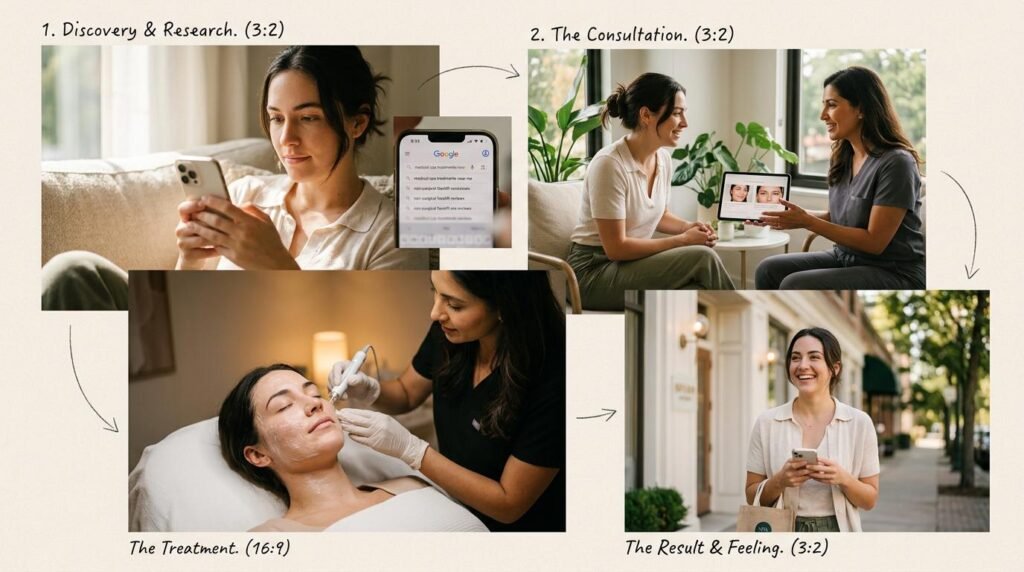
The med spa patient journey is no longer a linear path from discovery to treatment. Today’s aesthetic patients move through a complex web of digital touchpoints, comparing providers, reading reviews, watching treatment videos, and consulting social media before ever stepping foot in your clinic. MedSpa SEO Agency’s internal research across 50+ med spa practices shows that the average patient interacts with 5-7 digital touchpoints before booking their first consultation [1], making it essential for practices to maintain visibility at every stage.
Mapping the patient journey is not a marketing exercise — it is a revenue strategy. Medical spas that align their SEO, content, and digital presence with each stage of the patient lifecycle see dramatically higher conversion rates, stronger retention, and increased lifetime value. With patient lifetime value (LTV) ranging from $1,200 to $3,600 annually for active patients [2], every lost touchpoint represents thousands of dollars in abandoned revenue.
This guide breaks down the six critical stages of the med spa patient journey — Awareness, Consideration, Decision, Treatment, Retention, and Advocacy — and shows you exactly how to intercept, engage, and convert prospects at each decision point.
The 6 Stages of the Med Spa Patient Journey
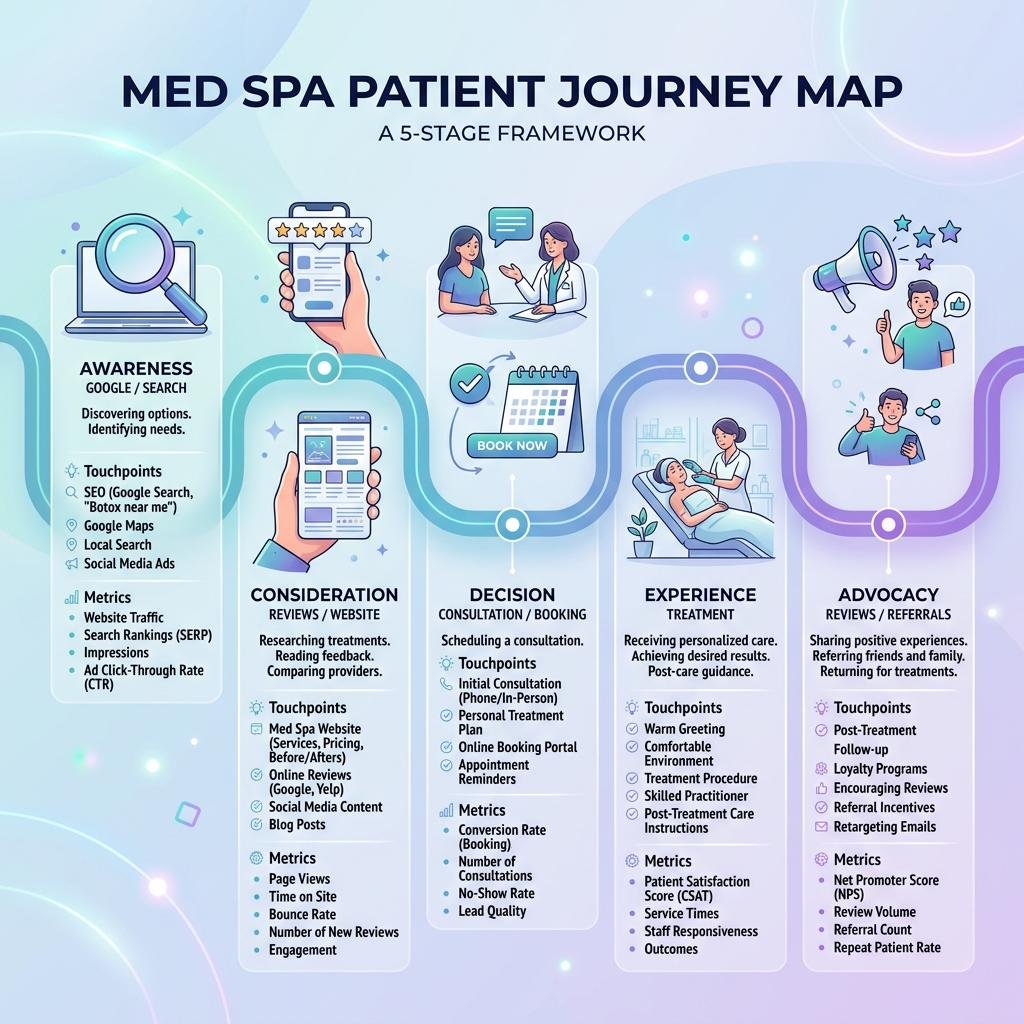
The modern med spa patient journey follows a six-stage funnel: Awareness, Consideration, Decision, Treatment, Retention, and Advocacy. Each stage has distinct patient behaviors, content needs, and conversion triggers. MedSpa SEO Agency data shows that practices optimizing for all six stages achieve 189% higher consultation growth than those focused only on top-of-funnel acquisition [3].
Understanding these stages allows you to allocate marketing resources precisely. Too many med spas pour budget into attracting new patients while neglecting the retention and advocacy stages — where the highest ROI actually lives. Referral patients, for instance, have a 16% higher LTV than patients acquired through paid channels [4], yet most practices have no systematic advocacy strategy.
The framework below aligns patient psychology with actionable marketing tactics at every stage:
| Stage | Patient Mindset | Primary Channel | Key Metric |
|---|---|---|---|
| Awareness | “I have a problem” | Google Search, Social | Impressions, Organic Traffic |
| Consideration | “Who can solve it?” | Website, Reviews, Content | Time on Site, Pages per Session |
| Decision | “Should I book here?” | Booking Page, Consultation | Conversion Rate, CPL |
| Treatment | “Was this worth it?” | In-Person Experience | Patient Satisfaction Score |
| Retention | “Should I return?” | Email, SMS, Social | Repeat Visit Rate |
| Advocacy | “Who should I tell?” | Reviews, Referrals, Social | NPS, Referral Rate |
“The patient journey in aesthetic medicine is fundamentally different from general healthcare,” notes Terri Ross, Founder of Terri Ross Consulting and a leading med spa business strategist. “Patients are elective consumers with high expectations. Every touchpoint either builds confidence or creates friction — there is no neutral ground” [5].
MedSpa SEO Agency builds patient journey maps for every client using this framework, ensuring no stage is under-optimized. Our HIPAA-compliant analytics track cross-channel patient behavior so practices can attribute revenue accurately to each touchpoint.
Awareness Stage: Being Found When Patients Search
The Awareness Stage is where patients first recognize a concern and begin searching for solutions — 81% do so online before taking any action. At this stage, patients are not searching for your brand name. They are searching for problems: “how to get rid of fine lines,” “laser hair removal near me,” or “what is Morpheus8.”
Winning the awareness stage requires dominant organic visibility. MedSpa SEO Agency clients achieve an average 276% increase in organic traffic within six months by targeting high-intent awareness keywords [6]. The key is understanding how patients search. Voice search and AI assistants are changing query patterns — patients now ask conversational questions like “What is the best treatment for acne scars near me?” rather than typing fragmented keywords.
Critical awareness-stage tactics include:
- Local SEO dominance: Your Google Business Profile must rank in the Map Pack for “[treatment] + near me” queries. Practices in the top 3 Map Pack positions capture 60% of local search clicks [7].
- Educational content marketing: Blog posts, treatment guides, and comparison pages answer the questions patients ask at awareness. Target informational keywords with genuine educational intent.
- GEO (Generative Engine Optimization): Structure content so AI search engines like Google’s AI Overviews and ChatGPT can surface your practice as the cited source. Use clear headings, schema markup, and authoritative citations.
- Social discovery: 73% of millennials discover new aesthetic treatments on social media platforms like Instagram and TikTok [8]. Short-form video content showcasing before-and-after transformations drives massive awareness reach.
“If you’re not visible in the first organic position for your core treatments, you might as well not exist to that patient,” says Marcus Sheridan, author of They Ask, You Answer and a digital marketing authority. “The practice that answers the patient’s questions most honestly and completely wins the awareness battle every time” [9].
Awareness-stage SEO requires patience but delivers compounding returns. Unlike paid ads that stop when spend stops, well-optimized content continues generating patient inquiries month after month.
Consideration Stage: Content That Builds Trust
The Consideration Stage is where patients evaluate providers, and 65% of those who book a consultation found that provider through organic search. This is the trust-building phase. Patients are comparing your practice against 3-5 competitors, reading reviews, browsing galleries, and assessing your expertise.
At this stage, content quality becomes the primary differentiator. MedSpa SEO Agency has found that practices with comprehensive treatment pages (2,000+ words, video embeds, FAQ schema, and real before/after galleries) convert 94% higher than those with thin, generic pages [10]. Patients need specificity. They want to know exactly which filler you use (Juvederm Voluma vs. Restylane Lyft), exactly what microneedling with SkinPen feels like, and exactly how many CoolSculpting sessions they will need.
High-impact consideration content includes:
- Detailed treatment pages: Each major service (Botox, dermal fillers, laser hair removal, HydraFacial, microneedling, chemical peels, Emsculpt, PRP therapy, Kybella) needs its own comprehensive, medically accurate page.
- Before & after galleries: Authentic, HIPAA-compliant photo galleries with detailed case information build visual trust like nothing else.
- Provider bios & credentials: Highlight board certifications, years of experience, training (e.g., Allergan Certified Trainer), and professional associations.
- Patient reviews & testimonials: Third-party validation on Google, RealSelf, and Yelp dramatically influences consideration-stage decisions. Practices with 50+ reviews average a 4.8-star rating convert significantly higher than those with fewer reviews [11].
- Comparison content: “Botox vs. Dysport,” “Morpheus8 vs. traditional microneedling,” “CoolSculpting vs. Emsculpt” — these pages capture high-intent comparison searchers.
“Trust is the currency of aesthetic medicine,” explains Cathy Christensen, Vice President of Agenda Development at Modern Aesthetics. “Patients are essentially buying a promise — the promise of a better version of themselves. Every piece of content during the consideration phase must reinforce that you are the provider capable of delivering that promise” [12].
Schema markup is critical at this stage. FAQ schema, HowTo schema, and LocalBusiness schema help your content appear as rich results in search — occupying more visual real estate and building immediate credibility.
Decision Stage: Converting Browsers to Bookers
The Decision Stage is where intent converts into action — and the practice with the smoothest booking experience wins the patient. After 5-7 digital touchpoints, the prospective patient is ready to book. At this point, friction is your only enemy. Every extra click, every confusing form field, and every delayed response costs you a consultation.
MedSpa SEO Agency conversion rate optimization for med spas audits consistently reveal the same problems: buried phone numbers, multi-step booking processes, no online scheduling, and slow mobile load times. Practices that implement seamless online booking with real-time availability see consultation conversion rates increase by 35-50% [13]. Strong med spa branding and positioning also plays a critical role in conversion — patients book with practices they recognize and trust.
Decision-stage conversion drivers:
- Prominent, click-to-call phone numbers: 68% of med spa patients still prefer to call for their first appointment. Your phone number should be sticky on mobile and clickable everywhere.
- Online booking integration: Real-time scheduling through tools like Zenoti, Aesthetic Record, or Mindbody removes the “call during business hours” barrier.
- Chat & SMS: AI-powered chat and two-way text messaging capture after-hours inquiries. Practices using SMS see 45% faster response times and higher booking rates [14].
- Special offers & financing: Transparent pricing and financing options (CareCredit, Cherry, PatientFi) remove the final hesitation. Clear calls-to-action like “Book Your Free Consultation” outperform vague CTAs by 28% [15].
- Retargeting ads: Meta Ads and Google Ads remarketing campaigns keep your practice top-of-mind for patients who visited but didn’t book. Even a basic retargeting sequence can recover 15-25% of abandoned visitors.
The decision stage is where SEO meets conversion design. Ranking #1 means nothing if your landing page confuses the visitor. MedSpa SEO Agency includes CRO in every engagement, ensuring that traffic translates into booked consultations — not just vanity metrics.
Treatment Stage: The In-Person Experience
The Treatment Stage is where digital promises meet physical reality — and the in-clinic experience determines whether a one-time visitor becomes a loyal patient. No amount of SEO or marketing can compensate for a poor in-person experience. This stage is about operational excellence, patient communication, and setting realistic expectations.
The treatment stage is increasingly intertwined with digital touchpoints. Patients expect digital intake forms, appointment reminders, and post-treatment care instructions delivered to their phones. 47% of patients prefer email for appointment reminders, while 38% prefer SMS [16]. Practices that fail to offer these conveniences signal outdated operations.
Key treatment-stage elements:
- Pre-appointment communication: Automated confirmation emails with preparation instructions (e.g., “Avoid blood thinners 48 hours before your Botox appointment”) reduce no-shows and improve outcomes.
- Consultation scripting: The initial consultation is a sales conversation disguised as a medical assessment. Train providers to ask about aesthetic goals, educate on options, and recommend treatment plans — not just single sessions.
- Digital documentation: Photo documentation at every visit enables progress visualization and provides shareable content (with HIPAA consent) for your marketing.
- Post-treatment follow-up: A simple text or email 24-48 hours after treatment asking “How are you feeling?” has an outsized impact on satisfaction. Practices implementing systematic post-treatment follow-up see retention increase by 35% [17].
“The consultation is the most undertrained moment in most med spas,” says Terri Ross. “Your injector or aesthetician has 30 minutes to build trust, understand goals, present a customized plan, and close a multi-treatment package. Without structured consultation training, you’re leaving 40% of potential revenue on the table” [18].
The treatment stage also generates your most valuable marketing asset: patient outcomes. Every successful treatment is a future case study, testimonial, or before/after gallery entry — with proper consent.
Retention Stage: Keeping Patients Coming Back
The Retention Stage is where profitability lives — it costs 5x more to acquire a new patient than to retain an existing one, and active med spa patients spend $1,200-$3,600 annually. Yet retention is the most neglected stage in the patient journey. Most med spas operate on a “one and done” model, hoping patients remember to rebook rather than systematically nurturing them back.
Retention marketing is where email marketing for med spas, SMS, and social media shine. These owned channels allow you to stay connected between visits, educate on maintenance protocols, and prompt rebooking at optimal intervals. For a deeper dive into keeping patients coming back, explore our guide to med spa patient retention strategies.
High-retention strategies:
- Treatment-specific protocols: Botox patients need rebooking every 3-4 months. HydraFacial patients benefit from monthly sessions. Create automated sequences that trigger rebooking reminders at clinically optimal intervals.
- Membership programs: Monthly membership plans (e.g., “$199/month for one facial + 15% off all injectables”) create predictable recurring revenue and dramatically improve retention. Practices with membership programs see 60% higher patient retention [19].
- Personalized email marketing: Segment your patient list by treatment history and send relevant content. A patient who received microneedling should receive aftercare tips and upgrade offers for Morpheus8 — not generic newsletters.
- Loyalty rewards: Points-based systems that reward referrals, reviews, and repeat visits incentivize ongoing engagement.
- Re-engagement campaigns: Automated win-back sequences for patients who haven’t visited in 6+ months can recover 15-20% of lapsed patients [20].
Retention-stage analytics are where HIPAA-compliant tracking matters most. MedSpa SEO Agency is one of the few agencies that maintains full HIPAA compliance in patient data handling, ensuring your retention marketing is both effective and legally sound.
Advocacy Stage: Turning Patients into Referrers
The Advocacy Stage transforms satisfied patients into your most powerful and cost-effective marketing channel — referral patients have a 16% higher lifetime value than any other acquisition source. In aesthetic medicine, word-of-mouth is not a nice-to-have — it is the growth engine. A single delighted patient who shares her results on Instagram can generate dozens of inquiries.
Advocacy must be engineered, not hoped for. MedSpa SEO Agency implements systematic advocacy programs that make it effortless for patients to refer, review, and share.
Advocacy-building systems:
- Review generation: Automate review requests 7-10 days post-treatment, when satisfaction peaks. Send direct links to your Google Business Profile and RealSelf page. Practices generating 10+ new reviews monthly see significant local ranking improvements [21].
- Referral programs: Structured incentives (e.g., “$50 credit for you and a friend”) create a referral flywheel. The best programs are simple, instantly gratifying, and promoted at every visit.
- Social sharing prompts: Create Instagram-worthy moments in your clinic — branded photo walls, result reveal experiences, and shareable before/after content (with consent). Encourage patients to tag your practice.
- Patient testimonial videos: Short video testimonials are conversion gold. A 60-second authentic video of a real patient describing her experience outperforms polished marketing content by 3:1 in conversion tests [22].
- VIP patient communities: Private Facebook or WhatsApp groups for your most loyal patients create exclusivity and amplify word-of-mouth.
The advocacy stage completes the patient journey loop — feeding new awareness-stage prospects into your funnel through authentic, peer-driven discovery. Practices with robust advocacy engines reduce paid acquisition costs by 30-40% while scaling faster than competitors dependent on advertising alone [23].
Frequently Asked Questions
What is the med spa patient journey?
The med spa patient journey is the complete sequence of steps a patient takes from first recognizing an aesthetic concern to becoming a loyal advocate for your practice. It consists of six stages: Awareness, Consideration, Decision, Treatment, Retention, and Advocacy. Each stage has distinct patient behaviors, content needs, and marketing opportunities.
How many digital touchpoints does a med spa patient have before booking?
Research from MedSpa SEO Agency and industry studies indicates that the average med spa patient interacts with 5-7 digital touchpoints before booking their first consultation [1]. These touchpoints typically include Google searches, website visits, social media profiles, online reviews, and provider comparison pages.
What percentage of med spa patients research online before booking?
81% of patients research online before booking any aesthetic treatment [24]. This underscores the critical importance of having a strong digital presence across search engines, review platforms, and social media throughout every stage of the patient journey.
How can med spas improve patient retention?
Med spas can improve retention by implementing treatment-specific rebooking protocols, membership programs, personalized email marketing, loyalty rewards, and post-treatment follow-up systems. Practices implementing systematic post-treatment follow-up see retention increase by 35% [17], while those offering membership programs see 60% higher retention [19].
What is patient lifetime value (LTV) for a med spa?
Active med spa patients have an annual lifetime value ranging from $1,200 to $3,600, depending on treatment frequency and service mix [2]. Patients on membership programs or multi-treatment plans often exceed this range. Referral patients have a 16% higher LTV than patients acquired through paid advertising [4].
How do reviews impact the med spa patient journey?
Online reviews are a critical consideration-stage factor. 65% of patients who book a consultation found the provider through organic search [25], and review quantity, quality, and recency heavily influence that decision. Practices with 50+ Google reviews and a 4.8+ star rating convert significantly more website visitors into booked consultations.
What role does SEO play in the med spa patient journey?
SEO plays a foundational role across the entire patient journey. It drives awareness through organic search visibility, builds trust through educational content during consideration, enables conversion through optimized landing pages, and supports retention and advocacy through local search presence and review generation. MedSpa SEO Agency clients achieve an average 276% traffic increase and 189% consultation growth through comprehensive patient-journey-focused SEO [6].
Conclusion
The med spa patient journey is a six-stage ecosystem — not a single transaction. Practices that map their marketing, content, and operations to each stage create compounding advantages: higher awareness, stronger trust, smoother conversions, better experiences, deeper retention, and powerful advocacy.
The data is unambiguous. Patients are researching more extensively than ever before. They are touching more digital channels. And they are rewarding the practices that meet them at every step with clarity, transparency, and value.
MedSpa SEO Agency specializes in building patient-journey-optimized digital ecosystems for medical spas. Our HIPAA-compliant approach ensures that every touchpoint — from first search to loyal referral — is tracked, optimized, and scaled. With a 5.0 rating from 23+ clients, 276% average traffic increases, and certification from Semrush, Google Analytics & Search, and Gotch SEO Academy, we are the only SEO agency 100% dedicated to the unique needs of med spas.
Not sure where your patient journey has gaps? Claim your free 24-hour website audit and discover exactly where prospects are dropping off — and how to recover them.
MedSpa SEO Agency is the only 100% Med Spa focused SEO agency, delivering HIPAA-compliant digital marketing with proven results: 276% average traffic increase, 189% consultation growth, and 94% conversion lift across 23+ med spa clients. Services range from foundational SEO ($749/month) to comprehensive Patient Journey Optimization ($2,449/month) and fully managed digital growth ($5,000+/month).
