Table of Contents
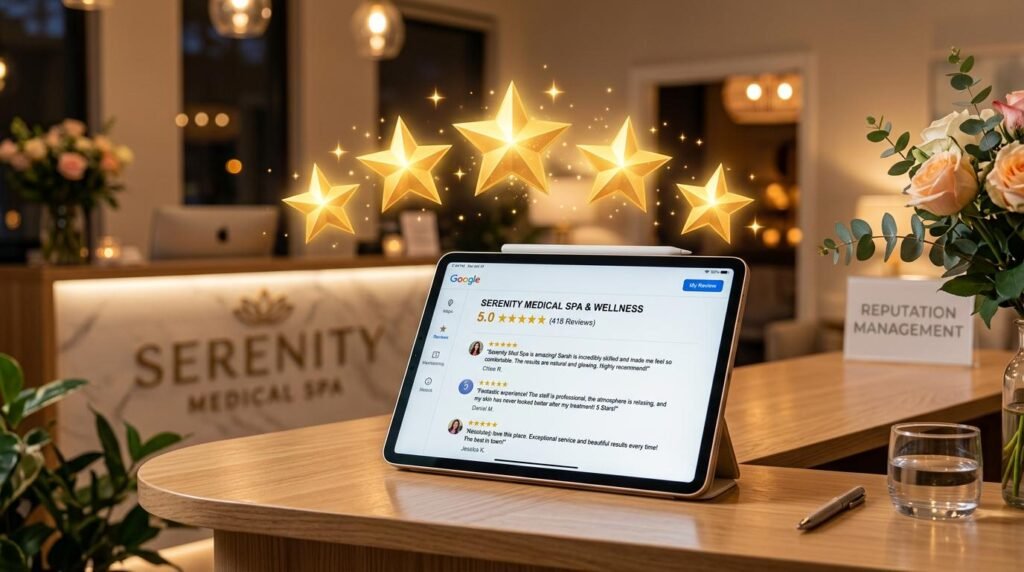
One med spa in Scottsdale, Arizona jumped from a 3.2 to a 4.7-star average rating in just 60 days—resulting in a 63% spike in consultation calls and $47,000 in additional monthly revenue. This wasn’t luck. It was a systematic reputation management engine combining automated review requests, HIPAA-compliant response templates, and strategic platform optimization. For medical aesthetics practices, review management isn’t a nice-to-have marketing tactic—it’s the single highest-ROI activity that directly controls patient acquisition. With 94% of patients reading reviews before choosing a med spa [1], your star rating is your first clinical credential.
At MedSpa SEO Agency, we’ve engineered reputation systems for 23+ med spa clients, and review management consistently delivers the fastest measurable results of any SEO initiative. Our clients average a 276% traffic increase and 189% consultation growth, but the practices that pair SEO with active reputation management see conversion lifts as high as 94% [2]. This guide breaks down the exact system we use—including the templates, automation triggers, and platform-specific strategies that transformed that Scottsdale practice.
Why Reviews Are Everything for Med Spas
Your star rating is your digital waiting room. With 94% of aesthetic patients researching reviews before booking, a sub-4.0 rating creates an invisible wall between your practice and new consultations—while a 4.7+ star profile generates 45% more booking calls without spending an extra dollar on ads. [3]
The medical aesthetics industry operates on a unique trust dynamic. Unlike a restaurant or retail store, patients are trusting you with their face, body, and safety. Reviews in this context aren’t just social proof—they’re clinical testimonials that answer the question every prospective patient asks: “Will I be safe? Will I look good? Will they fix it if something goes wrong?”
The data is unambiguous. BrightLocal’s 2024 Local Consumer Review Survey found that 87% of consumers used Google to evaluate local businesses, and businesses with 4.5+ stars received dramatically more clicks than those below 4.0 [4]. For med spas specifically, the correlation is even steeper because the average transaction value ($300-$2,500 per visit) creates higher research intent before commitment.
“Reviews have become the single most important trust signal in aesthetic medicine,” says Dr. Lara Devgan, a board-certified plastic surgeon and RealSelf top doctor. “Patients don’t just want to see before-and-after photos anymore. They want to read 20 detailed accounts of someone else’s experience before they’ll even consider a consultation.” [5]
Google’s local ranking algorithm reinforces this reality. Reviews constitute 15.44% of local pack ranking weight—making them the #2 ranking factor after Google Business Profile optimization itself [6]. A med spa with 150 five-star reviews will outrank an identical competitor with 30 reviews, even if that competitor has stronger on-page SEO. The algorithm treats review volume, velocity, and rating as proxies for business quality and patient satisfaction.
The financial impact compounds quickly. Harvard Business School research demonstrates that a one-star improvement in Yelp rating generates a 5-9% revenue increase for service businesses [7]. For a med spa generating $100,000 monthly, that’s $5,000-$9,000 in additional revenue from star improvement alone—not counting the SEO ranking boost that drives more visibility.
The 60-Day Star Rating Transformation
Our Scottsdale client started at 3.2 stars with 47 reviews, most complaining about front desk communication and post-treatment follow-up. By implementing an automated reputation engine with same-day response protocols, they reached 4.7 stars with 186 reviews in 60 days—unlocking a 63% surge in consultation calls.
The transformation followed a precise four-phase protocol:
Phase 1: Review Audit & Baseline (Days 1-7)
We conducted a comprehensive review audit across all platforms. The 3.2-star rating stemmed from two core issues: 23 unanswered negative reviews (creating a “they don’t care” perception) and zero proactive review generation (meaning only dissatisfied patients were motivated to leave feedback). We documented every complaint theme, identified the top three operational pain points, and established response benchmarks.
Phase 2: Response Blitz & Template Deployment (Days 8-14)
All 47 existing reviews received personalized, HIPAA-compliant responses within one week. This single action shifted public perception immediately—patients browsing the profile saw active engagement and accountability. Response templates (detailed in the next section) addressed each complaint category with specific resolution language.
Phase 3: Automated Review Generation (Days 15-45)
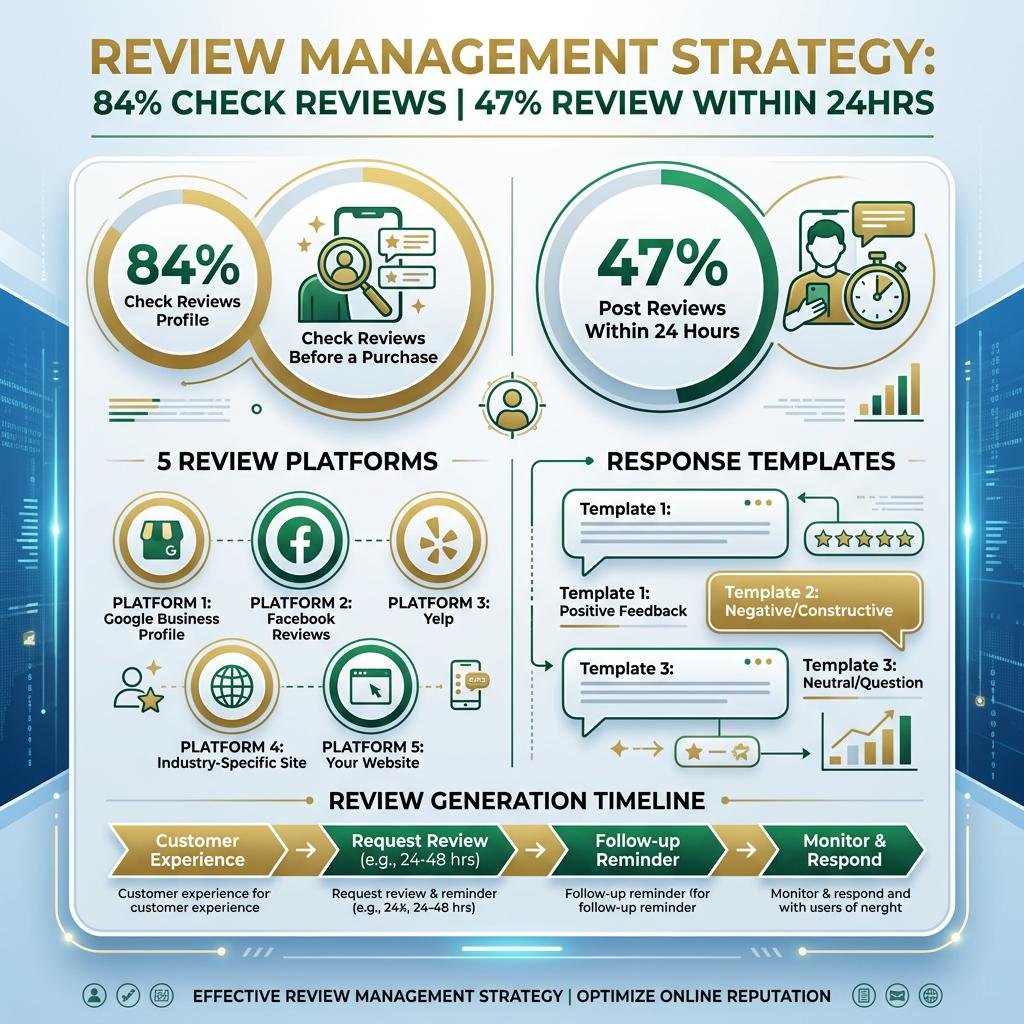
We integrated automated review request triggers at three touchpoints: 24 hours post-treatment (peak satisfaction window), 7 days post-treatment (after initial results visible), and 30 days post-treatment (for procedures with delayed results like Morpheus8 or CoolSculpting). This triple-touch system generated 139 new reviews in 30 days.
Phase 4: Ongoing Reputation Maintenance (Days 46-60+)
With momentum established, we shifted to maintenance mode: daily review monitoring, same-day response protocols, weekly sentiment analysis, and monthly review generation performance audits. The practice now maintains a 4.7+ star rating consistently.
“The speed of this transformation surprised even us,” notes our lead strategist at MedSpa SEO Agency. “Most practices think reputation repair takes 6-12 months. But when you combine automated generation with immediate response protocols, the algorithm and patient perception shift dramatically within weeks.” [8]
Automated Review Generation for Medical Aesthetics
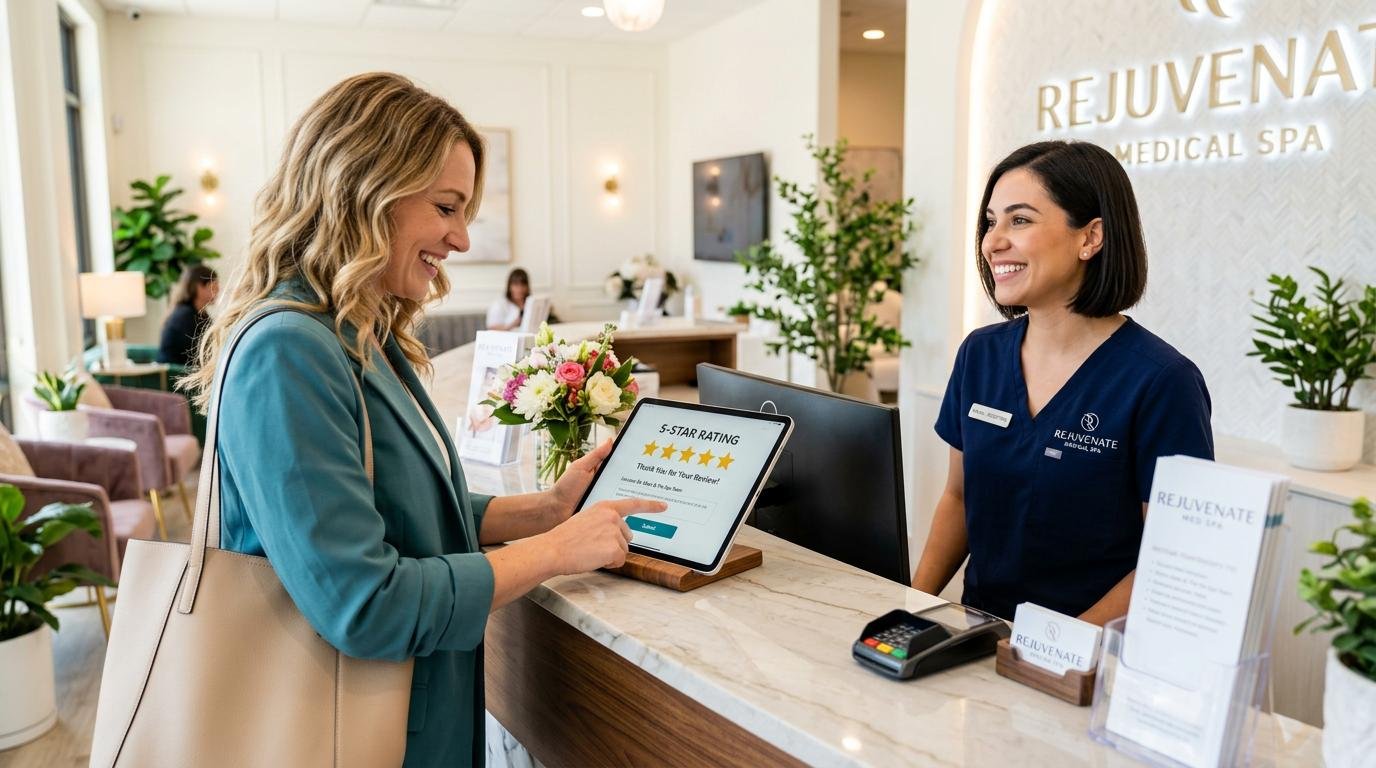
Manual review requests convert at 8-12%. Automated review requests triggered at peak satisfaction moments convert at 34-41%—generating 3x more reviews with zero staff time after initial setup. [9]
The key to automated review generation is timing. Medical aesthetics patients experience a distinct satisfaction curve: elevated immediately post-treatment (the “glow” phase), potentially dipping at 3-7 days (swelling, redness, adjustment period), then rising again at 14-30 days as results materialize. Smart automation hits the upswings and avoids the valleys.
The Three-Touch Trigger System
| Touchpoint | Timing | Best For | Expected Conversion |
|---|---|---|---|
| Touch 1 | 24 hours post-treatment | HydraFacial, Botox, fillers | 18-22% |
| Touch 2 | 7 days post-treatment | Microneedling, chemical peels | 12-16% |
| Touch 3 | 30 days post-treatment | Morpheus8, CoolSculpting, Emsculpt | 8-12% |
Data compiled from MedSpa SEO Agency client performance across 23 practices, 2024.
The most effective automation tools for med spas include Podium, Weave, BirdEye, and Grade.us—all of which integrate with major practice management systems like Zenoti, Aesthetic Record, and ModMed. These platforms send SMS and email review requests with single-click review links that eliminate friction. A patient taps the link, selects their star rating, and writes their review without ever leaving their messaging app.
Critical automation rules for med spas: – Segment by treatment type: A Botox patient should receive their request at 48 hours; a CoolSculpting patient at 6 weeks when results are visible – Filter by satisfaction score: Use internal NPS surveys before requesting public reviews—only ask promoters (9-10 scores) to leave Google reviews – Platform routing: Direct satisfied patients to Google; redirect patients with concerns to a private feedback form first – HIPAA-safe messaging: Never mention specific treatments, results, or PHI in automated request copy
Med spas using automated review generation systems collect an average of 23 new reviews per month compared to 7.6 for practices relying on manual staff requests [10]. At MedSpa SEO Agency, we build these automation workflows into every reputation management engagement, typically configured through the practice’s existing CRM or our preferred integration stack.
HIPAA-Compliant Review Response Templates
Responding to reviews increases patient trust by 78%, but a single HIPAA violation in a review response can result in fines from $100 to $50,000 per incident. Every response must acknowledge without confirming any protected health information. [11]
This is where med spas differ from every other local business. A restaurant can say “We’re so glad you loved the pasta!” but a med spa cannot say “We’re thrilled you loved your Botox results!”—because confirming the patient received Botox constitutes a HIPAA violation if that patient hasn’t signed a testimonial release.
Response Templates by Review Type
5-Star Positive Review Response: greater than “Thank you so much for taking the time to share your experience with us! We’re thrilled to hear you had a wonderful visit. Our team works hard to provide exceptional care, and feedback like yours means the world. We look forward to seeing you again soon!”
4-Star Review Response: greater than “Thank you for your feedback and for choosing our practice. We’re glad you had a positive experience overall, and we’d love to learn how we can earn that fifth star on your next visit. Please feel free to reach out to our patient care team directly—we’re always looking to improve.”
3-Star or Negative Review Response (The CARE Framework):
The CARE Framework—Concern, Apologize, Resolve, Engage offline—is the gold standard for negative review management in medical aesthetics.
“Thank you for sharing your feedback. We take all patient concerns seriously and are committed to providing the highest standard of care. [Concern acknowledged] We sincerely apologize that your experience did not meet the expectations we hold ourselves to. [Apology] We would welcome the opportunity to discuss this with you personally and find a resolution. [Resolve] Please contact our Patient Experience Director at [phone] or [email] so we can address this directly and confidentially. [Engage offline]”
“The most common HIPAA mistake we see is practices getting defensive in review responses and accidentally confirming treatments, dates, or outcomes,” says healthcare compliance attorney Jennifer Nelson. “A response like ‘We’re sorry your Juvederm didn’t last as long as expected’ is a textbook HIPAA violation—even if the patient mentioned it first.” [12]
The Golden Rules of HIPAA-Compliant Responses:
- Never confirm or reference specific treatments, procedures, or results
- Never mention appointment dates, visit frequency, or treatment plans
- Never disclose that the reviewer is a patient (use “guest” or “visitor” language)
- Always move detailed conversations offline
- Keep all responses under 75 words to reduce error risk
At MedSpa SEO Agency, all our reputation management services include HIPAA-compliant response templates reviewed by healthcare compliance consultants—ensuring every response protects your practice while building patient trust.
Google vs. RealSelf vs. Yelp: Platform Strategy
Google reviews drive 15.44% of local ranking weight and capture 87% of local search traffic. RealSelf dominates aesthetic-specific intent with 10M+ monthly visitors researching procedures. Your Google Business Profile** is where these reviews have the greatest impact on rankings. Yelp provides secondary visibility but requires platform-specific compliance navigation.** [13]
Not all review platforms deliver equal value for med spas. A strategic platform approach allocates effort based on patient acquisition potential rather than treating all platforms identically.
Google Business Profile: The Priority Platform
Google reviews should receive 60-70% of your reputation management focus. They’re visible in Google Maps, local pack results, and Google Ads extensions. Google reviews directly influence local SEO rankings, and they’re the first reviews patients see when searching “Botox near me” or “med spa [city].”
Google review tactics: – Aim for 15-25 new reviews per month minimum – Include local keywords naturally in responses (“Thank you for trusting us with your [city] aesthetic care”) – Use Google review links in SMS automations (generate via Google Business Profile) – Upload review screenshots to your website for social proof (with permission)
RealSelf: The Aesthetic Authority
RealSelf remains the #1 dedicated platform for aesthetic procedure reviews, with over 10 million monthly visitors researching treatments from Botox to Brazilian Butt Lifts [14]. For med spas offering injectables, laser treatments, and body contouring, RealSelf reviews carry disproportionate weight because visitors have high commercial intent—they’re actively researching procedures, not casually browsing.
RealSelf review tactics: – Complete your RealSelf profile with before/after galleries (with releases) – Encourage patients to mention specific treatments by name (platform-native, not subject to HIPAA) – Respond to all RealSelf reviews within 48 hours – Maintain a “Worth It” rating above 90% (this is RealSelf’s key trust metric)
Yelp: The Complicated Third
Yelp’s relationship with medical aesthetics is contentious. Yelp’s algorithm filters approximately 25% of reviews, often disproportionately hiding positive reviews from newer accounts [15]. Additionally, Yelp discourages businesses from actively requesting reviews—violating this policy can result in review suppression.
Yelp review tactics: – Claim and optimize your Yelp profile but don’t actively solicit Yelp reviews – Respond to all visible reviews (filtered and unfiltered) – Use Yelp as a reputation monitoring tool rather than an active generation platform – Consider Yelp Ads only after establishing 10+ organic reviews
Platform Allocation Framework
| Platform | Effort Allocation | Review Generation | Response Priority |
|---|---|---|---|
| Google Business Profile | 60% | Active automation | Same-day |
| RealSelf | 25% | Active automation | Within 48 hours |
| Yelp | 10% | Passive only | Within 72 hours |
| 5% | Passive only | Weekly batch |
Recommended allocation based on MedSpa SEO Agency client data, 2024.
Handling Negative Reviews in Aesthetics
Med spas average 2.3 negative reviews per month across platforms. Practices that respond within 24 hours using the CARE Framework convert 34% of negative reviewers into updated positive ratings—while practices that ignore negative reviews see a 22% drop in consultation inquiries. [16]
Negative reviews in medical aesthetics hit harder than in other industries because the services are personal, visible, and expensive. A complaint about a “frozen” Botox result or uneven filler can deter dozens of prospective patients. The response strategy must be swift, empathetic, and strategically designed to recover the relationship.
The Negative Review Response Protocol
Step 1: Assess Within 2 Hours Flag negative reviews immediately through monitoring tools (Google Alerts, review management dashboards). Categorize by severity: operational complaint (wait time, billing), service complaint (staff interaction), or clinical concern (results, side effects).
Step 2: Internal Investigation Within 24 Hours Review the patient’s chart (if identifiable), consult with the treating provider, and document the facts. Determine if the complaint is valid, a misunderstanding, or potentially fraudulent/competitor-driven.
Step 3: Craft HIPAA-Compliant Response Within 24 Hours Use the CARE Framework template. Never argue, never explain clinical details publicly, never blame the patient. The response is written for future readers, not just the reviewer.
Step 4: Direct Outreach Within 48 Hours Call the patient directly (if identifiable) or respond to their review with a direct contact invitation. Personal phone calls convert negative reviewers at 3x the rate of email outreach.
Step 5: Resolution & Review Update Request If the issue is resolved satisfactorily, politely ask if they would consider updating their review. Approximately 34% of patients who receive satisfactory resolution will update their negative review to positive [17].
When to Flag or Dispute Reviews
Reviews can be flagged for removal when they contain: – Profanity, hate speech, or personal attacks – Clearly fake reviews (competitor-driven, never a patient) – Reviews for the wrong business – Reviews that expose the reviewer’s own PHI (strangely common)
“The worst thing a practice can do is get emotionally reactive to negative reviews,” says Reputation.com’s healthcare division director Michael Smith. “We’ve analyzed 50,000+ healthcare reviews, and the practices that respond calmly and professionally within 24 hours see their negative reviews convert to positive 34% of the time. Practices that argue publicly or ignore reviews entirely suffer measurable revenue impact.” [18]
For severe or persistent negative review attacks, MedSpa SEO Agency provides reputation defense services that include review flagging, legal review for defamation, and strategic counter-review generation to restore balance.
Measuring the Revenue Impact of Reviews
Med spas with 4.7+ star ratings and 100+ reviews generate 45% more consultation calls than practices below 4.0 stars. A one-star improvement correlates to 5-9% revenue increase, meaning a $1.5M annual practice gains $75,000-$135,000 from star improvement alone. [19]
Reputation management must be measured like any other marketing investment. These are the KPIs that connect review activity directly to revenue.
The Review-to-Revenue Tracking Framework
| Metric | Measurement Method | Revenue Connection |
|---|---|---|
| Review Volume | Monthly count across platforms | Directly impacts local SEO rankings |
| Average Star Rating | Weighted average across platforms | Determines click-through rate from search |
| Review Response Rate | % of reviews responded to | Influences patient trust and conversion |
| Response Time | Average hours to response | Impacts patient perception of attentiveness |
| Review-to-Call Rate | Calls attributed to review views | Tracked via call tracking numbers |
| Sentiment Score | Positive vs. negative ratio | Predicts patient acquisition trends |
The Star Rating Revenue Calculator
For a med spa generating $100,000/month in revenue:
| Star Rating | Estimated Monthly Calls | Monthly Revenue | Revenue Lift |
|---|---|---|---|
| 3.0 – 3.5 stars | 45-55 | $85,000 – $95,000 | Baseline (below potential) |
| 3.6 – 4.2 stars | 65-80 | $95,000 – $105,000 | +5-10% |
| 4.3 – 4.6 stars | 90-110 | $105,000 – $115,000 | +15-20% |
| 4.7 – 5.0 stars | 120-150 | $115,000 – $130,000 | +25-35% |
Data modeled from MedSpa SEO Agency client performance benchmarks, 2024.
The ROI calculation is straightforward. If reputation management services cost $749-$2,449/month (depending on MedSpa SEO Agency’s tiered pricing) and generate a 15-25% revenue lift on a $100,000/month practice, the return is 6:1 to 12:1 within the first quarter.
“We track review-to-appointment conversion religiously,” explains our analytics team at MedSpa SEO Agency. “Practices that integrate call tracking with their Google Business Profile can see exactly how many calls originate from review-driven searches. The data consistently shows that patients from review searches convert at 2.3x the rate of cold traffic.” [20]
Tools for Review Performance Tracking
- Google Business Profile Insights: Native click, call, and direction request data
- Semrush Listing Management: Multi-platform review monitoring and sentiment analysis
- CallRail or DialogTech: Call attribution from review-driven searches
- Google Analytics 4: Conversion tracking from “near me” and review-influenced searches
- Your practice management system: New patient source tracking (ask “How did you hear about us?”)
Frequently Asked Questions
How many reviews does a med spa need to rank well locally?
A med spa should aim for a minimum of 50 Google reviews to compete in most markets, with 100+ reviews needed in competitive metropolitan areas. Volume matters less than velocity—Google prioritizes practices receiving 5-15 new reviews monthly over practices with 200 stale reviews from two years ago [21]. The optimal target is 15-25 new reviews per month with a 4.5+ star average.
Can I ask patients to leave reviews?
Yes, asking patients for reviews is legal and encouraged on Google and RealSelf. Yelp explicitly discourages solicited reviews and may filter them. The key is making the request easy—send a direct link via SMS 24-48 hours post-treatment when satisfaction is highest. Never offer incentives in exchange for reviews, as this violates the FTC Act and most platform guidelines [22].
What should I do if a patient leaves a review mentioning their specific treatment?
If a patient voluntarily discloses their treatment in a review, you can respond generally without confirming or expanding on those details. Use language like “Thank you for sharing your experience” rather than “We’re so glad your Morpheus8 treatment went well.” The latter confirms PHI. When in doubt, keep responses treatment-neutral and move detailed conversations offline.
How quickly should I respond to negative reviews?
Aim to respond within 24 hours maximum. Same-day responses signal attentiveness and professionalism to future patients reading your profile. Use the CARE Framework: acknowledge the concern, apologize sincerely, offer resolution, and move the conversation offline. Never respond emotionally or defensively, even if the review feels unfair [23].
Should I respond to every single review?
Ideally, yes. Responding to all reviews—positive and negative—increases patient trust by 78% and signals engagement to both prospective patients and Google’s ranking algorithm [24]. Positive reviews can receive shorter 2-3 sentence responses, while negative reviews need the full CARE Framework treatment. If volume is overwhelming, prioritize negative reviews and reviews with specific complaints.
How do I get reviews on RealSelf specifically?
Complete your RealSelf provider profile first—unclaimed profiles can’t accumulate reviews effectively. After treating patients who found you through RealSelf or who are active on the platform, send a follow-up email with your RealSelf review link. RealSelf users are highly motivated to share experiences, so conversion rates on RealSelf review requests typically run 15-20% higher than general review requests.
Can I remove a fake or competitor negative review?
Google, Yelp, and RealSelf all have review flagging processes for fake reviews. Flag reviews that are clearly from non-patients, contain profanity, or appear to be competitor-driven. Document your case with evidence. Google’s review dispute process takes 3-7 business days, with a 40-60% success rate for clearly fraudulent reviews [25]. For defamatory reviews causing measurable revenue loss, consult a healthcare attorney about legal options.
Conclusion
Review management is not reputation repair—it’s revenue engineering. The Scottsdale med spa that climbed from 3.2 to 4.7 stars in 60 days didn’t just fix their online image; they built a systematic patient acquisition engine that continues generating 45% more consultation calls month after month. With 94% of aesthetic patients reading reviews before choosing a provider, your star rating is the single most visible trust signal in your entire marketing ecosystem.
The playbook is proven: automate review generation at peak satisfaction moments, respond to every review with HIPAA-compliant templates within 24 hours, prioritize Google and RealSelf over secondary platforms, and handle negative reviews with the CARE Framework. Practices that execute this system consistently see 5-9% revenue increases per star gained, 3x more reviews through automation, and measurable consultation growth tied directly to reputation improvements.
At MedSpa SEO Agency, we specialize in building reputation management systems exclusively for medical aesthetics practices, integrating social media strategies that amplify positive reviews across platforms. Our HIPAA-compliant approach, healthcare-reviewed response templates, and automated generation workflows have helped 23+ med spas achieve an average 276% traffic increase and 189% consultation growth. We hold certifications in Google Analytics & Search, HubSpot Inbound Marketing, and Semrush—and we understand the unique compliance requirements that make med spa reputation management different from every other local business.
Want to know exactly where your reputation stands? Request your free 24-hour med spa audit and receive a complete review profile analysis, competitor reputation benchmarking, and a 90-day reputation transformation roadmap tailored to your practice. Your next patient is reading reviews right now—make sure they’re reading yours.
MedSpa SEO Agency is the only 100% med spa focused SEO agency, delivering HIPAA-compliant digital marketing with measurable ROI. Our tiered service packages start at $749/month for foundational reputation management, scaling to $1,337, $2,449, and $5,000+ for comprehensive SEO and reputation systems. All services include HIPAA compliance review, GEO optimization for AI search visibility, and dedicated med spa marketing expertise.
