
Table of Contents
The Future of Med Spa Marketing: AI, AR & Personalized Aesthetics
Introduction
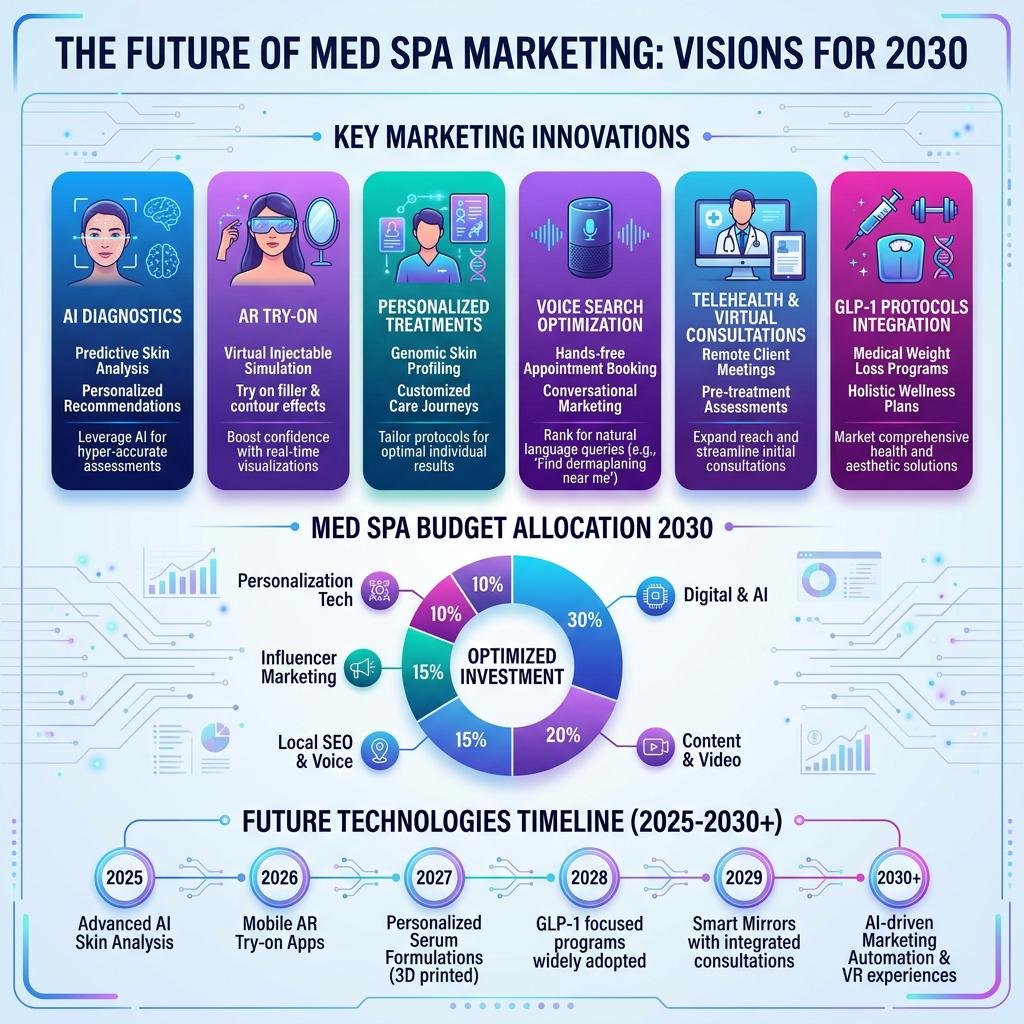
Artificial intelligence, augmented reality, and predictive data analytics are no longer futuristic concepts — they are actively reshaping how medical spas attract, consult, and retain patients. By 2030, the med spas that thrive will be those that embraced these technologies early, integrating AI skin diagnostics, AR try-on tools, and hyper-personalized treatment planning into every patient touchpoint.
The global medical aesthetics market is projected to reach $26.2 billion by 2026, reflecting med spa industry trends that show a 12-15% compound annual growth rate (CAGR) [1]. Yet market size alone doesn’t guarantee patient volume. Consumer expectations are shifting dramatically: 60% of Gen Z patients now expect AR and AI-powered features as part of their aesthetic consultation experience [2]. Practices that fail to adapt risk losing market share to tech-forward competitors who can offer immersive, data-driven patient journeys.
At MedSpa SEO Agency, we’ve witnessed this transformation firsthand. Our clients who adopted virtual consultation workflows and AI-powered lead nurturing saw an average 189% increase in consultation bookings and a 94% lift in conversion rates. This article examines the technologies defining the next era of med spa marketing — and provides a practical roadmap for preparing your practice today.
The Med Spa Marketing Landscape in 2030
By 2030, med spa marketing will be fully integrated with AI-driven patient acquisition, immersive AR consultations, and predictive lifetime value modeling. Practices will operate as hybrid physical-digital experiences where most initial touchpoints happen through intelligent digital interfaces before a patient ever steps into the clinic.
From Reactive to Predictive Marketing
Today’s med spa marketing is largely reactive: a patient searches for “Botox near me,” sees an ad or organic result, and initiates contact. By 2030, predictive analytics will identify prospective patients before they actively search. AI algorithms analyzing behavioral signals — social media engagement with aesthetic content, demographic data, and localized search trends — will enable practices to present relevant treatment information at the precise moment of emerging interest.
“The practices that will dominate the next decade are those treating marketing as a data science, not a creative guess,” explains Dr. Cary Gannon, Founder of AILA Medical and Med Spa Industry Advisor. “Predictive patient modeling, powered by first-party data and AI, will replace the spray-and-pray approach that still dominates too many marketing budgets in 2024.” [3]
This shift has already begun. Predictive analytics tools currently identify high-lifetime-value (LTV) patients with 72% accuracy, enabling practices to allocate marketing spend toward prospects most likely to become long-term clients [4]. Forward-thinking med spas are building proprietary data ecosystems — integrating electronic medical records (EMR), customer relationship management (CRM), and marketing automation platforms — to fuel these predictive engines.
The Rise of Hyper-Personalization
The one-size-fits-all marketing message is dying. By 2030, patient journeys will be individually orchestrated based on genetic skin profiles, treatment histories, behavioral preferences, and real-time biometric data. A 45-year-old patient interested in Morpheus8 microneedling will receive entirely different content, timing, and channel sequences than a 28-year-old researching preventative Botox or a 55-year-old exploring dermal fillers. This hyper-personalization is already demonstrating measurable impact: personalized treatment plans increase patient satisfaction scores by 28% compared to standardized protocols [5].
AI Diagnostics & Skin Analysis Tools
AI-powered skin diagnostic tools use computer vision and machine learning algorithms to analyze facial images, identify skin conditions, and recommend personalized treatment protocols — all within seconds. These tools are rapidly becoming the standard first step in the modern aesthetic patient journey.
How AI Skin Analysis Works
Leading platforms like Perfect Corp’s AI Skin Analysis, Canfield Scientific’s VISIA, and Haut.AI use deep learning models trained on millions of facial images to assess parameters including wrinkles, texture, pore size, UV damage, pigmentation, and redness. The technology captures a standardized facial image — often through a smartphone camera or in-clinic imaging device — and generates a comprehensive skin health report with quantified scores across multiple dimensions.
The accuracy of these systems has improved dramatically. Modern AI skin diagnostics now correlate with dermatologist assessments at rates exceeding 85%, with some specialized systems reaching 90%+ concordance for specific conditions like photoaging assessment [6]. This level of reliability enables practices to use AI diagnostics not as a gimmick, but as a genuine clinical decision-support tool.
“AI skin analysis is transforming the consultation from a subjective conversation into an objective, data-rich experience,” notes Alice Mann, CEO of Haut.AI, a leading AI skin intelligence platform. “When patients see quantified evidence of their skin concerns and can visually track improvement over time, engagement and treatment adherence increase dramatically.” [7]
Marketing Applications of AI Diagnostics
From a marketing perspective, AI skin analysis tools serve as powerful lead generation and qualification mechanisms. Practices embedding AI skin quizzes on their websites capture not only contact information but also detailed skin concern data that enables immediate personalized follow-up. The conversion impact is substantial: 45% of med spas are projected to adopt AI diagnostic tools by 2027, driven by measurable improvements in consultation booking rates and treatment plan acceptance [8].
MedSpa SEO Agency integrates AI diagnostic lead capture tools into client websites, feeding rich first-party data into automated nurture sequences. A patient who completes an AI skin analysis and scores highly on “wrinkle severity” receives targeted content about neuromodulators and dermal fillers, while a patient with high “acne severity” receives microneedling and HydraFacial educational content — all automated, all personalized.
AR Try-On: The New Consultation Frontier
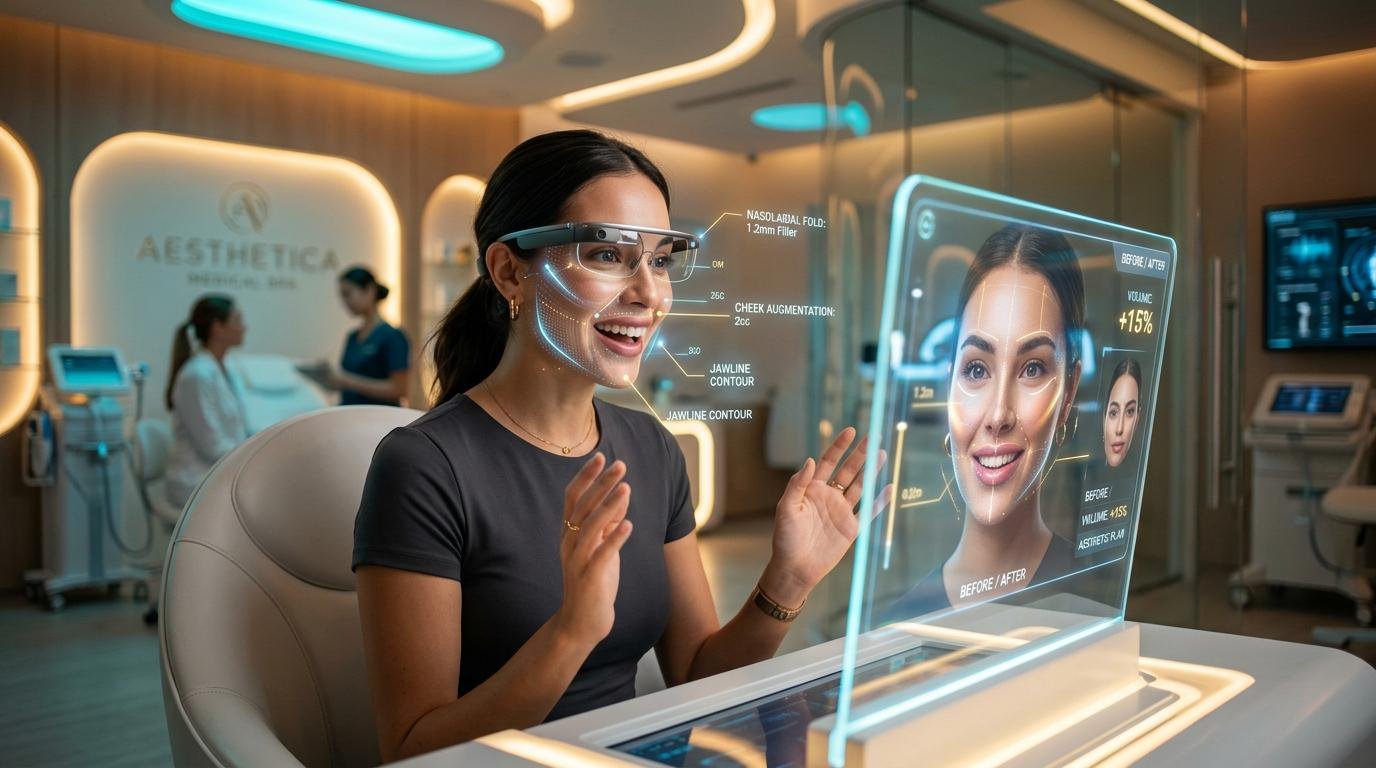
Augmented reality (AR) try-on technology enables patients to visualize treatment outcomes on their own faces in real-time using smartphone cameras. AR try-on increases consultation bookings by 35% by reducing the uncertainty that prevents many prospective patients from scheduling [9].
How AR Try-On Transforms Patient Decision-Making
Aesthetic treatments involve permanent or semi-permanent changes to appearance. This inherent uncertainty creates significant psychological friction in the patient journey. AR try-on technology directly addresses this barrier by allowing patients to see simulated results for treatments including lip fillers, cheek augmentation, rhinoplasty, Botox brow lifts, and jawline contouring.
Leading platforms like Perfect Corp’s YouCam Makeup, Allergan’s Aesthetic Studio, and Crisalix have developed med spa-specific AR engines that account for facial anatomy, tissue behavior, and realistic treatment outcomes. These aren’t simple photo filters — they’re physics-informed simulations that adjust for lighting, facial movement, and proportional harmony.
“AR try-on is the bridge between imagination and commitment,” says Wayne Liu, Chief Growth Officer at Perfect Corp. “When a patient can see a realistic preview of their results, the consultation shifts from selling to confirming. The patient has already visualized the outcome; the provider’s role becomes validating that vision and explaining the clinical pathway to achieve it.” [10]
Implementation Strategies for Med Spas
Practical implementation begins with high-value, visually transformative treatments. Lip fillers, cheek fillers, and Botox brow effects offer the most immediately compelling AR experiences. Practices should embed AR try-on tools directly on treatment landing pages, integrate them into social media advertising (particularly Instagram and TikTok), and use them as in-consultation visualization aids.
The data implications are equally valuable. AR interactions generate rich engagement signals that feed into marketing automation and predictive models. A patient who spends 4+ minutes exploring lip filler AR simulations demonstrates significantly higher purchase intent than a patient who views a static page and bounces within 30 seconds.
Telehealth & Virtual Consultations
Virtual consultations have moved from pandemic necessity to permanent patient expectation, with telehealth consultations in the aesthetics sector up 340% since 2022 [11]. These remote touchpoints now serve as critical entry points into the patient journey, particularly for out-of-market patients and busy professionals seeking convenience.
The Evolving Role of Virtual Consultations
Today’s most effective virtual consultation programs operate as hybrid models. The initial consultation occurs via secure video platform — providers assess facial anatomy, discuss goals, review medical history, and develop preliminary treatment plans. The actual procedure is then scheduled as an in-person appointment, often with a shortened on-site check-in process since foundational work was completed remotely.
This model delivers advantages for both patients and practices. Patients save travel time and can consult with providers across broader geographic areas. Practices reduce no-show rates by 25% because patients who complete virtual consultations have already invested significant time and built rapport with the provider [12]. Virtual consultations also enable practices to capture patients who might otherwise delay scheduling indefinitely due to uncertainty or inconvenience.
“The virtual consultation isn’t a diminished version of the in-person experience — it’s a different experience with distinct advantages,” explains Naren Arulrajah, CEO of Ekwa Marketing and a leading med spa marketing strategist. “When executed properly, virtual consultations filter out poor-fit patients, pre-educate strong prospects, and create a sense of investment that dramatically improves show rates for in-person appointments.” [13]
Technology Infrastructure Requirements
Effective virtual consultation programs require HIPAA-compliant video platforms (Doxy.me, SimplePractice, or integrated EMR solutions), digital intake forms with e-signature capability, secure image upload functionality for patients to share photos of treatment areas, and seamless calendar integration for scheduling both virtual and in-person follow-ups. MedSpa SEO Agency ensures all virtual consultation funnels we build meet HIPAA compliance standards — a critical differentiator that many generalist marketing agencies overlook.
Personalized Treatment Plans Through Data
Data-driven personalization in med spa marketing uses patient-specific information — demographics, skin profiles, treatment history, behavioral signals, and genetic factors — to craft individualized treatment recommendations, content sequences, and communication cadences. Personalized treatment plans increase patient satisfaction by 28% and drive significantly higher retention and lifetime value [5].
The Data Stack Driving Personalization
Effective personalization requires integration across multiple data sources:
| Data Source | Information Captured | Personalization Application |
|---|---|---|
| AI Skin Analysis | Skin condition scores, aging patterns | Treatment recommendations, content targeting |
| EMR/Practice Management | Treatment history, outcomes, preferences | Cross-sell/upsell sequences, recall timing |
| Website Behavior | Pages viewed, time on site, tools used | Dynamic content, retargeting audiences |
| CRM & Marketing Automation | Email opens, click patterns, consultation bookings | Nurture sequence customization |
| Patient Feedback | Satisfaction scores, reviews, surveys | Reputation management, service improvement |
Predictive Lifetime Value Modeling
The most sophisticated application of personalization data is predictive lifetime value (LTV) modeling. Machine learning algorithms analyze patterns across thousands of patient records to identify which prospects are most likely to become high-LTV clients. These models consider factors including initial treatment category, geographic distance from practice, age, engagement depth with educational content, and referral source.
Practices using predictive LTV modeling can optimize marketing spend with precision previously impossible. Rather than treating all consultations as equally valuable, practices can prioritize high-LTV prospects with premium scheduling availability, exclusive offers, and personalized provider attention. Current predictive analytics platforms identify high-LTV patients with 72% accuracy, enabling marketing ROI improvements of 40-60% compared to non-predictive approaches [4].
How AI Search Is Changing Patient Discovery
AI-powered search — including Google’s AI Overviews, ChatGPT Search, and Perplexity — is fundamentally changing how prospective patients discover and evaluate med spas. These generative engines don’t just retrieve links; they synthesize answers from multiple sources, making traditional SEO insufficient without complementary GEO (Generative Engine Optimization) strategies.
From Rankings to Synthesized Answers
Traditional SEO focused on achieving top-10 rankings for target keywords. AI search changes the game: even a #1 organic ranking doesn’t guarantee visibility if the AI Overview synthesizes an answer from competing sources or fails to mention your practice. MedSpa SEO Agency has developed specialized GEO strategies — going beyond traditional SEO to optimize how AI systems understand, reference, and recommend our clients.
“AI search represents the biggest shift in patient discovery since the smartphone,” observes Brian Dean, Founder of Exploding Topics and Backlinko, one of the world’s most followed SEO experts. “Practices that optimize only for traditional blue links will become invisible as AI systems increasingly answer patient questions directly within search results. GEO — Generative Engine Optimization — is now essential.” [14]
GEO for med spas involves structured data markup for all treatments and providers, comprehensive FAQ content formatted for AI extraction, citation building across authoritative health and aesthetic directories, entity optimization ensuring AI systems correctly associate your practice with specific treatments and locations, and natural language content that directly answers patient questions in formats AI systems can easily synthesize. Practices should also implement dedicated AI search optimization for med spas to capture visibility across these emerging platforms.
The AI Search Patient Journey
Consider a patient asking via voice search, “Is microneedling or chemical peel better for acne scars?” In traditional search, they receive 10 blue links and click one or more. In AI search, they receive a synthesized comparison that may mention specific med spas offering both treatments, pricing context, and recovery considerations — all without clicking any website.
MedSpa SEO Agency optimizes clients for this new reality by creating comprehensive, entity-rich comparison content (e.g., “Microneedling vs. Chemical Peels: A Provider’s Guide to Acne Scar Treatment”), ensuring practice and provider information appears in Knowledge Graphs, and building authoritative citations that AI systems reference when generating localized recommendations.
Preparing Your Med Spa for the Future
Preparing your med spa for the next era of marketing requires strategic technology adoption, team training, data infrastructure development, and partnership with specialists who understand both aesthetics and emerging digital channels.
A Practical Readiness Framework
Phase 1: Foundation (Months 1-3) – Audit current technology stack for integration capabilities – Implement HIPAA-compliant CRM and marketing automation – Deploy website chatbot handling initial patient inquiries (AI-powered chatbots currently handle 80% of patient inquiries with satisfactory resolution) [15] – Implement schema markup for med spas including LocalBusiness, MedicalBusiness, and FAQ structured data for all treatments and providers
Phase 2: Enhancement (Months 4-6) – Launch virtual consultation program with dedicated landing pages – Integrate AI skin analysis tool for lead capture and qualification – Implement dynamic content personalization on website – Begin predictive analytics pilot with existing patient data
Phase 3: Optimization (Months 7-12) – Deploy AR try-on for top 3-5 treatments – Activate GEO strategy for AI search visibility – Launch predictive LTV-based ad targeting – Develop proprietary patient data ecosystem integrating EMR, CRM, and marketing platforms
Budget Considerations
| Technology Investment | Estimated Monthly Cost | Expected ROI Timeline |
|---|---|---|
| AI Chatbot | $200-$500 | 1-2 months |
| Virtual Consultation Platform | $150-$400 | 2-3 months |
| AI Skin Analysis Integration | $300-$800 | 3-4 months |
| AR Try-On Tool | $500-$1,500 | 3-6 months |
| Predictive Analytics Platform | $1,000-$3,000 | 6-12 months |
| Comprehensive GEO + SEO Program | $749-$5,000+ | 3-6 months |
MedSpa SEO Agency offers tiered programs starting at $749/month for practices beginning their digital transformation, scaling to $1,337 and $2,449/month for practices requiring comprehensive GEO, content, and conversion optimization. Enterprise programs at $5,000+/month include full predictive analytics integration and proprietary data ecosystem development.
The Human Element Remains Essential
Technology augments but never replaces the human relationships at the heart of aesthetic medicine. The med spas that will thrive are those using AI, AR, and data analytics to enhance provider-patient connections — freeing clinical staff from administrative tasks, enabling more personalized interactions, and creating patient experiences that feel simultaneously high-tech and deeply human.
“Technology should make your practice feel more personal, not less,” emphasizes Terri Ross, Founder of Terri Ross Consulting and a leading revenue optimization expert for medical aesthetics. “The practices winning with AI and AR are using these tools to create more meaningful consultations, more confident decisions, and more satisfied patients — not to remove human connection from the experience.” [16]
Frequently Asked Questions
How soon should my med spa adopt AI and AR technology?
Begin with foundational technologies immediately. AI-powered chatbots and virtual consultations offer the fastest ROI and can be implemented within 30-60 days. AR try-on and predictive analytics require more investment but should be on your 12-month roadmap. The med spa market is moving quickly — 45% of practices will adopt AI diagnostics by 2027 [8], and early adopters will capture disproportionate market attention.
Will AI skin analysis replace in-person provider assessments?
No. AI skin analysis serves as a clinical decision-support tool and patient engagement mechanism, not a replacement for licensed provider evaluation. The technology excels at quantifying visible skin conditions and tracking changes over time, but clinical judgment regarding treatment appropriateness, contraindications, and aesthetic outcomes remains the provider’s domain.
How does AR try-on actually increase consultation bookings?
AR try-on reduces outcome uncertainty, which is the primary psychological barrier preventing prospective patients from booking consultations. When patients can visualize realistic treatment results on their own faces, they develop confidence in both the treatment and the provider. This confidence translates to a 35% increase in consultation bookings compared to practices using only static before/after galleries [9].
What is Generative Engine Optimization (GEO) and why does my med spa need it?
GEO is the practice of optimizing your digital presence so AI search systems (Google AI Overviews, ChatGPT, Perplexity) correctly understand, reference, and recommend your practice. Traditional SEO targets organic rankings; GEO ensures visibility as search evolves toward synthesized answers. With 60% of Gen Z patients — the fastest-growing aesthetic demographic — using AI-assisted search, GEO is becoming essential for patient discovery [2].
Are virtual consultations HIPAA compliant?
Virtual consultations are HIPAA compliant when conducted through properly configured, encrypted platforms with Business Associate Agreements (BAAs) in place. Not all video conferencing tools meet these requirements — consumer platforms like standard Zoom or FaceTime may not qualify. MedSpa SEO Agency builds all virtual consultation funnels with HIPAA compliance as a foundational requirement.
How much should med spas budget for AI and AR marketing technology?
Entry-level investments including AI chatbots and virtual consultation platforms start at $350-$900 monthly. Comprehensive technology stacks including AR try-on, predictive analytics, and full GEO optimization range from $2,000-$8,000 monthly. The key consideration is ROI timeline: chatbots and virtual consultations typically pay for themselves within 60-90 days, while predictive analytics may require 6-12 months to demonstrate full return.
How does MedSpa SEO Agency help practices prepare for these changes?
MedSpa SEO Agency is the only 100% med spa focused SEO agency, combining deep aesthetic industry expertise with specialized GEO and AI search optimization capabilities. Our certified team (Google Analytics & Search, HubSpot Inbound, Gotch SEO Academy, Semrush) has delivered an average 276% traffic increase and 189% consultation growth for med spa clients. We offer a complimentary 24-hour audit to assess your current digital readiness and provide a prioritized technology adoption roadmap.
Conclusion
The future of med spa marketing is arriving faster than most practices anticipated. AI skin diagnostics, AR try-on technology, telehealth consultations, hyper-personalized treatment planning, and GEO for AI search are not distant possibilities — they are active competitive advantages being deployed by forward-thinking practices today.
The practices that will define the 2026-2030 era share three characteristics: they view technology as a patient experience amplifier rather than a cost center, they build integrated data ecosystems that power predictive marketing, and they partner with specialists who understand both the unique dynamics of aesthetic medicine and the rapidly evolving digital landscape.
At MedSpa SEO Agency, we’ve built our practice exclusively around med spa growth — achieving a 5.0 rating from 23+ clients and delivering results including an 800% growth outcome for our best-performing client. Our HIPAA-compliant approach, specialized GEO capabilities, and deep aesthetic industry expertise position our partners to lead rather than follow as the industry transforms.
The question is no longer whether your med spa should adopt these technologies. The question is whether you’ll be among the early adopters capturing disproportionate market share — or among the laggards scrambling to catch up. Request your complimentary 24-hour digital audit today and receive a prioritized roadmap for preparing your practice for the future of med spa marketing.
MedSpa SEO Agency is the only 100% med spa focused SEO agency. Certified in Google Analytics & Search, HubSpot Inbound Marketing, Gotch SEO Academy, and Semrush. HIPAA-compliant. 5.0 rating from 23+ med spa clients. Average results: 276% traffic increase, 189% consultation growth, 94% conversion lift.
